Chindia Alert: You’ll be Living in their World Very Soon
aims to alert you to the threats and opportunities that China and India present. China and India require serious attention; case of ‘hidden dragon and crouching tiger’.
Without this attention, governments, businesses and, indeed, individuals may find themselves at a great disadvantage sooner rather than later.
The POSTs (front webpages) are mainly 'cuttings' from reliable sources, updated continuously.
The PAGEs (see Tabs, above) attempt to make the information more meaningful by putting some structure to the information we have researched and assembled since 2006.
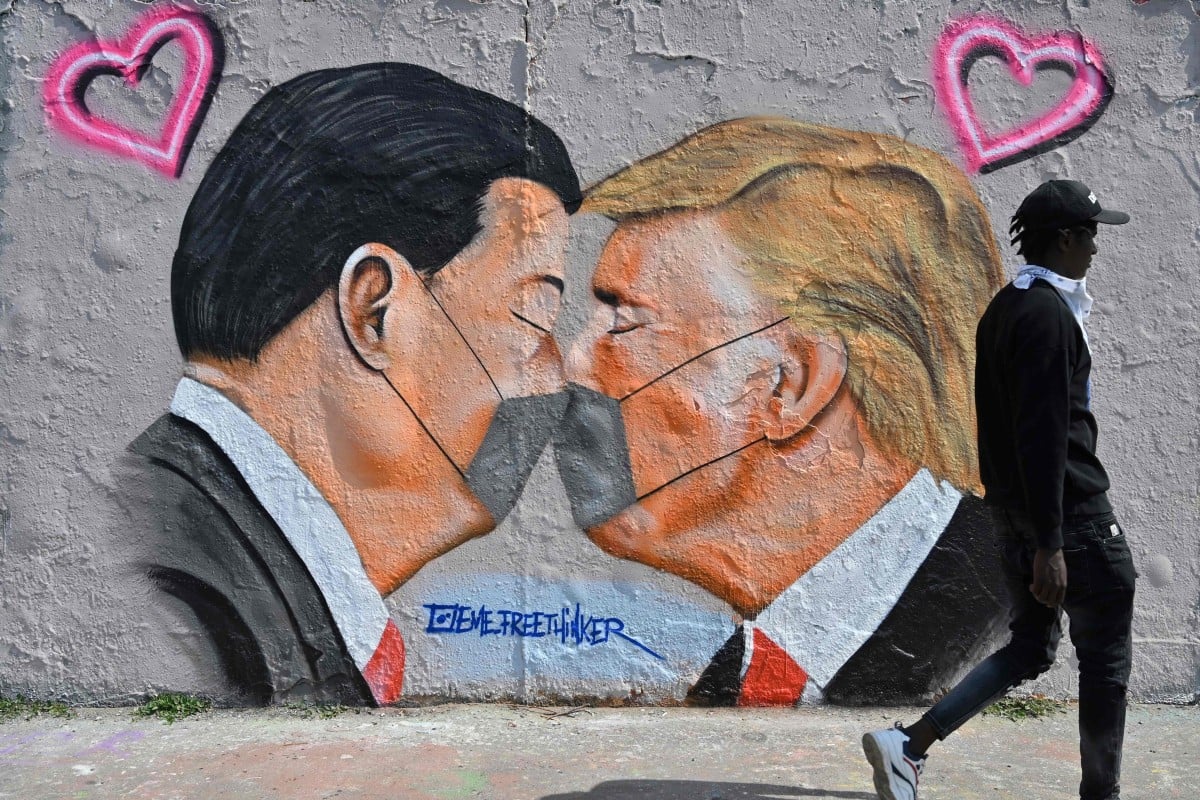
Chinese groups calling for more ‘fighting spirit’ are getting the upper hand on those who favour calm and cooperation, government adviser says
From Hong Kong to Covid-19, trade to the South China Sea, Beijing and Washington are clashing on a growing number of fronts and in an increasingly aggressive way
Efforts to promote dialogue and cooperation between the US and China are failing, observers say. Photo: AFP
Moderates who favour dialogue and cooperation as a way to resolve China’s disputes with the United States are losing ground to hardline groups bent on taking the fight to Washington, according to political insiders and observers.
“There are two camps in China,” said a former state official who now serves as a government adviser and asked not to be named.
“One is stressing the combat spirit, the other is trying to relieve tensions. And the former has the upper hand.”
Relations between China and the US are under intense pressure. After Beijing moved to introduce a national security law for Hong Kong, US President Donald Trump said on Friday that Washington would begin eliminating the special policy exemptions it grants the city, as it no longer considers it autonomous from mainland China.
Beijing’s decision to enact a national security law for Hong Kong was met with anger from the US and other Western countries. Photo: Sam Tsang
The two nations have also clashed over trade, Xinjiang, Taiwan and the South China Sea, with the US passing several acts denouncing Beijing and sanctioning Chinese officials.
China has also experienced turbulence in its relations with other countries, including Australia and members of the European Union, mostly related to the Covid-19 pandemic
and Beijing’s efforts to position itself as a leader in the fight against the disease with its policy of “mask diplomacy”.
After Canberra appealed for an independent investigation to be carried out to determine the origins of the coronavirus, Beijing responded by imposing tariffs on imports of Australian barley, showing it is prepared to do more than just trade insults and accusations with its adversaries.
Pang Zhongying, a professor of international relations at Ocean University of China in Qingdao, said there was a worrying trend in China’s relations with other nations.
“We need political and diplomatic means to resolve the challenges we are facing, but … diplomatic methods have become undiplomatic,” he said.
“There are some who believe that problems can be solved through tough gestures, but this will never work. Without diplomacy, problems become confrontations.”
said during his annual press conference on the sidelines of the National People’s Congress last weekend that China and the United States must work together to prevent a new Cold War.
His words were echoed by Chinese Premier Li Keqiang, who said during a press conference after the closure of the legislative session on Thursday that the many challenges facing the China-US relations could only be resolved through cooperation.
However, the government adviser said there was often quite a chasm between what China’s leaders said and what happened in reality.
“Even though we say we do not want a Cold War, what is happening at the working level seems to be different.” he said. “The implementation of policies is not properly coordinated and often chaotic.”
Tensions between China and the US have been in a poor state since the start of a trade war almost two years ago. After multiple rounds of negotiations, the sides in January signed a phase one deal, but the positivity that created was short-lived.
In February, Beijing expelled three reporters from The Wall Street Journal over an article it deemed racist, while Washington has ramped up its military activity in the South China Sea and Taiwan Strait, and threatened to revoke the visas of Chinese students studying science and technology in the US over concerns they might be engaged in espionage.
Beijing has also used its state media and army of “Wolf Warrior” diplomats to promote its narrative, though many Chinese scholars and foreign policy advisers have said the latter’s nationalistic fervour has done more harm than good and appealed to Beijing to adopt a more conciliatory tone.
However, Hu Xijin, editor-in-chief of Chinese tabloid Global Times, said China had no option but to stare down the US, which regarded the world’s most populous nation as its main rival.
“Being contained by the US is too high a price for China to pay,” he said. “I think the best thing people can do is forget the old days of China-US ties”.
Jin Canrong, a professor of international relations at Renmin University in Beijing, wrote in a recent newspaper article that Beijing’s actions – notably enacting a national security law for Hong Kong – showed it was uncompromising and ready to stand its ground against the US.
Wu Xinbo, dean of international studies at Fudan University in Shanghai, agreed, saying relations between the two countries were likely to worsen in the run-up to the US presidential election in November and that Beijing should be prepared for a fight.
But Adam Ni, director of China Policy Centre, a think tank in Canberra, said the issue was not that the moderate camp had been sidelined, but rather Beijing’s perception of the US had changed.
“Beijing has woken up to the idea that America’s tough policy on China will continue and it is expecting an escalation of the tensions,” he said.
“The centre of gravity in terms of Beijing’s perception of the US has shifted, in the same way the US perception of China has shifted towards a more negative image”.
Beijing was simply responding in kind to the hardline, assertive manner of the US, he said.
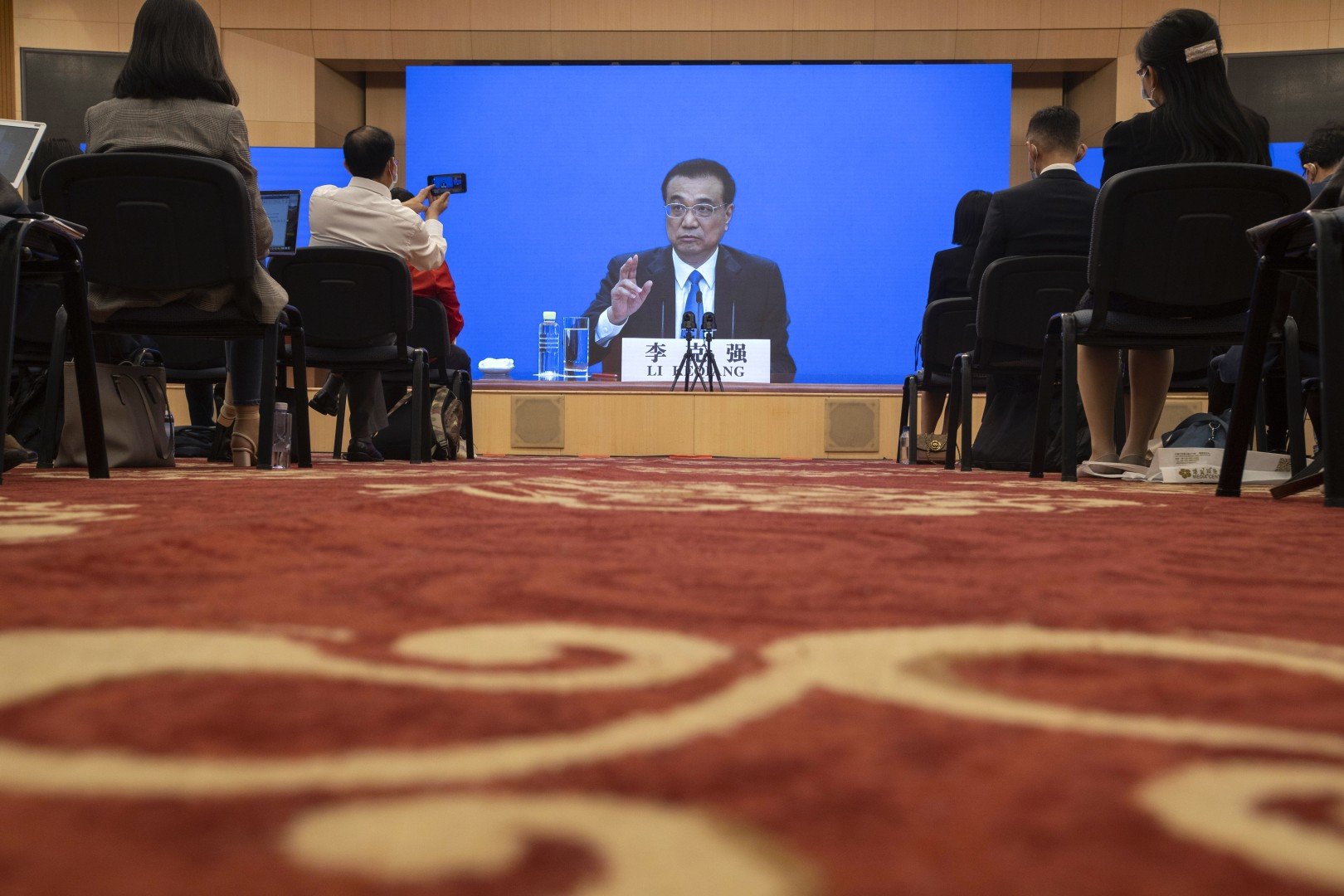
Li held a press conference to mark the end of the parliamentary session. This is the South China Morning Post’s live coverage.
Reporting by Wendy Wu, Gary Cheung, Frank Tang, Mai Jun, Sarah Zheng, Kinling Lo, Linda Lew, Coco Feng, Liu Zhen, Laura Zhou, Echo Xie, Keegan Elmer, Catherine Wong, Zhuang Pinghui, Tony Cheung
6:05PM
The End
Li’s key points
The main points from Li’s press conference:
The central government will stick to the principle of “one country, two systems”, and “Hong Kong people governing Hong Kong” with a high degree of autonomy. The NPC’s resolution for a
. But he said at the press conference that “peaceful reunification” was still Beijing’s policy and the mainland was open to further exchanges with Taiwan.
Even though the central government did not set a GDP growth target, China will implement
On the difficult and unpredictable external factors faced by China, Li said the pandemic had hit the world severely, greatly reducing exchanges between countries.
If conditions persisted, there would be more dangers to the global economy, which could undermine efforts to contain the coronavirus.
Combating the virus required an open economy to ensure the supply of goods for public health, he said.
He said China would to continue to open up and maintain the stability of the supply chain.
5:46PM
Rise in pensions
Li said that given the tough economic times, Beijing would expand coverage of subsistence allowances and unemployment benefits as well as increase pensions for the elderly.
“There can be no loopholes – if there are any gaps, then this will make people feel there is no hope for the future,” he said. “As the saying goes, the people are the foundation of a state and when the foundation is solid, the state enjoys tranquility.”
5:41PM
Ending poverty
Li said that even with the fallout from the coronavirus pandemic, the country was still determined to reach its goal of eliminating poverty by 2020.
He said there were some 5 million people living below the poverty line before the outbreak, and more may have fallen below it since then, making eliminating poverty a “daunting task”.
5:36PM
Questions
So far Li has taken nine questions, of which four were from foreign media, one was from Hong Kong and one from Taiwan.
Li said the central government must work hard to help business flourish, aiming at having 10,000 new enterprises registered each day.
The government must get rid of all unnecessary restrictions on the market, foster fair competition and create tangible wealth, he said.
He said there had been a surge in new kinds of businesses, such as online platforms, during the pandemic, and some of these businesses had seen their revenue grow by two-thirds.
5:20PM
China-US tensions
On escalations in China-US tensions and speculation about a new Cold War, Li acknowledged new challenges between the two countries, but said there was room for bilateral cooperation, including on the economy and technology.
Their relationship could be either mutually beneficial or mutually harmful, he said.
was not good for either country or the world, Li said.
Referring to a phase one trade deal reached in January, Li said the two countries should continue to follow through on the consensus reached by the leaders of both countries.
He said trade and economic cooperation should be based on market forces. There were differences in each other’s systems, and conflicts were inevitable, but the key was how to handle the problems.
We need to mutually respect each other’s core interests and search for areas for cooperation, Li said.
The US had in recent days issued a strategic policy that appeared to signal that Washington had abandoned its engagement policy towards Beijing.
He also spoke of new investment by a hi-tech US company in the central Chinese city of Wuhan, an example he said reflected the importance of business ties and cooperation between the countries.
Li had earlier sent a congratulatory letter to the company, the US conglomerate Honeywell.
5:11PM
Hong Kong and the national security law
Asked whether the NPC’s resolution for a national security law for Hong Kong
meant that Beijing had abandoned the “one country, two systems” model for Hong Kong, Li said the law was to secure the long-term stability of “one country, two systems”.
He said that “one country, two systems” and a high degree of autonomy were long an important part of Beijing’s basic state policy, and had been implemented from the start.
He said the national security law resolution was designed “for the steady implementation of one country, two systems and Hong Kong’s long-term stability and prosperity”.
5:04PM
Growth for jobs
Li said growth would be needed to support job creation, one issue of greatest public concern.
About one-third of recent comments left on the State Council’s website were on employment.
China was committed to helping businesses survive and retain jobs, he said.
University students are expected to graduate and enter the workforce in record numbers this year.
4:59PM
‘No change’ on Taiwan
Li said that Beijing’s cross-strait policy would not change, and that the mainland Chinese government was open to further exchanges with Taiwan to move forward on “peaceful reunification” with the self-ruled island.
He rejected all “Taiwanese independence forces” and external interference in Taiwan.
He said Beijing remained committed to the 1992 consensus – the political understanding that there is only “one China” but that each side has its own understanding of what this means.
Last week, Taiwanese President Tsai Ing-wen officially started her second term, after a landslide election win in January that many saw as an endorsement of her harder stand against Beijing.
Li said Beijing would continue to pay high attention to the island, adding that no Taiwanese died from the coronavirus in mainland China.
4:50PM
Jobs – not infrastructure
Li said the government’s measures to counter the coronavirus would focus on
About 70 per cent of the funds would support people’s income and boost consumption.
Smaller firms would also be targeted for support.
“The central government will live on a tight budget,” Li said.
4:44PM
‘No cover-up allowed’
Li said China had successfully controlled the coronavirus within its borders and Beijing had acted in a transparent and timely manner throughout the pandemic.
“No cover-up will ever be allowed,” he said.
Li said there were two main challenges in the pandemic: controlling the virus outbreak and reopening the economy. International cooperation was important for both.
“We may have to live with Covid-19 for some time to come,” he said.
4:36PM
Coronavirus inquiry
In response to a question about the origins of the coronavirus and calls for an
Li said that getting a clear, scientific understanding of the source of the virus could contribute to global public health.
He also referred to the World Health Assembly’s endorsement of an independent review into the World Health Organisation’s handling of the pandemic and its animal origins.
Li said the virus had no borders and much was still not known about it, adding that the international community needed to work together to keep the virus in check and create a vaccine.
Beijing and Washington have sparred over the origin of the virus, and earlier the Chinese foreign ministry condemned the US and Australia for their calls of an independent investigation into Beijing’s response to the pandemic.
The US has accused Beijing of cover-ups and a lack of transparency, while a Chinese foreign ministry spokesman suggested earlier that the US could be the origin of the virus.
Li said Beijing was open to international cooperation on research and development for a vaccine. Washington has accused China of seeking to steal its vaccine research, a charge that Beijing has strongly rejected.
Economic stability
The cabinet is determined to stabilise the economy, according to Li.
“If there are big changes, we still have policy room, including on the fiscal, financial and social security fronts,” he said.
“We are confident that under the strong leadership of [President] Xi Jinping and with joint efforts across the nation, we will be able to prevail in the difficulties and achieve the goal of building a moderately prosperous society.”
Chinese businesses still face grim economic reality despite Covid-19 restrictions being lifted
Coronavirus and the economy
Li said the Chinese economy was deeply integrated into the global economy, so China would not be immune from the impact of the coronavirus.
Economic development remained key to solving China’s problems today, Li said.
Li starts his annual press conference by saying that the restrictions imposed for Covid-19 will not affect his communication with the media.
Earlier, Li Zhanshu, chairman of the Standing Committee of the National People’s Congress, presided over a near-unanimous vote to pass a resolution on a national security law for Hong Kong that would ban separatism, subversion, foreign interference, and terrorism in the city.
The votes were 2,878 in favour, one against, six abstentions, and one who did not press the button to vote.
Critics say the move to enact a national security law will end the “one country, two systems” model in Hong Kong. The United States said on Thursday that Hong Kong was no longer autonomous from China, a decision that could end the city’s special trading status with the US.
This year all journalists are restricted to the press centre, the first time that the media have not been in the same room as the premier at his annual press conference.
Journalists waiting for the presser can watch a live broadcast of the NPC’s closing ceremony at the press centre’s lounge. But vote count is not shown at the broadcast. Photos: Jun Mai
All journalists attending the conference were tested for the coronavirus at 6am today and had to wait for the results at the Diaoyutai Hotel.
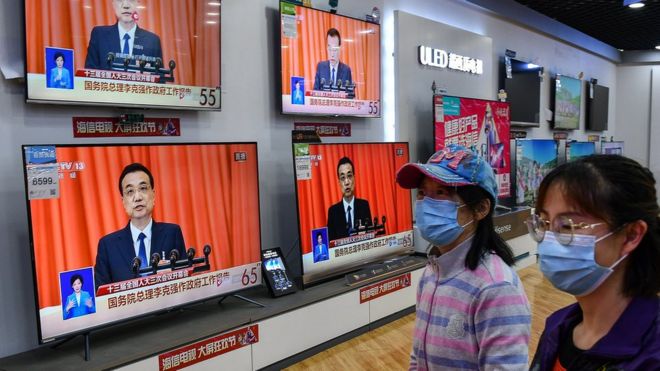
Image copyright AFP / GETTYImage caption Shoppers walking past a broadcast of Chinese Premier Li Keqiang delivering his speech at the opening of the NPC on Thursday
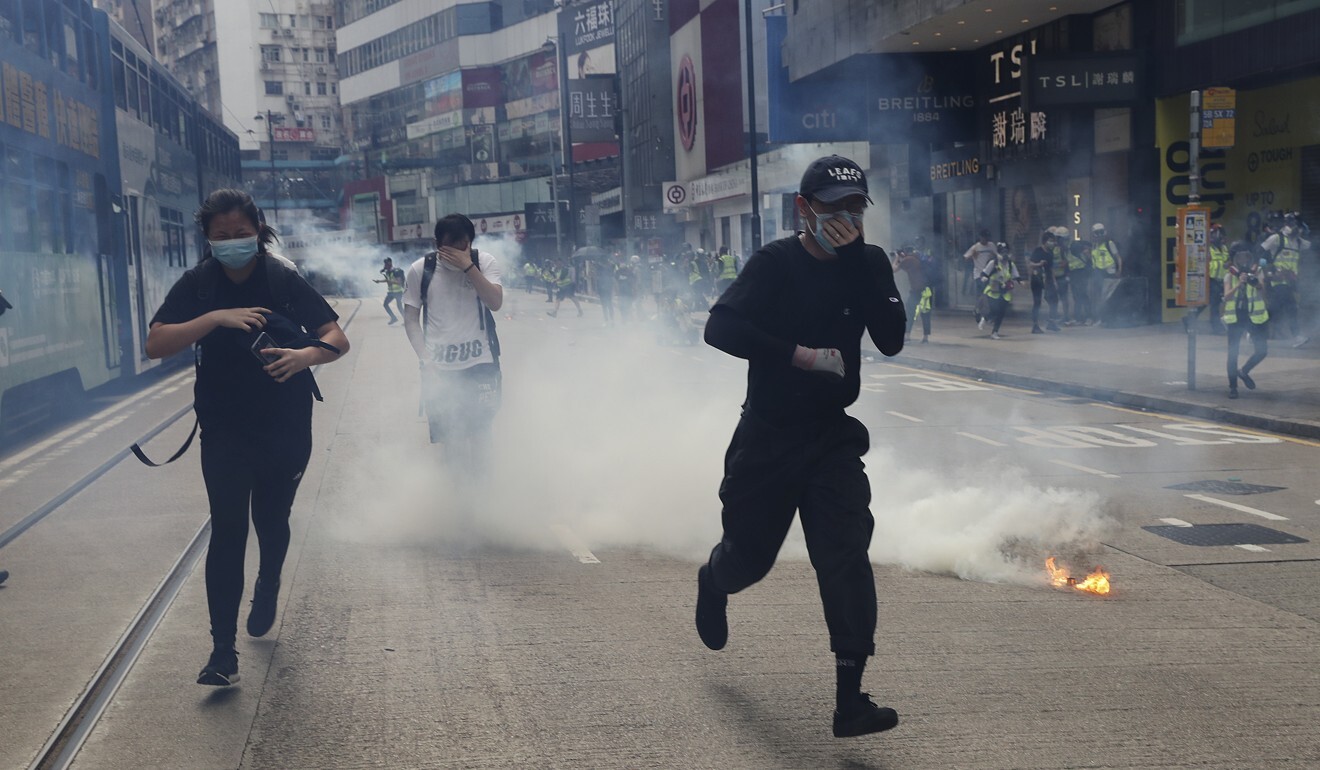
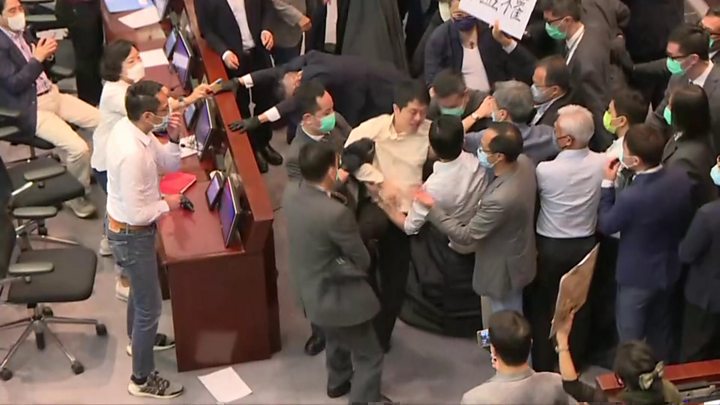
China’s ruling Communist Party has set in motion a controversial national security law for Hong Kong, a move seen as a major blow to the city’s freedoms.
The law to ban “treason, secession, sedition and subversion” could bypass Hong Kong’s lawmakers.
Critics say China is breaking its promise to allow Hong Kong freedoms not seen elsewhere in China.
It is likely to fuel public anger and may even trigger fresh protests and demands for democratic reform.
The plan was submitted at the annual National People’s Congress (NPC), which largely rubber-stamps decisions already taken by the Communist leadership, but is still the most important political event of the year.
Hong Kong, a semi-autonomous region and an economic powerhouse, was always meant to have introduced such laws after the handover from British control to Chinese rule in 1997.
After last year’s wave of sustained and violent protest, Beijing is now attempting to push them through, arguing “law-based and forceful measures” must be taken to “prevent, stop and punish” such protests in the future.
On Friday, Hong Kong’s government said it would co-operate with Beijing to enact the law, adding it would not affect the city’s freedoms.
That article says Hong Kong “must improve” national security, before adding: “When needed, relevant national security organs of the Central People’s Government will set up agencies in Hong Kong to fulfil relevant duties to safeguard national security in accordance with the law.”
China could essentially place this law into Annex III of the Basic Law, which covers national laws that must be implemented in Hong Kong – either by legislation, or decree.
Addressing the congress, Premier Li Keqiang spoke of the economic impact of the coronavirus and on Hong Kong and Macau said: “We’ll establish sound legal systems and enforcement mechanisms for safeguarding national security in the two Special Administrative Regions.”
What do opponents say the dangers are?
Hong Kong is what is known as a “special administrative region” of China.
It has observed a “one country, two systems” policy since Britain returned sovereignty in 1997, which has allowed it certain freedoms the rest of China does not have.
Pro-democracy activists fear that China pushing through the law could mean “the end of Hong Kong” – that is, the effective end of its autonomy and these freedoms.
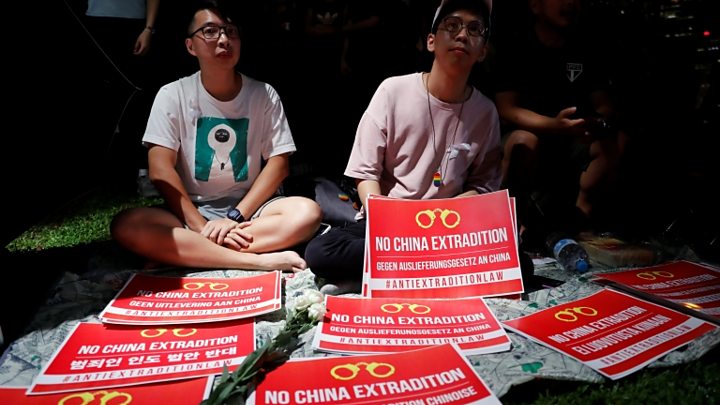
Last year’s mass protests in Hong Kong were sparked by a bill that would have allowed extraditions to mainland China.
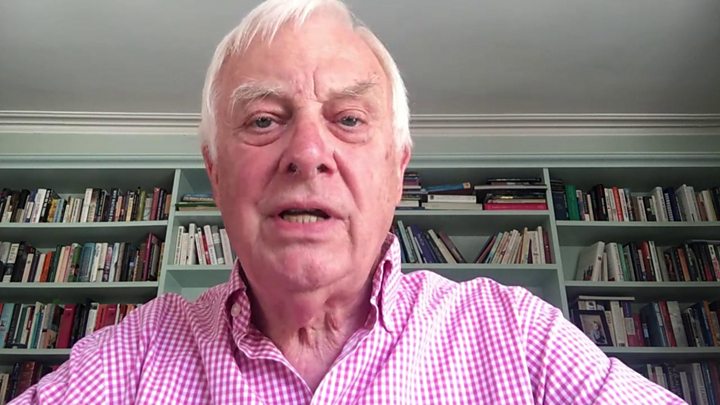
Media caption Former Hong Kong governor Chris Patten: “UK should tell China this is outrageous”
The bill was paused, then withdrawn – but the protests continued until the virus outbreak at the end of the year.
The US has also weighed in, with President Trump saying the US would react strongly if it went through – without giving details.
It is currently considering whether to extend Hong Kong’s preferential trading and investment privileges.
Why is China doing this?
Mr Wang said the security risks had become “increasingly notable” – a reference to last year’s protests.
“Considering Hong Kong’s situation at present, efforts must be made at the state-level to establish and improve the legal system and enforcement mechanisms,” he is quoted as saying in state media.
Media caption The BBC’s Helier Cheung on Hong Kong’s 2019 protests
Beijing may also fear September’s elections to Hong Kong’s legislature.
If last year’s success for pro-democracy parties in district elections is repeated, government bills could potentially be blocked.
What is Hong Kong’s legal situation?
Hong Kong was under British control for more than 150 years up to 1997.
The British and Chinese governments signed a treaty – the Sino-British Joint Declaration – that agreed Hong Kong would have “a high degree of autonomy, except in foreign and defence affairs”, for 50 years.
This was enshrined in the Basic Law, which runs out in 2047.
Nations may need help from China during virus outbreaks but remain wary of Beijing as adversary in disputed waters
Analysts say code of conduct negotiations are too sensitive and important for virtual meetings and may be delayed until coronavirus crisis is resolved
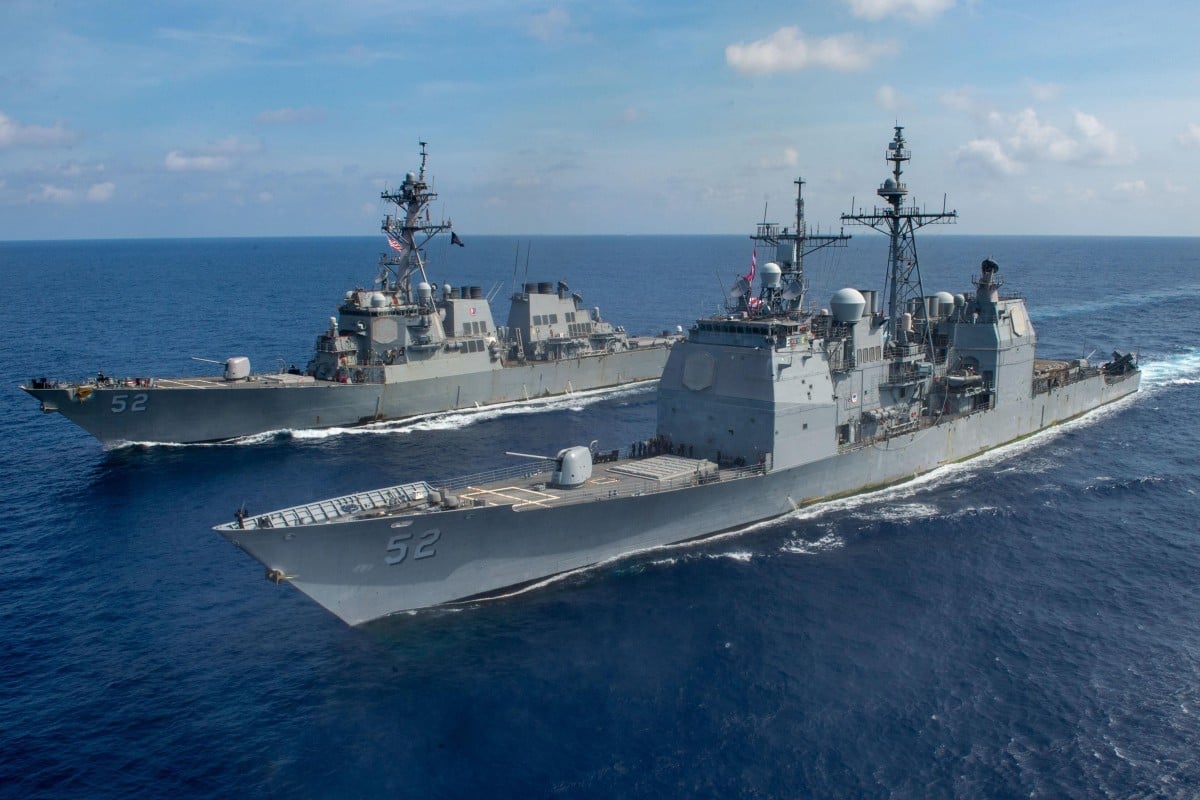
On April 18, the US Navy Ticonderoga-class guided missile cruiser USS Bunker Hill (front) and Arleigh-Burke class guided-missile destroyer USS Barry transit the South China Sea. The presence of both Chinese and American navy ships in the area in recent weeks worries Southeast Asian nations. Photo: US Navy
Negotiations between China and its Southeast Asian neighbours for a South China Sea
code of conduct have been postponed as the nations involved put their efforts into containing the Covid-19 pandemic, creating uncertainty about whether the two sides can work together amid rising tensions in the contested territory.
Southeast Asian nations are increasingly caught in a dilemma whether to maintain relations with Beijing during the pandemic while also fearing that tensions over the disputed waters are spiralling out of control. Both Chinese and United States navies are sending vessels to the area more frequently.
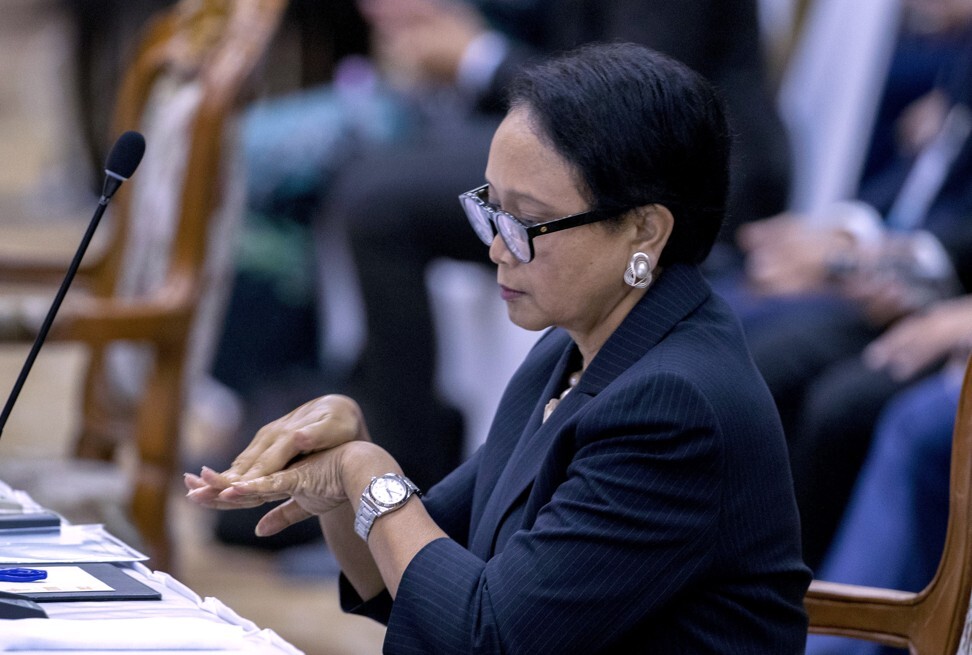
Indonesian Foreign Minister Retno Marsudi expressed concern over recent activities in the South China Sea, noting that they might potentially escalate tensions at a time when global collective effort to fight Covid-19 was essential.
Speaking on Wednesday, she called on all parties to respect international law, particularly the United Nations Convention on the Law of the Sea.
“While negotiation of the code of conduct is being postponed due to Covid-19, Indonesia calls on all relevant parties to exercise self-restraint and to refrain from undertaking action that may erode mutual trust and potentially escalate tension in the region,” she said.
Indonesia’s Foreign Minister Retno Marsudi. Photo: AP
Calls for a binding code of conduct surfaced in 1995 when China occupied Mischief Reef
, a maritime feature claimed by the Philippines. China did not agree to start talks until 1999, and subsequent negotiations led to a non-binding Declaration on Conduct in 2002.
The Association of Southeast Asian Nations (Asean) and China agreed in 2018 on a draft code laying the foundations for conduct in the disputed waters. At that time, Chinese Premier Li Keqiang said China hoped to complete the negotiation by the end of 2021, a move he said could show China and Asean could jointly maintain regional peace.
Named and claimed: is Beijing spoiling for a new fight in the South China Sea?
27 Apr 2020
But tensions over the South China Sea have not calmed and, in fact, have surged in recent months with both Beijing and Washington seen to be using the Covid-19 pandemic to create a stronger presence there.
This year, the US has conducted four freedom of navigation operations in the South China Sea and China has scrambled air and sea patrols to expel US vessels.
The confrontation between Beijing and Southeast Asian nations has also intensified. Last month, a Vietnamese fishing boat sank after a collision with a Chinese coastguard vessel near the Paracel Islands, known in China as the Xisha Islands, and in Vietnam as the Hoang Sa Islands.
On Saturday, the 35th escort fleet of the Chinese navy also conducted drills in the Spratly Islands chain – known as Nansha Islands in China – after completing an operation in the Gulf of Aden, off Somalia. Analysts said the drill aimed to boost far-sea training for combat ships and boost protection against piracy for Chinese merchant ships.
Collin Koh, a research fellow at the S. Rajaratnam School of International Studies, based at Nanyang Technological University in Singapore, said the code of conduct talks had been delayed because of the pandemic, but Beijing was consolidating its position in the South China Sea amid the outbreak.
“So it’s doing what it can now to consolidate and further enhance its position before talks restart, and by then these moves will raise Beijing’s leverage in the negotiations with its Asean counterparts,” he said.
“The current situation gives it a window of opportunity amid this interlude on the talks, to further advance its physical hold in the South China Sea, especially while Asean parties have their hands full on the pandemic”.
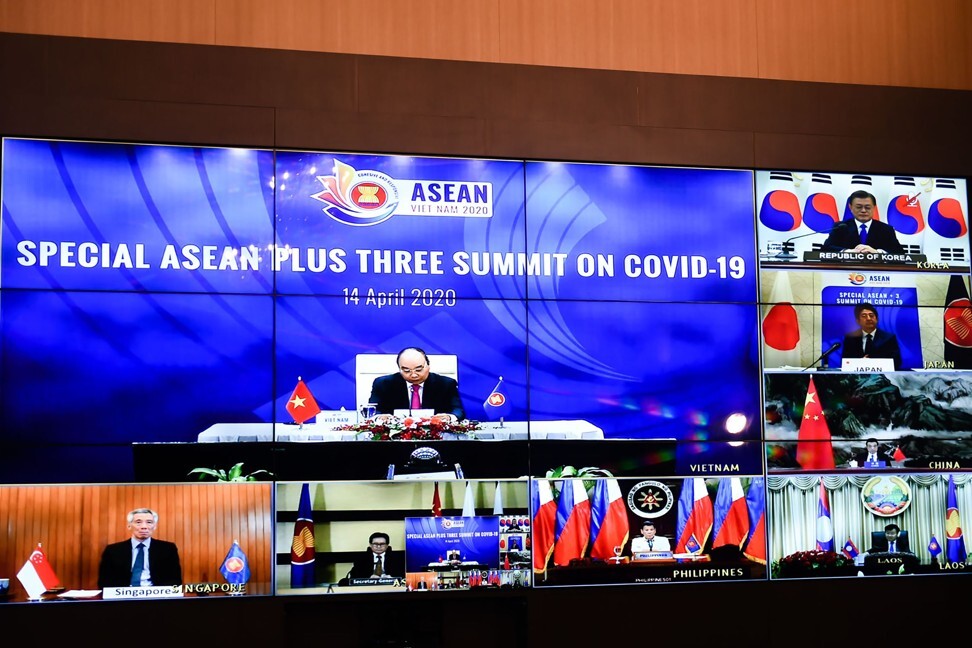
Asean nations have turned their attention to coping with coronavirus outbreaks in their own countries. On April 14, a live video conference for the special Asean Plus Three Summit on the coronavirus pandemic was held in Hanoi. Photo: AFP
Kang Lin, a researcher with Hainan University, said progress for the code of conduct would still go ahead, but it might be affected as face-to-face meetings between officials were disrupted.
“The negotiations involves multiple departments, such as diplomacy, maritime affairs, fisheries and even oil and gas-related departments,” he said, adding that those discussions might go online and might not be as effective.
“It is not easy to predict to what extent it will affect next year's goals. If the pandemic cannot be eliminated in the first half of next year, it may be longer than the three-year period we had previously scheduled,” he said.
Richard Heydarian, an academic and former Philippine government adviser, said video-conference meetings would be inadequate for negotiations about the future of the South China Sea.
“The problem with the negotiation of the code is that these are very sensitive, difficult negotiations. I don't think you can really do it just online, these are things that are done in the corridors of power,” he said. “It’s close to impossible to have that right now with the suspension of all international meetings in the Asean.”
Heydarian said Southeast Asian nations hoped to get help from China to contain the pandemic, but were showing unease about Beijing.
“I think there is a lot of resentment building against China,” he said. “There is also a lot of desperation to get assistance from China and, at the same time, complete helplessness with the fact that it is very hard to conduct any important extended international meeting on the level of Asean and beyond under current circumstances.”
Chinese Foreign Ministry spokesman Hua Chunying said on Thursday that China would push forward negotiations on the code of conduct, and hoped the code would be useful for peace and stability over the South China Sea.
European nations are divided over how best to deal with Beijing, which looms larger in their policy and public debates
Think tanks came together and reported on China’s much-touted medical aid and ‘mask diplomacy’ during Covid-19 crisis
European nations are looking to be more cohesive in their approach towards relations with China. Photo: Bloomberg
As Beijing steps up its pressure campaign on Europe in the wake of the Covid-19 pandemic, their relations look set to become more diverse and contested amid growing distrust and wariness of China’s expanding influence, according to new research.
The study, based on analysis of China’s role in 19 European countries’ handling of the coronavirus crisis, showed that Europe remained largely divided over how to deal with Beijing, which has figured ever more prominently in policy and public debates in many parts of the continent.
A total of 28 experts from 21 think tanks across the continent, collectively known as the European Think-tank Network on China, were involved in the research.
It came on the heels of a diplomatic debacle in the past week that saw the European Union reportedly bowing to pressure by China. The EU reportedly toned down part of a report documenting Beijing’s disinformation efforts to deflect the blame and rewrite the global coronavirus narrative.
Although a spokesperson for the EU denied those allegations, the saga has “moreover revealed the pressures that China has placed on
officials during the crisis”, according to John Seaman, editor of the report and a research fellow at the French Institute of International Relations.
In a phone call on Wednesday, Chinese Premier Li Keqiang and European Commission President Ursula von der Leyen shrugged off concerns about their discord and vowed to boost the fight against the virus and boost economic recovery, according to Xinhua.
Germany ‘rejected China’s bid for positive spin’ on pandemic response
27 Apr 2020
According to Seaman, the Covid-19 crisis hit at a time when traditionally trade-driven China-EU relations had grown more complex and competitive after the European Commission said for the first time last year that Beijing was a systemic rival.
“Debates over the need to adopt more coherent strategies towards China have been emerging across Europe. In many ways, the current crisis has become a catalyst for a number of trends that have been shaping Europe-China relations in recent years, while in other ways it has turned the tables,” he said in the report.
“It has simultaneously brought Europe and China into closer cooperation, pushed them further apart, and seemingly underlined the fractures that exist within Europe on how to approach an increasingly influential China.”
A growing number of European countries, including Sweden and Britain, have joined the United States and Australia in calling for an international inquiry into China’s handling of the pandemic. Leaders from Germany and France have also pressed Beijing for greater transparency about the origin of the deadly virus.
The European think tanks’ report was also focused on China’s unusually aggressive coronavirus diplomacy, with Chinese embassies and ambassadors shifting the blame on to Western democracies and promoting Beijing’s messaging “with varying degrees of dogmatism, divisiveness and moderation” on Twitter and in traditional media.
“While China’s increasingly proactive public diplomacy is widespread, and there appears to be a relative degree of consistency in messaging, there is a diversity in method that ranges from low key (Latvia or Romania) to charm offensive (Poland, Portugal, Italy or Spain) to provocative or aggressive (Sweden, Germany or France),” the report said.
It examined China’s much-touted medical aid and “mask diplomacy” and found “a correlation between Chinese companies with commercial interests in the country and donations from these companies” in countries including Greece, Hungary, Italy, Portugal and Spain.
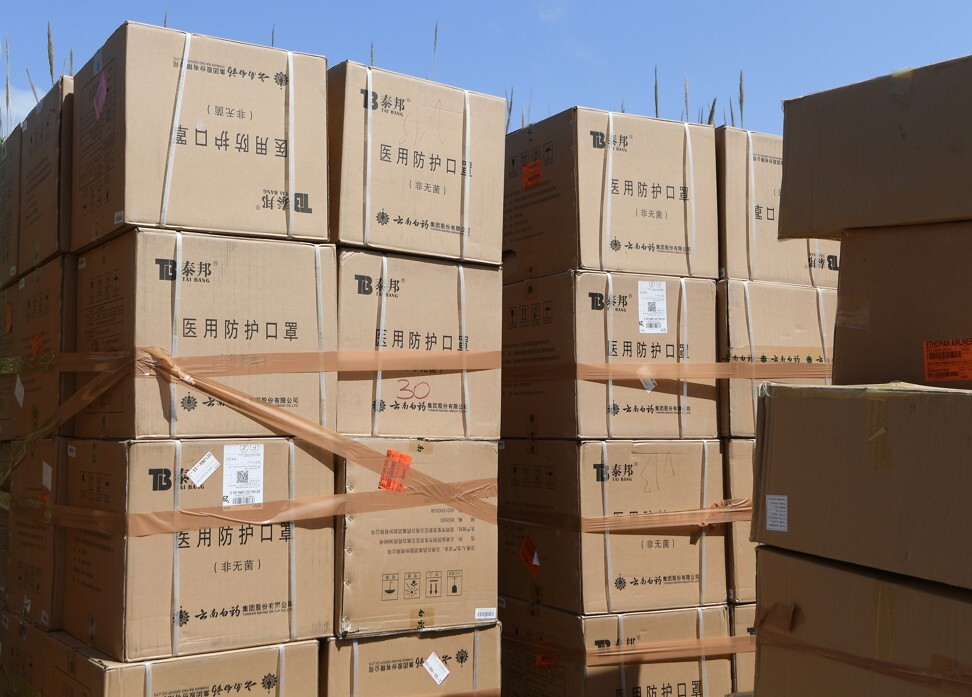
Boxes of medical supplies from China in Rome. Some European nations are growing wary about China’s diplomatic overreach and apparent willingness to alter the coronavirus narrative. Photo: Xinhua
Many countries have pushed back against China’s diplomatic overreach and its preferred narrative that has served to “[underline] the apparent successes of its autocratic governance model, ignoring its clear downfalls in managing the crisis initially, while sowing doubt on the effectiveness of liberal democracies”, according to Seaman.
While the European Union’s foreign policy chief Josep Borrell warned of Beijing’s geopolitical game to expand its influence through spinning and “politics of generosity”, countries such as Germany and Sweden have moved to tighten investment screening, 5G and industrial policies targeting Chinese firms.
Zhang Ming, China’s top envoy to the EU, last week dismissed the concerns about China’s alleged ploy to use the vulnerabilities of other countries to advance China’s geopolitical interests, such as with the country’s embattled tech giant Huawei and the ambitious Belt and Road Initiative.
“Disinformation is our common enemy and we need to make joint efforts to eradicate it,” Zhang said, claiming China had been a victim of unspecified disinformation campaigns.
The report also noted that China’s actions towards Europe in times of crisis looked set to amplify the fractures across the continent and prompt further debates about the need for a coherent EU strategy on China.
A poll of more than 12,000 people across the 28 EU member countries by German think tank Bertelsmann Stiftung in September last year showed 45 per cent of Europeans saw China as a competitor while only 9 per cent believed their countries shared the same political interests or values with China.
Another survey of 16 European countries released by the Pew Research Centre in December also showed the continent remained deeply divided over how to approach China.
While people in most of western Europe and some of Central and Eastern Europe, such as Slovak and Czech, saw China negatively, 51 per cent in Greece had a positive view of China and those in Russia, Ukraine, Poland, Bulgaria and Lithuania tended to see China more favourably.
BEIJING, April 1 (Xinhua) — China-India relations are standing at a new starting point and facing new opportunities, Chinese President Xi Jinping said Wednesday when exchanging congratulatory messages with his Indian counterpart, Ram Nath Kovind, on the 70th anniversary of bilateral diplomatic ties.
In his message, Xi said China-India relations have experienced extraordinary development during the past 70 years. With joint efforts of both sides, the two countries have established a strategic and cooperative partnership for peace and prosperity, and are endeavoring to build an even closer partnership of development, he added.
The two sides enjoy increasingly deepening bilateral exchanges and cooperation in various fields, and constantly improving coordination on important regional and international affairs, he said.
Xi said he attaches great importance to the development of bilateral relations and is willing to work with President Kovind to elevate China-India ties to a higher level, so as to bring more benefits to the two countries and peoples and contribute more positive energy to Asia as well as the world.
Kovind, in his message, said India-China relations have achieved substantive development in the past 70 years, with bilateral linkages increasingly strengthened in such fields as politics, economy and people-to-people exchanges.
India and China are neighboring countries, and both are ancient civilizations and major emerging economies, Kovind said, adding that keeping a good relationship is in line with both countries’ interests and of great importance to regional and even global peace and prosperity.
The Indian side is ready to work with China to expand and deepen their closer partnership of development, Kovind added.
On the same day, Chinese Premier Li Keqiang and Indian Prime Minister Narendra Modi also exchanged congratulatory messages.
In his message, Li said that friendly cooperation of mutual benefit between China and India accords with the fundamental interests of both countries and their people, and also benefits Asia and the world.
China is willing to work with India, taking the 70th anniversary as an opportunity, to continue to push for new achievements in their strategic and cooperative partnership, he said.
For his part, Modi said that over the past 70 years, bilateral relations in such areas as politics, economy and people-to-people exchanges have achieved stable development.
He added that the two countries should strengthen coordination and solidarity and address global challenges together.
As US financial support expires in 2023, Beijing could ‘loosen the screws’ on regional alliance with lucrative development deals
Independence vote in Micronesia’s Chuuk state in March could raise the stakes, potentially allowing China access to strategically vital waters
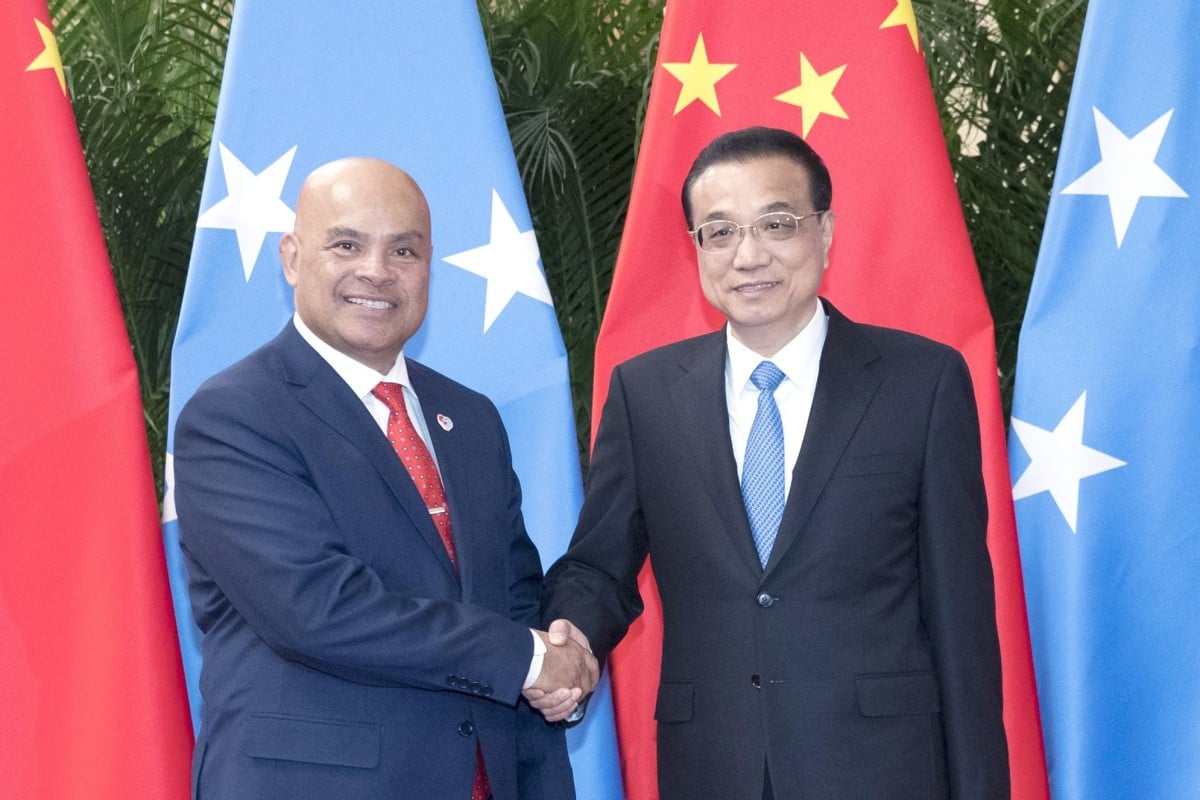
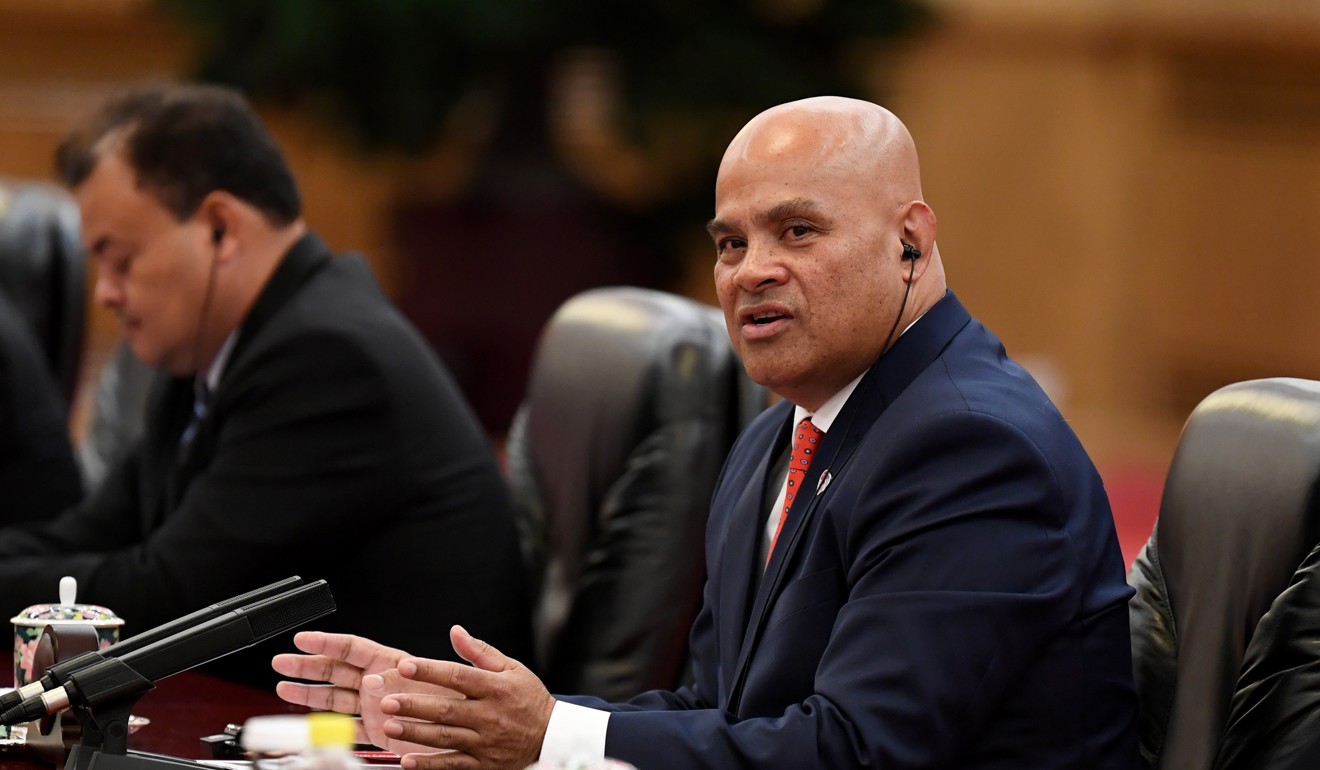
President of the Federated States of Micronesia David Panuelo shakes hands with Chinese Premier Li Keqiang at the Great Hall of the People in Beijing. Photo: Xinhua
In China earlier this month, David Panuelo, the president of the Federated States of Micronesia, climbed the Badaling section of the Great Wall. And, according to Huang Zheng, Beijing’s ambassador to the Pacific nation, the countries’ “great friendship rose to even greater heights” during Panuelo’s visit.
Chinese investment in Micronesia reached similarly lofty levels in conjunction with Panuelo’s trip, which marked three decades of diplomatic ties and included meetings with President Xi Jinping and Premier Li Keqiang. Beijing has committed US$72 million in economic development deals, almost as much as its total investment of the previous three decades.
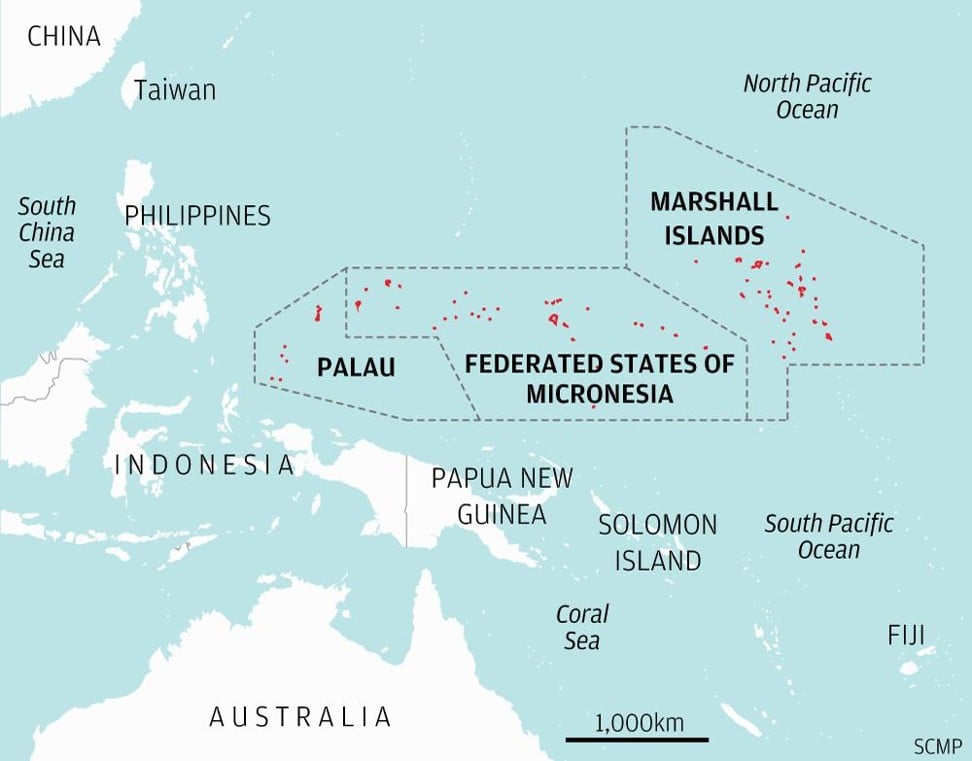
Micronesia is one of three Pacific nations with agreements with Washington, known as the Compact of Free Association (COFA), which allows their citizens to live and work in the US. In exchange, Micronesia, neighbouring Palau and the Marshall Islands grant the US exclusive military and defence access to their territorial waters – more than 2 million square miles of the Pacific that have been an essential element of Washington’s power projection in the region since World War II.
Much of China’s funding has been directed to Micronesia’s Chuuk state, which will in March vote in an independence referendum.
Although Chuuk is home to fewer than 50,000 people, its waters include one of the region’s deepest and most strategically appealing lagoons, creating extra incentive for Beijing and potential concern for Washington as the two countries
With a population of just 113,000 people, Micronesia relies on remittances sent home by citizens working in the US as well as the financial support from Washington under COFA. That assistance is scheduled to expire in 2023, creating uncertainty about the future of the relationship and making Chinese investment even more influential.
“Panuelo’s visit to China is a perfect example of how [the Chinese side] just needs to do a little to get a lot,” said Derek Grossman, senior analyst at Rand Corporation, a Washington think tank. “US$100 million is not very much for them and they can essentially loosen the screws [on COFA] with that.”
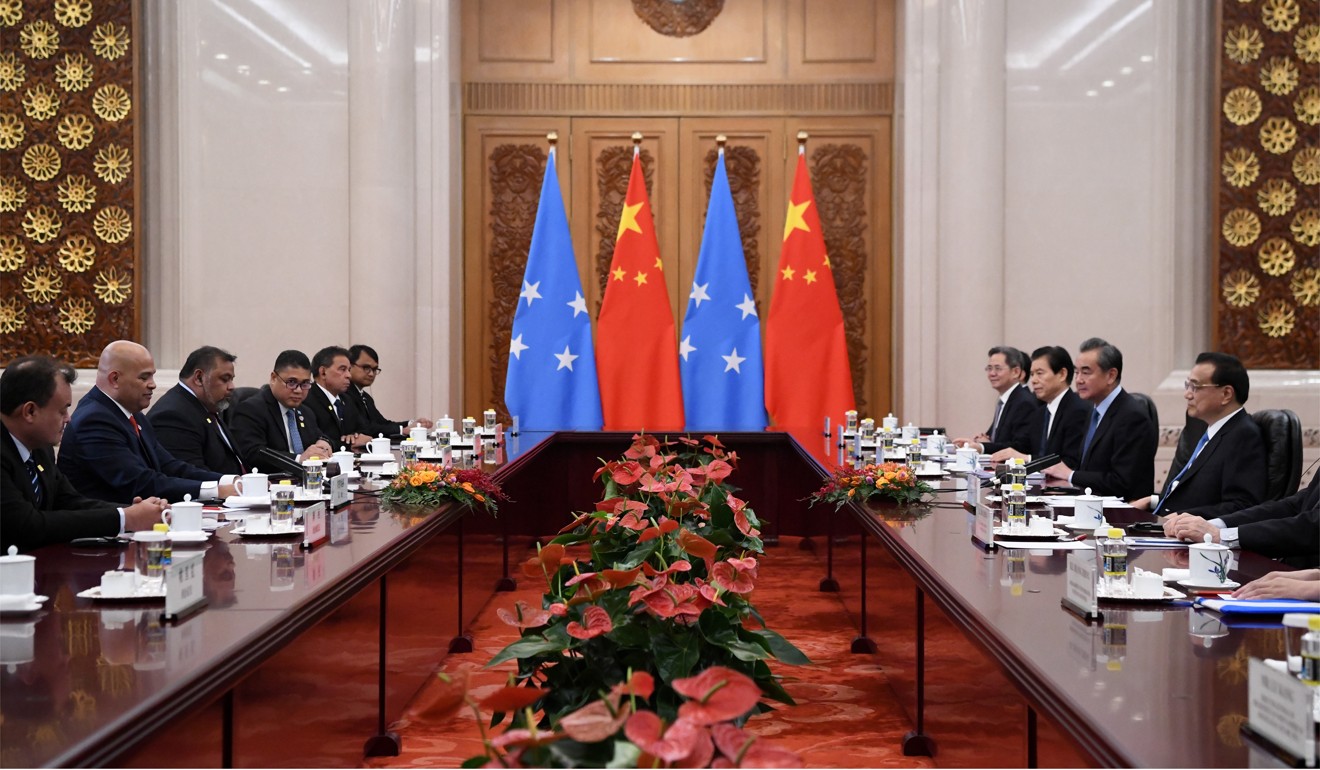
Micronesian President David Panuelo (second on left) and Chinese Premier Li Keqiang (right) during their talks in Beijing. Photo: EPA-EFE
The value of Micronesia’s bilateral trade with China has increased by nearly 30 per cent annually for the past five years, according to Micronesia’s Foreign Ministry. In 2017, the island nation signed onto President Xi’s signature Belt and Road Initiative which aims to build a vast network of strategic investment, trade routes and infrastructure projects across more than 150 countries.
US-China tech war’s new battleground: undersea internet cables14 Dec 2019
In recent years Chinese funding in Micronesia has built office and residential complexes for government officials, a showpiece new convention centre in the capital city Palikir, transport infrastructure and student exchanges, according to a recent report by Rand.
Jian Zhang, associate professor at UNSW Canberra at the Australian Defence Force Academy, said Beijing’s investment reflected a decision to cultivate broader, deeper ties.
Micronesian President David Panuelo during his meeting with Chinese officials in Beijing. Photo: EPA-EFE
“China’s interest in building the relationship with Micronesia is not just about its diplomatic rivalry with Taiwan or economic interests,” he said. “It has elevated the relationship to a comprehensive strategic partnership which encompasses all areas.”
During his recent visit, Panuelo described China as Micronesia’s top economic partner and the US as its top security partner. Pompeo’s visit to Micronesia highlights US anxiety about rising Chinese influence in Pacific 5 Aug 2019
Gerard Finin, professor of regional planning at Cornell University, who previously worked with the US Department of State in the Pacific, said: “China’s leadership consistently accords large ocean states the full protocol that is expected when a head of state visits.
“In contrast, Washington has only had a limited number of meetings and never hosted an official state visit to Washington for the leader of a Pacific Island nation,” said Finin.
US President Donald Trump in May hosted the leaders of Micronesia, Palau and the Marshall Islands together at the White House. When Mike Pompeo visited Micronesia
in August, he became the only sitting US secretary of state to have done so.
Pompeo said negotiations to update COFA had begun but no details have been made public. Micronesia has assembled a team to conduct the negotiations but the US has not, the Honolulu Civil Beat website reported.
US Secretary of State Mike Pompeo visited Micronesia in August. Photo: AFP
Breakaway vote could raise the stakes
Panuelo’s team met Micronesian students studying in China and representatives of state-owned China Railway Construction Corporation, which will build the roads in Chuuk, funded in part by US$50 million from Beijing. Construction of the Chuuk government complex was also funded by Beijing and the state’s governor joined Panuelo for his visit.
Should Chuuk vote to separate from Micronesia in March, it could also mean breaking from COFA, jeopardising the US work privileges of thousands of Chuukese and opening the state’s waters to other partners, particularly China.
Chuuk is home to one of the deepest lagoons in the Pacific, a geographic rarity of particular value in strategic military operations and submarine navigation.
US Coast Guard looks to bolster Pacific allegiances as Chinese clout grows
22 Oct 2019
Zhang said Beijing would explore any opportunity to build a port with potential military capability.
“China has a long-term need to gain a strategic foothold in the region,” Zhang said. “That is a key part of the Belt and Road Initiative. At the general level it’s an economic initiative but an important aspect of the maritime Silk Road is to develop a network of strategically located port facilities.”
Sabino Asor, chair of the public education committee for the Chuuk Political Status Commission, told Civil Beat seceding from Micronesia would be the best option for Chuuk’s future.
“There is no encouraging prospect if Chuuk remains within the Federation,” he said.
However, Patrick Buchan, at Washington think tank Centre for Strategic and International Studies, said Chuuk’s dependence on remittances from the US made breaking from COFA unlikely.
China courts Pacific island states in pursuit of ‘foothold’ as US risks losing influence
8 Aug 2019
In the meantime, uncertainty over COFA negotiations persists, although there is a chance it will be renewed with few changes.
“There is circulation with people easily coming and going that provides a level of understanding and friendship that does not exist between too many other countries,” Finin said.
However, China’s most attractive feature may be its willingness to at least discuss the most pressing concern of Pacific Island nations: climate change.
“When the Trump administration talks about how it doesn’t believe in climate change, or can’t even say the words – that is really offensive for Pacific nations,” Grossman said. “China knows that, and is taking full advantage of it.”
Summit between Chinese, South Korean and Japanese leaders could yield results for future of Korean peninsula, analyst says
North Korea has promised an unwelcome “Christmas present” if the US does not show the “right attitude” for talks. Photo: KCNA
Chinese President Xi Jinping has again stressed the need for tensions on the Korean peninsula to be resolved through dialogue, as the deadline looms in North Korea’s threat to give the United States an unwelcome “Christmas gift”
.
With just over a week to go until Pyongyang’s year-end deadline for Washington to change what it says a policy of hostility, Xi held separate talks with South Korean President Moon Jae-in and Japanese Prime Minister Shinzo Abe in Beijing on Monday.
Moon and Abe will also join Chinese Premier Li Keqiang for a trilateral summit in Chengdu, Sichuan province, on Tuesday.
The first trilateral leadership talks took place in 2008, but were not held in 2013 and 2014, or in 2016 and 2017.
Xi said China and South Korea “both insist on maintaining peace and stability on the peninsula, and advocate solving problems through dialogue and consultation”, state news agency Xinhua reported on Monday.
“China supports South Korea in continuing to improve its relationship with
and injecting impetus for the Korean peninsula peace talks,” the report said.
Moon said the suspension of talks between the US and North Korea and heightened tensions along the peninsula “are not beneficial to both our countries and North Korea”, according to South Korean news agency Yonhap.
Moon also said that China had played an “important role” in efforts for the denuclearise the peninsula, the report said.
North Korea has signalled impatience over the stalled talks with the US, and the fading hopes for an end to Washington’s economic sanctions.
In April, North Korean leader Kim Jong-un said that he would “wait” until the end of the year to decide whether the US had the “right attitude” to allow a resumption of negotiations, but no signs of further talks have emerged.
Then earlier this month Pyongyang warned that Washington would receive a “Christmas gift”, and US actions would determine whether the present would be good or bad.
In an apparent sign of frustration with the US, North Korean news agency KCNA reported on Sunday that Kim held a meeting of the Workers’ Party of Korea to “bolster the overall armed forces of the country” to deal with the “the fast-changing situation”.
The US imposed crippling sanctions on North Korea’s economy in 2017, though many countries, including China, South Korea and Japan, have also tightened measures against the North.
South Korea and Japan both scaled back people-to-people links in 2016, China banned coal exports to the North in 2017. Earlier this year, Trump thanked China and Russia for maintaining sanctions against Pyongyang.
As diplomats make last-ditch attempts to stop renewed confrontation, US special envoy for North Korea Stephen Biegun shuttled around the region last week, meeting senior officials in China, South Korea and Japan. Biegun urged North Korea to return to negotiations, and said the US “does not have a deadline” for talks.
China and Russia also proposed last week that the United Nations Security Council
Xi’s meeting with Moon also comes as Beijing tries to mend ties with Seoul to prevent neighbouring nations from getting closer to Washington.
Relations between China and South Korea deteriorated in 2017 after Seoul deployed a US-led missile defence system known as THAAD, which Beijing deemed as a security threat to its own territory.
On Monday, both Xi and Moon said in their meeting that they looked forward to improving relations between their countries.
“We have been friends and partners that have continued close cooperation,” Xi said. “We have a wide range of common understandings in various fields, including on further developing bilateral relations, facilitating regional peace, stability and prosperity, and defending multilateralism and a free trade system.”
Sun Xingjie, a North Korea specialist at Jilin University, said the US signal was “very clear” in Beigun’s comments.
“They still want to continue discussions,” he said.
Sun also said the talks in Chengdu on Tuesday would likely play an important role in the future of resolving problems on the Korean peninsula.
“After returning to the platform these last couple years, I believe this will become an important, normalised place for discussions. Whatever problems they run into, the platform should continue to move forward,” Sun said.
BEIJING (Reuters) – The spectre of new confrontation between Pyongyang and Washington hangs over meetings between China, Japan and South Korea this week, with growing risks North Korean actions could end an uneasy detente and upend recent diplomatic efforts.
South Korean President Moon Jae-in and Japanese Prime Minister Shinzo Abe are expected to meet Chinese President Xi Jinping separately on Monday. They will then travel to the southwestern city of Chengdu for a trilateral meeting with Chinese Premier Li Keqiang. Though they are expected to discuss various economic matters, North Korea appears likely to dominate the agenda.
Pyongyang has grown increasingly frustrated that its halt of nuclear and long-range missile tests has not ended the crippling economic sanctions against it. It set a Dec. 31 deadline for the United States to make concessions, but Washington has been unmoved.
Some experts believe North Korea may be readying to test an intercontinental ballistic missile launch soon, which would likely end the 2018 agreement struck by its leader, Kim Jong Un, and U.S. President Donald Trump.
“Safeguarding the stability and peace of the Korean Peninsula and pushing for a political solution to the Korean Peninsula issue are in the interests of China, Japan and South Korea,” Chinese Vice Foreign Minister Luo Zhaohui told reporters on Thursday at a briefing on the trilateral meetings.
U.S. special envoy for North Korea Stephen Biegun met with two senior Chinese diplomats during his two-day visit to Beijing this week, following similar meeting in South Korea and Japan days earlier, as diplomats make last-ditch attempts to prevent new confrontation.
North Korea has not responded to his public call to resume dialogue, however.
“The silence, even after Biegun’s speech in Seoul, makes me concerned,” Jenny Town, managing editor at the North Korea monitoring website 38 North, said on Twitter.
Beijing, jointly with Russia, proposed on Monday that the United Nations Security Council lift some sanctions in what it calls an attempt to break the current deadlock and seeks to build support. But it’s unclear whether Beijing can convince Seoul and Tokyo to break ranks from Washington, which has made its opposition clear and can veto any resolution.
Though South Korea sees China as instrumental in reviving negotiations, it has so far sidestepped questions on whether it supports the new proposal by Beijing and Moscow. Japan, which has historically been a staunch supporter of sanctions against North Korea, has also refrained from commenting on the proposal.
“With the (2020 Tokyo) Olympics coming up, North Korea going wild would pose a problem for Japan,” said Narushige Michishita, professor at Japan’s National Graduate Institute for Policy Studies.
“But bilateral talks with North Korea, for example, will probably be a better approach for Japan than easing UN sanctions.”
Chinese President Xi Jinping meets with International Monetary Fund (IMF) Managing Director Kristalina Georgieva at the Great Hall of the People in Beijing, capital of China, Nov. 22, 2019. (Xinhua/Huang Jingwen)
BEIJING, Nov. 22 (Xinhua) — Chinese President Xi Jinping met with International Monetary Fund (IMF) Managing Director Kristalina Georgieva in Beijing on Friday.
Xi extended his welcome for Georgieva’s first visit to China as IMF chief.
Xi said global economic growth is slowing down with increasing downside risks, protectionism in the world is on the rise, and multilateralism and free trade are facing severe challenges. Therefore, the international community has higher expectations for the role of the IMF.
“I hope that under your administration, the IMF will further improve the international currency and its governance system, and enhance the representation and voice of emerging markets and developing countries,” said Xi.
The Chinese president expressed the hope that the IMF will continue to promote global trade, safeguard a fair and open global financial market, and advance the development of the international order in a more just and rational manner.
Xi said in recent years, China and the IMF have carried out sound cooperation in strengthening the capacity building of countries involved in the Belt and Road Initiative.
“China is willing to continuously deepen cooperation with the IMF,” said Xi.
Stressing that China’s economic development has great resilience, potential and room for maneuvering, Xi said the long-term positive trend of China’s economic growth will not change.
“I am full of confidence in China’s development,” said Xi, noting that China will stick to the new vision for development, forge ahead high-quality economic development, continuously promote a higher level of opening up, and bring more opportunities to the world economic growth.
Georgieva said China aims to eradicate absolute poverty by 2020, and the goal is of landmark significance for China and the world. China has achieved sustained and strong economic growth through reform and opening up. It is believed that China will continue to remain open to the outside world in various fields including finance and capital.
The IMF attaches great importance to its relationship with China and will continue to deepen cooperation with China, she said.
Noting that the world economy is currently in a difficult period, Georgieva said the IMF firmly supports free and open trade and strives to achieve peaceful trade relations.
She said the IMF is ready to carry out reforms in line with the needs of the times and enhance the weight of emerging economies.
Georgieva also expressed the willingness to work with China to advance the building of a community of a shared future for humanity and strengthen Belt and Road cooperation.
During her stay in China, Georgieva, who took office as the managing director of the IMF last month, also attended a roundtable meeting hosted by Chinese Premier Li Keqiang with leaders of six major international economic and financial institutions.









 CHINDIA ALERT: You'll be living in their world, very soon