09/10/2019
BEIJING, Oct. 9 (Xinhua) — Chinese President Xi Jinping’s upcoming trip to India and Nepal is expected to inject new impetus into China’s relations with the two countries, an official said here Wednesday.
The Chinese Foreign Ministry announced earlier in the day that at the invitation of Indian Prime Minister Narendra Modi and Nepali President Bidhya Devi Bandari, President Xi will attend the second informal meeting with Modi and pay a state visit to Nepal from Oct. 11 to 13.
This will be Xi’s first overseas trip after the grand celebration of the 70th anniversary of the founding of the People’s Republic of China, Vice Foreign Minister Luo Zhaohui told a press briefing.
Xi’s trip will inject new impetus into China-India and China-Nepal relations, even China’s relations with South Asia, Luo said, adding that Xi’s trip will also open up new space for strengthening regional connectivity and economic and trade cooperation, set up new platforms for enhancing mutual trust and friendship among regional people, and make new contributions to world peace and prosperity.
China and India, both as developing countries and emerging economies, are the only two major countries in the world with a population of more than 1 billion, Luo said, stressing that China-India cooperation will not only benefit the development of the two countries, but also help promote world multipolarization and economic globalization, and safeguard the common interests of developing countries.
Since the first informal meeting between Xi and Modi in Wuhan last year, China-India relations have entered a new stage of steady growth, with cooperation and exchanges being carried out in various fields and differences being properly managed, Luo said.
In Chennai, Xi will have an in-depth communication with Modi on issues that have overall, long-term and strategic significance on bilateral relations, set the tune and guide the direction for future development of the ties, and speak to the world in unanimous voice, so as to inject positive energy into the world full of uncertainties.
Regarding Xi’s visit to Nepal, Luo said that Xi will be the first Chinese president to visit the South Asian country after an interval of 23 years.
Nepal, as a friendly neighbor, also serves as an important partner of China in terms of carrying out the Belt and Road cooperation, Luo said.
Since the establishment of diplomatic ties, the two countries have treated each other on an equal footing with mutual respect and support, said Luo, adding that China and Nepal have become a model of mutually beneficial cooperation between countries that are different in social system and size.
“This historic visit will definitely exert historic influence,” Luo said.
He said that Xi will attend the welcome ceremony and banquet hosted by President Bandari, meet with Bandari, hold talks with Prime Minister K.P. Sharma Oli and jointly witness the signing of cooperation documents with him.
Xi will also meet with co-chairman of the Nepal Communist Party Pushpa Kamal Dahal, also known as Prachanda, and leaders of the country’s Federal Parliament and other political party leaders, Luo added.
Leaders of the two countries will make new plans for the development of bilateral relations, ushering in a new era of fast development for China-Nepal relations, Luo said.
This will also consolidate political mutual trust and foundation of public opinions for friendship between the two countries, push forward high quality construction of the Belt and Road, speed up building an interconnectivity network across the Himalayas, and inject new impetus into pragmatic cooperation in various areas between the two countries, Luo said.
Source: Xinhua
Posted in 70th anniversary of the founding of the PRC, Belt and Road (B&R), Belt and Road Cooperation, Chennai, China-India relations, China-Nepal relations, Chinese foreign ministry, Chinese President Xi Jinping, diplomatic ties, economic globalization, Federal Parliament, grand celebration, Himalayas, India alert, Indian Prime Minister Narendra Modi, multipolarization, Nepal, Nepal Communist Party, Nepali President Bidhya Devi Bandari, overseas trip, Prime Minister K.P. Sharma Oli, South Asia, South Asian country, Uncategorized, Vice Foreign Minister Luo Zhaohui, Wuhan |
Leave a Comment »
09/10/2019
NEW DELHI (Reuters) – India’s Prime Minister Narendra Modi will welcome Chinese President Xi Jinping at an informal summit this week, the Indian foreign ministry said on Wednesday, their talks coming at a time of strained ties over the disputed region of Kashmir.
The meeting in the southern Indian city of Chennai on Oct. 11-12 is aimed at enhancing the rapport the leaders built when they met in the Chinese city of Wuhan last year to help stabilise ties after a standoff in another contested section of their long border, far removed from Kashmir.
But India’s decision in August to withdraw special status for Kashmir drew sharp condemnation from Pakistan and its old ally, China, which took the matter to the U.N. Security Council.
During a meeting with Pakistan Prime Minister Imran Khan in Beijing on Wednesday, Xi said that he was watching the situation in Kashmir closely, the official Xinhua News Agency reported.
Xi said that the right and wrong of the situation was clear and India and Pakistan should resolve the dispute via peaceful dialogue, according to Xinhua.
India says its revocation of the special status of Muslim-majority Kashmir, which was accompanied by a crackdown on dissent by the security forces, is an internal matter aimed at developing the Himalayan territory, which is also claimed by Pakistan, more quickly.
India will make clear that any change to its Jammu and Kashmir state is an internal affair if the Chinese side were to raise the matter in the forthcoming talks, a government source said.
China’s close security ties with Pakistan have long been a matter of concern in New Delhi and in recent years India has drawn closer to the United States to help balance China’s rising weight across the region.
“The forthcoming Chennai Informal Summit will provide an opportunity for the two leaders to continue their discussions on overarching issues of bilateral, regional and global importance and to exchange views on deepening India-China Closer Development Partnership,” the Indian ministry said in a statement.
“OMINOUS SIGNALS
China, which has been criticised by the United States for its treatment of members of Muslim ethnic minorities, said it believed India and Pakistan must refrain from taking unilateral action in Kashmir and has expressed concern over human rights violations there. India has dismissed those concerns.
Srikanth Kondapalli, professor of Chinese studies at New Delhi’s Jawaharlal Nehru University, said it was important for the nuclear-armed neighbours to stabilise relations as both dealt with domestic and regional issues.
“The second informal meeting as such is significant given these ominous signals at bilateral, regional and global levels,” he said.
Xi will also make a state visit to Nepal at the end of his India visit, the first by a Chinese president in 22 years, the Nepali foreign ministry said.
China has deepened ties with India’s neighbours, building ports and power stations in an arc stretching from Bangladesh to Sri Lanka and Pakistan as part of its grand Belt and Road energy and infrastructure plan.
Ahead of Xi’s trip to India, China invited Pakistan’s Prime Khan for talks and said it supports Pakistan in safeguarding its independent sovereignty and territorial integrity.
The Himalayan region of Kashmir is divided between India, Pakistan and China. India rules the populous Kashmir Valley and the Hindu-dominated region around Jammu city, while Pakistan controls a wedge of territory in the west, and China holds a thinly populated high-altitude area in the north.
During Xi’s visit, Modi is expected to raise economic issues, including India’s $53 billion trade deficit with China in 2018/19, and the smaller presence of Indian companies in China compared with that of other major economies.
Source: Reuters
Posted in Bangladesh, Beijing, Belt and Road (B&R), Chennai, Chinese President Xi Jinping, Himalayan territory, India alert, India-China Closer Development Partnership, Indian Prime Minister Narendra Modi, informal summit, Jammu and Kashmir, Jawaharlal Nehru University, Kashmir, Nepal, Nepali foreign ministry, New Delhi, Pakistan, Prime Minister Imran Khan, Sri Lanka, U.N. Security Council, Uncategorized, United States, Wuhan, Xinhua News Agency |
Leave a Comment »
06/10/2019
BEIJING, Oct. 4 (Xinhua) — Chinese President Xi Jinping and his Guinean counterpart Alpha Conde on Friday exchanged congratulatory messages on the 60th anniversary of the establishment of the two countries’ diplomatic ties.
Noting that Guinea was the first sub-Saharan African country to establish diplomatic relations with the People’s Republic of China, Xi said in his message that over the past 60 years, the two countries have always maintained sincerity, friendship and mutual support no matter how the international situation changed, setting an example of unity and cooperation for China-Africa relations.
Xi said he attaches great importance to the development of China-Guinea relations, and values the traditional friendship between the two countries.
He said he is willing to work together with Conde, taking the 60th anniversary of bilateral diplomatic relations as a new starting point, to grasp the historical opportunity of jointly building the Belt and Road and the flourishing development of China-Africa cooperation, cement friendship and mutual trust, and deepen practical cooperation.
The two sides should continue to promote the development of China-Guinea comprehensive strategic cooperative partnership, so as to benefit both countries and peoples, and further contribute to building an even stronger China-Africa community with a shared future, said the Chinese leader.
Conde, for his part, said that the establishment of Guinea-China diplomatic relations has great significance to the development of Africa-China ties. For a long time, the two countries have maintained special, friendly relations, representing an epitome of Africa-China friendly cooperation.
Guinea highly appreciates the Belt and Road Initiative, and is willing to work together with the Chinese side to cement their traditional friendship, carry out the outcomes of the Beijing Summit of the Forum on China-Africa Cooperation, and promote continuous and in-depth development of China-Guinea comprehensive strategic cooperative partnership, Conde added.
Source: Xinhua
Posted in 60th anniversary, Alpha Conde, Beijing Summit of the Forum on China-Africa Cooperation, Belt and Road Initiative, Belt and Road Initiative (BRI), China-Africa relations, China-Guinea comprehensive strategic cooperative partnership, Chinese president, Chinese President Xi Jinping, congratulations, diplomatic ties, exchange, Guinea, Guinean presidents, People's Republic of China, sub-Saharan African country, Uncategorized |
Leave a Comment »
01/10/2019
Chinese President Xi Jinping, also general secretary of the Communist Party of China (CPC) Central Committee and chairman of the Central Military Commission, greets the Chinese women’s volleyball team, after they returned home from a resounding triumph at the World Cup in Japan, at the Great Hall of the People in Beijing, capital of China, Sept. 30, 2019. (Xinhua/Wang Ye)
BEIJING, Sept. 30 (Xinhua) — Chinese President Xi Jinping greeted the Chinese women’s volleyball team at the Great Hall of the People on Monday afternoon after they returned home from a resounding triumph at the World Cup in Japan.
The Chinese women’s volleyball team successfully defended its World Cup crown with a perfect record of 11 wins. It is China’s 10th title in world major volleyball events including the World Cup, the World Championships and the Olympic Games.
Xi first extended warm congratulations to the volleyball players and coaches, saying that they have won a great honor for the country and the Chinese people.
The triumph of the Chinese team at the World Cup has ignited the patriotic enthusiasm of the Chinese people and enhanced national confidence and pride, he said.
Xi stressed that the women’s volleyballers didn’t fear any opponents and fought hard with both style and skills.
“With the championship already secured with one match remaining, you didn’t slack off in the last game and went all out for every ball, which is a good interpretation of the Olympic spirit and Chinese sportsmanship,” he said.
Xi, who is an avid sports fan, recalled that 38 years ago, when the Chinese women’s volleyball team won the World Cup for the first time, the whole nation was overwhelmed with emotion and hundreds of millions of people cried tears of joy.
“The people love the Chinese women’s volleyball team, not only because you have won the championship, but also because you have displayed the spirit of putting the motherland first, through unity, cooperation, tenacity and never giving up,” he said.
“The ever-evolving spirit of the Chinese women’s team represents a new era, and embodies the strongest will of the Chinese nation to rejuvenate itself,” Xi continued.
Xi called on all sportspeople to carry forward the spirit of striving to achieve the goal of China becoming a world sports power.
“I hope the Chinese women’s volleyball team will continue to work hard and I look forward to your excellent results at the Tokyo Olympic Games,” he said.
The Chinese volleyballers won their first major title at the 3rd World Cup in 1981 and have since gone on to claim more top honors at the Olympic Games, the World Championships and the World Cup.
Source: Xinhua
Posted in Chinese President Xi Jinping, Chinese women's volleyball team, Great Hall of the People, Japan, Uncategorized, welcomes, World Championships, World Cup win |
Leave a Comment »
26/09/2019
Li Zhanshu, chairman of the Standing Committee of the National People’s Congress of China, meets with First President of Kazakhstan Nursultan Nazarbayev in Kazakhstan, Sept. 23, 2019. Li paid an official goodwill visit to Kazakhstan from Sept. 21 to 25 at the invitation of Dariga Nazarbayeva, speaker of the Kazakh Parliament’s Upper House, Nurlan Nigmatulin, speaker of the Kazakh Parliament’s Lower House. (Xinhua/Zhai Jianlan)
NUR-SULTAN, Sept. 25 (Xinhua) — Li Zhanshu, chairman of the Standing Committee of the National People’s Congress (NPC) of China, and Kazakh leaders have agreed here to boost mutually beneficial cooperation in various areas.
During an official goodwill visit from Saturday to Wednesday, Li met with First President of Kazakhstan Nursultan Nazarbayev and conveyed Chinese President Xi Jinping’s cordial greetings to him.
Li told Nazarbayev that China and Kazakhstan are good neighbors and the most reliable friends and partners.
Li said China and Kazakhstan have decided to develop a permanent comprehensive strategic partnership and build a community with a shared future, and their ties have become a model of interstate relations following 27 years of development since the establishment of their diplomatic relationship.
Both sides need to strengthen political mutual trust and mutually beneficial cooperation in various fields, Li said, adding that China has full confidence in the future of Kazakhstan and will continue to support the Central Asian country in pursuing its development path that suits its national conditions.
Nazarbayev told Li that China is a good friend of his country and China’s development is vital to Kazakhstan.
He said strengthening Kazakhstan-China cooperation is in line with the two countries’ interests, and Kazakhstan always prioritizes in its foreign policy cementing and developing ties with China.
At a meeting with Kazakh President Kassym-Jomart Tokayev, Li conveyed Xi’s good wishes to him.
Li said the construction of a Silk Road Economic Belt was first proposed in Kazakhstan, and both countries as permanent comprehensive strategic partners should respect, trust and support each other no matter how the global and regional situations develop.
China and Kazakhstan should improve the alignment of their development strategies and boost cooperation in production capacities, energy, agriculture, inter-connectivity, finance, cross-border e-commerce, high-technology, education, sports, culture and tourism, Li said.
Tokayev said that Kazakhstan, located in the center of the Eurasian continent, will always be a friendly neighbor of China. He praised China’s key role in maintaining global security and stability.
The Belt and Road Initiative is significant to Kazakhstan, which is ready to strengthen cooperation with China, implement bilateral agreements and achieve more outcomes.
At talks with Dariga Nazarbayeva, speaker of the Kazakh parliament’s upper house, and Nurlan Nigmatulin, speaker of the lower house, Li said the two legislatures should implement the important consensuses reached by the heads of state and facilitate bilateral cooperation with legislation and favorable policy.
Li said the two legislatures should push for the signing of an updated version of the China-Kazakhstan investment protection pact, streamline procedures for customs clearance and work permits, and create a sound investment environment.
Nazarbayeva said that strengthening Kazakhstan-China cooperation has particular significance as the world is fraught with risks and challenges, and that she expects better quality in such cooperation.
Nigmatulin said the Kazakh parliament is willing to compare notes on legislation and supervision with the NPC of China.
During his visit, Li and Kazakh Prime Minister Askar Mamin attended the opening ceremony of the China Construction Bank’s Astana office.
Li listened to a report about the Astana International Financial Center and encouraged financial institutions in the center to participate in the Belt and Road Initiative.
The Chinese top legislator also visited the site of the 2017 Astana Expo and the national museum.
Source: Xinhua
Posted in 2017 Astana Expo, agriculture, Askar Mamin, Astana International Financial Center, Astana office, Belt and Road Initiative, Belt and Road Initiative (BRI), Central Asian country, chairman of the Standing Committee of the National People's Congress (NPC), China Construction Bank, China-Kazakhstan investment protection pact, Chinese President Xi Jinping, Culture, Dariga Nazarbayeva, education, energy, Eurasian continent, Finance, financial institutions, First President of Kazakhstan, high technology, Kazakh leader, Kazakh Prime Minister, Kazakhstan, Kazakhstan-China cooperation, Li Zhanshu, national museum, NPC of China, Nurlan Nigmatulin, opening ceremony, speaker of the Kazakh parliament, speaker of the lower house, sports, Tourism, Uncategorized |
Leave a Comment »
26/09/2019
Chinese President Xi Jinping, also general secretary of the Communist Party of China (CPC) Central Committee and chairman of the Central Military Commission, attends the operation ceremony of the Beijing Daxing International Airport on Sept. 25, 2019. Xi announced the official opening of the airport and inspected the airport’s platforms and check-in hall. (Xinhua/Ju Peng)
BEIJING, Sept. 25 (Xinhua) — Chinese President Xi Jinping on Wednesday announced the official opening of the Beijing Daxing International Airport.
Xi, also general secretary of the Communist Party of China (CPC) Central Committee and chairman of the Central Military Commission, attended the opening ceremony of the airport on Wednesday morning.
Xi stressed that the new airport, which was built in less than five years and put into operation smoothly, has shown China’s prowess in engineering construction.
It is also a display of the political advantages of the CPC leadership and China’s socialist system that can mobilize all sources to make great achievements, said Xi.
While inspecting the rail transit of Daxing Airport Express at Caoqiao station, Xi stressed that urban rail transit marks the direction for future transportation development in large modern cities, and the development of rail transit is an effective way to solve “big city malaise” and to build green and smart cities.
Beijing should continue to develop rail transit in a bid to build a modern international metropolis, Xi said.
Then Xi took the subway heading for the Beijing Daxing International Airport.
On the way, he inquired in detail about the design and production of the rail trains, ticket prices, baggage consignment and connection with other traffic lines.
Xi stressed that transportation should precede urban modernization, and the Daxing International Airport should fully play its role in serving the coordinated development of the Beijing-Tianjin-Hebei region.
After his arrival at the airport, Xi heard a report on the construction of the airport integrated transportation system and commended the construction of supporting transportation facilities for the airport.
He said that building a comprehensive transportation system with internal and external traffic connections is essential to improving the operational efficiency of the airport.
Advanced management concepts and modern information technology should be employed to make the management and operation more intelligent and convenient, he said.
When inspecting the airport’s platforms and check-in hall, Xi called the airport a significant landmark project of Beijing which would contribute to the coordinated development of the Beijing-Tianjin-Hebei region.
He urged the three areas to seize the opportunity to strengthen coordination and cooperation and accelerate the pace of promoting regional high-quality development.
Xi also stressed the need to construct more advanced aviation hubs and more improved comprehensive transportation systems.
At the check-in counters, Xi saw how self-service paperless check-in was done, acknowledged the airport’s application of modernized facilities to provide passengers with convenient services and urged more efforts to develop the airport into a world-class aviation hub.
At the International Departure area, Xi met with delegates responsible for airport construction and operation.
Xi said that the new airport has demonstrated the great ambition and strategic vision of the Chinese people and displayed the spirit and modern craftsmanship of the nation.
He encouraged builders to march forward and persist in making new contributions.
Chinese Vice Premier Han Zheng also attended the ceremony, saying that the opening of the airport is of great significance to enhancing the international competitiveness of China’s civil aviation industry, better serving the country’s opening up and promoting the coordinated development of the Beijing-Tianjin-Hebei region.
In December 2014, China started building the Beijing Daxing International Airport with a terminal area of 700,000 square meters, four runways and 268 aircraft stands. Flight checks were successfully completed in February this year.
Source: Xinhua
Posted in Beijing, Beijing Daxing International Airport, Beijing-Tianjin-Hebei region, big city malaise, build, Caoqiao station, Chairman of the Central Military Commission, China's socialist system, Chinese President Xi Jinping, Chinese Vice Premier Han Zheng, civil aviation industry, cpc leadership, Daxing Airport Express, engineering construction, general secretary of the Communist Party of China (CPC) Central Committee, green and smart cities, International Departure, modern international metropolis, official opening, opening ceremony, rail transit, Subway, Uncategorized, urban rail transit |
Leave a Comment »
26/09/2019
- Visually spectacular and with the latest technology, the Chinese capital’s second international airport is open for business
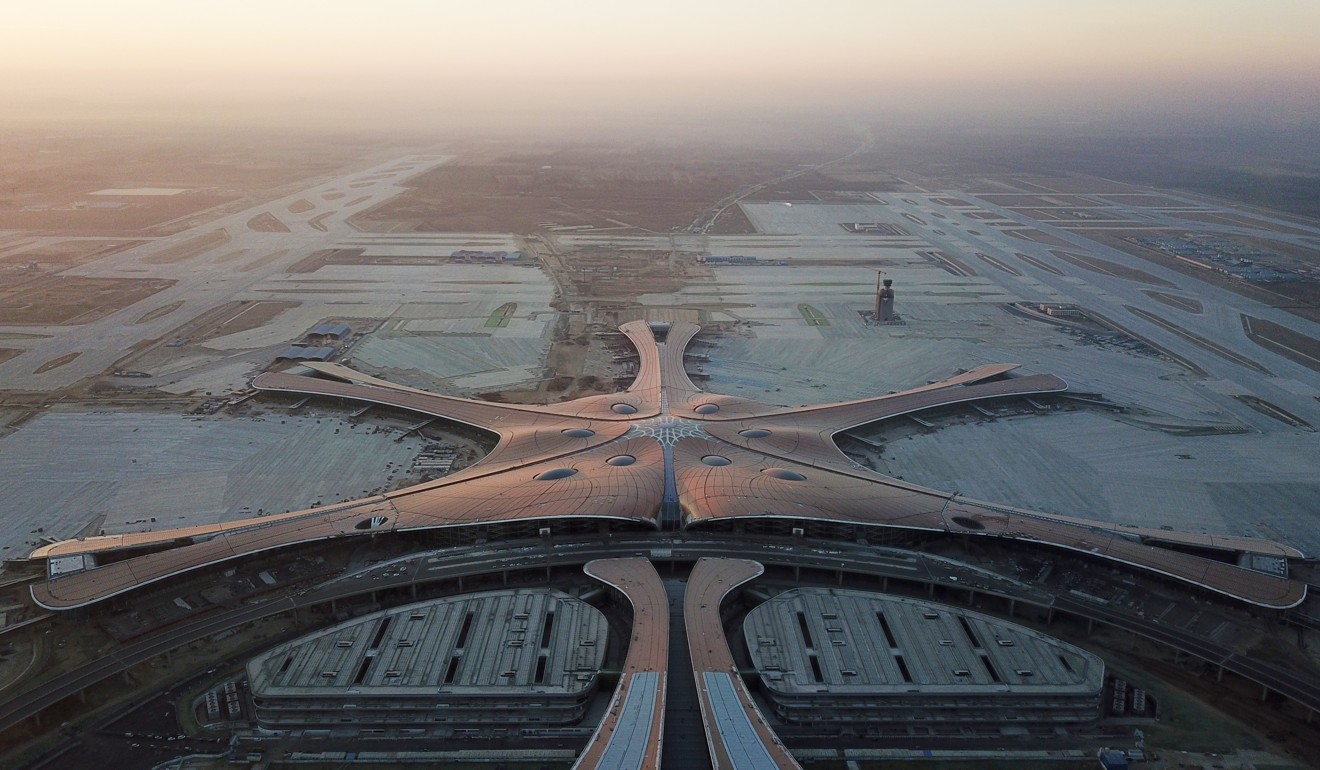
The terminal building at Beijing Daxing International Airport, which has officially opened. Photo: Xinhua
At 4.23pm on Wednesday a China Southern Airlines A380 left Beijing for Guangzhou – on the first commercial flight out of the world’s latest and largest airport terminal at Daxing, five years after construction began on the ambitious project.
The 80 billion yuan (US$11 billion) Beijing Daxing International Airport was officially opened by Chinese President Xi Jinping on Wednesday morning.
China Southern Airlines, the mainland’s largest carrier, has 40 per cent of the flight slots at the new airport. It is one of 16 airlines which will be operating out of Beijing Daxing International Airport, the visually spectacular new facility at the southern end of the Chinese capital.
Six other flights, including China Eastern Airlines for Shanghai and Air China for Chengdu, took off before 5pm in the afternoon. These domestic airlines will have part of their operations moving to Daxing for the upcoming winter-spring season, according to the mainland’s aviation authority. No Hong Kong airlines were listed.
British Airways has announced its whole operation will be moved to Daxing, while some foreign airlines, such as Ethiopian Airlines, Polish Airlines, Malaysia Airlines, Royal Air Maroc and Finnair, will operate at both airports.
Spanning 47 sq km (18 square miles) – almost 50 per cent larger than the city of Macau – Daxing, with its 700,000 square metre (7.5 million sq ft) terminal is a spectacular sight. Its futuristic shape, resembling a giant hexagonal starfish or – as some internet users have dubbed it – an alien base, not only handles more aircraft, it also keeps passengers’ walks
From the centre of the security check to the furthest end gate in each wing is about 600 metres (1,970 feet), or less than an eight-minute walk.
Beijing’s new 7-runway, star-shaped Daxing airport opened by Xi Jinping
According to Xinhua, more than 70 restaurants, tea shops and coffee houses will operate in the airport, along with 36 international brands, including Louis Vuitton, Gucci and Bottega Veneta.
Daxing is designed to take pressure off the overcrowded Beijing Capital International Airport (BCIA) and, by 2021, is expected to handle 45 million passengers a year, rising to 72 million by 2025.
Located at the south of the capital, 46km (28.5 miles) from the central Tiananmen Square, the airport was once frowned upon for its less than optimal location, with its southern end at the border with Hebei province. But it may not be as time-consuming for travellers as originally thought.
The design of the airport means passengers will walk a much shorter distance to the check-in and security check.Hu Haiqing, China Southern Airlines
Hu Haiqing, deputy general manager of China Southern Airlines’ operation control centre, told Global Times that “although Daxing is further away from downtown Beijing than the Capital airport, there are still some advantages, especially for our airline”.
With most of its bases in the south of the country, China Southern Airlines flights to Daxing will be 10 to 15 minutes shorter than to the Capital airport. A further 15 to 20 minutes taxiing time will also be saved, thanks to its position in the new airport.
“The design of the airport also means passengers, once they leave their car or train, will walk a much shorter distance to the check-in and security check,” Hu said.
According to Xinhua, Daxing’s design also makes transit much quicker, with transfers between international and domestic flights up to 90 minutes shorter than from the Capital airport.
The futuristic shape of Daxing airport not only handles more aircraft, it also keeps passengers’ walks to a minimum. Photo: Xinhua
Public transport will be the quickest way to reach the new airport from downtown Beijing – 20 minutes from West Beijing railway station once the Beijing-Xiongan high-speed rail officially opens. The airport express service will also take passengers from Caoqiao station to the airport in 19 minutes.
There is no underground rail service or airport express connecting the Capital airport in the north with Daxing, but passengers can change trains at Caoqiao for downtown Beijing or other stations which connect with BCIA’s airport express service.
Waiting times at the new airport will be greatly reduced by the use of facial recognition technology for self-service check-in and smart security checks, according to Wang Hui, manager of Daxing’s terminal management department.
The technology does away with the need for a paper boarding pass and passengers can check-in, with or without luggage, and go through the security check by themselves.
Beijing is the window for China to go global … Daxing airport makes it possible to open more global routes.China Eastern Airlines pilot
“The airport has more than 400 self-service check-in kiosks, which means more than 80 per cent of check-ins will be self-service. That shortens each passenger’s queuing time to no more than 10 minutes,” Wang told Global Times.
“The smart security check channels are able to handle 260 passengers per hour, 40 per cent faster than using traditional means,” he said.
The opening of Daxing Airport could be a great boost for the mainland – and even the global – aviation industry by easing pressure on the Capital airport and making new routes possible, said a veteran China Eastern Airlines pilot who declined to be named.
5 things we know about Beijing’s new Daxing International Airport
Opening new flight routes from BCIA was almost impossible, he pointed out, because the centre of Beijing was a no-fly zone for security reasons. Daxing airport’s location at the southern end of the city, however, avoided the problem of planes having to bypass the restricted space, leaving room to open more routes for domestic and international flights.
“Beijing is the window for China to go global but the Capital airport’s schedule is saturated and unable to open new routes. Daxing airport makes it possible to open more global routes,” the pilot said.
He said the runway design at Daxing also meant fewer delays, because the four runways of phase one – more than any other airport in China – included one which was perpendicular to the other three, allowing flights to land and take off regardless of wind direction.
Source: SCMP
Posted in Air China, Aircraft, airport express, airport express service, alien base, announced, aviation authority, aviation industry, Beijing, Beijing Capital International Airport (BCIA), Beijing-Xiongan high-speed rail, both airports, Bottega Veneta, British Airways, capital, car, Chengdu, China Eastern Airlines, China Eastern Airlines pilot, China Southern Airlines, Chinese capital, Chinese President Xi Jinping, coffee houses, Daxing airport, domestic flights, downtown, Finnair, giant hexagonal starfish, Global Times, Guangzhou, Gucci, Hebei province, international, kiosks, largest carrier, latest technology, Louis Vuitton, Macau, mainland, Malaysia Airlines, new airport, paper boarding pass, passenger’s queuing time, passengers’ walks, Polish Airlines, public transport, quickest way, restaurants, Royal Air Maroc, second international airport, self-service check-in, Shanghai, smart security checks, takes flight, tea shops, Tiananmen Square, Train, transfers, transit, Uncategorized, underground rail service, Visually spectacular, West Beijing railway station, whole operation, world’s largest terminal, Xinhua |
Leave a Comment »
23/09/2019
BEIJING, Sept. 23 (Xinhua) — Chinese President Xi Jinping extended greetings to farmers and people working in agriculture and rural areas as Monday marked the second Chinese farmers’ harvest festival.
Xi, also general secretary of the Communist Party of China (CPC) Central Committee and chairman of the Central Military Commission, sent his greetings via the China Central Television’s newly-launched channel dedicated to agriculture and rural affairs.
“With a solid foundation laid by agriculture, we have full confidence in development,” Xi said.
The achievements that China has made in the fields related to agriculture, rural areas and farmers are not only the outcomes of concerted efforts of the whole CPC and the country but also the results of hard work of all farmers and people working in agriculture and rural areas, he said.
Xi also congratulated on the launch of the new channel, expecting the channel to publicize agricultural policies, plans as well as new looks of farmers and rural areas in-depth.
Xi also expected the channel to lead the audience to pay attention to agriculture, care for the countryside and farmers, and contribute to poverty alleviation, reform and development in agriculture and the countryside, and the realization of rural revitalization.
The Chinese farmers’ harvest festival is the first national festival created specifically for the country’s farmers. Starting in 2018, the festival coincides with the Autumnal Equinox each year, which is one of the 24 solar terms of the Chinese lunisolar calendar and usually falls between Sept. 22 and 24 during the country’s agricultural harvest season.
The new channel is the first national all-media channel dedicated to agriculture and rural affairs. With daily 18-hour programs, the channel officially began broadcasting on Monday.
Source: Xnhua
Posted in agriculture, Autumnal Equinox, Chairman of the Central Military Commission, China Central Television, China Central Television (CCTV), Chinese lunisolar calendar, Chinese President Xi Jinping, country's farmers, farmers, first national festival, general secretary of the Communist Party of China (CPC) Central Committee, harvest festival, rural areas, Uncategorized |
Leave a Comment »
22/09/2019
Li Zhanshu (L), chairman of the Standing Committee of the National People’s Congress of China, meets with Azerbaijani President Ilham Aliyev in Baku, Azerbaijan, Sept. 19, 2019. Li paid an official goodwill visit to Azerbaijan from Sept. 19 to 21 at the invitation of Ogtay Asadov, speaker of the National Assembly of Azerbaijan. (Xinhua/Pang Xinglei)
BAKU, Sept. 21 (Xinhua) — Li Zhanshu, chairman of the Standing Committee of the National People’s Congress (NPC) of China, and top Azerbaijani officials have agreed here to strengthen bilateral cooperation in various areas.
During an official goodwill visit from Thursday to Saturday, Li met with Azerbaijani President Ilham Aliyev and conveyed Chinese President Xi Jinping’s cordial greetings to him.
Li briefed Aliyev on the great achievements of the People’s Republic of China since its founding 70 years ago, saying that the Communist Party of China is forging ahead on the road of socialism with Chinese characteristics in line with China’s national conditions.
The socialism with Chinese characteristics has now entered a new era, and China under the leadership of Xi is striving to achieve its “two centenary goals” and realize the Chinese dream of the great rejuvenation of the Chinese nation, Li told Aliyev.
China deems Azerbaijan as an important partner in Eurasia and is ready to implement the blueprint made by Xi and Aliyev on the development of bilateral ties, further cement political mutual trust, strengthen practical cooperation in various areas, and jointly safeguard the two countries’ security and development interests, Li said.
Aliyev asked Li to convey his best wishes to Xi and said he had witnessed the great changes in China with his own eyes during his repeated trips to the country and that he admired such achievements.
Azerbaijan-China relations are developing rapidly with a rosy future, he said, adding that his country firmly adheres to the one-China principle, and intends to combat jointly with China the “three forces” of terrorism, separatism and extremism, and improve their coordination and cooperation on international and regional issues.
LEGISLATIVE EXCHANGES
During a meeting with Ogtay Asadov, speaker of the National Assembly of Azerbaijan, Li said his visit was aimed at strengthening cooperation between the two legislatures and implementing the important consensuses reached by the two heads of state.
The Chinese top legislator suggested both sides increase interactions at various levels, exchange experience on governing the countries, and provide legal assurance for bilateral practical cooperation.
Every country has a unique history, national situation and culture, so different civilizations should coexist harmoniously and learn from each other, Li said.
The NPC of China is willing to work with the National Assembly of Azerbaijan to promote cultural and people-to-people exchanges between the two countries, learn from each other, and cement public support for bilateral relations, he said.
Asadov said Li was the first top Chinese legislator to visit Azerbaijan in 19 years and that the trip has injected new vitality into the development of bilateral relations and the interactions between the two legislatures.
Azerbaijan and China have signed many cooperation deals and the two legislatures should help to deliver on the agreements, Asadov said.
An increasing number of Azerbaijani people are interested in Chinese culture and there is a need to promote educational, cultural and youth exchanges, he said.
ECONOMIC COOPERATION
At a meeting with Azerbaijani Prime Minister Novruz Mammadov, Li said Azerbaijan is located at the junction of Europe and Asia and is an important country along the Belt and Road.
Li said China is ready to boost economic and trade exchanges with Azerbaijan and enhance cooperation with the country in jointly building the Belt and Road and achieve more cooperation outcomes in such fields as energy, agriculture, transportation, logistics, tourism and informatization.
He welcomed Azerbaijan to the second China International Import Expo to be held in early November in Shanghai.
Mammadov said his country was among the earliest participants in the Belt and Road Initiative and is ready to expand cooperation with China in various areas.
He welcomed more Chinese investments in Azerbaijan and expected cooperation with China on the construction of a Trans-Caspian International Transport Corridor so that more Chinese goods can hit the Eurasian market via Azerbaijan.
During his stay in Baku, Li also visited the Heydar Aliyev Center and a carpet museum, and laid a wreath at the tomb of former President Heydar Aliyev and the Eternal Flame.
Source: Xinhua
Posted in agriculture, Asia, Azerbaijan, Azerbaijan-China relations, Azerbaijani Prime Minister, Belt and Road (B&R), Belt and Road Initiative, Belt and Road Initiative (BRI), blueprint, carpet museum, chairman of the Standing Committee of the National People's Congress (NPC) of China, China alert, China International Import Expo, China International Import Expo (CIIE), Chinese goods, Chinese President Xi Jinping, Communist Party of China, cooperation, cultural, educational, energy, Eurasia, Europe, extremism, Heydar Aliyev Center, informatization, Li Zhanshu, logistics, Novruz Mammadov, Ogtay Asadov, one-China principle, People's Republic of China, pledge, President Ilham Aliyev, promote, rejuvenation, separatism, Shanghai, Socialism with Chinese characteristics, speaker of the National Assembly of Azerbaijan, strengthen, terrorism, the Eternal Flame, tomb, Tourism, Trans-Caspian International Transport Corridor, transportation, two centenary goals, Uncategorized, wreath, youth exchanges |
Leave a Comment »
21/09/2019
- Iranian news outlet quotes military official as saying exercise will be held soon, but Chinese media silent on reported manoeuvres
An Iranian news source says China, Russia and Iran are planning a joint naval exercise soon. Photo: Xinhua
China, Russia and Iran are planning a joint naval drill in the Sea of Oman and northern Indian Ocean “soon” a semi-official Iranian news outlet reported on Saturday, just days after the United States
blamed Iran for a drone attack on Saudi Arabian oil facilities.
General Ghadir Nezami Pour, head of international affairs and defence diplomacy of the Iranian Armed Forces General Staff, said the drill would take place in international waters, Iran Press news agency reported.
“The exercises have different goals including the exchange of tactical and military experiences and sometimes they seek political goals which show a kind of convergence between participants,” he was quoted as saying.
“Officials at the level of defence minister, chief of staff of the armed forces and commanders of the armed forces will come to Iran in the near future and these actions reflect Iran’s active defence diplomacy.”
The comments came in the aftermath of the September 14 missile strikes on Saudi Arabia’s Abqaiq and Khurais oil facilities.
Washington accused Tehran of masterminding the attacks, allegations that Iran denied.
Tehran warned that any military action by the United States or Saudi Arabia would result in “all-out war”.
US Secretary of State Mike Pompeo initially condemned the attacks on the oil facilities as an “act of war” but later said the US was seeking a peaceful solution to the crisis.
On Friday, Chinese President Xi Jinping condemned the attacks during a phone conversation with Saudi Arabia’s King Salman, adding that he hoped the incident would receive a full and fair investigation.
There was no report of the joint drill plan in Chinese media.
Analysts said the exercise was possible as China might want to show support for Iran.
“The timing of the joint exercise might be a bit sensitive and some might take it as a show of China’s support for Iran should there be any military conflicts between countries,” Beijing-based naval expert Li Jie said.
“But it might well be a regular military exchange between the countries if it is held in international waters and without targeting another country.”
China calls for calm in aftermath of drone strikes on Saudi oil facilities
Ni Lexiong, a military specialist and professor at Shanghai University of Political Science and Law, said the drill was to send the message that China would side with Iran “in extreme scenarios”.
“I don’t see things will go that far, but the navy drill is to send the intimidating message,” Ni said.
Two years ago China and Iran conducted a joint naval exercise near the Strait of Hormuz in the Persian Gulf after Washington accused Tehran of sending fast attack boats to harass US warships passing through the area.
Major General Mohammad Baqeri, Chief of Staff of the Iranian Armed Forces, was in Beijing for a three-day visit earlier this month and agreed that the two countries would have more visits with senior military officials and advance cooperation in training.
China still accounts for more than half of Iran’s oil exports, according to the United States, complicating Washington’s efforts to economically isolate Tehran in its “maximum pressure campaign”.
Source: SCMP
Posted in Abqaiq and Khurais oil facilities, accused, act of war, allegations, attack boats, attacks, Beijing, Chief of Staff of the Iranian Armed Forces, China alert, Chinese President Xi Jinping, condemned, crisis, denied, drone attack, extreme, General Ghadir Nezami Pour, head of international affairs and defence diplomacy, Indian Ocean, International waters, iran, Iranian Armed Forces General Staff, joint, King Salman, Major General Mohammad Baqeri, masterminding, message, Mike Pompeo, missile strikes, naval drill, Naval expert, navy drill, oil facilities, peaceful solution, Persian Gulf, plan, Russia, Saudi Arabia, Saudi Arabian, scenarios, Sea of Oman, Shanghai University of Political Science and Law, Strait of Hormuz, Tehran, Uncategorized, United States, US Secretary of State, US warships, visit, Washington |
Leave a Comment »




 CHINDIA ALERT: You'll be living in their world, very soon