Chindia Alert: You’ll be Living in their World Very Soon
aims to alert you to the threats and opportunities that China and India present. China and India require serious attention; case of ‘hidden dragon and crouching tiger’.
Without this attention, governments, businesses and, indeed, individuals may find themselves at a great disadvantage sooner rather than later.
The POSTs (front webpages) are mainly 'cuttings' from reliable sources, updated continuously.
The PAGEs (see Tabs, above) attempt to make the information more meaningful by putting some structure to the information we have researched and assembled since 2006.
WASHINGTON (Reuters) – U.S. President Donald Trump on Friday said he thinks a trade deal between the United States and China will be signed by the time the Asia-Pacific Economic Cooperation meetings take place in Chile on Nov. 16 and 17.
RELATED COVERAGE
China says will work with the U.S. to address each other’s core concerns
Chinese Vice Premier Liu He will provide Beijing’s perspective on the progress of the talks in a speech on Saturday, according to a tweet from editor-in-chief of the Global Times, a tabloid published by the People’s Daily of China’s ruling Communist Party.
“I think it will get signed quite easily, hopefully by the summit in Chile, where President Xi and I will both be,” Trump told reporters at the White House, without providing details.
“We’re working with China very well,” Trump also said.
The White House has announced that China agreed to buy up to $50 billion of U.S. farm products annually, as part of the first phase of a trade deal, although China seems slow to follow through.
The so-called phase 1 deal was unveiled at the White House last week during a visit by vice premier He as part of a bid to end a tit-for-tat trade war between Beijing and Washington that has roiled markets and hammered global growth. U.S. officials said a second phase of negotiations could address thornier issues like forced technology transfer and non-financial services issues.
Chinese Vice Premier Liu He, also a member of the Political Bureau of the Communist Party of China Central Committee, meets with Chairman of the U.S.-China Business Council (USCBC) Evan Greenberg at the latter’s request in Beijing, capital of China, on Sept. 12, 2019. (Xinhua/Liu Bin)
BEIJING, Sept. 12 (Xinhua) — Chinese Vice Premier Liu He on Thursday met with Chairman of the U.S.-China Business Council (USCBC) Evan Greenberg in Beijing at the latter’s request.
Liu, also a member of the Political Bureau of the Communist Party of China Central Committee, said China welcomes the U.S. side’s latest decision to delay an increase in tariffs, which was previously scheduled for Oct. 1.
The whole world looks forward to seeing progress in trade consultations between China and the United States, Liu said, adding that working groups of both sides will meet next week and have earnest discussions on trade balance, market access, protection of investors and other issues of common concern.
The U.S. business sector does not want to see a hike in tariffs, and hopes that the two countries will solve their differences through consultations and bring bilateral trade back to normal, Greenberg said.
The USCBC is willing to play a positive role in this regard, he added.
Chinese Vice Premier Liu He, also a member of the Political Bureau of the Communist Party of China Central Committee, reads a congratulatory letter to the 2019 Smart China Expo sent by Chinese President Xi Jinping at the expo’s opening ceremony in southwest China’s Chongqing Municipality, Aug. 26, 2019. (Xinhua/Wang Quanchao)
CHONGQING, Aug. 26 (Xinhua) — Chinese Vice Premier Liu He on Monday called for seizing the new opportunities in technological development and promoting the healthy development of the intelligent industry.
Liu, also a member of the Political Bureau of the Communist Party of China Central Committee, made the remarks at the 2019 Smart China Expo that opened Monday in southwest China’s Chongqing Municipality.
At the opening ceremony, he read a congratulatory letter from President Xi Jinping.
The letter fully demonstrated that the president attaches great importance to the development of intelligent industry, and pointed the direction for the sector’s healthy development, Liu said.
Noting that China’s economy is switching from high-speed growth to high-quality development, Liu said the country’s dynamic microfundations and sufficient macro-policy tools can ensure the sound fundamentals of its economic development.
China’s intelligent industry is developing rapidly and emerging as a new economic growth point, Liu said.
To promote the sector’s development, efforts must be centered on promoting the well-being of humanity, maintain a balance between efficiency and job creation, respect and protect individual privacy, and uphold the ethical and moral bottom line, he said.
In underscoring China’s willingness to advance international cooperation in the intelligent sector, Liu said China welcomes enterprises from all over the world, including the United States, to invest and operate in China.
The country will continue to create an appealing investment environment and strengthen protection of property rights and intellectual property rights, he said.
China is willing to resolve problems calmly through consultation and resolutely opposes the escalation of the trade war, Liu said, adding that any escalation will run against the interests of the people of China, the United States and the whole world.
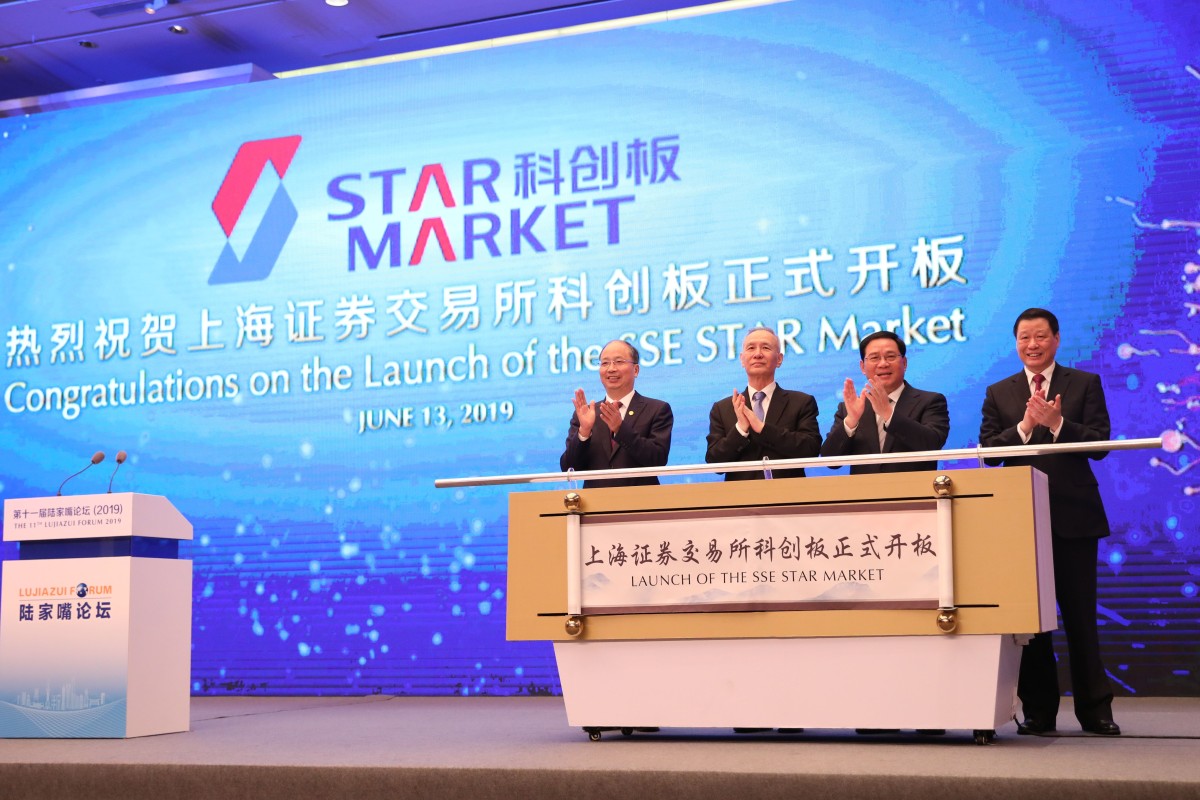
President Xi Jinping’s chief US trade war negotiator did not specifically reference rising tensions with United States during surprise speech in Shanghai
Keynote address at Lujiazui financial forum his first public appearance in three weeks since tour of Jiangxi province with Xi
The keynote address by Liu He (second left) at the Lujiazui financial forum in Shanghai on Thursday was his first public appearance in three weeks. Photo: Xinhua
Vice-Premier Liu He believes the “external pressure” now hitting China’s economy was inevitable and could actually boost the country’s innovation and development.
Liu, the top economic aide to President Xi Jinping and chief negotiator in the trade talks with the United States, backed up comments last week from
that Beijing has sufficient policy tools to address the risks and challenges to ensure that China’s long-term growth prospects remain sound.
He did not directly mention the US-China trade war in remarks at the Lujiazui financial forum on Thursday, but said that there was ample room in China’s macroeconomic system to support growth and that recent moves by the government to cut taxes and government administrative fees were starting to have a positive impact on the economy.
“We do face some external pressure at the moment, but this is the inevitable test that China’s economic upgrade must experience,” Liu told the forum, which is an annual event organised by the Shanghai government and the People’s Bank of China. “The external pressure will help us improve innovation and self-development, speed up reform and opening up and push forward with high quality growth.”
Liu was critical of economists for focusing solely on monthly economic data that has shown signs of weakness in the Chinese economy, while neglecting positive trends that support long-term growth in the world’s second largest economy.
Chinese employment, consumer prices and the balance of payment remained at “reasonable” levels, he said, although
did rise to the highest level in 15 months in May, partly because of the rising price of pork and fresh fruit.
“No matter what happens temporarily, China’s long-term growth remains positive, which won’t change,” Liu said. “After the global financial crisis, our financial system has been stable. The rapid growth of debt in the system has been contained.”
The keynote speech, which was Liu’s first public appearance since accompanying Xi on a tour of Jiangxi province three weeks ago, was only confirmed at the last minute having initially been announced as a speech by “a State Council leader”.
The external pressure will help us improve innovation and self-development, speed up reform and opening up and push forward with high quality growthLiu He
In an unusual move, Liu used charts and slides, both in Chinese and English, to address Chinese and foreign bankers and investors as well as other Chinese officials including Banking and Insurance Regulatory Commission chairman Guo Shuqing and People’s Bank of China governor Yi.
It remains to be seen whether Liu will resume trade talks on China’s behalf, with a meeting between
at the G20 summit at the end of June yet to be confirmed after negotiations broke down in early May.
“We noticed that the US side had repeatedly expressed the hope that the two presidents could meet during the G20 summit later this month. Right now I have no new information to offer about the China-US trade talk,” said Chinese Ministry of Commerce spokesman Gao Feng during Thursday’s regular press conference.
“Nothing is agreed until everything is agreed.”
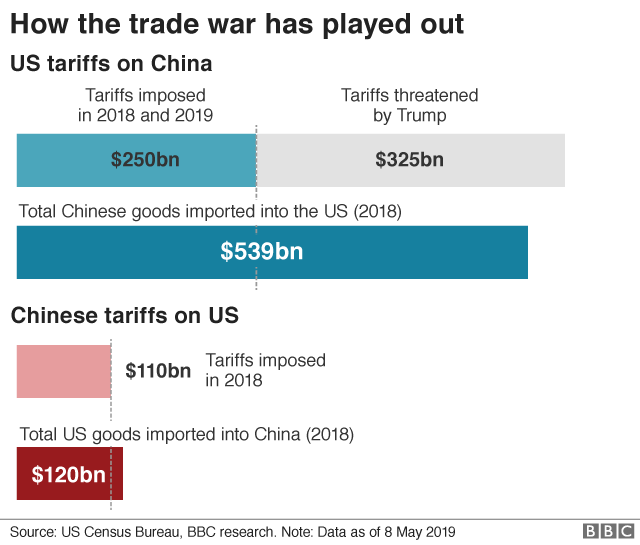
Since the last round of talks in Washington, which were attended by Liu, the US has increased tariffs on US$200 billion of Chinese goods from 10 per cent to 25 per cent, while Trump has threatened to impose tariffs on the US$300 billion worth of imports not yet covered by duties.
“The US used state power to suppress Chinese enterprises and generalise the concept of national security. These are the behaviours of distorting the market,” Gao added.
“It was the US who reneged and was dishonest in the trade talks, unilaterally escalated the trade tensions and made the negotiation fall into an impasse.”
WASHINGTON, May 11 (Xinhua) — Chinese Vice Premier Liu He said Friday that cooperation is the only right choice for China and the United States, but China will not compromise on major issues of principle.
China-U.S. relations are of great importance, Liu said in a group interview with Chinese media after the conclusion of the 11th round of high-level economic and trade consultations between the world’s top two economies, which took place on Thursday and Friday in Washington.
Economic and trade relations serve as the ballast and propeller of the overall China-U.S. relationship, and matter not only to bilateral ties, but also to world peace and prosperity, added Liu, also a member of the Political Bureau of the Communist Party of China (CPC) Central Committee.
Cooperation is the only right choice for the two sides, but it has to be based on principles, said the vice premier, who heads the Chinese side of the China-U.S. comprehensive economic dialogue.
China, he stressed, will never make concessions on major issues of principle.
The Chinese delegation came to Washington for the latest round of talks with sincerity, and held candid and constructive exchanges with the U.S. side, Liu said, adding that the two sides agreed to continue to push forward the consultations.
China strongly opposes U.S. tariff hikes, which are harmful not only to China and the United States, but to the world at large, and China will have to take necessary countermeasures, he added.
Stressing that any agreement must be equal and mutually beneficial, Liu said that the two sides have reached important consensus on many aspects, but there remain three core concerns of China that must be addressed.
The first is to remove all the additional tariffs, he said, adding that the levy of those tariffs is the starting point of the ongoing bilateral trade dispute, and must be totally revoked if the two sides were to reach a deal.
The second is that the amount of purchases should be realistic, he said, adding that the two sides reached consensus on the volume in Argentina, and should not change it randomly.
The third is to improve the balance of the wording of the text, he said, adding that every country has its dignity, the text must be balanced, and more discussions are needed on some critical issues.
Noting that it is just normal that there have been some ups and downs in bilateral consultations since last year, Liu pointed out that it is irresponsible to casually accuse one party of “backtracking” while the two sides are still in the process of negotiation.
As for China, the vice premier said the most important thing is to focus on its own business.
China enjoys huge domestic market demand, the implementation of the supply-side reform will comprehensively boost the competitiveness of Chinese products and enterprises, and there is still ample room for fiscal and monetary policy manoeuvres, he said, adding the Chinese economic prospect is very optimistic.
Liu pointed out that it is a good thing for a major country to encounter some twists and turns in its development, as they can serve as an ability test.
Under the strong leadership of the CPC Central Committee with Xi Jinping at the core, as long as the Chinese people have firm confidence and make joint efforts, China is not afraid of any difficulties, and will certainly be able to maintain the good momentum of sustained and sound economic development, he added.
Chinese Vice Premier Liu He receives an interview in Washington D.C., the United States, May 9, 2019. Liu He, a member of the Political Bureau of the Communist Party of China Central Committee and chief of the Chinese side of the China-U.S. comprehensive economic dialogue, arrived in Washington D.C. on Thursday for the 11th round of high-level economic and trade consultations with the U.S. side. (Xinhua/Liu Jie)
WASHINGTON, May 9 (Xinhua) — Chinese Vice Premier Liu He arrived in Washington on Thursday for the 11th round of high-level economic and trade consultations with the U.S. side.
Liu told reporters upon his arrival that he came to Washington with sincerity, saying that under the current special circumstances he hopes to engage in rational and candid exchanges with the U.S. side.
Liu is also a member of the Political Bureau of the Communist Party of China Central Committee and chief of the Chinese side of the China-U.S. comprehensive economic dialogue.
China believes that raising tariffs is not a solution to the problems, Liu said, noting that it is harmful to China, to the United States and to the whole world.
The US has more than doubled tariffs on $200bn (£153.7bn) worth of Chinese products, in a sharp escalation of the countries’ damaging trade war.
Tariffs on affected Chinese goods have risen to 25% from 10%, and Beijing has vowed to retaliate.
China says it “deeply regrets” the move and will have to take “necessary counter-measures.”
It comes as high-level officials from both sides are attempting to salvage a trade deal in Washington.
Only recently, the US and China appeared to be close to ending months of trade tensions.
China’s Commerce Ministry confirmed the latest US tariff increase on its website.
“It is hoped that the US and the Chinese sides will work together… to resolve existing problems through co-operation and consultation,” it said in a statement.
Tariffs are taxes paid by importers on foreign goods, so the 25% tariff will be paid by American companies who bring Chinese goods into the country.
Even though Mr Trump has downplayed the impact of tariffs on the US economy, the rise is likely to affect some American companies and consumers as firms may pass on some of the cost, analysts said.
Deborah Elms, executive director at the Asian Trade Centre, said: “It’s going to be a big shock to the economy.
“Those are all US companies who are suddenly facing a 25% increase in cost, and then you have to remember that the Chinese are going to retaliate.”
Image copyright GETTY IMAGESImage caption US and Chinese officials have held several round of talks in an attempt to strike a deal to end the trade war.
In a statement, the American Chamber of Commerce in China said it was committed to helping both sides find a “sustainable” solution.
“While we are disappointed that the stakes have been raised, we nevertheless support the ongoing effort by both sides to reach agreement on a strong, enforceable deal that resolves the fundamental, structural issues our members have long faced in China.”
French Finance Minister Bruno Le Maire warned that the trade dispute escalation threatened jobs across Europe.
“There is no greater threat to world growth,” Mr Le Maire told CNews. “It would mean that trade tariffs go up, fewer goods would circulate around the world… and jobs in France and in Europe would be destroyed.”
‘Serious escalation’ of the trade war
No breakthrough, and no deal – just, more tariffs.
With this move, US President Donald Trump has effectively dealt a fresh blow to not just the Chinese economy – as he had presumably hoped – but also to US’s.
The previous set of tariffs of 10% on $200bn of Chinese goods have to some extent been absorbed by American importers, but economists say a 25% tariff will be much harder for them to stomach.
They will almost certainly have to pass on that cost to American consumers – and that means higher prices.
Make no mistake, this is a serious escalation – and the trade war between the world’s two largest economies is back on.
This means the rest of us should be prepared for more pain ahead.
How will the tariff increase affect negotiations?
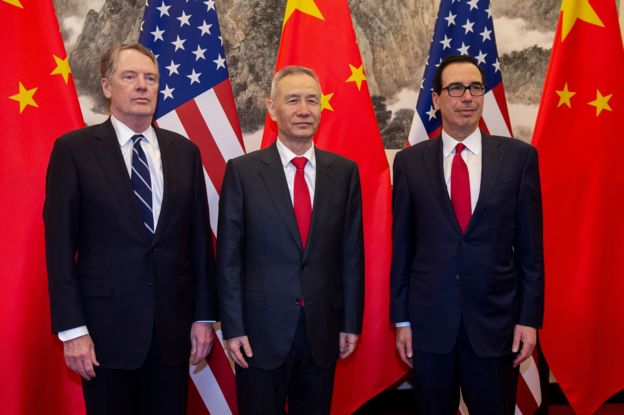
Despite this week’s escalation in tensions, talks were held between Chinese Vice-Premier Liu He, US Trade Representative Robert Lighthizer and Treasury Secretary Steven Mnuchin on Thursday.
A White House spokesman said US officials had agreed with the vice-premier to resume talks on Friday morning, according to media reports.
Even though there had been growing optimism about progress in trade talks recently, sticking points have persisted throughout.
These have included issues around intellectual property protection, how fast to roll back tariffs and how to enforce a deal.
Analysts say the Chinese are still willing to negotiate to retain the moral high ground and because they recognise the importance of solving the trade war.
“A trade war will be bad for China, both the real economy and the financial markets. It will also be bad for the world economy,” said Gary Hufbauer of the Peterson Institute for International Economics.
“Better for China to play the role of conciliatory statesman than angry retaliator.”
Why are the US and China at odds?
China has been a frequent target of Donald Trump’s anger, with the US president criticising trade imbalances between the two countries and Chinese intellectual property rules, which he says hobble US companies.
Some in China see the trade war as part of an attempt by the US to curb its rise, with Western governments increasingly nervous about China’s growing influence in the world.
Both sides have already imposed tariffs on billions of dollars worth of one another’s goods. The situation could become worse still, as Mr Trump has also warned he could “shortly” introduce 25% duties on $325bn of Chinese goods.
What exactly sparked the US president’s latest actions, which apparently took China by surprise, is unclear.
Ahead of the discussions, Mr Trump told a rally China “broke the deal” and would pay for it.
The International Monetary Fund said the row poses a “threat to the global economy”.
“As we have said before, everybody loses in a protracted trade conflict,” the body which aims to ensure global financial stability said in a statement, calling for a “speedy resolution”.
This combo photo shows Chinese Vice Premier Liu He, who is also a member of the Political Bureau of the Communist Party of China Central Committee and chief of the Chinese side of the China-U.S. comprehensive economic dialogue, posing for photos with U.S. Trade Representative Robert Lighthizer and Treasury Secretary Steven Mnuchin. They held the tenth round of China-U.S. high-level economic and trade consultations in Beijing from April 30, 2019 to May 1, 2019. (Xinhua/Shen Hong, Zhai Jianlan)
BEIJING, May 1 (Xinhua) — Chinese Vice Premier Liu He, U.S. Trade Representative Robert Lighthizer and Treasury Secretary Steven Mnuchin held the tenth round of China-U.S. high-level economic and trade consultations in Beijing from Tuesday to Wednesday.
As planned, the two sides will hold the 11th round of high-level economic and trade consultations in Washington D.C. next week.
Liu is also a member of the Political Bureau of the Communist Party of China Central Committee and chief of the Chinese side of the China-U.S. comprehensive economic dialogue.
Beijing has retaliated with duties on $110bn worth of American products.
Tariffs on $200bn worth of Chinese goods were due to more than double at the start of the year, rising from 10% to 25%.
But both countries agreed to suspend tit-for-tat tariffs after they struck a truce in December, and began negotiations to work towards a deal.
US President Donald Trump recently said the US and China had agreed on “a lot of the most difficult points” but that “we have some ways to go”.
What are the sticking points?
Sticking points in negotiations in recent months have included how a deal would be enforced, issues around intellectual property protection, and how fast to roll back tariffs.
Gary Hufbauer from the Peterson Institute for International Economics in Washington said enforcement was a crucial issue, but remained optimistic about the prospect of a deal.
“China will make lots of promises, the US remains sceptical on implementation,” he said.
Still, he expects a deal to be announced by mid-May. The latest round of talks are expected to be followed by further negotiations in Washington on 8 May.
The US accuses China of stealing intellectual property and wants Beijing to make changes to its economic policies, which it says unfairly favour domestic companies through subsidies. It also wants China to buy more US goods to rein in a lofty trade deficit.
He said China would boost efforts to secure intellectual property protection, increase imports of goods and services and ensure a fair trading environment for firms.
But what makes trade negotiations particularly difficult to resolve is the fact they are part of a broader power struggle between the world’s two largest economies.
China’s growing influence has put many Western governments – and particularly the US on the defensive. Some in China see the trade war as part of US efforts to curb its rise.
The trade war is already having an impact on the world economy.
International Monetary Fund chief economist Gita Gopinath said the escalation of US-China trade tensions was one factor that had contributed to a “significantly weakened global expansion, especially in the second half of 2018.” The IMF cut its growth forecast for this year by 0.2 percentage points to 3.3%.







 CHINDIA ALERT: You'll be living in their world, very soon