

 Image copyrightGETTY IMAGES
Indonesia is going to the polls on 17 April for presidential and nationwide elections.
The presidential campaign has been mainly fought over jobs and the economy against a backdrop of rising nationalism.
President Joko Widodo, who is seeking re-election, has embarked on an ambitious infrastructure push. To do it he has welcomed Chinese investment and accepted loans and partnerships with foreign companies.
His rival, former military general Prabowo Subianto, has accused the president of selling out the country to foreigners, and opposition lawmakers are claiming Indonesia is facing an influx of Chinese workers.
A long and occasionally violent history of anti-Chinese sentiment means these are contentious issues, especially in an election year.
Social media is king in Indonesia and in the lead-up to the vote it has been awash with rumours over rising numbers of Chinese workers in the country.
But what does the data show? We’ve taken a look into the figures behind China’s growing role in Indonesia.
Online rumours
In January this year a video showing thousands of workers protesting at an industrial park in Morowali on the island of Sulawesi was widely shared on social media.
The video claimed that these were Indonesian workers demonstrating against Chinese migrants who were earning higher salaries and taking local jobs.
However, the manpower minister dismissed the claims, posting on Twitter that the protest in the video was about wages and not Chinese workers, and the police arrested a suspect accused of spreading false information.
Other widely shared social media posts have shown images of Chinese tourists at airports with alarming captions claiming them to be illegal workers flooding into the country.
And last month, a steel manufacturer in Java was forced to clarify how many Chinese nationals they employed after a video claiming to show foreign workers leaving the factory when viral.
What is Prabowo saying?
On the campaign trail Mr Prabowo hasn’t directly referred to Chinese workers but has taken aim at the president’s changes to foreign worker regulations, which aim to speed up the process of foreign worker applications to Indonesia.
He has said “we are not anti-foreigner but we need to take care of our own people, if we open our door to foreign workers, then what is left for us?”
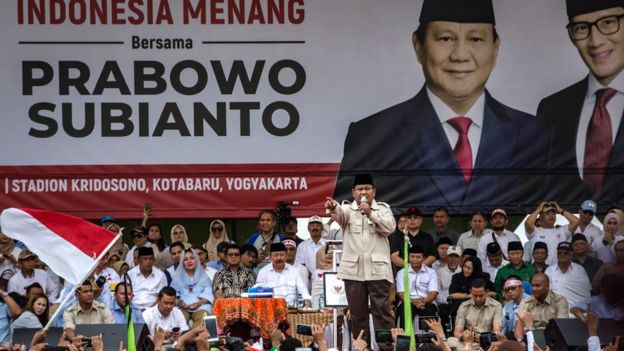 Image copyrightGETTY IMAGES
Mr Prabowo has also suggested that Indonesia could learn from other countries.
“The United States wants to make a wall to keep them out. In Australia people who try to enter are sent to remote islands,” he said during a speech ahead of the campaign.
What does the data show?
China is Indonesia’s third largest source of foreign direct investment behind Singapore and Japan, according to the Indonesian government agency overseeing investment.
These figures show Chinese firms have invested almost $10bn (£7.6bn) in Indonesia since 2014.
Some of these big Chinese-backed projects have run into serious difficulties.
A $6bn project to build high-speed train between Jakarta and the nearest city, Bandung, has been plagued by delays.
In North Sumatra, environmentalists are fighting in the courts to stop a $1.6bn hydroelectric dam supported by the Bank of China that they say threatens to wipe out a critically endangered species of orangutan.
While on the island of Borneo, a Chinese state-owned company is set to build hydropower plants worth almost $18bn.
Indonesia hopes to attract $60bn in investment from China, but it is unlikely to get that much, says Fung Siu, an Asia specialist at the Economist Intelligence Unit.
These Chinese-backed projects often seek to employ Chinese labour as a way to cut costs and increase efficiency.
Where are Indonesia’s foreign workers from?
The most accurate way of measuring the number of registered foreign workers in Indonesia is to look at the number of permits issued.
China receives the most foreign worker permits and the numbers are rising – doubling since 2013.
But the total of just over 30,000 issued in 2018 is substantially less than the millions claimed by some.
 Image copyrightREUTERS
The World Bank estimates that overall, foreign workers made up a fraction, just 0.06%, of Indonesia’s workforce in 2016, significantly less than Singapore, Malaysia and Thailand.
However, there may well be many more Chinese workers in Indonesia than the official tally of work permits suggests, although it’s difficult to know how many.
The Confederation of Indonesian Workers’ Union (KSPI) claims low-skilled Chinese workers are coming in on tourist visas in their hundreds of thousands.
The government also says Indonesian workers benefit from the training they receive from the highly skilled Chinese labour, who eventually return home leaving the local teams to take over.
So, while the available data shows foreign workers from China and elsewhere make up a fraction of the total workforce in Indonesia, the issue remains a divisive and emotional one, easily stirred up during elections.
Source: The BBC

 CHINDIA ALERT: You'll be living in their world, very soon
Coronavirus: Chinese workers in Vietnam cry foul after being fired by Taiwanese firm making shoes for Nike, Adidas
A group of 150 Chinese workers believe the world’s largest maker of trainers used the coronavirus as an excuse to fire them, having helped Taiwanese firm Pou Chen successfully expand its production into Vietnam for more than a decade.
Pou Chen, which makes footwear for the likes of Nike and Adidas, informed the group in late April that they would no longer be needed as they were unable to return to
from their hometowns in China due to the coronavirus lockdowns.
“We 150 employees were the first batch of Chinese employees to be laid off this year. We are all pessimistic and expect more will be cut,” added Zhang.
In its email on April 27, Pou Chen said it was forced to terminate the contracts of the Chinese employees across five of its factories due to an unprecedented decline in orders and financial losses.
The Chinese employees, many of whom have been working for the shoemaker for decades, said the compensation offered was unfair and below the levels required by labour law in both Vietnam and China.
“[The dismissals were] in accordance with the relevant labour laws of the country of employment … and employee labour contracts,” added the statement from Pou Chen, which employs around 350,000 people worldwide.
Company data showed Pou Chen’s first quarter revenues tumbled 22.4 per cent year-on-year to NT$59.46 billion (US$1.99 billion), the weakest in six years.
With the likes of Nike and Adidas closing retail stores around the world to comply with social distancing requirements, analysts also said orders plummeted 50 per cent in the second quarter, although the company declined to comment on the media reports.
Andy Zeng, who had worked for the firm since 1995, said the group were “very upset” when they received the news last month as the impact of the coronavirus pandemic began to reverberate around the world, disrupting global value chains.
“Most of us joined Pou Chen in the 1990s when we were in our late teens or early 20s, when the Taiwan-invested company started investing and setting up factories in mainland China. Now more than two decades have passed,” he said.
Zeng was among the first generation of skilled workers in China as Pou Chen developed rapidly, enjoying the benefits of cheap labour, although the workers themselves were rewarded with regular pay rises.
The company needed a group of skilled Chinese workers to go to its new factories in Vietnam. I said yes because I thought it was a good opportunity to see the outside world – Andy Zeng
What our Chinese employees have done in Vietnam for more than a decade can be said to be very simple but very difficult – Dave Zhang
Posted in 50 per cent, accordance, Adidas, adjustment of manpower, around the world, automation level, below the levels, Bloomberg, boomed, bottlenecks, Chaos, cheaper, China, China’s economy, Chinese employees, Chinese workers, closing, comment, Company, compensation, comply, contributed, cooperated, coronavirus, coronavirus lockdowns, Covid-19 response, cry foul, cultural shock, deaths, decade, decline, declined, dismissals, disputes, Dong Nai, Dongguan, employee labour contracts,, expand, expendable, factories, families, financial losses, fired, footwear, furloughs, higher, hometowns, impact, Indonesia, Labour law, lack of orders, land, Mainland China, making, management experience, management style, media reports, Nike, opportunity, orders, pay cuts, pessimistic, plans, plummeted, Pou Chen, production, production line, relocation process, requirements, retail stores, returns, Reuters, Rush hour, second quarter, set up, shoe manufacturing, shoes, skilled, Social distancing, south china morning post, strain under, streets, strike, Taipei Times, Taiwan, Taiwan-invested, Taiwanese firm, Uncategorized, unfair, unprecedented, Vietnam, Vietnamese, Virus, workers, world’s largest maker of trainers | Leave a Comment »