Chindia Alert: You’ll be Living in their World Very Soon
aims to alert you to the threats and opportunities that China and India present. China and India require serious attention; case of ‘hidden dragon and crouching tiger’.
Without this attention, governments, businesses and, indeed, individuals may find themselves at a great disadvantage sooner rather than later.
The POSTs (front webpages) are mainly 'cuttings' from reliable sources, updated continuously.
The PAGEs (see Tabs, above) attempt to make the information more meaningful by putting some structure to the information we have researched and assembled since 2006.
Image copyright AFP / GETTYImage caption The P4 laboratory (centre) in Wuhan is among a handful around the world cleared to handle viruses that pose a high risk of person-to-person transmission
Chinese state media has accused US Secretary of State Mike Pompeo of lying, after he said there was “enormous evidence” the coronavirus emanated from a laboratory in Wuhan.
Mr Pompeo made the claim on Sunday, without going into specifics.
In an editorial on Tuesday, the hawkish Global Times newspaper said Mr Pompeo was “degenerate”.
The World Health Organization says the US claims are “speculative”, and that it has seen no “specific evidence”.
What did Chinese media say?
Editorials in Chinese state media often given an insight into the direction of government thinking, but there has been no official response to Mr Pompeo’s comments as yet.
“Pompeo aims to kill two birds with one stone by spewing falsehoods,” it said.
“First, he hopes to help Trump win re-election this November…second, Pompeo hates socialist China and, in particular, cannot accept China’s rise.”
Media caption “The Chinese Communist Party has refused to co-operate with world health experts” – Mike Pompeo
The editorial admitted there were “initial problems” in China’s response to the outbreak, but claimed “the overall performance is bright enough to outweigh the flaws”.
It also said it was “conceivable that the virus first contacted humans in other places [than Wuhan]”.
The Global Times is not the only Chinese outlet to take aim at Mr Pompeo and the US.
The People’s Daily said Mr Pompeo had “no evidence”, while a piece on the CCTV site accused US politicians of “nefarious plotting”.
What did Mike Pompeo say?
In an interview with ABC on Sunday, Mr Pompeo said there was “enormous evidence” that the virus had emerged from the Wuhan Institute of Virology.
“Remember, China has a history of infecting the world, and they have a history of running sub-standard laboratories,” he said.
Mr Pompeo – a former director of the Central Intelligence Agency (CIA) – said he did not think the virus was man-made or genetically modified.
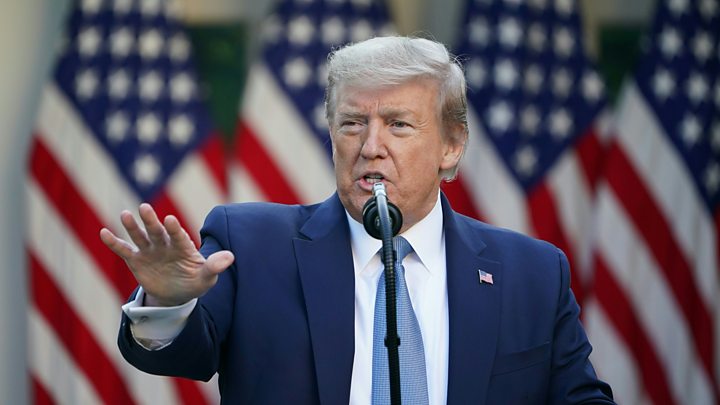
The Wuhan laboratory is known to study coronaviruses in bats. In April, President Trump was asked whether “lax safety protocols” allowed such a virus to escape via an intern and her boyfriend.
Mr Trump did not confirm the theory, but said: “More and more we’re hearing the story.”
Media caption Donald Trump was recently asked if the virus emanated in a laboratory, rather than a market
Last week, he was asked if he had seen evidence that gave him a “high degree of confidence” that the virus emerged in the Wuhan laboratory.
“Yes I have,” he replied – but said he could not go into specifics.
On Monday, World Health Organization emergencies director Michael Ryan said it had received “no data or specific evidence” from the US about the virus origins.
“So from our perspective, this remains speculative,” he said.
Last week, the US intelligence community said it “concurred” that the virus “was not man-made or genetically modified”.
But it said it would “continue to examine” whether the outbreak began via “contract with infected animals, or if it was the result of an an accident at a laboratory in Wuhan”.
Australian Prime Minister Scott Morrison said on Tuesday that the most likely source of the virus was a wildlife market. However he said he would not rule out the theory that it originated in a lab.
“What’s really important is that we have a proper review, an independent review which looks into the sources of these things in a transparent way so we can learn the lessons,” he told reporters.
Meanwhile, Western “intelligence sources” have told several news outlets there is “no evidence” to suggest the virus leaked from a laboratory.
People work at a construction site of a utility tunnel in Wuhan, central China’s Hubei Province, April 30, 2020. (Xinhua/Xiao Yijiu)
BEIJING, May 1 (Xinhua) — China is getting the world’s largest workforce back to work as the nationwide battle against COVID-19 has secured major strategic achievements.
The unprecedented fight has nurtured new trends in the workplace. For example, more attention is being paid to public health and e-commerce to boost consumption and emerging sectors brought by new applications based on the country’s rapid new infrastructure development of 5G networks and data centers.
In this aerial photo taken on April 29, 2020, representatives of frontline health workers fighting COVID-19 attend a bell-ringing ceremony at the Yellow Crane Tower, or Huanghelou, a landmark in Wuhan, central China’s Hubei Province. (Xinhua/Xiao Yijiu)
ANGELS OF PUBLIC HEALTH
Ye Man, head nurse of gastrointestinal department of Hubei General Hospital East District, one of the five remaining COVID-19 designated hospitals in Wuhan, is taking her first weeklong vacation since January.
The 34-year-old mother of two started to take a week off on Monday, one day after her hospital cleared all remaining confirmed COVID-19 patients. The nine ICU wards in her hospital had been kept occupied over the past several months.
Friday marked International Workers’ Day, and the start of China’s five-day public holiday. Ye said she planned to visit urban parks with her family during the holiday.
At her busiest point, she and her colleagues took care of a ward filled with 40 COVID-19 patients.
“It was a really tough time,” she recalled. She had to wear a protective gown and a mask for nine hours a day and be separated from her family to avoid possible cross-infections.
Wuhan, capital of central China’s Hubei Province and once hard hit by COVID-19, cleared all confirmed cases in hospitals on April 26. Over 42,000 medical workers mobilized nationwide to aid Hubei have contributed to achieving a decisive outcome in the fight to defend Hubei and Wuhan.
In an inspection tour to Wuhan on March 10, President Xi Jinping, also general secretary of the Communist Party of China Central Committee and chairman of the Central Military Commission, lauded medical workers as “the most beautiful angels” and “messengers of light and hope.”
To reward brave and dedicated medics, major tourist sites in Hubei are offering free entry to medical staff over the following two years.
Chinese President Xi Jinping, also general secretary of the Communist Party of China Central Committee and chairman of the Central Military Commission, learns about development of the black fungus industry in Jinmi Village of Xiaoling Township in Zhashui County, Shangluo City, northwest China’s Shaanxi Province, April 20, 2020. (Xinhua/Xie Huanchi)
LIVESTREAMING ANCHORS
“We have a new batch of supplies today. Those who did not get the goods should hurry to buy now,” said Li Xuying, a livestreaming anchorwoman selling agaric mushrooms in Zhashui, a small county deep in the Qinling Mountains in northwest China’s Shaanxi Province.
Li has been prepared for a boom of online shopping in the holiday, because online buyers rushed to her livestreaming website to place orders, after Xi inspected the county and chatted with her in the village of Jinmi during a recent tour to Shaanxi.
“I used to sell goods worth about 50,000 yuan (7,070 U.S. dollars) on average after a six-hour livestreaming session. Now the sales are 10 times that,” she said.
Li was one of the 10 sales staff sent by the local agricultural e-commerce firm to Chinese e-commerce platform Taobao’s headquarters for livestreaming training. She said livestreaming is effective in bridging buyers and farmers, through which viewers can watch planting and harvesting online.
With the number of netizens in China reaching 904 million in March, e-commerce has been one of the popular means of promoting the sale of farm produce and helping farmers shake off poverty. Despite the impact of COVID-19, the country is determined to eradicate absolute poverty by the end of this year.
Workers work at the construction site of a 5G base station at Chongqing Hi-tech Zone in Chongqing, southwest China, April 15, 2020. (Xinhua/Wang Quanchao)
HI-TECH WORKERS IN “NEW INFRASTRUCTURE” BUILDING
As an elasticity calculation engineer of Alibaba Cloud, Zhao Kun and his colleagues always stay on alert for high data flow, for example, brought by the anticipated online shopping spike during the holiday.
“The profession, which may sound obscure, is actually closely connected to everyone’s life, as cloud computing is the infrastructure supporting high-tech applications of artificial intelligence and blockchain,” said Zhao.
The Chinese leadership has underscored expediting “new infrastructure” development to boost industrial and consumption upgrading and catalyze new growth drivers.
Seizing the opportunities of industrial digitization and digital industrialization, China needs to expedite the construction of “new infrastructure” projects such as 5G networks and data centers, and deploy strategic emerging sectors and industries of the future including the digital economy, life health services and new materials, President Xi has said.
During the epidemic, Zhao and his colleagues expanded more than 100,000 cloud servers to ensure the stable operation of “cloud classrooms” and “cloud offices” for millions of people working and studying from home.
In the “new infrastructure” building, people like Zhao contribute to constructing the virtual infrastructure of an ecosystem, which enables e-commerce, e-payment, online teaching and the digital transformation of manufacturing and supply chain management.
In early April, China released a plan on promoting the transformation of enterprises toward digitalization and intelligence by further expanding the application of cloud and data technologies, to nurture new business models of the digital economy.


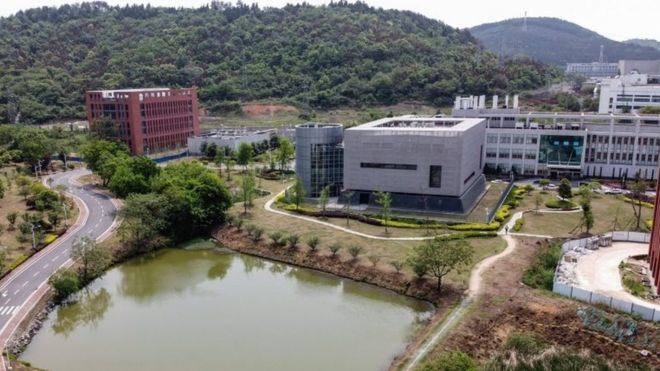 Image copyright AFP / GETTY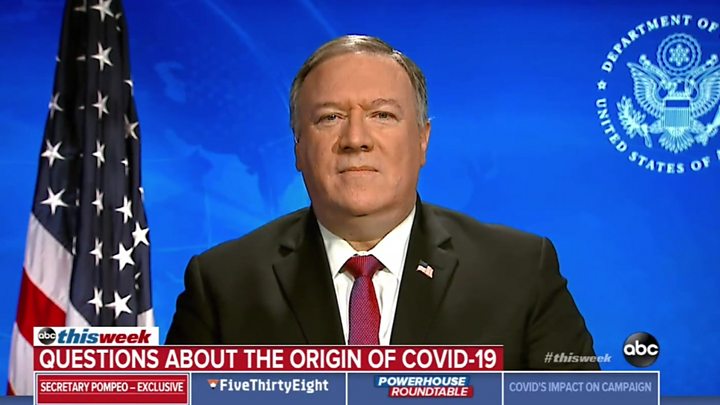


 CHINDIA ALERT: You'll be living in their world, very soon