Chindia Alert: You’ll be Living in their World Very Soon
aims to alert you to the threats and opportunities that China and India present. China and India require serious attention; case of ‘hidden dragon and crouching tiger’.
Without this attention, governments, businesses and, indeed, individuals may find themselves at a great disadvantage sooner rather than later.
The POSTs (front webpages) are mainly 'cuttings' from reliable sources, updated continuously.
The PAGEs (see Tabs, above) attempt to make the information more meaningful by putting some structure to the information we have researched and assembled since 2006.
BEIJING, May 31 (Xinhua) — The U.S. government has been slammed at home and abroad after announcing on Friday “terminating” its relationship with the World Health Organization (WHO).
U.S. health experts and lawmakers have expressed concern over the decision announced by President Donald Trump amid the COVID-19 outbreak.
Patrice Harris, president of the American Medical Association, described Trump’s move as a “senseless” action with “significant, harmful repercussions.”
“COVID-19 affects us all and does not respect borders; defeating it requires the entire world working together,” Harris was quoted by CNN as saying, urging Trump to reverse the course.
Lawrence Gostin, a professor of global health law and director of the O’Neill Institute for National and Global Health Law at Georgetown University, described the move as “foolish and arrogant” in his Twitter account.
“Trump’s action is an enormous disruption and distraction during an unprecedented health crisis,” said Gostin, also the director of the WHO collaborating center on national and global health law. “The President has made us less safe.”
Democratic Senator Joe Manchin of West Virginia said that “the United States cannot eliminate this virus on its own and to withdraw from the World Health Organization — the world’s leading public health body — is nothing short of reckless,” according to a CNN report.
Even within the Republican party, some Republicans also expressed their disagreement. Senate Health Committee Chairman Lamar Alexander reportedly said he disagreed with Trump’s decision, because, without U.S. funding, clinical trials to develop a COVID-19 vaccine might be hampered.
In addition, the European Union (EU) has urged the United States to reconsider its termination of ties with the WHO, warning that Trump’s move would erode global efforts to curb the spread of the virus.
“The WHO needs to continue being able to lead the international response to pandemics, current and future. For this, the participation and support of all is required and very much needed. In the face of this global threat, now is the time for enhanced cooperation and common solutions. Actions that weaken international results must be avoided,” Ursula von der Leyen, president of the European Commission, and Josep Borrell, the EU High Representative for Foreign Affairs and Security Policy, said in the statement on Saturday.
“In this context, we urge the U.S. to reconsider its announced decision,” the statement said.
German Health Minister Jens Spahn tweeted that Trump’s move was “a disappointing backlash for International Health.”
“The EU must take a leading role and engage more financially,” Spahn said, noting that this would be one of Germany’s priorities when it becomes the bloc’s rotating presidency on July 1.
British Prime Minister Boris Johnson’s spokesperson said earlier that Britain “has no plans to stop funding the WHO, which has an important role to play in leading the global health response.”
“Coronavirus is a global challenge and it is essential that countries work together to tackle this shared threat,” the spokesperson was quoted by The Guardian as saying.
Irish Minister for Health Simon Harris on Friday described Trump’s move as an “awful decision.”
“A global pandemic requires the world working together … We should unite in our fight against it (COVID-19) & not fight each other,” Harris tweeted.
Russian Foreign Ministry spokesperson Maria Zakharova told TASS news agency that Washington “dealt a blow” to the international framework for cooperation in healthcare at the moment when the world needed to join forces.
SEOUL (Reuters) – South Korean and Chinese officials on Tuesday cast doubt on reports North Korean leader Kim Jong Un was ill after media outlets said he had undergone a cardiovascular procedure and was in “grave danger”.
Daily NK, a Seoul-based speciality website, reported late on Monday, citing one unnamed source in North Korea, that Kim was recovering after undergoing the procedure on April 12. The North Korean leader is believed to be about 36.
CNN cited a U.S. official with direct knowledge of the matter as saying Washington was “monitoring intelligence” that Kim was in grave danger after surgery. Bloomberg quoted an unnamed U.S. official as saying the White House was told that Kim took a turn for the worse after the surgery.
However, two South Korean government officials rejected the CNN report without elaborating on whether Kim had undergone surgery. The presidential Blue House said there were no unusual signs coming from the reclusive, nuclear-capable state.
Kim is the unquestioned leader of North Korea and the sole commander of its nuclear arsenal. He has no clear successor and any instability in the country could be a major international risk.
RELATED COVERAGE
Factbox: Questions hang over North Korea succession amid reports on Kim health
The state KCNA news agency gave no indication of the whereabouts of Kim in routine dispatches on Tuesday, but said he had sent birthday gifts to prominent citizens.
An official at the Chinese Communist Party’s International Liaison Department, which deals with North Korea, told Reuters the source did not believe Kim was critically ill. China is North Korea’s only major ally.
Chinese foreign ministry spokesman Geng Shuang said Beijing was aware of reports about the health of Kim, but said it does not know their source, without commenting on whether it has any information about the situation.
South Korean shares exposed to North Korea tumbled and the Korean won fell on the reports. The won traded down more than 1% against the dollar even as South Korean government sources said Kim was not gravely ill.
U.S. stock futures were trading 0.5% lower, but it was not clear how much of that weakness was owing to the collapse in U.S. oil prices and consequent concerns over global demand.
Daily NK said Kim had been admitted to hospital on April 12, just hours before the cardiovascular procedure, as his health had deteriorated since August due to heavy smoking, obesity and overwork.
It said he was now receiving treatment at a villa in the Mount Myohyang resort north of the capital Pyongyang.
“My understanding is that he had been struggling (with cardiovascular problems) since last August but it worsened after repeated visits to Mount Paektu,” a source was quoted as saying, referring to the country’s sacred mountain.
Accompanied by senior North Korean figures, Kim took two well-publicised rides on a stallion on the snowy slopes of the mountain in October and December.
KIM’S HEALTH KEY TO STABILITY
An authoritative U.S. source familiar with internal U.S. government reporting on North Korea questioned the CNN report that Kim was in “grave danger”.
“Any credible direct reporting having to do with Kim would be highly compartmented intelligence and unlikely to leak to the media,” a Korea specialist working for the U.S. government said on condition of anonymity.
Japan’s top government spokesman, Yoshihide Suga, declined to comment on the reports of Kim’s health.
“We are regularly gathering and analysing information about North Korea with great concern,” he said. “We will keep gathering and analysing information regarding North Korea by collaborating with other countries such as the U.S.”
Kim’s potential health issues could fuel uncertainty over the future of the reclusive state’s dynastic rule and stalled denuclearisation talks with the United States, issues in which Kim wields absolute authority.
With no details known about his young children, analysts say his sister and loyalists could form a regency until a successor is old enough to take over.
Speculation about Kim’s health first arose following his absence from the anniversary of the birthday of its founding father and Kim’s grandfather, Kim Il Sung, on April 15.
On April 12, North Korean state media reported that Kim Jong Un had visited an airbase and observed drills by fighter jets and attack aircraft.
Two days later North Korea launched multiple short-range anti-ship cruise missiles into the sea and Sukhoi jets fired air-to-surface missiles as part of military exercises.
The missile launches were part of the celebrations for Kim’s grandfather, Seoul officials said, but there was no North Korea state media report on his attendance or the tests.
Reporting from inside North Korea is notoriously difficult, especially on matters concerning the country’s leadership, given tight controls on information. There have been false and conflicting reports in the past on matters related to its leaders.
Kim is a third-generation hereditary leader who rules North Korea with an iron-fist, taking over the titles of head of state and commander in chief of the military since late 2011.
In recent years Kim has launched a diplomatic offensive to promote both himself as a world leader and his hermit kingdom, holding three meetings with U.S. President Donald Trump, four with South Korean President Moon Jae-in and five with China’s President Xi Jinping.
He was the first North Korean leader to cross the border into South Korea to meet Moon in 2018. Both Koreas are technically still at war, as the Korean War of 1950-53 ended in an armistice, not a peace treaty.
Kim has sought to have international sanctions against his country eased, but has refused to dismantle his nuclear weapons programme, a steadfast demand by the United States.
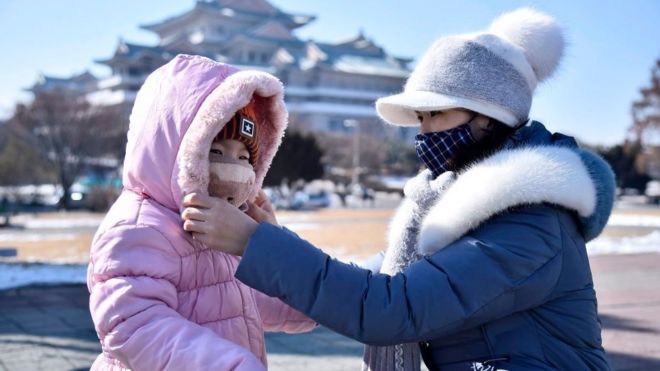
Image copyright GETTY IMAGESImage caption North Korea says not a single person has the virus
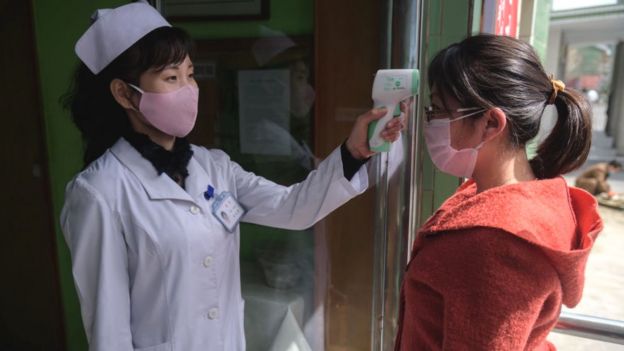
North Korea’s claim that “not a single person” in the country has been infected with the coronavirus is facing growing scepticism.
It has credited strict containment measures and the shutting down of its borders for this success.
But the top US military commander in South Korea has said this is “untrue”, calling it an “impossible claim”.
A North Korean expert told the BBC it was likely there were cases but unlikely a mass outbreak had happened.
There are currently more than one million coronavirus cases across the world and 53,069 deaths, according to a Johns Hopkins University tally.
Pak Myong-su, a director at North Korea’s Central Emergency Anti-epidemic headquarters, told news agency AFP on Friday: “Not one single person has been infected with the novel coronavirus in our country so far.”
“We have carried out pre-emptive and scientific measures such as inspections and quarantine for all personnel entering our country and thoroughly disinfecting all goods, as well as closing borders and blocking sea and air lanes.”
Could this be true?
US General Robert Abrams, head of the US military forces in South Korea, has said it is untrue that North Korea has no virus cases.
“I can tell you that is an impossible claim based on all of the intel that we have seen,” he said in a joint interview with news sites CNN and VOA.
However, he said he could not say exactly how many cases there were, not confirm where the information came from.
Oliver Hotham, managing editor of specialist news site NK News, agreed that North Korea has probably had cases.
“It’s very unlikely that it has seen no cases because it borders China and South Korea. [Especially with China], given the amount of cross border trade and the economic relationship I really don’t see how its possible they could have prevented it,” he said.
However, he adds that it is “unlikely” there is a full scale outbreak.
“They really did take precautions early. I think it’s possible they’ve prevented a full on outbreak.”
How has North Korea reacted to the crisis?
North Korea has indeed moved much more quickly against the virus than many other countries in the region.
In late January, it sealed off its borders and later quarantined hundreds of foreigners in the capital Pyongyang. During that time, the number of cases in China were growing exponentially.
An NK News report also suggests that up to 10,000 citizens had been placed under isolation in the country – around 500 still remain in quarantine.
Are those in North Korea even aware of the virus?
Most people in North Korea are “really aware” of what’s going on, says Mr Hotham.
“There’s been so much media coverage. Almost every day you have a whole page about the efforts the country is taking domestically and also the international situation,” he told the BBC.
Fyodor Tertitskiy, a senior researcher at Kookmin University, also adds the country is currently running an “ongoing propaganda campaign teaching people how to prevent the spread of the virus”.
The answer is, according to experts – better than you would think – depending on where in North Korea you are.
Mr Tertitsky says the North’s healthcare system is “much, much better than other countries with a similar GDP per capita”.
“What they did was to train a large number of doctors who, although less qualified and infinitely paid less than their colleagues in the West, can still provide basic healthcare to the population,” he told the BBC.
Mr Hotham agrees, but says that the number of doctors in North Korea enables the country to deal with basic illnesses, but perhaps not so much more serious illnesses which also need more healthcare equipment.
Sanctions have also restricted North Korea’s ability to obtain advanced medical equipment.
Mr Hotham adds that the care you receive largely depends on where you are. The capital, Pyongyang, for example, has various medical facilities, but those in rural areas might not be so lucky.
“Some provinces are desperately underfunded, where you’ll have hospitals with no running water or stable power.”
Image copyright GETTY IMAGESImage caption Some international experts say North Korea’s health system is appalling
Why might North Korea be trying to cover up cases?
For North Korea to admit they have cases now could be a sign of “defeat”.
“The state has put a lot of stock into its response and there has been so much propaganda about how well they’re doing,” said Mr Hotham.
“I think for them to admit now that there were cases is essentially to admit defeat. I think it would also cause panic and people would freak out. If you have large movements of people trying to get away, that could create instability and even more infections.”
Mr Tertitskiy also puts this down to North Korea trying to preserve its self-image.
“The country is very paranoid about giving away any information that may make it look bad. Their basic rule is to say nothing unless there is a good reason to do otherwise.”
It was close to midnight and Vlada, a Serbian engineer, was speeding towards his apartment in Belgrade. He had taken his 20-year-old son out that evening but bombs had started to fall across the Yugoslav capital. The power grid was down and he wanted to get home.
Nato, the world’s most powerful military alliance, had been pummelling Yugoslavia from the skies since late March to try to bring a halt to atrocities committed by President Slobodan Milosevic’s forces against ethnic Albanians in the province of Kosovo. It was now 7 May 1999 and the US-dominated air campaign was only growing more intense.
Vlada’s family had spent many nights in recent weeks huddled with others in the basement of their apartment building as air raid sirens blared outside, praying that an errant missile wouldn’t strike their homes.
They were lucky, some thought, to live just next to the Chinese embassy – an important diplomatic mission. Being there would surely protect them.
But as Vlada and his son approached the glass doors of their building in the dark, US B-2 stealth warplanes were in the skies above Belgrade. They were locked-on to the precise co-ordinates of a target selected and cleared by the CIA. All Vlada heard at first was the whoosh of an incoming missile. There was no time to move. The doors shattered, spraying glass at them.
“The force of the first bomb lifted us off the ground and we fell… Then one after the other [more bombs landed] – bam, bam, bam. All the shutters on the block were ripped off by the blast, it broke all the windows.”
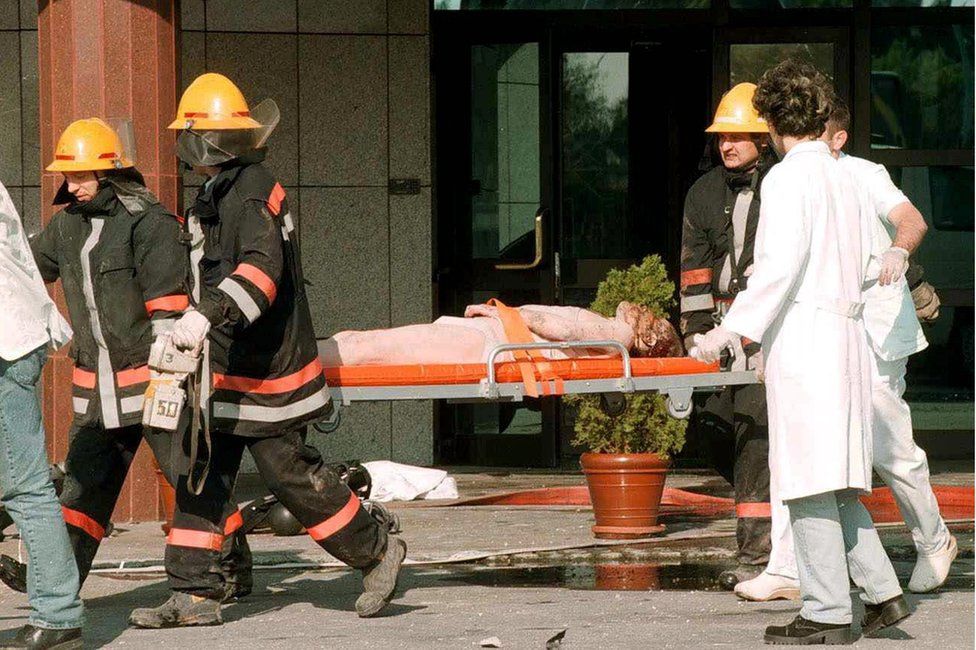
They were terrified but uninjured. All five bombs had hit the embassy, 100 metres away.
The US and Nato were already facing scrutiny over mounting civilian casualties in a bombing campaign conducted without UN authorisation and fiercely opposed by China and Russia. They had now attacked a symbol of Chinese sovereignty in the heart of the Balkans.
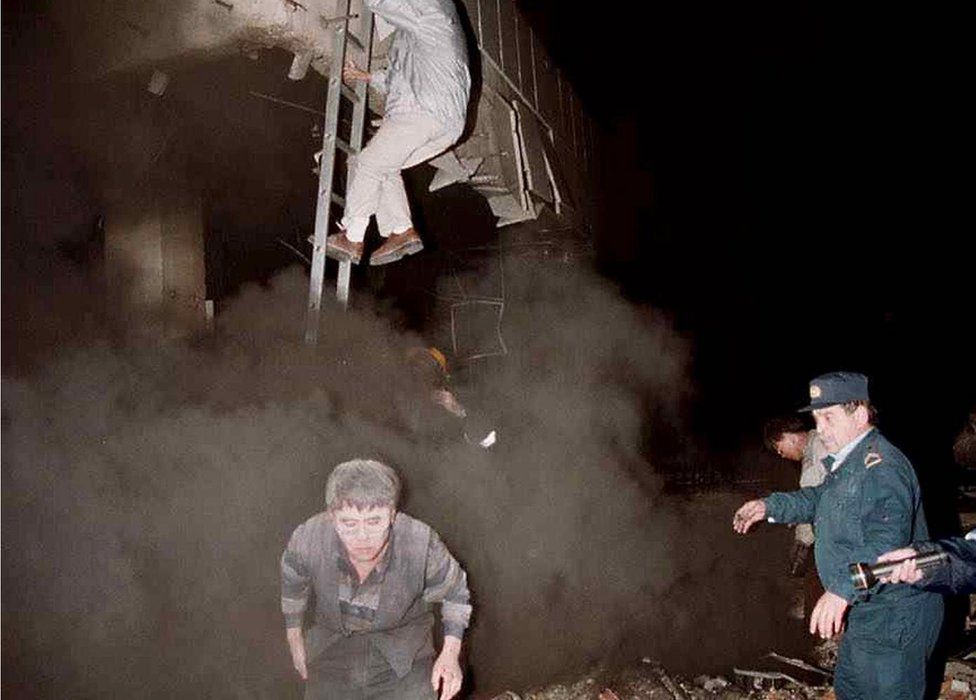
Image copyright SASA STANKOVIC/EPA/REX/SHUTTERSTOCKImage caption Embassy workers escaped through windows after the strikesAcross town, Shen Hong, a well-connected Chinese businessman, was getting word that the embassy had been hit. He refused to believe it. Just a few days earlier, his father had phoned from Shanghai and joked that his son should park his new Mercedes at the diplomatic compound to keep it safe.
“I called a policeman who I knew and he said, ‘Yes, Shen, it’s really hit’. He said come right away, so then I knew it was real, it was true.”
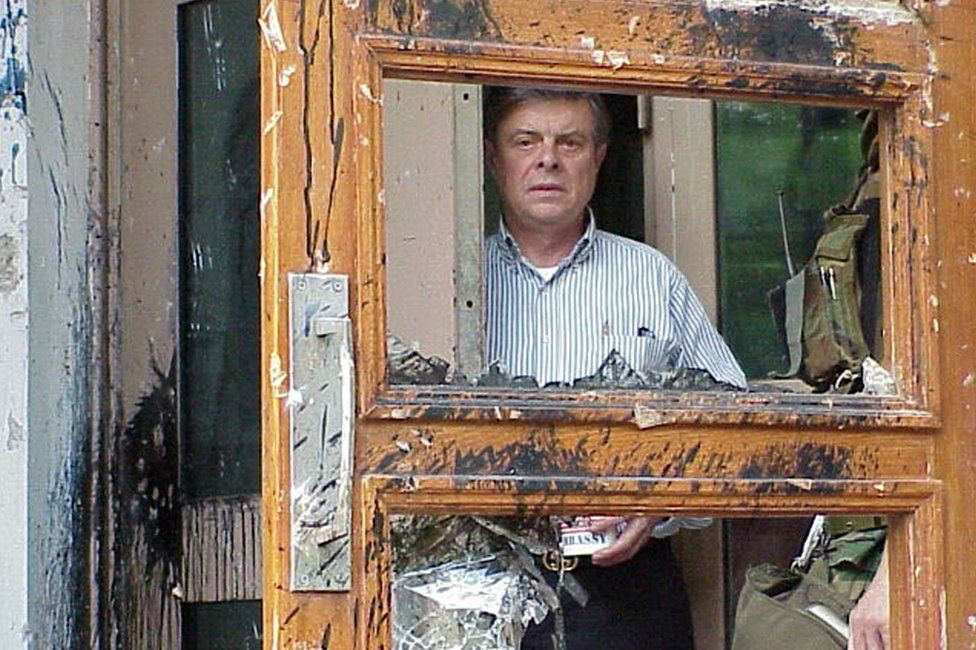
He arrived to a scene of chaos. The embassy was burning; workers covered in blood and dust were climbing out of windows to escape. Politicians close to Milosevic – who had been charged two weeks earlier with crimes against humanity by an international tribunal – were already arriving to denounce the bombing as the latest example of Nato barbarity.
“We could not go inside. There was a lot of smoke, there wasn’t any electricity and we couldn’t see anything. It was horrible,” said Shen.
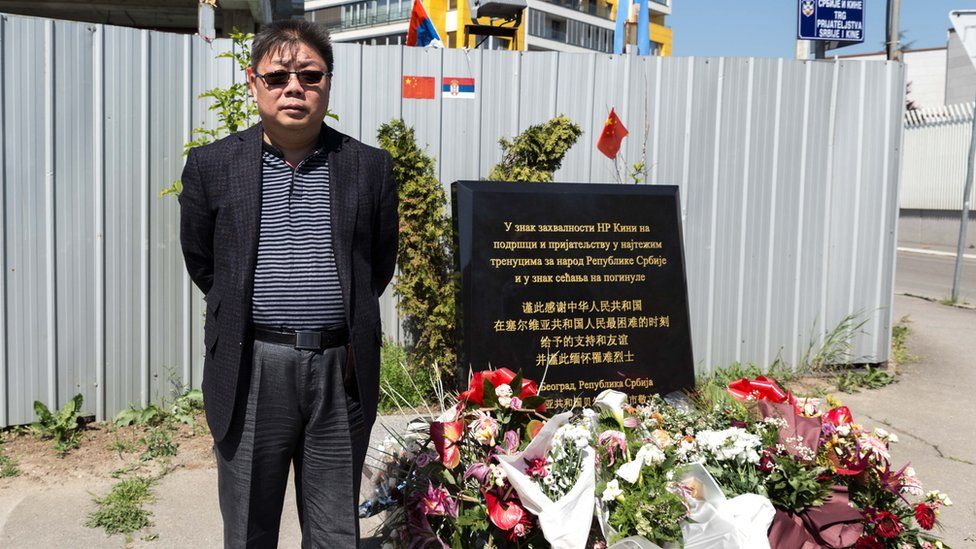
Image copyright LAZARA MARINKOVICImage caption Shen Hong lost close friends in the bombingHe spotted the cultural attaché, a man he knew, who had knotted together curtains to get out of a first-floor window. “We didn’t see that he was injured and he didn’t notice it either. It was only when I shook his hand that I realised my hands were covered in blood. I told him ‘you’re injured, you’re injured!’ – but when he saw this he passed out.”
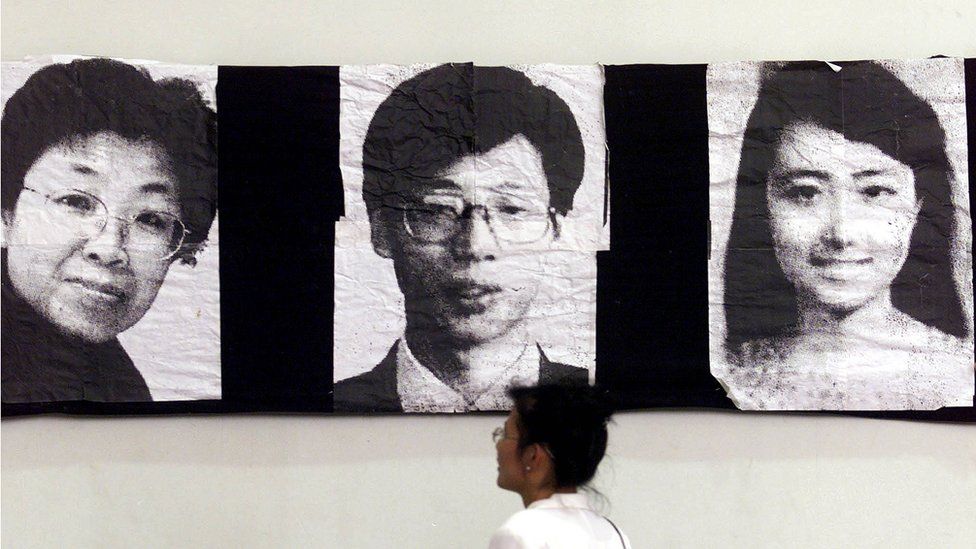
The next day Shen would learn that two close friends – newlywed journalists Xu Xinghu, 31, and Zhu Ying, 27 – had been killed by a bomb that hit the sleeping quarters of the embassy. Their bodies were found under a collapsed wall.
The pair had worked for the Guangming (Enlightenment) Daily – a communist party newspaper. Xu, a language graduate who spoke fluent Serbian, had chronicled life in Belgrade during the bombings in a series of special reports called “Living Under Gunfire”.
Image copyright DRASKO GAGOVIC/EPA
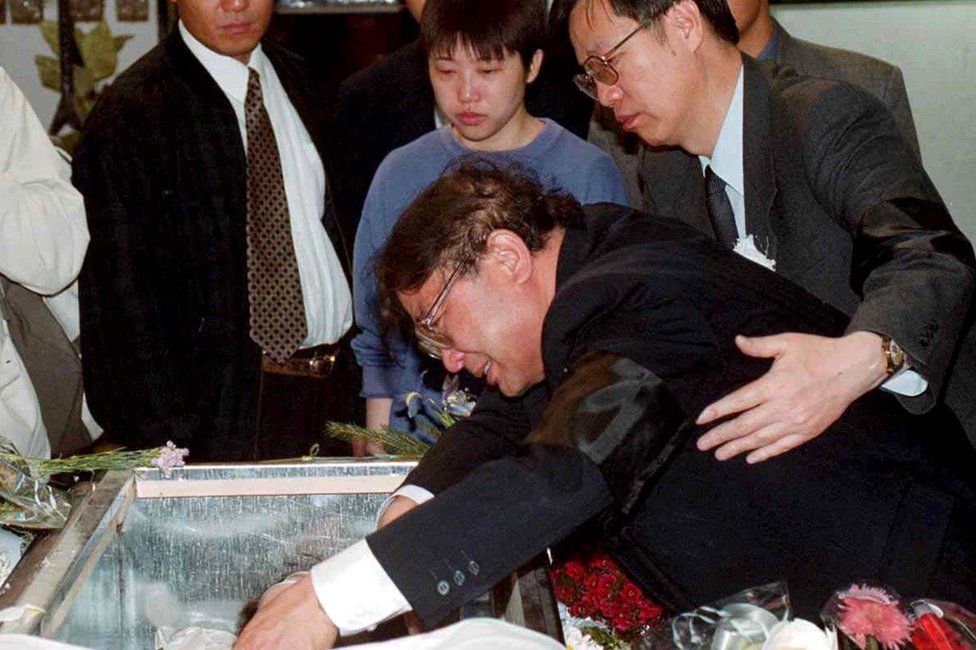
Zhu Ying worked as an art editor in the paper’s advertising department. Her mother collapsed with grief and was sent to hospital when she learned of her daughter’s death so Zhu’s father travelled alone to Belgrade to see the body.
A third journalist, 48-year-old Shao Yunhuan, of the Xinhua news agency, also died. Her husband, Cao Rongfei, was blinded. The embassy’s military attaché, who is believed to have run an intelligence cell from the building, was sent back to China in a coma. In total, three people were killed and at least 20 injured.
For Shen, this was an act of war. The next day he led a protest through the streets of Belgrade carrying a sign reading “NATO: Nazi American Terrorist Organisation”
It was a sign of what was to come.
Image copyright REUTERSImage caption Three journalists were killed in the embassy
Within hours of the bombing, two competing narratives began to emerge. They would harden over the coming months and form the basis of how the incident – which continues to linger over the US-China relationship – remains debated today.
The bombing fuelled speculation, and there was no shortage of unanswered questions and missing pieces that were put together by some to imply a grand conspiracy. Intrigue continued to hang over the incident and, months afterwards, two respected European newspapers suggested the strikes were by design.
But, as former Nato officials point out, in 20 years no clear evidence has come to light proving what almost all of China believes and America strenuously denies: that it was deliberate.
In those first hours after the bombs fell, the US and Nato wasted no time to announce that it was an accident. China’s representative at the UN, meanwhile, denounced a “crime of war” and a “barbarian act”.
In Brussels, Jamie Shea – the British Nato spokesman who became the public face of the war – was woken up in the middle of the night and told he would have to face the world’s press in the morning. The information available in those early hours was thin but he would give one of the first explanations of what had happened, along with an apology. The warplanes, he said from the briefing podium, had “struck the wrong building”.
“It’s like a train accident or a car crash – you know what has happened but what you don’t know is why it has happened,” he says 20 years later. “That took a lot longer to establish… But it was clear right from the get-go, that targeting a foreign embassy was not part of the Nato plan.”
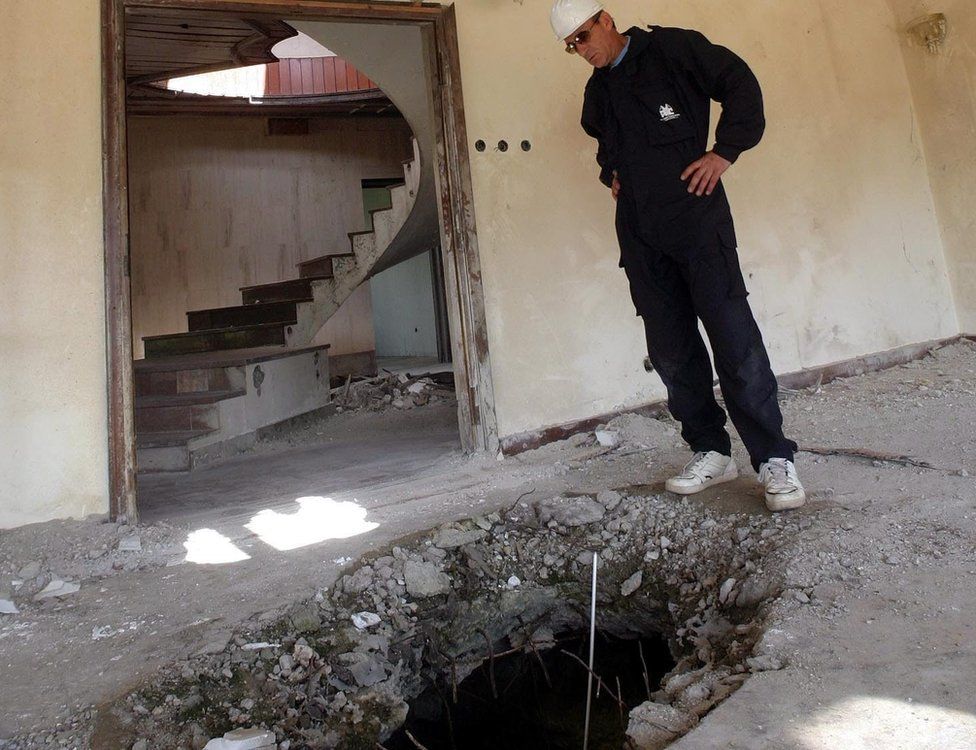
Image copyright BORIS SUBASIC/EPAImage caption The father of Zhu Ying weeps over her coffin in BelgradeIt would take more than a month for the US to give Beijing a full explanation: that a series of basic errors had led to five GPS-guided bombs striking China’s embassy – including one that hurtled through the roof of the ambassador’s residence next to the main building but didn’t explode, likely sparing his life.
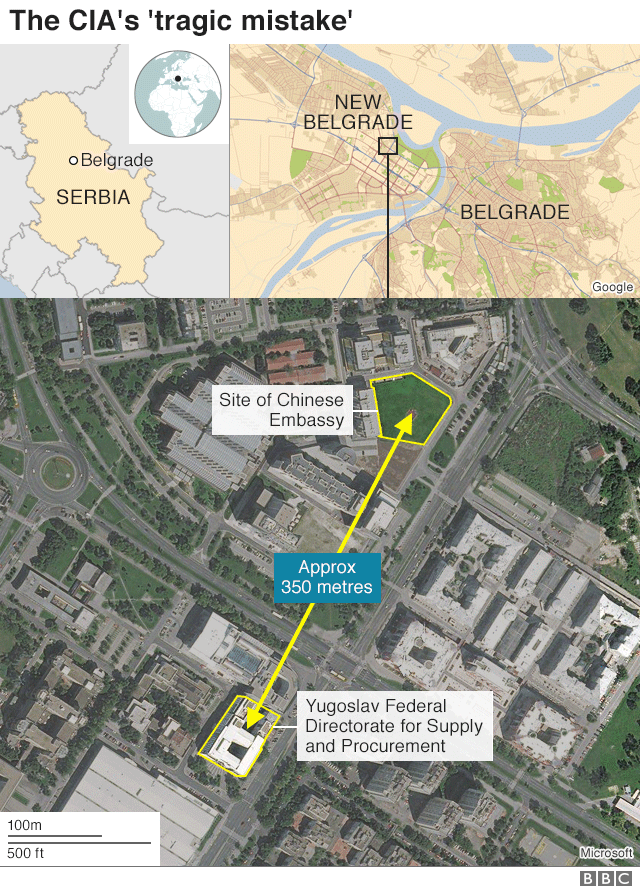
The real target, officials said, was the headquarters of the Yugoslav Federal Directorate for Supply and Procurement (FDSP) – a state agency that imported and exported defence equipment. The grey office building is still there today – hundreds of metres down the road from the embassy site.
Nato had initially hoped the bombing campaign would only last a few days until Milosevic gave up, pulled his forces out of Kosovo and allowed peacekeepers in. But by the time the embassy was hit it had stretched to more than six weeks. In the rush to find hundreds of new targets to sustain the aerial assault, the CIA, which was not normally involved in target-picking, had decided the FDSP should be struck.
But America’s premier intelligence agency said it had used a bad map.
“In simple terms, one of our planes attacked the wrong target because the bombing instructions were based on an outdated map,” US defence secretary William Cohen said two days after the bombing. He was referring to a US government map that apparently did not show the correct location of the Chinese embassy nor the FDSP.
All US intelligence officers had was an address for the FDSP – 2 Bulevar Umetnosti – and a basic military navigation technique was used to approximate its co-ordinates. The technique used was so imprecise, CIA chief George Tenet later said, that it should never have been used to pick out a target for aerial bombing.
To compound the initial error, Tenet said, intelligence and military databases used to cross-check targets did not have the embassy’s new location listed, despite the fact that many US diplomats had actually been inside the building.
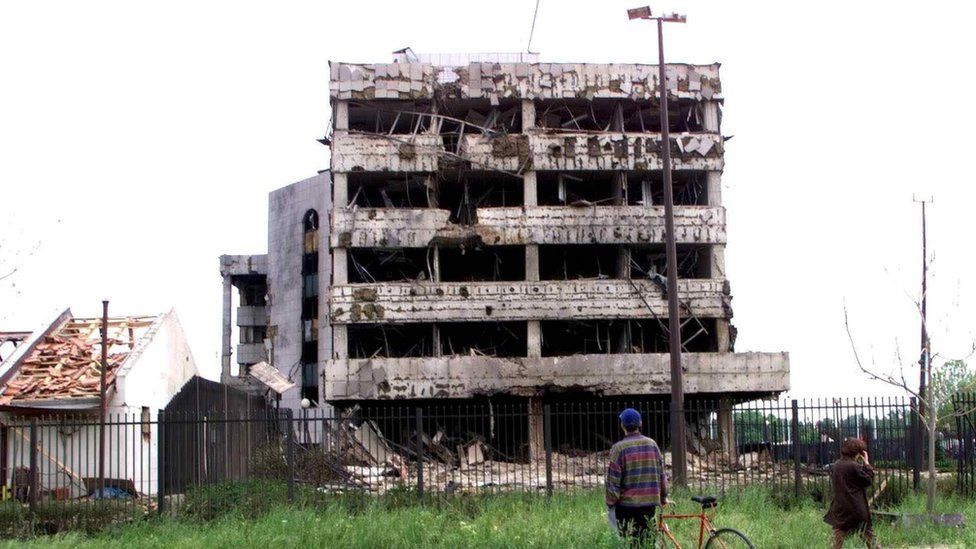
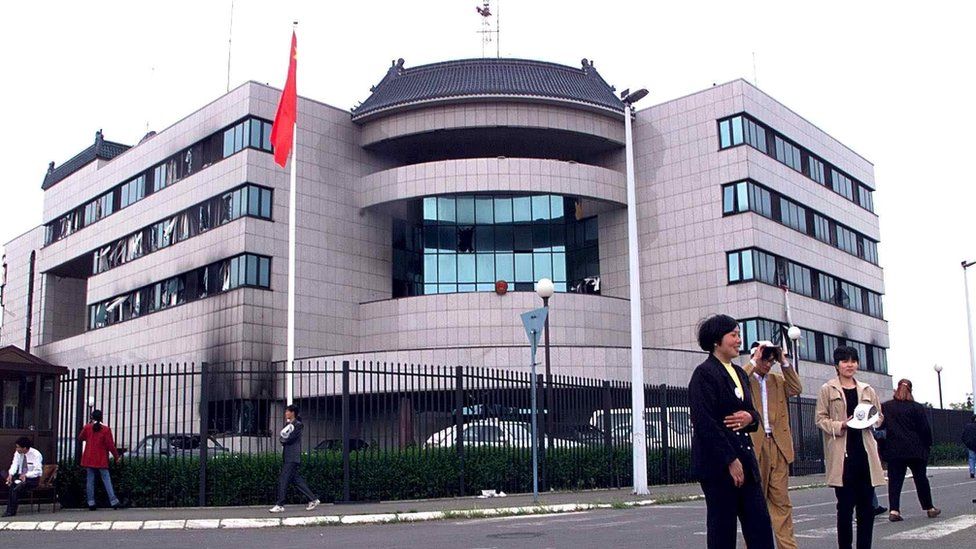
Had anyone on the ground visited the site to be bombed they would have found a gated compound, a five-storey building with a green-tiled oriental sloped roof, a bronze plaque announcing the embassy’s presence and a large, bright red Chinese flag fluttering more than 10 metres in the air.
Image copyright SASA STANKOVIC/EPA/REX/SHUTTERSTOCKImage caption The front of the embassy was largely undamagedThe crux of the CIA’s explanation was hard for many to believe: the world’s most advanced military had bombed a fellow UN Security Council member and one of the most vocal opponents of the Nato air campaign because of a mapping error. China was having none of it. The story, it said, was “not convincing”.
“The Chinese government and people cannot accept the conclusion that the bombing was a mistake,” the foreign minister told a US envoy sent to Beijing in June 1999 to explain what had happened.
But why would the US intentionally attack China?
It wasn’t long after the Sun rose on the morning of Saturday, 8 May 1999, that David Rank, a US diplomat, got out of bed in Beijing.
He turned on the television and switched to CNN. The American news network was carrying live pictures of the smouldering Chinese embassy in pitch-dark Belgrade.
By that afternoon, thousands of irate Chinese protesters would be gathered outside. But Rank, at that stage, was fairly calm. He rang his boss, the head of the political section: “I said, you know, Jim, this is the damndest thing.”
The diplomat rushed from his residence to the embassy down the road, where US officials were trying to figure out what had happened. Something had clearly gone wrong but this must have been, had to have been, a tragic mistake.
“It was so patently obvious that it was a sort of fog of war accident… At that point I didn’t think that down the road this was going to be a major problem. Obviously, it was a major problem, but not the sort of convulsive incident that it turned out to be,” said Rank.
But in the next hours, the shape of how the Chinese government and people would respond started to become clear.
Image copyright PETER ROGERS/GETTY IMAGESRank began receiving calls from liberal Chinese friends who were outraged at the bombing. American journalists got similar calls from Chinese contacts with pro-US views, expressing shock and a sense of betrayal.
Chinese state media was already laying out a clear narrative – the US had breached international law by bombing a Chinese diplomatic outpost. “The language that I heard from lots and lots of Chinese, it was identical. It was the same almost word-for-word lines of real anger,” said Rank.
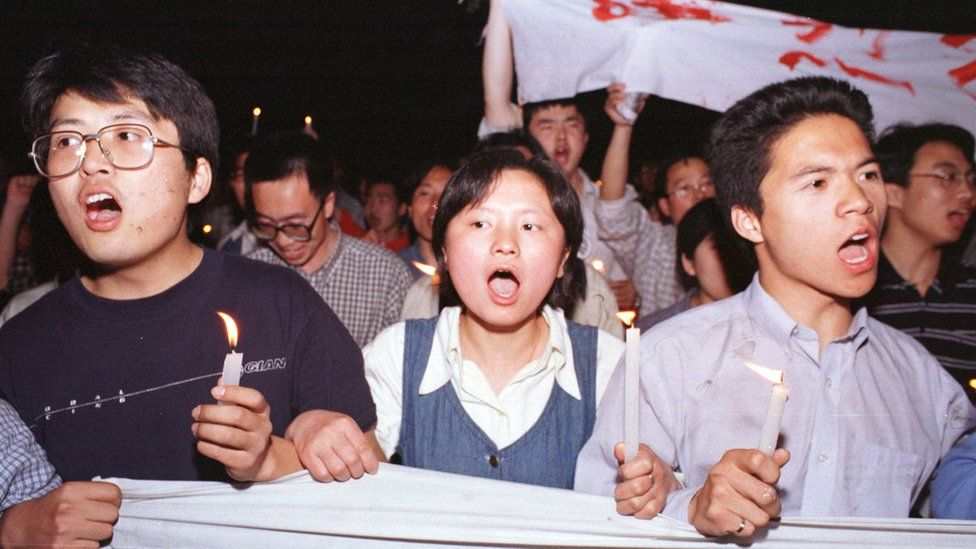
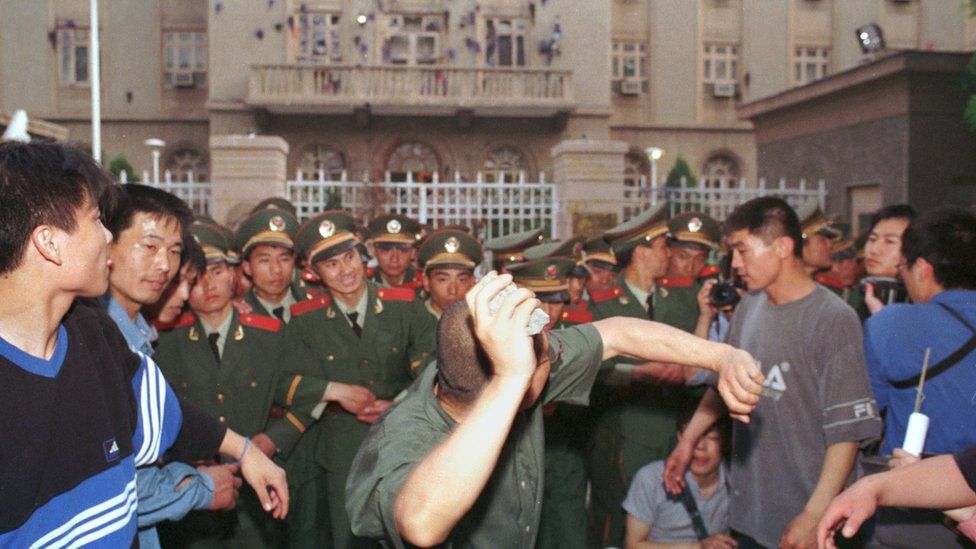
By that afternoon thousands of students were streaming onto the streets of Beijing. They gathered outside the embassy and things quickly turned violent.
“They were pulling up the paving stones. Beijing sidewalks aren’t paved, they have big tiles and they were pulling those up and smashing them and throwing them over the walls.”
Image copyright PETER ROGERS/GETTY IMAGESMany of those bits of concrete were crashing through the windows of a building where more than a dozen embassy staff, including US Ambassador James Sasser, had hunkered down. Embassy cars were being defaced and attacked.
The message was clear: the bombing was intentional and, as one slogan went, “the blood of Chinese must be repaid”. The protests would continue the next day, with even more people – some reports said 100,000 – storming the diplomatic district, and pelting stones, paint, eggs and concrete at the British and American embassies.
“We feel like we’re hostages,” Bill Palmer, an embassy spokesman trapped in one of the buildings, said at the time.
Demonstrations of this scale had not been seen in tightly-controlled China in the decade since students led a pro-democracy uprising in Beijing’s Tiananmen Square in 1989. This time the anger was directed away from the Communist Party but, with the 10th anniversary of the crackdown on students in Tiananmen approaching, the government had to strike a balance between giving vent to public anger and remaining in control.
In a rare TV address Vice-President Hu Jintao endorsed the protests but also warned they had to remain “in accordance with the law”.
Image copyright REUTERSImage caption US Ambassador James Sasser was trapped in the embassy for four days as protests ragedThe uproar was not isolated to Beijing. Crowds also took to the streets of Shanghai and other cities that weekend. In central Chengdu, the US consul’s residence was set alight.
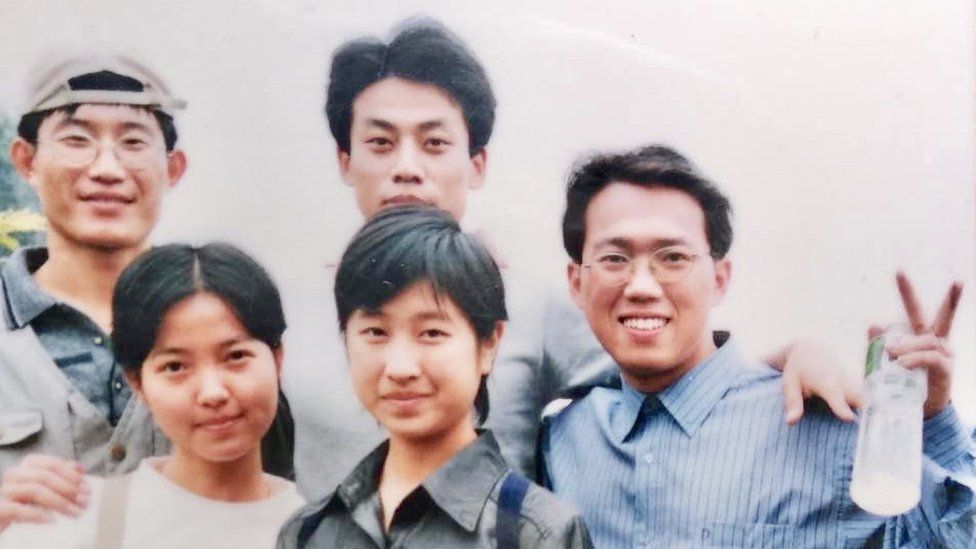
Weiping Qin, a then 19-year-old student leader at the maritime college in southern Guangzhou city, said demonstrators were not informed that Nato had already apologised for what it said was an accident. “The government was hiding this important message. They didn’t tell us – so young people, everybody, felt angry. We just wanted to go in the streets and protest against the United States.”
He said that initially students at his college were told they had to stay in their dormitories. But 24 hours after the bombing, the university leadership told him that they needed 30,000 students in the streets around the US consulate – 500 of whom would come from the maritime college.
The fired-up students drew lots to choose who could attend. They were loaded onto buses and given statements to read that echoed the stilted official language being broadcast by state media. “They gave us long sentences. But in the street, to speak out in long sentences is very hard.” He decided to yell slogans about the evils of Nato and the US instead.
Image copyright WEIPING QINImage caption Weiping Qin (right) was a student leader at Guangzhou Maritime College in 1999“We were just young people and we just felt angry. Our emotions came out like a wave,” said Qin, who now lives in the US and criticises the Chinese government in YouTube videos.
David Rank agreed that the anger was genuine. “I think it would really sell the Chinese people short to say this was manufactured by the system,” he said. “There was real outrage.”
Since the early 1990s, China had embarked on a concerted campaign to instil nationalism and “patriotic education” in its people. The narrative pushed in school textbooks, university classrooms and the media was that China – home to a great and benevolent civilisation – had been subjugated and humiliated at the hands of Western powers. The Belgrade embassy bombing fit the story.
“The anger that ordinary Chinese felt I think can only be understood in that historical context, being socialised to resent the West,” said Peter Gries, a professor of Chinese politics at Manchester University and an expert on Chinese nationalism.
For Liu Mingfu – a retired People’s Liberation Army colonel known for his hardline views of the US – the embassy bombing was part of a series of events that proved the US was engaged in a “new Cold War against China”.
“It was totally intentional. It was a purposeful, planned bombing, rather than an accident,” he said.
China would receive $28m in compensation from the US for the bombing, but had to give back close to $3m for the damage to US diplomatic property in Beijing and elsewhere. The US paid another $4.5m to the families of the dead and injured.
On the day of the bombing, Dusan Janjic, an academic and advocate for ethnic reconciliation in Yugoslavia, was having lunch at an upscale restaurant in central Belgrade with a man he considered a good friend.
Ren Baokai was the military attaché at the Chinese embassy and Janjic said he was surprisingly open with him about the fact that China was spying on Nato and US operations and tracking warplanes from its Belgrade outpost. The attaché invited him to dinner at the embassy that night because he knew he liked Chinese food.
“And I started making jokes. ‘Come on, you’re going to be bombed! I’m not coming!’,” Janjic recalled. He was being facetious: he did not actually think the embassy would be hit.
But Janjic couldn’t make it to dinner and that evening, when the missiles flew into the building, Ren was thrown to the ceiling by the blast and then fell through a crater left by a bomb. He was found in the basement in a coma only the next morning.
Citing Nato sources, they reported that the embassy was being used as a rebroadcast station for Yugoslav army communications and was as a result removed from a prohibited target list. US Secretary of State Madeleine Albright decried the story as “balderdash”, while British Foreign Secretary Robin Cook said there was “not a single shred of evidence” to support it.
But two decades later, Jens Holsoe, Politiken’s correspondent in the Balkans from 1995 to 2004, and John Sweeney, formerly of the Observer and now with the BBC, said they stood by their reporting that the bombing was intentional.
Holsoe said what made him investigate in the first place was CIA Chief George Tenet publicly saying that satellite images gave no indication the target was an embassy – “no flags, no seals, no clear markings” – when in fact all three were present.
One of his sources – a very senior Danish military figure – almost went on the record to confirm publicly that the bombing was intentional, he said. “Then he suddenly backed out and said if he uttered another word to me about this story that not only did he risk being fired but also prosecuted.”
Holsoe said it was clear at the time that there was military co-operation between Serb forces and the Chinese – and that he personally saw military vehicles entering and exiting the Chinese embassy. American officials told the New York Times that after the bombing they learned the embassy was China’s most significant intelligence collection platform in Europe.
“This was, and always will be, a murky story,” said Sweeney.
Ren Baokai survived and was later given the rank of general. He declined an interview with the BBC, saying he was now retired.
The Chinese ambassador who narrowly survived the strike, Pan Zhanlin, denied in a book that the embassy had been used for re-broadcasting and that China, in exchange, had been given parts of the US F-117 stealth fighter jet that Serbian forces had shot down in the early stages of the Nato campaign.
Getty Images
I think it’s complete nonsense – it was a bad map-reading error and a bad mistake.
It’s widely assumed that China did get hold of pieces of the plane to study its technology. It’s also been speculated that China was using the Nato air campaign to test technology to track stealth bombers that are normally undetectable.
But even if all these stories are true – the question remains: would the US really take the risk of bombing a Chinese embassy on purpose?
Even among ex-Yugoslav insiders there is no consensus. One former military intelligence officer told the BBC he believed the bombing was intentional and that the CIA’s explanation was ludicrous; while another, a retired colonel, said he believed America’s story.
“When something bad happens everybody thinks there has to be a secret reason – not a cock-up but a conspiracy,” said the former Nato spokesman Jamie Shea. “I think it’s complete nonsense – it was a bad map-reading error and a bad mistake.”
On a sunny day in late April, more than a dozen fresh bouquets were stacked up neatly against the memorial stone, but Shen Hong still felt compelled to re-arrange them. He comes to the site of the embassy bombing regularly, to remember his friends that died. But these days, it’s rare that he is alone.
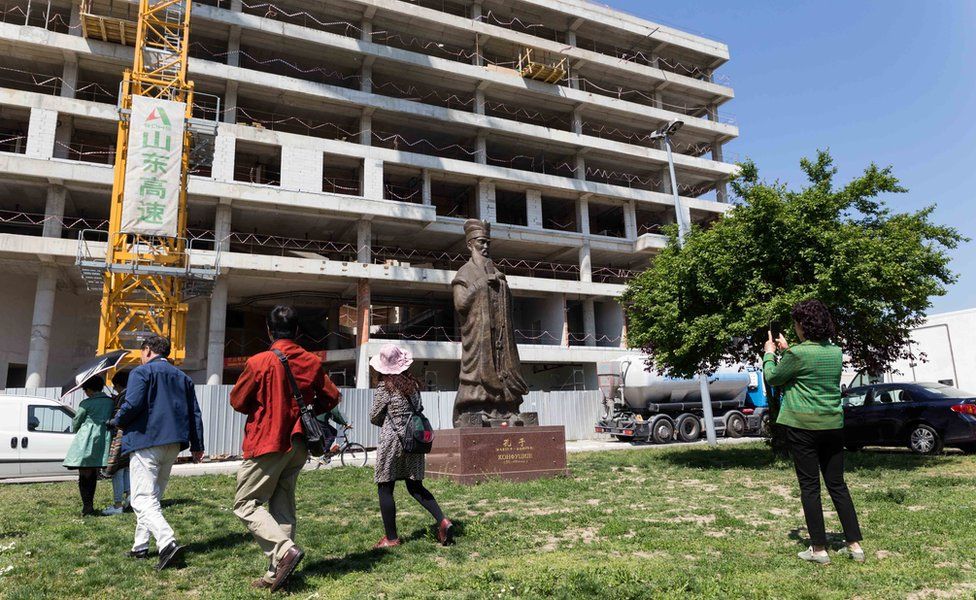
Busloads of Chinese tourists arrive every day to gaze at the memorial and the statue of the Chinese sage and philosopher Confucius that now stands nearby.
A young Chinese couple, Zhang and He, were in Belgrade for their honeymoon and decided to visit the memorial. They are around the same age that Xu Xinghu and Zhu Ying were when they were killed in 1999. “Three of our countrymen died here. We knew about this since we were kids and we came to see it,” said He.
Yang, a guide who was leading some 30 middle-aged Chinese tourists on a two-week bus tour through the Balkans, said the embassy site was a mandatory stop. “Our embassy was destroyed by Americans. Every Chinese knows this.”
Image copyright LAZARA MARINKOVICImage caption The embassy site is being turned into one of the largest Chinese cultural centres in EuropeIn 1999, China was not the economic, technological and military giant it is now. It was focused on getting wealthy and had a much less visible foreign policy. But 20 years later the country knows it sits at the top table with America and its ambitions around the world reflect that.
The Belgrade embassy site is being turned into a Chinese cultural centre that will be one of the biggest in Europe. The symbolism is hard to miss: a site of national humiliation and tragedy at the hands of the West re-born as a shiny edifice to China’s glorious history.
It’s a sign that Beijing has no plans to forget a bombing that allows it to paint the US as an imperialist superpower looking to hurt China. Diplomats who have served in Beijing say the incident is still brought up regularly in conversations.
Image copyright LAZARA MARINKOVICBut even those who called for immediate retaliation in 1999 now realise it was fortunate that China’s reaction did not spiral out of control: no Americans were killed during the protests and the compensation agreement allowed Beijing to draw a line – if a thin one – under the incident.
“We were the fastest developing country, every year our economy grew by double-digits. And if we would have stopped that because of war back then, we would have lost a lot,” said Shen, as another group of tourists arrived at the memorial.
“By nature, I’m a radical. I am always more for war than for a conversation. But when I look back, they did a good thing. Because now we can sit equally with the Americans.”
Different social systems should not be ‘a barrier to unification or an excuse for separation’, according to mainland’s cross-strait affairs office
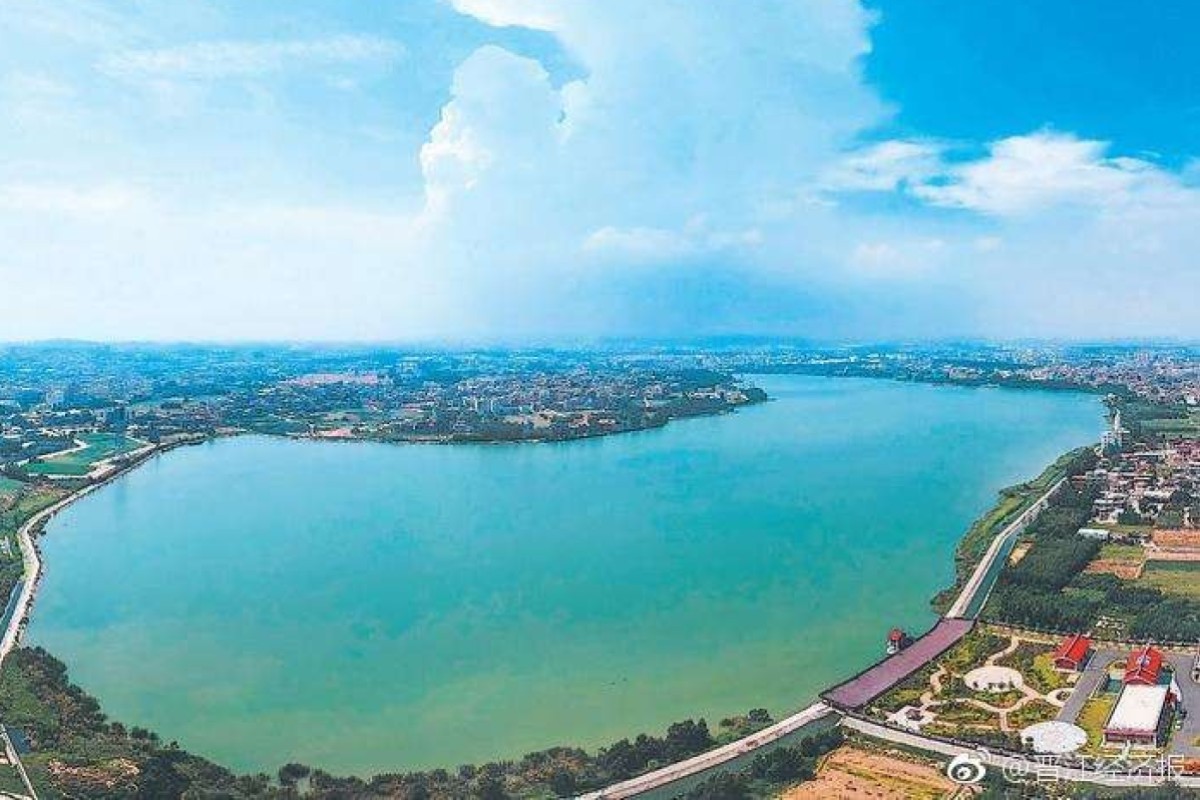
After Quemoy began importing water from Fujian in August, preliminary research has been done to supply water to Matsu chain and electricity to both
News
Beijing says it can ease power and water shortages on Taiwan’s islands
27 Feb 2019
Taiwan-controlled Quemoy Island – which is just 2km from Xiamen – began importing water from the mainland in August. Photo: Weibo
Beijing says it is prepared to supply electricity and water to islands controlled by Taipei in the Taiwan Strait despite escalating tensions between the two sides.
An Fengshan, spokesman for the Taiwan Affairs Office in Beijing, also said their different social systems should not be “an excuse” to separate the country, and any deal between the mainland and Taipei should be struck in the interests of a “peaceful unification” agenda.
Speaking at a monthly press briefing on Wednesday, An said the mainland could supply power and water to meet the needs of residents on Quemoy, also known as Kinmen, and the Matsu island group. Controlled by Taipei, the islands are located off the mainland’s southeastern Fujian coast – Quemoy is just 2km from Xiamen – and have been on the front line of cross-strait tensions since 1949.
Taiwan’s cold war island begins to thaw
“The people of the Quemoy and Matsu islands have long hoped that the mainland could help to resolve the difficulties they face with power and water shortages, and they have made numerous appeals for gas and bridge connections [with the mainland],” An said.
“Our attitude is very clear – that in regards to these demands, the mainland will make every effort to provide opportunities and conditions to help them achieve bigger and better development.”
An said Fujian province authorities had completed preliminary research and planning to supply electricity to the Quemoy and Matsu islands, as well as water to the Matsu chain. Plans to supply gas and build bridges were expected in the future, he said, without elaborating.
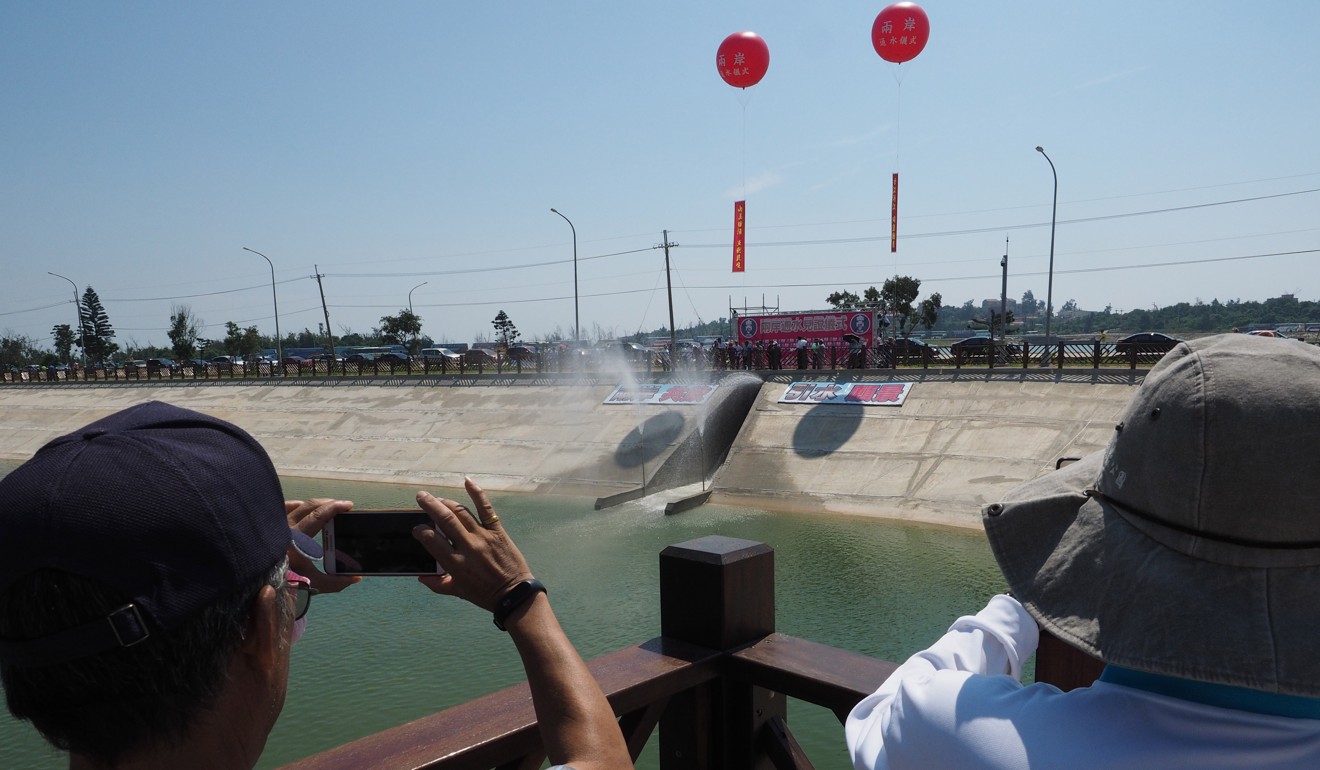
Water is released into the Tianbu Reservoir on Quemoy island in August when the mainland supply began. Photo: EPA-EFE
Quemoy began importing water from Fujian to ease its water shortage in August, three years after it signed a 30-year agreement with the mainland province to supply water via an undersea pipeline.
But Taiwan’s Mainland Affairs Council, which handles cross-strait ties, asked the Quemoy county government to downplay a ceremony marking the start of the supply
because of moves by Beijing to suppress Taipei.
Beijing sees Taiwan as a breakaway province subject to eventual reunification, by force if necessary. Relations across the strait soured after Tsai Ing-wen, of the independence-leaning Democratic Progressive Party, became president in 2016 and refused to accept the one-China principles.
Since then, mainland China has stepped up pressure on Taiwan, suspending official communications with the Tsai government, poaching its diplomatic allies and staging war games near the self-ruled island, which is edging closer to Washington.
In an interview with CNN last week, Tsai said she would seek re-election next year and there would be no peace deal with the mainland unless Beijing ruled out using force against Taiwan.
On Wednesday, An said the different social systems across the strait should not be a barrier to unification, which President Xi Jinping sees as part of his Chinese dream of national rejuvenation but has been rejected by Tsai.
“Peaceful unification and ‘one country, two systems’ are the basic policies for us to resolve the Taiwan issues, and the best way to realise the motherland’s unification,” An said.
He was referring to a speech by Xi in January calling for Beijing and Taipei to start talks on “one country, two systems” in Taiwan – first proposed by late paramount leader Deng Xiaoping in the 1980s – as the path to bring the island back into the China fold.
“The differences in the systems should not be a barrier to unification or an excuse for separation,” An said.
China protests against US ‘provocation’ after two American warships pass through Taiwan Straits.
Asked about Beijing-friendly Kuomintang chairman Wu Den-yih’s recent remarks that Taipei would sign a peace deal with the mainland if his party won the election in 2020, An said the two sides could explore a deal “as long as it benefits and safeguards the peace of the Taiwan Strait, increases the peaceful development of relations and pushes the peaceful unification process of the motherland”.










 CHINDIA ALERT: You'll be living in their world, very soon
South Korea, China cast doubt on reports North Korean leader Kim gravely ill
SEOUL (Reuters) – South Korean and Chinese officials on Tuesday cast doubt on reports North Korean leader Kim Jong Un was ill after media outlets said he had undergone a cardiovascular procedure and was in “grave danger”.
Daily NK, a Seoul-based speciality website, reported late on Monday, citing one unnamed source in North Korea, that Kim was recovering after undergoing the procedure on April 12. The North Korean leader is believed to be about 36.
CNN cited a U.S. official with direct knowledge of the matter as saying Washington was “monitoring intelligence” that Kim was in grave danger after surgery. Bloomberg quoted an unnamed U.S. official as saying the White House was told that Kim took a turn for the worse after the surgery.
However, two South Korean government officials rejected the CNN report without elaborating on whether Kim had undergone surgery. The presidential Blue House said there were no unusual signs coming from the reclusive, nuclear-capable state.
Kim is the unquestioned leader of North Korea and the sole commander of its nuclear arsenal. He has no clear successor and any instability in the country could be a major international risk.
RELATED COVERAGE
The state KCNA news agency gave no indication of the whereabouts of Kim in routine dispatches on Tuesday, but said he had sent birthday gifts to prominent citizens.
An official at the Chinese Communist Party’s International Liaison Department, which deals with North Korea, told Reuters the source did not believe Kim was critically ill. China is North Korea’s only major ally.
Chinese foreign ministry spokesman Geng Shuang said Beijing was aware of reports about the health of Kim, but said it does not know their source, without commenting on whether it has any information about the situation.
South Korean shares exposed to North Korea tumbled and the Korean won fell on the reports. The won traded down more than 1% against the dollar even as South Korean government sources said Kim was not gravely ill.
U.S. stock futures were trading 0.5% lower, but it was not clear how much of that weakness was owing to the collapse in U.S. oil prices and consequent concerns over global demand.
Daily NK said Kim had been admitted to hospital on April 12, just hours before the cardiovascular procedure, as his health had deteriorated since August due to heavy smoking, obesity and overwork.
It said he was now receiving treatment at a villa in the Mount Myohyang resort north of the capital Pyongyang.
“My understanding is that he had been struggling (with cardiovascular problems) since last August but it worsened after repeated visits to Mount Paektu,” a source was quoted as saying, referring to the country’s sacred mountain.
Accompanied by senior North Korean figures, Kim took two well-publicised rides on a stallion on the snowy slopes of the mountain in October and December.
KIM’S HEALTH KEY TO STABILITY
An authoritative U.S. source familiar with internal U.S. government reporting on North Korea questioned the CNN report that Kim was in “grave danger”.
“Any credible direct reporting having to do with Kim would be highly compartmented intelligence and unlikely to leak to the media,” a Korea specialist working for the U.S. government said on condition of anonymity.
Japan’s top government spokesman, Yoshihide Suga, declined to comment on the reports of Kim’s health.
“We are regularly gathering and analysing information about North Korea with great concern,” he said. “We will keep gathering and analysing information regarding North Korea by collaborating with other countries such as the U.S.”
Kim’s potential health issues could fuel uncertainty over the future of the reclusive state’s dynastic rule and stalled denuclearisation talks with the United States, issues in which Kim wields absolute authority.
With no details known about his young children, analysts say his sister and loyalists could form a regency until a successor is old enough to take over.
Speculation about Kim’s health first arose following his absence from the anniversary of the birthday of its founding father and Kim’s grandfather, Kim Il Sung, on April 15.
On April 12, North Korean state media reported that Kim Jong Un had visited an airbase and observed drills by fighter jets and attack aircraft.
Two days later North Korea launched multiple short-range anti-ship cruise missiles into the sea and Sukhoi jets fired air-to-surface missiles as part of military exercises.
The missile launches were part of the celebrations for Kim’s grandfather, Seoul officials said, but there was no North Korea state media report on his attendance or the tests.
Reporting from inside North Korea is notoriously difficult, especially on matters concerning the country’s leadership, given tight controls on information. There have been false and conflicting reports in the past on matters related to its leaders.
Kim is a third-generation hereditary leader who rules North Korea with an iron-fist, taking over the titles of head of state and commander in chief of the military since late 2011.
In recent years Kim has launched a diplomatic offensive to promote both himself as a world leader and his hermit kingdom, holding three meetings with U.S. President Donald Trump, four with South Korean President Moon Jae-in and five with China’s President Xi Jinping.
He was the first North Korean leader to cross the border into South Korea to meet Moon in 2018. Both Koreas are technically still at war, as the Korean War of 1950-53 ended in an armistice, not a peace treaty.
Kim has sought to have international sanctions against his country eased, but has refused to dismantle his nuclear weapons programme, a steadfast demand by the United States.
Source: Reuters
Posted in 1950-53, 2018, 36, about, absence, absolute, accompanied, admitted, after, air-to-surface missiles, airbase, ally, analysts, anniversary, anonymity, anti-ship, April, armistice, arose, attack aircraft, attendance, August, authoritative, authority, aware, “grave danger”, “monitoring intelligence”, before, Beijing, believed, Birthday, birthday gifts, Bloomberg, Blue House, border, capital, cardiovascular, cardiovascular problems, cast, celebrations, China, China's President Xi Jinping, China’s, Chinese Communist Party’s International Liaison Department, chinese foreign ministry spokesman, Chinese officials, cited, citing, Citizens, clear, CNN, collaborating, collapse, coming from, commander-in-chief, comment, commenting, compartmented, concerning, concerns, condition, conflicting, consequent, controls, Country, country’s, critically ill, cross, Daily NK, deals, December, declined, demand, denuclearisation, details, deteriorated, difficult, diplomatic offensive, Direct, dismantle, dollar, doubt, drills, dynastic rule, eased, elaborating, enough, especially, exposed, false, fighter jets, fired, first, five, following, founding father, four, future, given, global demand, government officials, government spokesman, grandfather, gravely, head of state, health, heavy smoking, hereditary, hermit kingdom, himself, Hospital, hours, ill, indication, information, Instability, intelligence, international, international risk, iron-fist, issues, Japan’s, KCNA news agency, Kim, Kim Il Sung, Kim Jong Un, knowledge, Korean, Korean War, launched, leader, leadership, leak, lower, loyalists, Major, matter, matters, media, media outlets, meetings, Military, military exercises, Monday, Mount Myohyang, Mount Paektu, Mountain, multiple, North, North Korean leader, notoriously, nuclear arsenal, nuclear weapons, nuclear-capable, obesity, observed, October, Official, old, one, only, overwork, owing, part, peace treaty, President Moon Jae-in, presidential, procedure, programme, prominent, promote, Pyongyang, quoted, receiving, reclusive, recovering, refused, regency, rejected, repeated, report, reported, reports, Resort, Reuters, rides, routine dispatche, routine dispatches, rules, sacred mountain, sanctions, saying, sea, senior, sent, Seoul, shares, short-range, sister, situation, snowy slopes, sole commander, source, South Korea, South Korean, speciality, speculation, stalled, stallion, state, steadfast, still at war, struggling, succession, successor, Sukhoi jets, surgery, take over, taking, talks, technically, tests, Third-generation, Three, tight, titles, told, top, trading, treatment, Tuesday, tumbled, turn for the worse, two, U.S. official, U.S. oil prices, U.S. President Donald Trump, Uncategorized, uncertainty, undergoing, undergone, United States, unlikely, unnamed, unquestioned, unusual signs, urn for the worse, villa, visited, visits, Washington, weakness, website, well-publicised, whereabouts, whether, White House, wields, without, won, world leader, worsened, young children | Leave a Comment »