20/12/2019
COLOMBO, Dec. 20 (Xinhua) — China highly appreciates the remarks made by Sri Lankan President Gotabaya Rajapaksa over the Hambantota Port agreement, said a statement released by the Chinese Embassy in Colombo on Friday.
China is willing to guide related enterprises to work with the Sri Lankan side to expedite implementing the established agreement and further promote the prosperity and development of Hambantota Port, according to the statement.
China highly respects the sovereignty and territorial integrity of Sri Lanka and the security and control of Hambantota Port was entirely in the hands of the Sri Lankan government and navy, which is no difference from any other port in Sri Lanka, said the statement.
President Rajapaksa, in a meeting with Colombo based foreign correspondents on Thursday said he would not renegotiate the Hambantota Port agreement with China and would look to ensure that the security of the port lied with the Sri Lankan side.
Rajapaksa said he would not renegotiate the commercial agreement of the project as that had already been signed, and he was studying to see if the entire security of the port was under Sri Lanka’s control.
Rajapaksa said if additional clauses are needed to be inserted to reassure the security deal, then the government would go ahead with it.
The president further said that he would not renegotiate the 99-year lease agreement of the port, as this was purely commercial and he did not want to convey a message to investors that commercial agreements would change every time a new government was elected to power.
Source: Xinhua
Posted in China alert, Colombo, Hambantota Port, presidents, remarks, Sri Lankan, Uncategorized, welcomes |
Leave a Comment »
04/07/2019
- Development minister leads high-level investment forum in Beijing
- Points to free trade agreements and preferential duty deals to offset trade war pressures for Chinese factories
Sri Lankan Minister for Development Strategies and International Trade Malik Samarawickrama at the Sri Lanka Investment Forum in Beijing on Wednesday. Photo: Simon Song
Sri Lanka is wooing Chinese manufacturers, urging them to make use of its preferential duty-free treatment by the US and Europe as a way to offset the growing tariff pressure of the trade war.
The country’s development minister, Malik Samarawickrama, was in Beijing on Wednesday as part of an investment forum at the Sri Lankan embassy attended by dozens of Chinese businesspeople.
“China has invested heavily in infrastructure and they are assisting us to invest in ports, roads, railways, water supplies and so on. Now we would like China to get involved in setting up their manufacturing plants in Sri Lanka, primarily for the purpose of exports,” he said.
“They can make use of the preferential market access we have – we have duty free access to the European Union countries and we have free trade agreements with Pakistan, Singapore and India. And, since the cost of manufacturing in China is going up, we would like the Chinese to look at Sri Lanka for their manufacturing and we want it to be exported back to China.”
Sri Lanka, bruised from Easter bombings, seeks US$1 billion loan from China
Along with trade officials and diplomats, Samarawickrama, one of Sri Lanka’s most senior government ministers, was also keen to boost investor confidence following the deadly Easter Sunday bombings in Colombo which killed 253 people.
“Let me assure you, absolutely, Sri Lanka is safe for investment,” he told the dozens of representatives from Chinese state-owned and private companies who attended the forum.
“We must bring to your notice that none of the industries have been affected as a result of the bombings and none of the export orders were cancelled or delayed. This is a testament to the resilience of the economy.”
China is one of Sri Lanka’s largest trading partners and – sometimes controversially – the largest financier of its booming new infrastructure. Other big lenders to the island nation are the Asian Development Bank and Japan.
Earlier this year the Sri Lankan government signed a US$989.5 million loan agreement with China’s Export-Import Bank for a major new motorway project. And last month Sri Lanka’s finance ministry confirmed it was in talks with the China-led Asian Infrastructure Investment Bank (AIIB) for a further loan of nearly US$1 billion for energy and motorways.
Did Japan and India just launch a counter to China’s Belt and Road?
The surge of Chinese investment has raised concerns that Sri Lanka could become caught up in the rivalry between China and India as Beijing seeks to expand its influence in South Asia and the Indian Ocean.
Last month, Sri Lanka signed an agreement with India and Japan to jointly develop the East Container Terminal at the Port of Colombo, which some observers said could become a competitor to the China-funded Hambantota Port, and was perhaps a sign that the island nation was seeking to neutralise the growing influence of China.
Samarawickrama denied claims the involvement of Japan and India in Sri Lanka’s biggest port project was to counter China’s influence.
Under the agreement, he said, the terminal was owned by Sri Lanka Port Authority, with a 51 per cent stake, while Japan and India would develop the remaining 49 per cent.
“We need the expertise from Japan,” Samarawickrama said. “We need the Indians to get involved in the operation because 75 per cent of the transshipment cargoes in the Colombo port come from India and India is extremely important to us.
“They are the operators of the terminal and they are not building any ports.”
Source: SCMP
Posted in Asian Development Bank, Asian Infrastructure Investment Bank (AIIB), Beijing, Belt and Road (B&R), China alert, China’s Export-Import Bank, chinese manufacturers, Colombo, East Container Terminal, energy, impact, India alert, Indian Ocean, Japan, major new motorway project, motorways, offset, Port of Colombo, South Asia, Sri Lanka, Sri Lanka Investment Forum, Sri Lankan Minister for Development Strategies and International Trade, trade war, Uncategorized |
Leave a Comment »
09/06/2019
MALE, Maldives (Reuters) – Indian Prime Minister Narendra Modi has called for a global conference to tackle the threat of terrorism in the region and around the world.
During a speech on his first foreign visit since winning re-election, he told the Maldivian parliament in Male that “terrorism is not just a threat for a country, but to the entire civilisation”.
“The international community has actively arranged for global convention and many conferences on the threat of climate change. Why not on the issue of terrorism?” Modi said.
He called for a global conference “so that there can be meaningful and result-oriented discussions for plugging the loopholes that terrorists and their supporters exploit”.
India is pursuing what it calls a “neighbourhood first” foreign policy centred on its allies in South Asia, although there is little sign of a warming in relations with arch rival Pakistan.
His trip to the Maldives is being viewed as a statement of intent to counter the rise of China, which has been making strategic inroads in the Indian Ocean in recent years and seeking closer military ties, to the alarm of New Delhi.
“In the neighbourhood, Maldives is priority,” Modi said in his speech.
During the visit, Modi has signed a slew of agreements with the island nation encompassing ferry services, port terminals and a new national cricket stadium.
His next stop is Sri Lanka’s capital, Colombo, where security is likely to be high on the agenda.
A wave of bombings on Easter Sunday killed more than 250 people across Sri Lanka despite repeated warnings from Indian intelligence services about a militant plot.
Source: Reuters
Posted in Colombo, global conference, Maldives, Pakistan, PM Modi, South Asia, Sri Lanka, terrorism, Uncategorized |
Leave a Comment »
22/04/2019
- Embassy officials have contacted families of two Chinese nationals who were killed in the blasts on Easter Sunday, and visited five who were injured
- Four of the missing were travelling to the Indian Ocean on a study trip
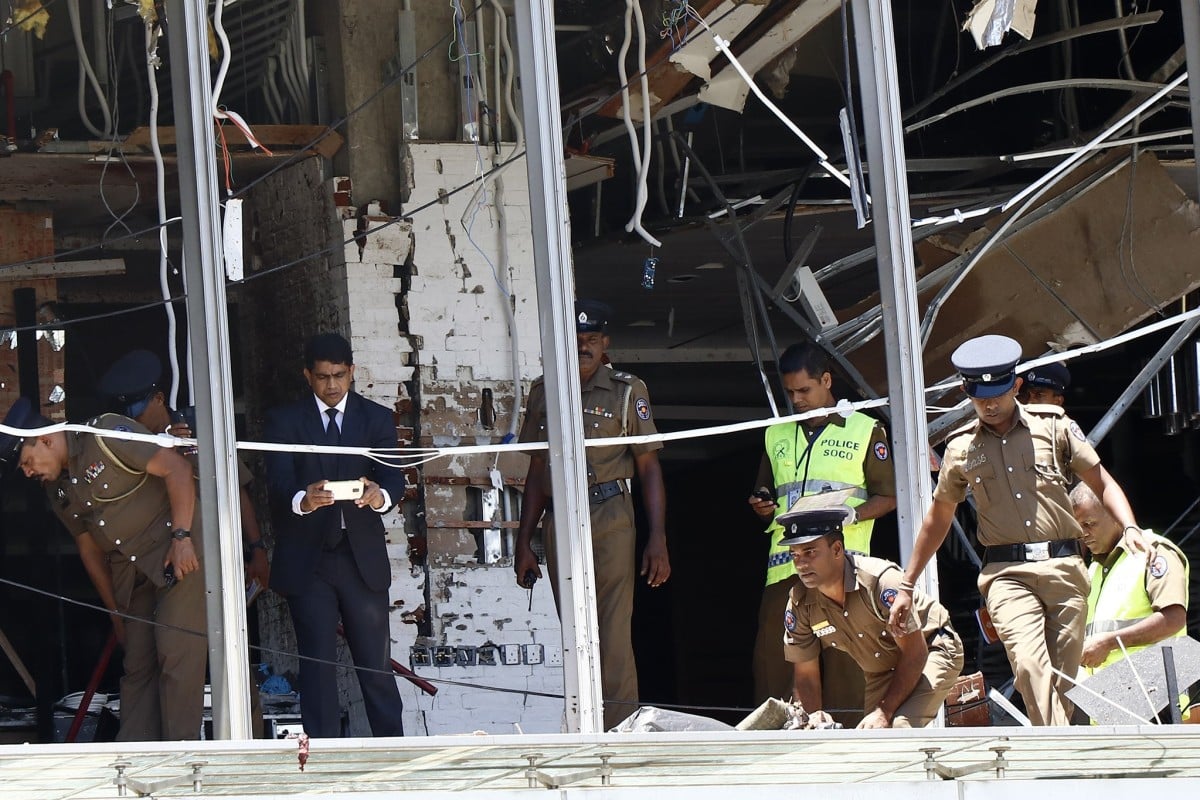
Police and investigators work at the Shangri-La Hotel blast scene in Colombo on Sunday, where the two Chinese were killed. Photo: Xinhua
Five Chinese nationals remain missing following a series of suicide bombings in hotels and churches in Sri Lanka on Easter Sunday that claimed the lives of
At least 290 people were killed and more than 500 others injured in the blasts, according to a Sri Lankan government official on Monday, who said a local militant group was behind the attacks.
The Chinese embassy in Colombo had contacted the families of the two deceased Chinese and was awaiting police confirmation on the fate of the five still missing, state-run People’s Daily reported.
Two Chinese nationals sustained serious injuries in the blasts and three others minor ones. Embassy officials had visited them several times in hospital, the report said.
“The embassy will closely monitor the situation, urge Sri Lankan police to confirm the whereabouts of the missing persons and assist Chinese citizens and families to properly handle the aftermath,” the embassy was quoted as saying.
The two Chinese who died, cousins surnamed Tan, were caught in a blast at the Shangri-La Hotel in Colombo, Red Star News quoted a Chinese businesswoman in the Sri Lankan capital as saying.
“Their families identified them at the scene,” she said.
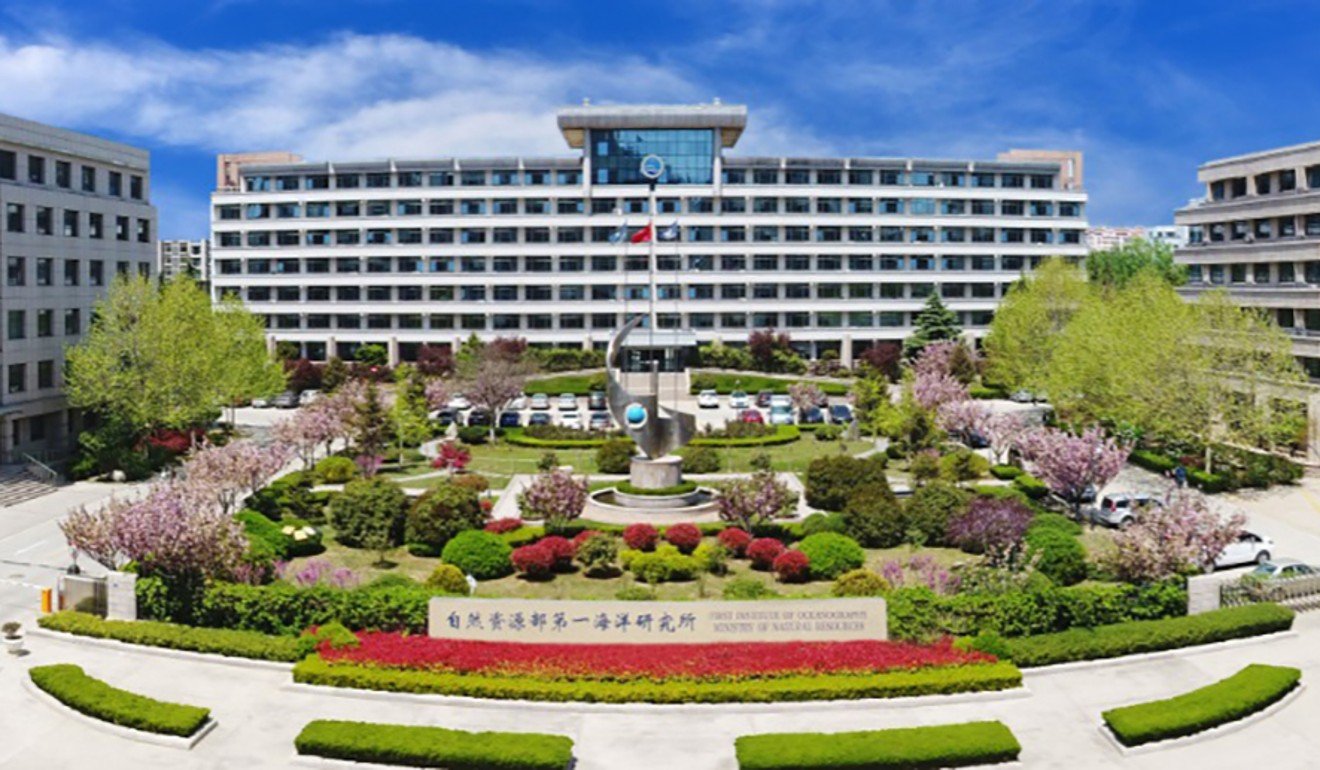
Four of the missing Chinese are students from the First Institute of Oceanography at the Ministry of Natural Resources. Photo: FIO
Four of the missing Chinese – Li Dawei, Li Jian, Pan Wenliang and Wang Liwei – are students from the Ministry of Natural Resources’ First Institute of Oceanography who were going to take part in a study in the Indian Ocean, an institute staff member told Red Star News.
The institute has sent staff to
Four of the five injured are students from the Chinese Academy of Sciences’ South China Sea Institute of Oceanology, who were en route to a study trip in the eastern Indian Ocean.
“It is an annual scientific expedition programme and they were on the way to replace the 10 others who had completed their rotation,” a staff member told The Beijing News. “Some sustained bruising on their legs and one could hardly hear after the blast.”
Tourists who returned to Shanghai and Chengdu, Sichuan province, told the newspaper that their trip had to be cut short as shops were closed and a curfew imposed amid tight security.
“All the private cars, coaches, vans and buses had to open their doors for inspection. There were checkpoints every 10 metres,” said one tour guide from Chengdu.
A traveller from the same city said airport security had also been stepped up. “There was a bombing 20 minutes after we left a restaurant and another one outside the airport when we were waiting there. We had to pass through three or four very strict security checks at the airport,” she said.
Back in Shanghai, another woman said: “We were not scared there but we are very glad to be back home.”
Source: SCMP
Posted in Chengdu, China alert, Chinese Academy of Sciences, Colombo, embassy, First Institute of Oceanography, Five Chinese, Indian Ocean, Li Dawei, Li Jian, Ministry of Natural Resources, missing, Pan Wenliang, People’s Daily, Red Star News, return home, Shanghai, Shangri-La Hotel, sichuan province, South China Sea Institute of Oceanology,, Sri Lanka bombings, Sri Lankan police, suicide bombings, The Beijing News, tourists, Uncategorized, Wang Liwei |
Leave a Comment »



 CHINDIA ALERT: You'll be living in their world, very soon