Archive for ‘comparison’

25/04/2020

Coronavirus: China’s belt and road plan may take a year to recover from slower trade, falling investment

  • But trade with partner countries might not be as badly affected as with countries elsewhere in the world, observers say
  • China’s trade with belt and road countries rose by 3.2 per cent in the January-March period, but second-quarter results will depend on how well they manage to contain the pathogen, academic says
China’s investment in foreign infrastructure as part of its Belt and Road Initiative has been curtailed because of the coronavirus pandemic. Photo: Xinhua
The coronavirus pandemic is set to cause a slump in Chinese investment in its signature

Belt and Road Initiative

and a dip in trade with partner countries that could take a year to overcome, analysts say.

But the impact of the health crisis on China’s economic relations with nations involved in the ambitious infrastructure development programme might not be as great as on those that are not.
China’s total foreign trade in the first quarter of 2020 fell by 6.4 per cent year on year, according to official figures from Beijing.
Trade with the United States, Europe and Japan all dropped in the period, by 18.3, 10.4 and 8.1 per cent, respectively, the commerce ministry said.
By comparison, China’s trade with belt and road countries increased by 3.2 per cent in the first quarter, although the growth figure was lower than the 10.8 per cent reported for the whole of 2019.
China’s trade with 56 belt and road countries – located across Africa, Asia, Europe and South America – accounts for about 30 per cent of its total annual volume, according to the commerce ministry.

Despite the first-quarter growth, Tong Jiadong, a professor of international trade at Nankai University in Tianjin, said he expected China’s trade with belt and road countries to fall by between 2 and 5 per cent this year.

His predictions are less gloomy than the 13 to 32 per cent contraction in global trade forecast for this year by the World Trade Organisation.

“A drop in [China’s total] first-quarter trade was inevitable but it slowly started to recover as it resumed production, especially with Southeast Asian, Eastern European and Arab countries,” Tong said.

“The second quarter will really depend on how the epidemic is contained in belt and road countries.”

Nick Marro, Hong Kong-based head of global trade at the Economist Intelligence Unit, said he expected China’s total overseas direct investment to fall by about 30 per cent this year, which would be bad news for the belt and road plan.

“This will derive from a combination of growing domestic stress in China, enhanced regulatory scrutiny over Chinese investment in major international markets, and weakened global economic prospects that will naturally depress investment demand,” he said.

The development of the Chinese built and operated special economic zone in the Cambodian town of Sihanoukville is reported to have slowed, while infrastructure projects in Bangladesh, including the Payra coal-fired power plant, have been put on hold.
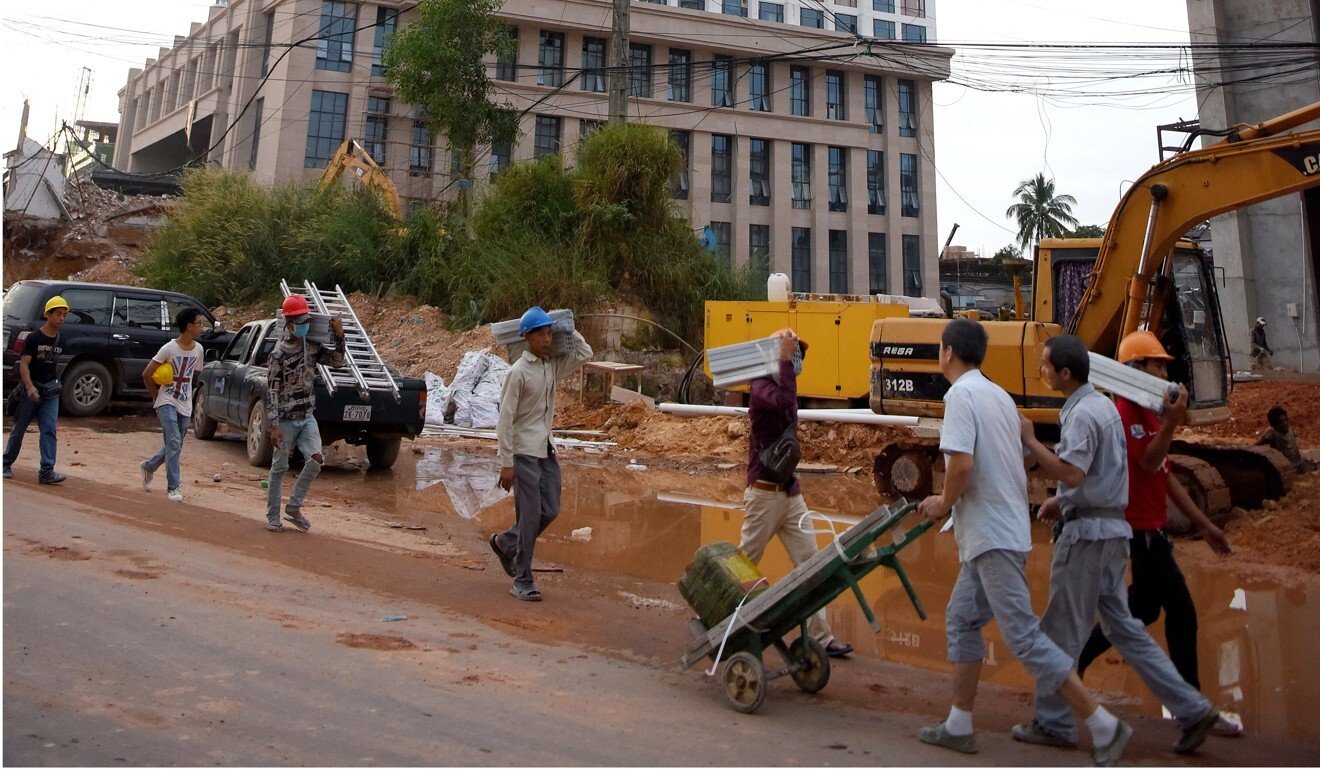
The development of the Chinese built and operated special economic zone in the Cambodian town of Sihanoukville is reported to have slowed. Photo: AFP
Marro said the reduction of capital and labour from China might complicate other projects for key belt and road partner, like Pakistan, which is home to infrastructure projects worth tens of billions of US dollars, and funded and built in large part by China.

“Pakistan looks concerning, particularly in terms of how we’ve assessed its sovereign and currency risk,” Marro said.

“Public debt is high compared to other emerging markets, while the coronavirus will push the budget deficit to expand to 10 per cent of GDP [gross domestic product] this year.”

Last week, Pakistan asked China for a 10-year extension to the repayment period on US$30 billion worth of loans used to fund the development of infrastructure projects, according to a report by local newspaper Dawn.

China’s overseas investment has been falling steadily from its peak in 2016, mostly as a result of Beijing’s curbs on capital outflows.

Last year, the direct investment by Chinese companies and organisations other than banks in belt and road countries fell 3.8 per cent from 2018 to US$15 billion, with most of the money going to South and Southeast Asian countries, including Singapore, Vietnam, Indonesia and Pakistan.

Tong said the pandemic had made Chinese investors nervous about putting their money in countries where disease control measures were becoming increasingly stringent, but added that the pause in activity would give all parties time to regroup.

“Investment in the second quarter will decline and allow time for the questions to be answered,” he said.

“Past experience along the belt and road has taught many lessons to both China and its partners, and forced them to think calmly about their own interests. The epidemic provides both parties with a good time for this.”

Dr Frans-Paul van der Putten, a senior research fellow at Clingendael Institute in the Netherlands, said China’s post-pandemic strategy for the belt and road in Europe
might include a shift away from investing in high-profile infrastructure projects like ports and airports.
Investors might instead cooperate with transport and logistics providers rather than invest directly, he said.
“Even though in the coming years the amount of money China loans and invests abroad may be lower than in the peak years around 2015-16, I expect it to maintain the belt and road plan as its overall strategic framework for its foreign economic relations,” he said.
Source: SCMP
12/02/2020

Coronavirus cases fall, experts disagree whether peak is near

BEIJING/SINGAPORE (Reuters) – China reported on Wednesday its smallest number of coronavirus cases since January, lending weight to a prediction by its top medical adviser for the outbreak to end by April, but a global infectious diseases expert warned of the spread elsewhere.

Financial markets took heart from the outlook of the Chinese official, epidemiologist Zhong Nanshan, who said on Tuesday the number of new cases was falling in some provinces, and forecast the epidemic would peak this month, even as the death toll in China rose to more than 1,100 people.

World stocks, which had seen rounds of sell-offs over the virus, surged to record highs on hopes of a peak in cases. The Dow industrials, S&P 500 and Nasdaq all hit new highs, and Asian shares nudged higher on Wednesday.

But the World Health Organization (WHO) has warned that the epidemic poses a global threat akin to terrorism and one expert coordinating its response said while the outbreak may be peaking at its epicentre in China, it was likely to spread elsewhere in the world, where it had just begun.

“It has spread to other places where it’s the beginning of the outbreak,” the official, Dale Fisher, head of the Global Outbreak Alert and Response Network coordinated by the WHO, said in an interview in Singapore.

“In Singapore, we are at the beginning of the outbreak.”

Singapore has reported 47 cases and worry about the spread is growing. Its biggest bank, DBS (DBSM.SI), evacuated 300 staff from its head office on Wednesday after a confirmed coronavirus case in the building.

Hundreds of cases have been reported in dozens of other countries and territories around the world, but only two people have died outside mainland China – one in Hong Kong and another in the Philippines.

WHO chief Tedros Adhanom Ghebreyesus said on Tuesday the world had to “wake up and consider this enemy virus as public enemy number one” and the first vaccine was 18 months away.

In China, total infections have hit 44,653, health officials said, including 2,015 new confirmed cases on Tuesday. That was the lowest daily rise in new cases since Jan. 30.

The number of deaths on the mainland rose by 97 to 1,113 by the end of Tuesday.

But doubts have been aired on social media about how reliable the figures are, after the government last week amended guidelines on the classification of cases.

‘STAY HOPEFUL’

The biggest cluster of cases outside China is aboard the Diamond Princess cruise ship quarantined off Japan’s port of Yokohama, with about 3,700 people on board. Japanese officials on Wednesday said 39 more people had tested positive for the virus, taking the total to 175.

One of the new cases was a quarantine officer.

Thailand said it was barring passengers from another cruise ship, MS Westerdam, from disembarking, the latest country to turn it away amid fears of the coronavirus, despite no confirmed infections on board.

“We try to stay hopeful,” American passenger Angela Jones told Reuters in a video recording. “But each day, that becomes a little bit more difficult, when country after country rejects us.”

Echoing the comparison with the fight against terrorism, China’s state news agency Xinhua said late on Tuesday the epidemic was a “battle that has no gunpowder smoke but must be won”.

The epidemic was a big test of China’s governance and capabilities and some officials were still “dropping the ball” in places where it was most severe, it said, adding: “This is a wake-up call.”

The government of Hubei, the central province at the outbreak’s epicentre, dismissed the provincial health commission’s Communist Party boss, state media said on Tuesday, amid mounting public anger over the crisis.

China’s censors had allowed criticism of local officials but have begun cracking down on reporting of the outbreak, issuing reprimands to tech firms that gave free rein to online speech, Chinese journalists said.

The pathogen has been named COVID-19 – CO for corona, VI for virus, D for disease and 19 for the year it emerged. It is suspected to have come from a market that illegally traded wildlife in Hubei’s capital of Wuhan in December.

The city of 11 million people remains under virtual lockdown as part of China’s unprecedented measures to seal infected regions and limit transmission routes.

Travel restrictions that have paralysed the world’s second-biggest economy have left Wuhan and other Chinese cities resembling ghost towns.

Even if the epidemic ends soon, it has taken a toll of China’s economy, with companies laying off workers and needing loans running into billions of dollars to stay afloat. Supply chains for makers of items from cars to smartphones have broken down.

ANZ Bank said China’s first-quarter growth would probably slow to 3.2% to 4.0%, down from a projection of 5.0%.

The likely slowdown in China could shave 0.1 to 0.2 percentage points off both euro zone and British growth this year, credit rating agency S&P Global estimated.

Source: Reuters

Law of Unintended Consequences

continuously updated blog about China & India

ChiaHou's Book Reviews

continuously updated blog about China & India

What's wrong with the world; and its economy

continuously updated blog about China & India