Archive for ‘consumption’

03/10/2019

India’s PM Modi exhorts nation to end usage of single-use plastic by 2022

NEW DELHI (Reuters) – Indian Prime Minister Narendra Modi called on the nation to work toward ending the consumption of single-use plastics by 2022, in a speech on Wednesday.

“Hygiene, protection of environment and protection of life were of keen interest to Gandhi,” said Modi, speaking on the anniversary of the freedom movement leader’s birth. “Plastic is dangerous to all these three goals. So we need to reach the goal of ending single-use plastic by 2022.”

Meanwhile, India held off a plan to impose a blanket ban on single-use plastics as it was seen as a measure too disruptive for industry at a time when India is dealing with an economic slowdown and job losses, officials told Reuters on Tuesday.

In a tweet on Wednesday, India’s environment ministry however, denied that it had planned to issue a ban.

“India, today is on the verge of starting a historic movement against #SingleUsePlastic, setting an example for the world. At such a time, discovering a shelved ban, when none was planned is indeed misleading & doesn’t do justice to its fight against single use plastic,” the ministry said in a tweet.

Reuters had in August reported that India was set to impose a nationwide ban on plastic bags, cups and straws on Oct. 2, in a sweeping measure to stamp out single-use plastics from cities and villages that rank among the world’s most polluted.

Concerns are growing worldwide about plastic pollution, especially in oceans, where nearly 50% of single-use plastic products end up, killing marine life and entering the human food chain, studies have shown.

Source: Reuters

20/09/2019

China’s border region expedites reform to build a financial gateway for ASEAN

NANNING, Sept. 19 (Xinhua) — Pham Thi Nguyet Hoa, a vendor living in Vietnam’s Mong Cai, comes to Dongxing, a southern Chinese port city, to sell Vietnam fruits every day. When night falls, she often ends up with thousands of yuan in her pocket, much more than what she can earn at home.

“Most of my customers are Chinese, and it is very convenient to exchange Chinese yuan to Vietnamese Dong as many banks in Dongxing have this currency exchange service,” said Pham.

Tourism has been a pillar industry in the border city of southern China’s Guangxi Zhuang Autonomous Region. Dongxing port saw 12 million people, of which half were tourists, pass through last year, ranking first among all land ports in China.

In the first six months this year, tourism consumption at the port exceeded 6.2 billion yuan (874 million U.S. dollars), up 40.4 percent from the year before.

The flourishing border tourism has brought a huge demand for currency exchange, with a slew of financial reforms rolled out in recent years.

In 2014, the ABC China (Dongxing Experimental Zone) ASEAN Currency business center was established in Dongxing, allowing direct convertibility of Chinese yuan and Vietnamese Dong.

In February 2018, a total of 8 million yuan was transferred in cash from Vietnam to China, marking the first cross-border cash transfer in Guangxi between China and Vietnam.

Fan Zuojun, vice president of Guangxi University, said the cross-border cash transfer will further promote the financial cooperation between China and Members of the Association of Southeast Asian Nations (ASEAN) as well as deepen reform and push forward the internationalization of the Chinese currency in the region.

China and ASEAN countries have always maintained close relations in trade.

In January 2010, the China-ASEAN Free Trade Area was set up, which has significantly boosted bilateral trade. China has maintained its position as the largest trading partner of ASEAN for 10 consecutive years, and trade between China and ASEAN has skyrocketed tenfold from 16 years ago to 587.8 billion U.S. dollars in 2018.

In the first half of 2019, ASEAN became China’s second-largest trading partner, with bilateral trade volume reaching 291.85 billion U.S. dollars, up 4.2 percent year on year.

Guangxi’s geographical advantages have also given it huge development dividends over the past decades. ASEAN has been Guangxi’s largest trade partner for 19 consecutive years, and trade volume between Guangxi and ASEAN in the first seven months of this year topped 128 billion yuan, accounting for 48.7 percent of Guangxi’s total foreign trade.

Now with the launch of the Guangxi Pilot Free Trade Zone (FTZ) in August, bilateral trade exchanges are expected to embrace another golden opportunity.

The pilot FTZ, with a total area of nearly 120 square km, will focus on modern financial services, smart logistics, digital economy, port shipping logistics, international trade and cross-border tourism, among others.

Guangxi vows to make greater efforts to consolidate its financial strength and build itself into an ASEAN-oriented financial portal, with over 90 financial reform measures being rolled out to further facilitate trade and investment and promote innovation in financial services with ASEAN countries.

Source: Xinhua
19/09/2019

China to tap pork reserves as swine fever hits industry


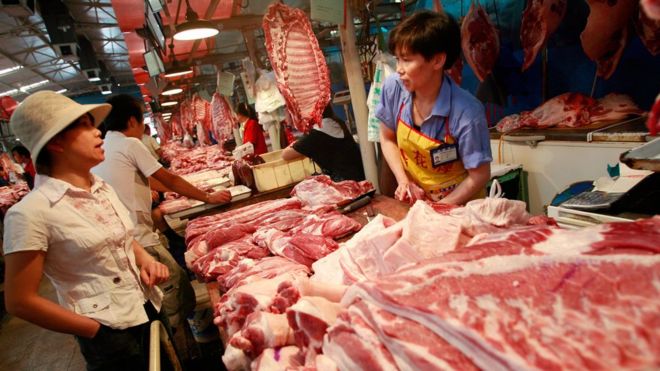
A customer shops for pork at at butcher in ChinaImage copyright GETTY IMAGES

China is set to release pork supplies from its central reserves as it moves to tackle soaring prices and shortages caused by an outbreak of swine fever.

A state-backed body will auction 10,000 tonnes of frozen pork from its strategic reserves on Thursday.

China, the world’s biggest producer and consumer of pork, has struggled to control the spread of the disease.

Beijing has slaughtered more than 1 million pigs in a bid to contain the incurable pig virus.

The highly contagious disease is not dangerous to humans, but has hit China’s crucial pig-farming industry and driven up costs for consumers.

Pork prices jumped 46.7% in August on a year earlier, official figures showed.

In a bid to stabilise prices, a state-backed group that manages the pork reserves will auction imported frozen pork from countries including Denmark, France, the US and UK.

Only 300 tonnes will be sold to each bidder at the auction.

Pork is used widely in Chinese festivals, and the auction comes as the country prepares to celebrate a week-long national holiday for the 70th anniversary of the People’s Republic of China.

Julian Evans-Pritchard, senior China economist at Capital Economics, said the auction would provide slight relief to the industry but would not do much to contain prices.

“In itself, I don’t think it will be able to prevent pork prices from rising further unless they manage to get the disease under control,” he said.

Beijing created its strategic pork reserve in 2007 but the size of the stockpile is not known.

Capital Economics estimates that at most, the stockpile would hold four days’ worth of pork supplies to feed China.

How has swine fever hit China’s pork industry?

Pork is one of China’s main food staples and accounts for more than 60% of the country’s meat consumption. The industry produced close to 54 million tonnes of pork last year.

About 1.2 million pigs have been culled in China in an effort to halt the spread of swine fever since August 2018, according to data from the Food and Agriculture Organization, a UN agency.

In April, Rabobank estimated Chinese pork production would fall by up to 35% this year due to swine fever.

The supply shortage has sent pork prices soaring and has eaten into household incomes.

That poses a fresh challenge for the Chinese economy, which is already facing a slowdown and a trade war between Beijing and Washington.

Source: The BBC

15/09/2019

China Focus: Shanghai tourism festival witnesses consumption upgrade

SHANGHAI, Sept. 14 (Xinhua) — As the 2019 Shanghai Tourism Festival opened Saturday evening, the festival, which began in 1990, has been a witness to China’s development and citizens’ consumption upgrade over the past few decades.

Twenty-five floats, which represent China’s well-known tourist destinations such as Nanjing and Suzhou cities in Jiangsu Province, and 32 performance groups from 19 countries and regions, including Germany, Switzerland and France, participated in the dance and music show in downtown Shanghai, attracting some 300,000 spectators.

The festival, which will last until Oct. 6, will feature 100 activities including some for overseas travelers. A folk culture exhibition on Belt and Road countries will also be held. Dozens of tourist sites, museums and galleries in Shanghai will offer half-price admissions during the event.

The first tourism festival in Shanghai attracted half a million tourists from home and abroad. The 2018 festival attracted 12.7 million visitors. As people’s living standards have improved remarkably, tourism is not a luxury any more, but a necessity for many citizens.

“In 1995, the company rewarded me with a trip to Hainan. I was so proud and cherished it very much,” recalled a Shanghai taxi driver surnamed Guo, 54. “Now, our income has increased a lot, travel becomes a routine for most people who are willing to pay their own money to relax.”

Thirty years ago, ideal tourism resources were lacking, said Lu Guojun, a clerk with Shanghai Huangpu River Cruise Group Co., Ltd, citing the swaths of croplands along the eastern coast of the river which flows through the city center.

In recent years, with improved infrastructure and rapid development of service economy, more companies have joined the development of the river tourism, Lu said.

Dai Bin, president of the China Tourism Academy in Beijing, said people’s aspirations for a better life lead to their high expectations of tourism quality.

In August, China issued a guideline to unleash the cultural and tourism consumption potential, urging efforts to deepen supply-side reform in cultural and tourism industries.

On Friday, Shanghai signed agreements with six cities and regions including Budapest, Phnom Penh and Bangkok to boost culture and tourism exchange.

Culture and tourism promote mutual friendship and understanding, said Yu Xiufen, head of the Shanghai Municipal Administration of Culture and Tourism.

In 2018, domestic tourists made 5.54 billion trips, up 10.8 percent year on year, and the total number of inbound and outbound tourists reached 291 million, up 7.8 percent. The total tourism revenue reached 5.97 trillion yuan (842.7 billion U.S. dollars) last year, up 10.5 percent, data of the Ministry of Culture and Tourism showed.

Source: Xinhua

29/08/2019

Exclusive: India set to outlaw six single-use plastic products on October 2 – sources

NEW DELHI (Reuters) – India is set to impose a nationwide ban on plastic bags, cups and straws on Oct. 2, officials said, in its most sweeping measure yet to stamp out single-use plastics from cities and villages that rank among the world’s most polluted.

Prime Minister Narendra Modi, who is leading efforts to scrap such plastics by 2022, is set to launch the campaign with a ban on as many as six items on Oct. 2, the birth anniversary of independence leader Mahatma Gandhi, two officials said.

These include plastic bags, cups, plates, small bottles, straws and certain types of sachets, said the officials, who asked not to be identified, in line with government policy.

“The ban will be comprehensive and will cover manufacturing, usage and import of such items,” one official said.

India’s environment and housing ministries, the two main ministries leading the drive, did not respond to emails from Reuters to seek comment.

In an Independence Day speech on Aug. 15, Modi had urged people and government agencies to “take the first big step” on Oct. 2 towards freeing India of single-use plastic.

Concerns are growing worldwide about plastic pollution, with a particular focus on the oceans, where nearly 50% of single-use plastic products end up, killing marine life and entering the human food chain, studies show.

The European Union plans to ban single-use plastic items such as straws, forks, knives and cotton buds by 2021.
China’s commercial hub of Shanghai is gradually reining in use of single-use plastics in catering, and its island province of Hainan has already vowed to completely eliminate single-use plastic by 2025.
India lacks an organized system for management of plastic waste, leading to widespread littering across its towns and cities.
The ban on the first six items of single-use plastics will clip 5% to 10% from India’s annual consumption of about 14 million tonnes of plastic, the first official said.
Penalties for violations of the ban will probably take effect after an initial six-month period to allow people time to adopt alternatives, officials said.
Some Indian states have already outlawed polythene bags.
The federal government also plans tougher environmental standards for plastic products and will insist on the use of recyclable plastic only, the first source said.
It will also ask e-commerce companies to cut back on plastic packaging that makes up nearly 40% of India’s annual plastic consumption, officials say.
Cheap smartphones and a surge in the number of internet users have boosted orders for e-commerce companies, such as Amazon.com Inc (AMZN.O) and Walmart Inc’s (WMT.N) Flipkart, which wrap their wares – from books and medicines to cigarettes and cosmetics – in plastic, pushing up consumption.

Source: Reuters

08/03/2019

China Focus: China to ramp up efforts to provide better elderly care

BEIJING, March 7 (Xinhua) — As China is faced with a growing aging population, the government has pledged to provide better elderly care services and facilities for the silver-haired, and give a strong boost to domestic demand.

Elderly care remains high on the agenda in this year’s government work report, which said that significant steps would be taken to develop elderly care, especially community elderly care services.

The number of people in China aged 60 and above reached 250 million by the end of 2018, accounting for 17.9 percent of the country’s population.

“Growing demand will trigger greater market potential in China’s senior care industry,” said Tang Wenxiang, founder of Fullcheer Group, a major elderly care services provider based in Changsha, capital of central China’s Hunan Province.

Fullcheer Group has 50 branches in more than 10 provinces and cities with a total of 5,000 beds. Tang expects the number of his company’s beds to increase to 50,000 in five years.

“There is still a huge gap between the demand of China’s aging population and the number of elder care facilities,” Tang said.

The country will provide support to institutions offering services in the community like day care, rehabilitation care, and assisted meal services and outdoor fitness services using measures such as tax and fee cuts and exemptions, funding support, and lower charges for water, electricity, gas and heating, according to the government work report.

Tang said government’s measures to develop elderly care services greatly boosted the confidence of entrepreneurs who run businesses in the sector.

Developing the elderly care industry is good for improving people’s well-being and stimulating consumption, said Xu Hongcai, an economist with the China Center for International Economic Exchanges.

“Consumption on elderly care requires the supply of the elder care market, offered by both the government and the market,” he said.

A research report issued by Guolian Securities suggests that a string of policies have been carried out in China to encourage the participation of the social sector in the senior care industry, which will boost the country’s consumption in the health and medical sectors.

As China opens this sector, foreign firms such as France’s Orpea and Japan’s Nichii have tapped the elderly service market in China.

China still lacks leading players in the senior care market which includes nursing care, rehabilitation assistive devices and daily necessities for seniors, Tang said.

The long-term care insurance system will help increase the occupancy rate of some elderly services facilities given a number of elderly people can hardly afford the expenses, according to Tang.

Source: Xinhua

09/02/2019

China’s information consumption surges in 2018

BEIJING, Feb. 9 (Xinhua) — China’s information consumption saw a rapid increase last year, according to the Ministry of Industry and Information Technology (MIIT).

Total business volume of the telecommunication sector rose by 137.9 percent from the previous year, the MIIT has said.

Services of 4G continued to develop last year, with the number of users reaching 1.17 billion.

The average household usage of mobile traffic reached 6.25GB per month in December 2018, more than double the amount in the same period in the previous year, the ministry said.

The ministry attributed the soaring information consumption to Chinese telecommunications operators’ measures of increasing Internet connection speed and cutting connection costs.

Wen Ku, director of the telecom department at the MIIT, said the ministry would make continued efforts to expand Internet coverage, improve service quality and release the potential of the digital economy.

Source: Xinhua

14/12/2018

Lowest retail sales growth for 15 years dash China’s hopes that consumption will offset trade war

Beijing had high hopes that tax cuts for individuals would lift consumer spending and boost an economy which is showing the effects of the trade war, but overall retail sales in November proved disappointing.

Even record spend on Singles’ Day’ on November 11 could not prevent retail sales from posting their weakest growth rate in 15 years.

November’s retail sales, which covers both corporate and consumer spending, stood at 3.52 trillion yuan, down from 3.55 trillion yuan in October, according to data released by the National Bureau of Statistics on Friday.

The growth rate fell to 8.1 per cent compared to November 2017, below the 8.6 per cent rate in October. The figure was also below the 8.8 per cent growth forecast by a Bloomberg poll of economists. Adjusted for inflation, the growth was even lower, at 5.8 per cent.

As the US-China trade war continues to weigh on exports, Beijing is counting on households and companies to spend more to stabilise growth.

However, weak consumption underscores the difficulties the Chinese leadership is having in its efforts to keep the economy stable.

The government expected that its October move to raising the threshold for taxable personal income to 5,000 yuan per month would release unlock spending power equivalent to hundreds of billions of yuan.

It appears likely that some consumers saved their extra income for the November 11 shopping festival, when they can benefit from large discounts.

Shen Li, a physical therapist from Beijing, said his monthly after-tax income increased by 1,000 yuan due to the tax cut, which he used to purchase items such as household appliances on Singles’ Day.

Singles’ Day, China’s version of the US’ Black Friday, is often seen as a gauge of Chinese consumers’ spending power, but in the past it has not been able to drive up total retail sales figures.

This year’s Singles’ Day sales across Alibaba’s e-commerce platforms totalled US$30.8 billion, dwarfing the online sale numbers for Black Friday and Cyber Monday combined. But the growth rate of total transactions fell to 27 per cent, from last year’s 39 per cent.

The late October launch of Apple’s new iPhone XR, which is cheaper than the earlier iPhone XS series, did not boost telecom sales in China, which dropped 5.9 per cent in November year on year, to 48.5 billion yuan.

However, a plunge in car sales was the main culprit for weak consumption. Auto sales were down 10 per cent on a year earlier, to 345.9 billion yuan, according to the statistics bureau figures, as auto dealers struggled to clear their inventories.

This matched industry surveys from the China Passenger Car Association (CPCA), which reported this week that retail sales of sedans, multi-purpose vehicles and sport utility vehicles plunged 18 per cent to 2.05 million units last month, which makes a full-year decline very likely in the world’s largest auto markets.

Ding Shuang, chief China economist from Standard Chartered Bank, said weak auto sales were caused by the expiration of tax rebates for smaller cars, a slowdown in consumer loans partly due to the crackdown in online peer-to-peer lending platforms, and subdued property investment, since new homes are often sold together with garages.

Local commentators worried about ‘downgrading’ of consumption in 2018 as spending on premium goods slowed.

The growth of real estate investment from January to November remained stable at the 9.7 per cent rate seen in the January to October period.

“The decline of consumers’ abilities and willingness to spend is going to first cut down on big ticket items like cars,” said Jiang Chao, chief economist from Haitong Securities. “Auto accounts for two-thirds of China’s consumption of consumer durables.”

Rising household debt has given Chinese policymakers few options to boost spending other than cutting taxes. China’s household debt-to-GDP rose to 49.3 per cent in the first quarter, which was lower than in advanced economies but higher than the average 40 per cent among emerging economies, according to the Bank of International Settlements.

“Household debt will continue to rise and so debt service costs will remain a drag on consumption. But the debt service burden on households should not get much worse unless there is a big acceleration in credit growth (which we do not expect),” Ernan Cui, an analyst from research firm Gavekal Dragonomics, wrote in a report.

“Local commentators worried about ‘downgrading’ of consumption in 2018 as spending on premium goods slowed,” Cui said. “The biggest boom in products favoured by affluent households is probably over, but consumption upgrading will continue as long as income growth does.”

NBS spokesman Mao Shengyong said at a press conference on Friday that China still had the potential to maintain a stable and fast rate of consumption growth next year, given the rise in the number of middle class citizens.

Economists are eyeing new individual tax deductions that will go into effect next year and more tax relief for private companies to prevent the economy from slowing further.

A more complex tax deduction policy which takes in six types of expenses – from elderly care to medical costs- could inject an additional 80 billion yuan in consumers spend, according to Cui’s estimate.

Beijing has also indicated that it will tighten the collection of social insurance contributions that employers are required to pay, but analysts fear that this could negate the benefits of the tax deductions for employees.

Law of Unintended Consequences

continuously updated blog about China & India

ChiaHou's Book Reviews

continuously updated blog about China & India

What's wrong with the world; and its economy

continuously updated blog about China & India