Archive for ‘controversy’

30/05/2020

China battles to control nationalist narrative on social media

  • Embassy in France removes ‘false image’ on Twitter in latest online controversy amid accusations of spreading disinformation
  • After months of aggressive anti-US posts by Chinese diplomats Beijing is cracking down on ‘smear campaigns’ at home
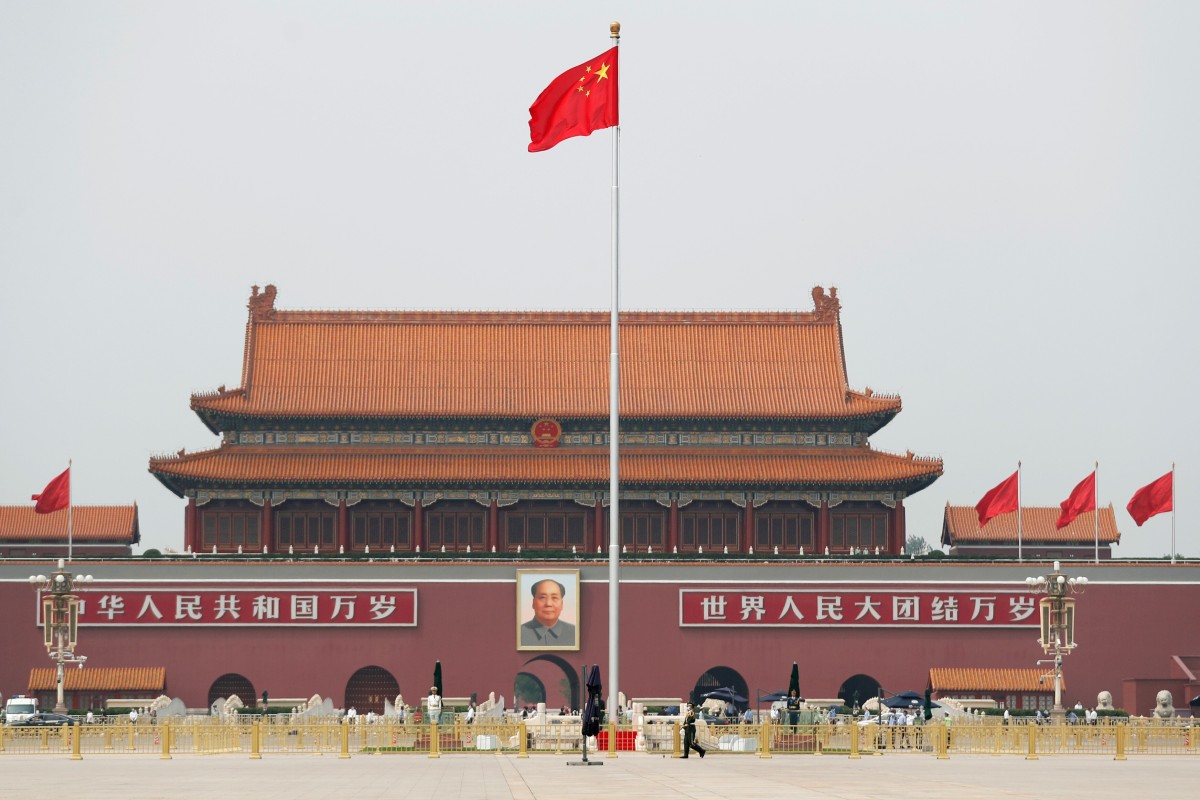
Beijing’s ‘Wolf Warrior’ diplomacy has coincided with a rise of nationalist content on Chinese social media. Photo: Reuters

Beijing is battling allegations that it is running a disinformation campaign on social media, as robust posts by its diplomats in Western countries promoting nationalist sentiment have escalated into a spat between China and other countries, especially the United States.

In the latest in a series of online controversies, the Chinese embassy in France claimed its official Twitter account had been hacked after it featured a cartoon depicting the US as Death, knocking on a door marked Hong Kong after leaving a trail of blood outside doors marked Iraq, Libya, Syria, Ukraine and Venezuela. The inclusion in the image of a Star of David on the scythe also prompted accusations of anti-Semitism.

Top China diplomats call for ‘Wolf Warrior’ army in foreign relations

25 May 2020
“Someone posted a false image on our official Twitter account by posting a cartoon entitled ‘Who is Next?’. The embassy would like to condemn it and always abides by the principles of truthfulness, objectivity and rationality of information,” it said on Monday.

The rise of China’s aggressive “Wolf Warrior” diplomacy has been regarded by analysts as primarily aimed at building support for the government at home but the latest incident is seen as an attempt by Beijing to take back control of the nationalist narrative it has unleashed.

Florian Schneider, director of the Leiden Asia Centre in the Netherlands, said the removal of the embassy’s tweet reflected a constant concern in Beijing about the range of people – including ordinary citizens – who were involved in spreading nationalistic material online.

“The state insists that its nationalism is ‘rational’, meaning it is meant to inspire domestic unity through patriotism but without impacting national interests or endangering social stability,” he said.

“This makes nationalism a mixed blessing for the authorities … if nationalist stories demonise the US or Japan or some other potential enemy, then any Chinese leader dealing diplomatically with those perceived enemies ends up looking weak.

“Trying to guide nationalist sentiment in ways that further the leadership’s interests is a difficult balancing act and I suspect this is partly the reason why the authorities are currently trying to clamp down on unauthorised, nationalist conspiracy theories.”

Too soon: Chinese advisers tell ‘Wolf Warrior’ diplomats to tone it down
14 May 2020
Last month the European Union toned down a report which initially accused China of running a “global disinformation campaign”
to deflect blame for the coronavirus outbreak using “overt and covert tactics”. The section was removed after intervention by Beijing.

The report came after months of social media posts – including by Chinese diplomats – defending China against accusations it had mishandled the coronavirus pandemic and attacking the US and other perceived enemies.

In March, Chinese foreign ministry spokesman Zhao Lijian promoted a conspiracy theory on Twitter suggesting the virus had originated in the US and was brought to China by the US Army. His comments were later downplayed, with China’s ambassador to the US Cui Tiankai saying questions about the origin of the virus should be answered by scientists.

Schneider said this showed that the state-backed nationalistic propaganda online was at risk of backfiring diplomatically.

“The authorities have to constantly worry that they might lose control of the nationalist narrative they unleashed, especially considering how many people produce content on the internet, how fast ideas spread, and how strongly commercial rationales drive misinformation online,” he said.

Last month, a series of widely shared social media articles about people in different countries “yearning to be part of China” resulted in a diplomatic backlash against Beijing. Kazakhstan’s foreign ministry summoned the Chinese ambassador in April to lodge a formal protest against the article.

Following the incident, the Cyberspace Administration of China, the country’s internet regulator which manages the “firewall” and censors material online, announced a two-month long “internet cleansing” to clear privately owned accounts which engage in “smear campaigns”.

A popular account named Zhidao Xuegong was shut down by the Chinese social media platform WeChat’s owner Tencent on Sunday after publishing an article which claimed Covid-19 may have killed 1 million people in the US and suggested the dead were “very likely” being processed as food.

The article had at least 100,000 readers, with 753 people donating money to support the account. According to Xigua Data, a firm that monitors traffic on Chinese social media, the account garnered more than 1.7 million page views for 17 articles in April.

According to a statement from WeChat, the account was closed for fabricating facts, stoking xenophobia and misleading the public.

A journalism professor at the University of Hong Kong said this case differed from the Chinese embassy’s tweet, despite both featuring anti-US sentiment.

Masato Kajimoto, who leads research on news literacy and the misinformation ecosystem, said the closure of the WeChat account seemed to be more about Chinese authorities feeling the need to regulate producers of media content whose motivations were often financial rather than political.

“I would think the government doesn’t like some random misinformation going wild and popular, which affects the overall storylines they would like to push, disseminate and control,” he said.

One way for China to respond to the situation was to fact-check social media and to position itself as a protector facts and defender of the integrity of public information, he said.

“In the age of social media, both fake news and fact-checking are being weaponised by people who try to influence or manipulate the narrative in one way or another,” Kajimoto said.

“Not only China but also many other authoritarian states in Asia are now fact-checking social media. Governments in Singapore, Thailand, Indonesia and other countries all do that.

“Such initiatives benefit them because they can decide what is true and what is not.”

Source: SCMP

08/04/2020

Coronavirus: Carrie Lam takes pay cut, Hong Kong set for HK$138 billion in Covid-19 aid

  • Most of the relief fund earmarked to subsidise employees’ wages in affected industries
  • Lam and ministers slash their salaries following controversy over chief executive’s pay
Many businesses have been forced to close because of the coronavirus outbreak. Photo: Winson Wong

More than 1 million Hong Kong workers will have part of their wages paid for by the government under a HK$137.5 billion package of measures to help businesses and residents struggling during the Covid-19 crisis, while the city’s leader and her ministers have vowed to take a pay cut, the Post has learned.

Revealing the massive relief fund on Wednesday, Chief Executive Carrie Lam Cheng Yuet-ngor said HK$80 billion would go towards the wage scheme, targeting coronavirus-hit industries over six months with individual payments capped at 50 per cent of salaries, up to HK$9,000 a month. The employers receiving the lifeline must pledge not to lay off workers, she added.

Hong Kong records 25 new cases, including two-month-old baby; tally at 960

8 Apr 2020

Lam said the package, together with other recent pledges of financial relief, would cost a total of HK$287.5 billion, causing the budget deficit to surge from HK$139.1 billion this financial year to HK$276.6 billion, which is equivalent to 9.5 per cent of gross domestic product.

The relief deal is equivalent in size to 4.6 per cent of the city’s GDP.

Meanwhile, Lam’s monthly salary will fall to HK$390,000 after rising to HK$434,000 last July.

Lam and her 16 ministers had voluntarily agreed to a 10 per cent pay reduction for a year, the chief executive told the press conference.

The HK$137.5 billion deal – which was given the green light by her Executive Council earlier in the day – aims to safeguard employment and ease the woes of businesses, with the number of confirmed Covid-19 cases in the city reaching 960 on Wednesday.

A source said: “The scheme is aimed at coping with the economic hardship brought by the pandemic in the next six months. More than 1 million employees from various sectors, on top of those directly affected by the government’s social-distancing measures, will benefit.”

Staff affected by the latest social-distancing rules – including businesses forced to close – will benefit from the wage scheme, along with employees in sectors such as tourism and construction, two other sources said.

Some businesses set to benefit would be those related to education, such as tutorial centres, school bus operators and  PE coaches contracted from outside, according to one.

In February, the government unveiled a HK$30 billion fund that included 24 initiatives to help struggling sectors.
‘Lost faith’: EU’s top scientist quits over Covid-19 response
8 Apr 2020

“The government is drawing reference from the British government’s recent practice of paying 80 per cent of salaries of employees in affected industries, although the percentage and cap are lower in Hong Kong,” one source said.

In an unprecedented step announced last month, the UK government said the state would pay grants covering up to 80 per cent of salaries if companies kept workers on the payroll rather than laying them off.

In Singapore, the government has offered to pay 75 per cent of workers’ April wages, capped at S$4,600 (HK$25,000) per person.

The Japanese government on Tuesday approved its largest-ever economic relief package, which includes grants of up to 2 million yen (US$18,350), for small and medium-sized businesses whose revenues had more than halved.

Hongkonger recalls weeks of lockdown in Wuhan, China, the first epicentre of the Covid-19 pandemic
With the Hong Kong government sitting on reserves of more than HK$1.1 trillion, the Professional Commons think tank said the authorities should spend HK$200 billion on businesses and workers, including handing HK$7,500 a month over six months to sacked staff and covering 80 per cent of salaries up to a monthly maximum of HK$25,000 for workers at struggling firms and the self-employed.
Source: SCMP
16/11/2019

China’s PLA soldiers help clean up Hong Kong streets as protesters leave campuses

HONG KONG (Reuters) – China’s People’s Liberation Army (PLA) soldiers in shorts and t-shirts made a surprising appearance in some Hong Kong streets on Saturday, briefly helping residents clean up debris after anti-government protests blocked roads, witnesses said.

The presence of PLA troops on the streets, even to help clean up roads near their base, could stoke further controversy over the Chinese-ruled territory’s autonomous status.

Hong Kong has been rocked by more than five months of demonstrations by protesters angry at perceived Communist Party meddling in the former British colony, which was guaranteed its freedoms when it returned to Chinese rule in 1997.

Beijing denies interfering and has blamed the unrest on foreign influences.

Clashes between protesters and police have become increasingly violent. China has warned that any attempt at independence for Hong Kong will be crushed, but troops have remained inside their base.

Saturday’s clean up followed some of the worst violence seen this year, after a police operation against protesters at the Chinese University of Hong Kong on Tuesday.

The authorities have since largely stayed away from at least five university campuses that had been barricaded by thousands of students and activists who stockpiled petrol bombs, catapults, bows and arrows and other weapons.

Many protesters appeared to have left the campuses by late Saturday, though some remained behind to man makeshift barricades. Hong Kong’s Cross-Harbour Tunnel was still blocked by protesters occupying Polytechnic University.

Earlier, hundreds of pro-China demonstrators gathered by the city’s legislature and police headquarters, waving Chinese and Hong Kong flags. Some held up posters reading “Police we stand with you”, while others chanted “Support the police”.

Pro-China protests have so far attracted much smaller numbers than those angry at Beijing.

RARE TROOP PRESENCE

By late afternoon, the PLA soldiers had left the streets outside Baptist University, beside their barracks in leafy Kowloon Tong.

Chinese troops have appeared on local streets only once since the 1997 handover, to help with cleanup operations after a typhoon in late 2018. It was not immediately clear how many were involved on Saturday.

Calls to the PLA Hong Kong garrison office and a media liaison officer went unanswered.

Demosistō, a pro-democracy organisation, said Saturday’s cleanup operation could set a “grave precedent” if the city’s government invites the military to deal with internal problems.

In August, Beijing moved thousands of troops across the border into Hong Kong in what state news agency Xinhua described as a routine “rotation”.

Foreign envoys and security analysts estimate up to 12,000 troops are now based across Hong Kong — more than double the usual garrison number.

Standing beside a black flag with the slogan “Liberate Hong Kong, Revolution of our Times,” James Wong, 23, was among a handful of protesters still manning a bridge at Baptist University.

“We didn’t want to confront the people and the PLA troops directly,” he told Reuters. “We are not directly against the PLA, but rather the government. But the PLA should not leave their base because this is Hong Kong territory.”

Wong said even after the campus fortifications have been dismantled “Hong Kong will keep resisting until the government responds to our demands”.

Hundreds of residents moved in to help clear barricaded roads near several universities.

Clashes on Saturday saw at least one petrol bomb thrown before anti-government protesters at the campuses retreated. No soldiers appeared to have been involved in the confrontations.

“We just want our lives to continue,” said one resident who was helping clear streets near HKU. “There are many elderly who need to go the hospital and children who need to go to school. I am very sad to see what is happening in my community.”

PRO-POLICE DEMONSTRATION

Saturday’s rally to denounce the anti-government violence drew a mix of young and elderly.

“From the bottom of our hearts, we believe it is the correct thing to support the police in fighting the rioters for Hong Kong citizens,” said a 49-year-old housewife surnamed Kong.

“A lot of people keep silent, afraid of the rioters. It’s time for all the people who are silent to step up and say that’s enough.”

A 70-year-old street cleaner died on Thursday after being hit on the head by one of several bricks police said had been thrown by “masked rioters”. On Monday, police blamed a “rioter” for dousing a man in petrol and setting him on fire. The victim is in critical condition.

On the same day, police shot a protester in the abdomen. He was in a stable condition.

Many pro-police protesters laid white flowers outside the government office to pay their respects to the cleaner. Others applauded and cheered the police, some bowing and giving thumbs up as they walked past riot police on duty.

Authorities said on Saturday that a highway blocked by anti-government protesters on Friday had reopened after being cleared of debris and petrol bombs.

Train services suspended earlier in the week were gradually resuming, metro operator MTR Corp (0066.HK) said.

Source: Reuters

29/09/2019

Are China’s grandparents reaching their limits on free childcare?

  • Millions of Chinese children are raised by their grandparents but some seniors are demanding compensation
For generations in China grandparents have provided childcare, but some are no longer willing to do so for free. Photo: Shutterstock

The traditional role of grandparents in caring for China’s children has been called into question with two recent lawsuits sparking debate about whether seniors should be paid for their efforts.

Two grandmothers took their demands for compensation to court in separate cases which have highlighted the reliance of Chinese workers on their parents to provide childcare while they pursue professional advancement.

A woman in Mianyang, in the southwestern province of Sichuan, was awarded more than 68,000 yuan (US$9,500) by a local court after she sued her son and daughter-in-law for the costs of raising her nine-year-old grandchild, according to Red Star News.

The woman, identified only by her surname Wang, had been the child’s full-time carer for eight years after his parents left home to seek better-paid jobs elsewhere. Wang said she had taken care of most of her grandson’s living expenses and had decided to seek compensation when his parents said they were considering a divorce.

They should respect our contribution. Grandmother Wang, Sichuan province

“I only want to let them know through this lawsuit that it’s their obligation to raise their children,” she was reported as saying. “The young ones should not take it for granted that old people ought to look after their grandchildren. They should respect our contribution.”

Despite winning the case, she has not received a penny and the boy still lives with her.

In another case, three months ago, a Beijing court supported a woman’s demand for compensation for helping to raise her granddaughter since her birth in 2002.

The stories of the two women generated a public reflection on the Chinese way of childcare which, for generations, has involved leaving most – if not all – of the burden on grandparents.

One of 60 million: life as a ‘left-behind’ child in China

From a cultural perspective, it has been a matter of course in a country with a long history of several generations living under one roof, for grandparents to participate in child rearing, according to Xu Anqi, a researcher specialising in family studies at the Shanghai Academy of Social Sciences.

“Today, as people face fierce competition and great pressure from work, it’s still common to rely on their old parents to look after their children,” she said.

While rapid urbanisation in recent decades has broken up multi-generational households, Chinese elderly still take an active role in child rearing, with many relocating to their children’s cities to take on the job.

Millions more families do it the other way round – with parents leaving children in their hometown with the grandparents while they seek better paying jobs in the cities. In August last year, according to the Ministry of Civil Affairs, China had nearly 7 million “left behind kids”, as they are known.

My little granddaughter is adorable, and generally I enjoy doing all this.Li Xiujuan, grandmother

“Many grandmothers like me would joke that we are ‘unpaid nannies’, but at the same time we feel it’s our responsibility to help them out – they would be in financial stress if one of them quit or they hired a nanny,” said Li Xiujuan, who relocated from her hometown in the central province of Henan to Shanghai two years ago to help look after her granddaughter.
“I’m a 24-hour nanny for my grandkid. I prepare food for her, wash her clothes, attend early childhood classes with her, take her for a walk in the park twice a day, sleep beside her at noon and night …” she said.
“I never cared for my daughter when she was little like I do her daughter now. You know, it was also her grandmother who mainly took care of her daily life when she was young,” Li said, laughing.
“My little granddaughter is adorable, and generally I enjoy doing all this. The hard part is that I miss my friends and relatives back home. We don’t have friends here. I have plenty of things to do at home, but here, nothing but babysitting. People are polite, but it’s difficult to make new friends,” she said.
‘Left behind’ sisters cry when parents leave home to go to work
In a 2017 study of about 3,600 households in six major cities including Beijing and Guangzhou, the Chinese Society of Education found almost 80 per cent of surveyed households had at least one grandparent as carer before children began primary school.
The study also showed that 60 per cent of parents still relied on help from grandparents after children were old enough for primary school at the age of six.
Whether grandparents should be compensated for their efforts split a poll of 49,000 users conducted by social media platform Weibo in late June, with half believing that the older generation should be paid for raising their grandchildren. Only 2.3 per cent said babysitting grandchildren was “an unalterable principle” for the elderly.
“This arrangement could be well managed and improve blood ties if children reward the elderly in their own ways, such as sending gifts on holidays and taking them on trips,” Shanghai researcher Xu said.

I think what they need more is words of appreciation, which many of us have neglected. David Dai, Beijing parent

Grandmother Li agreed: “I think regular payment is a little awkward, but I do expect some kind of reward, like cash gifts on festivals and daily necessities as presents.”
David Dai, a 30-year-old white collar worker in Beijing, said how to reward grandparents for their contribution depended on the financial situation of each household.
“My parents are farmers – they are in good shape and not so old – in their late 50s, and if they didn’t come all the way from my hometown in Anhui to Beijing to look after my son, they would still be taking some odd jobs,” he said.
“Therefore, besides covering their living costs at my place, I give them cash gifts on their birthdays, the Spring Festival and other important occasions, because babysitting their grandchild means they lose the opportunity to work,” he added.
“In some families, the grandparents might have retired and have a good pension. They don’t lack money and enjoy spending time with their grandkids. I don’t think they need to be paid. I think what they need more is words of appreciation, which many of us have neglected,” Dai said.
China boosts childcare and maternal health services in bid to lift birth rate
But for those who never show any gratitude, their parents have every reason not to offer child rearing help or to demand payment, Xu said.
Zhang Tao, a lawyer at the Hiways Law Firm in Shanghai, noted that as long as at least one parent of a child was living, the grandparents had no obligation to help with childcare.
“The grandparents should be compensated for the money they have paid for the child’s education, medical fees, and accommodation from the beneficiary,” he said.
But whether they should be paid has become the latest controversy as more grandparents find it a burden.
Source: SCMP
31/08/2019

Assam NRC: What next for 1.9 million ‘stateless’ Indians?

Final Draft of National Register of Citizens of India (NRC) released on July 30, 2018Image copyright GETTY IMAGES
Image caption Four million people were stripped of their citizenship in the draft list last July

India has published the final version of a list which effectively strips about 1.9 million people in the north-eastern state of Assam of their citizenship.

The National Register of Citizens (NRC) is a list of people who can prove they came to the state by 24 March 1971, the day before neighbouring Bangladesh declared independence from Pakistan.

People left off the list will have 120 days to appeal against their exclusion.

It is unclear what happens next.

India says the process is needed to identify illegal Bangladeshi migrants.

It has already detained thousands of people suspected of being foreigners in temporary camps which are housed in the state’s prisons, but deportation is currently not an option for the country.

The process has also sparked criticism of “witch hunts” against Assam’s ethnic minorities.

A draft version of the list published last year had four million people excluded.

What is the registry of citizens?

The NRC was created in 1951 to determine who was born in Assam and is therefore Indian, and who might be a migrant from neighbouring Bangladesh.

The register has been updated for the first time.

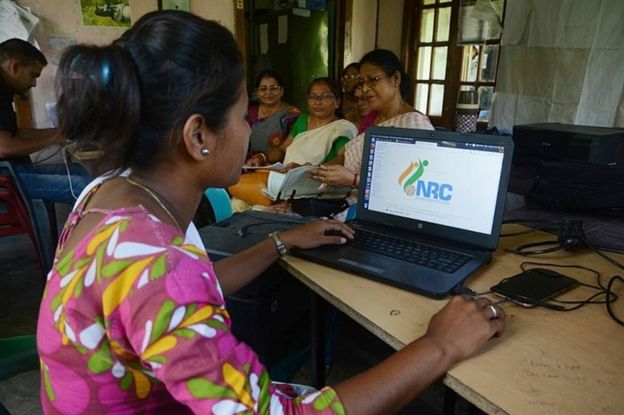
Indian worker of National Register of Citizens (NRC) office checks different documents which were submitted by people for NRC ahead of the release of the final draft of NRC in Guwahati, Assam, India, 26 August 2019.Image copyright EPA
Image caption The NRC was created in 1951 to determine who was born in the state and is Indian

Families in the state have been required to provide documentation to show their lineage, with those who cannot prove their citizenship deemed illegal foreigners.

Prime Minister Narendra Modi’s Hindu nationalist Bharatiya Janata Party (BJP) has long railed against illegal immigration in India but has made the NRC a priority in recent years.

Presentational grey line

An anxious wait

By Rajini Vaidyanathan, BBC News, Assam

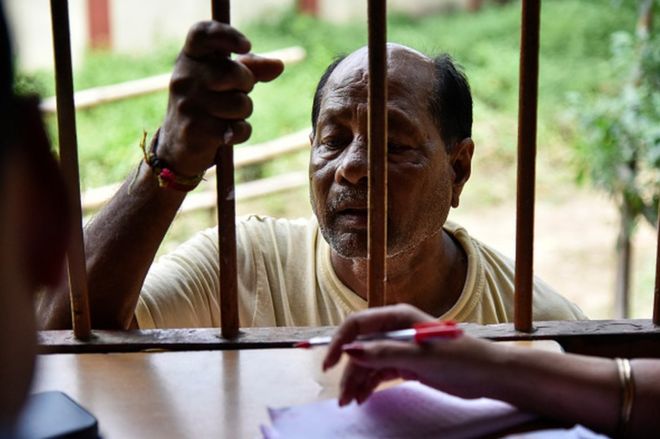
A small community centre in the village of Katajhar is being guarded by two members of the Indian army. Outside, a line of people wait. Some are clutching plastic bags containing documents.

As they enter one of two rooms, an official runs his eyes down a print-out to see if their names or photos are on it. This list – the National Register of Citizens – is one with huge consequences. And so there’s fear and trepidation as people here find out whether they’ve been included.

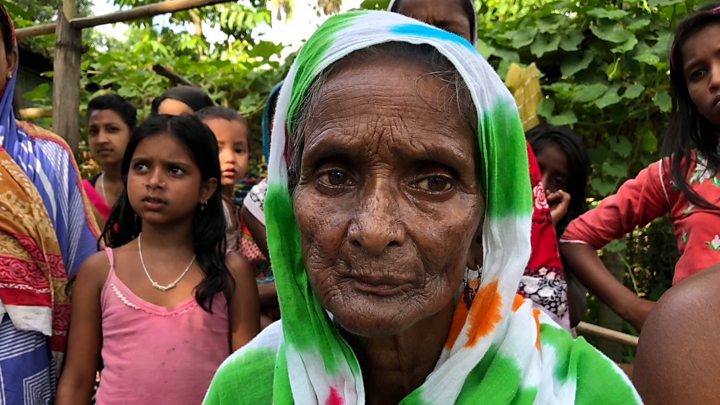
Many here who haven’t made it tell me it’s a mistake as they show me paperwork they say proves they belong in this country.

None of Asia Khatun’s family of nine made the list. They now have the chance to appeal but there’s real fear about what might come next. “I’d rather die than go to a detention centre,” she tells me. People here are angry but they’re also scared.

Presentational grey line

Why is the registry happening in Assam?

Assam is one India’s most multi-ethnic states. Questions of identity and citizenship have long vexed a vast number of people living there.

Among its residents are Bengali and Assamese-speaking Hindus, as well as a medley of tribespeople.

A third of the state’s 32 million residents are Muslims, the second-highest number after Indian-administered Kashmir. Many of them are descendants of immigrants who settled there under British rule.

But illegal migration from neighbouring Bangladesh, which shares a 4,000-km long border with India, has been a concern there for decades now. The government said in 2016 that an estimated 20 million illegal immigrants were living in India.

So have 1.9 million people effectively become stateless?

Not quite. Residents excluded from the list can appeal to the specially formed courts called Foreigners Tribunals, as well as the high court and Supreme Court.

However, a potentially long and exhaustive appeals process will mean that India’s already overburdened courts will be further clogged, and poor people left off the list will struggle to raise money to fight their cases.

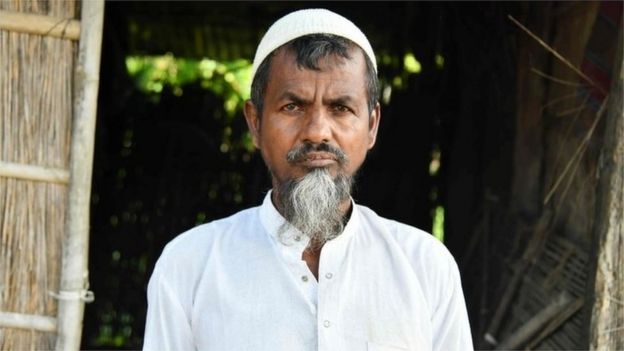
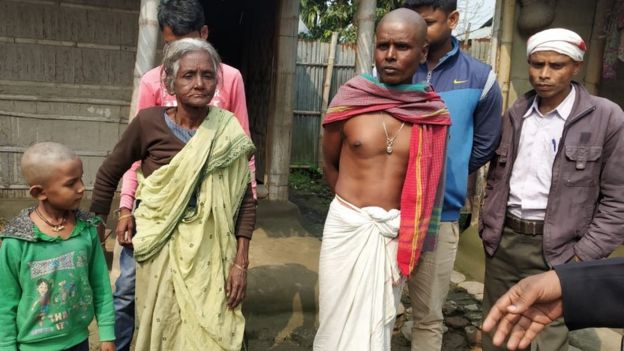
In this photo taken on August 29, 2019, Saheb Ali, 55, poses for a photograph at his home in Khutamari village in Goalpara district, some 160km from Guwahati, the capital city of India's north-eastern state of AssamImage copyright AFP
Image caption Saheb Ali, 55, from Goalpara district, has not been included in the list

If people lose their appeals in higher courts, they could be detained indefinitely.

Some 1,000 people declared as foreigners earlier are already lodged in six detention centres located in prisons. Mr Modi’s government is also building an exclusive detention centre, which can hold 3,000 detainees.

“People whose names are not on the final list are really anxious about what lies ahead. One of the reasons is that the Foreigners Tribunal does not have a good reputation, and many people are worried that they will have to go through this process,” Sangeeta Barooah Pisharoty, author of Assam: The Accord, The Discord, told the BBC.

Why have been the courts so controversial?

The special courts were first set up in 1964, and since then they have declared more than 100,000 people foreigners. They regularly identify “doubtful voters” or “illegal infiltrators” as foreigners to be deported.

But the workings of the specially formed Foreigners Tribunals, which have been hearing the contested cases, have been mired in controversy.

There are more than 200 such courts in Assam today, and their numbers are expected to go up to 1,000 by October. The majority of these tribunals were set up after the BJP came to power in 2014.

The courts have been accused of bias and their workings have often been opaque and riddled with inconsistencies.

Media caption Living in limbo: Assam’s four million unwanted

For one thing, the burden of proof is on the accused or the alleged foreigner.

For another, many families are unable to produce documents due to poor record-keeping, illiteracy or because they lack the money to file a legal claim.

People have been declared foreigners by the courts because of differences in spellings of names or ages in voter rolls, and problems in getting identity documents certified by authorities. Amnesty International has described the work by the special courts as “shoddy and lackadaisical”.

Journalist Rohini Mohan analysed more than 500 judgements by these courtsin one district and found 82% of the people on trial had been declared foreigners. She also found more Muslims had been declared foreigners, and 78% of the orders were delivered without the accused being ever heard – the police said they were “absconding”, but Mohan found many of them living in their villages and unaware they had been declared foreigners.

“The Foreigners Tribunal,” she says, “must be made more transparent and accountable.”

A decorated Indian army veteran, Mohammed Sanaullah spent 11 days in a detention camp in June after being declared a “foreigner”, prompting national outrage.

Both the citizen’s register and the tribunals have also sparked fears of a witch hunt against Assam’s ethnic minorities.

Have the minorities been targeted?

Many say the list has nothing to do with religion, but activists see it as targeting the state’s Bengali community, a large portion of whom are Muslims.

They also point to the plight of Rohingya Muslims in neighbouring Bangladesh.

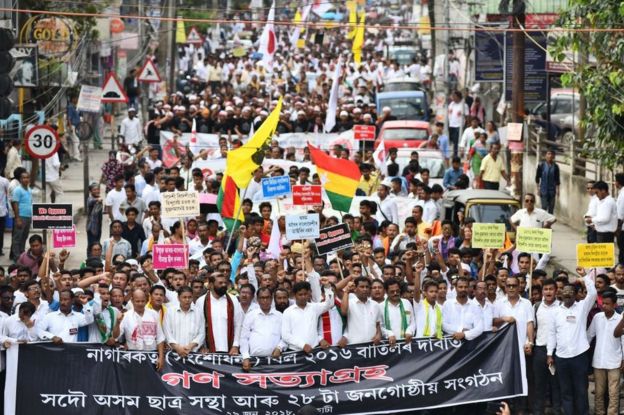
Activists in Assam take part in a protest against the a bill that seeks to give Hindu migrants more rights.Image copyright GETTY IMAGES
Image caption The move to make millions of people stateless will probably spark protests

However significant numbers of Bengali-speaking Hindus have also been left off the citizenship list, underscoring the communal and ethnic tensions in the state

“One of the communities worst affected by the list are the Bengali Hindus. There are as many of them in detention camps as Muslims. This is also the reason just days before NRC is to be published the BJP has changed tack, from taking credit for it to calling it error-ridden. That is because the Bengali Hindus are a strong voter base of the BJP,” says Barooah Pisharoty.

The human tragedy

Fearing possible loss of citizenship and detention after exclusion from the list, scores of Bengali Hindus and Muslims have killed themselves since the process to update the citizen register started in 2015, activists say.

And in an echo of US President Donald Trump’s policy to separate undocumented parents and children, families have been similarly broken up in Assam.

Detainees have complained of poor living conditions and overcrowding in the detention centres.

Bhaben Das' family get ready to perform his final ritesImage copyright CITIZENS FOR JUSTICE AND PEACE
Image caption A father and son killed themselves 30 years apart because of citizenship doubts (photo shows funeral)

One detainee told a rights group after his release he had been taken to a room which had a capacity for 40 people, but was filled with around 120 people. People who have been declared foreigners as well as many inmates have been suffering from depression. Children have also been detained with their parents.

Human rights activist Harsh Mander, who visited two detention centres, has spoken about a situation of “grave and extensive human distress and suffering”.

What happens to people who are declared foreigners?

The BJP which rules the state, has insisted in the past that illegal Muslim immigrants will be deported. But neighbouring Bangladesh will definitely not accede to such a request.

Many believe that India will end up creating the newest cohort of stateless people, raising the spectre of a homegrown crisis that will echo that of the Rohingya people who fled Myanmar for Bangladesh.

It is not clear whether the people stripped of their Indian citizenship will be able to access welfare or own property.

One possibility is that once they are released, they will be given work permits with some basic rights, but will not be allowed to vote.

Source: The BBC

02/03/2019

‘One chowkidar has defamed all others’: Rahul Gandhi’s renews attack on PM Modi

Rahul Gandhi renewed his attack on PM Modi over Rafale deal controversy during his public rally in Jharkhand

INDIA Updated: Mar 02, 2019 15:58 IST

HT Correspondent
HT Correspondent
Hindustan Times, Ranchi
Rahul Gandhi,ranchi,jharkhand
Congress president Rahul Gandhi addressing a public rally in Jharkhand on Saturday.(Photo: Twitter/INCIndia)

Congress president Rahul Gandhi on Saturday renewed his attack on Prime Minister Narendra Modi reiterating his charge that he misled the people on the issues of providing corruption-free government, job creation and addressing farm distress. Gandhi said PM Modi’s image has changed from a leader who promised to bring “achchhe din” (better time) to “chowkidar chor hai” (the watchman is a thief).

Speaking at the Congress’s Parivartan Ulgulan Maha Rally at the Morahbad in Jharkhand, Gandhi said, “One chowkidar has defamed all chowkidars of India…All the chowkidars of India are honest…Everyone knows that when someone says chowkidar chor hai, it refers to Narendra Modi.”

The Congress president alleged that PM Modi “snatched” Rs 30,000 crore from the Indian Air Force (IAF), which protects the country, and the Hindustan Aeronautics Limited (HAL) and gave it to industrialist Anil Ambani in Rafale deal.

Gandhi has been targeting PM Modi over Rs 58,000-crore Rafale deal with France that India signed in 2016 for the purchase of 36 fighter planes. A similar deal was being negotiated when the Congress-led United Progressive Alliance (UPA) was in power before 0214 for the purchase of 126 Rafale jets.

The Modi government renegotiated the deal with France terming the previous one unworkable. The Congress and other opposition parties have alleged that commercial favouritism was done in Rafale deal.

Gandhi on several occasions has alleged that PM Modi personally ensured that Ambani’s firm, Reliance Defence gets contract in Rafale deal. Both the government and the Reliance Defence have rejected the allegation as baseless. Reliance Defence is an off-set partner of the Dassault Aviation, the manufacturer of Rafale fighter jets.

Addressing his first rally in Jharkhand since 2014, the Congress president repeated his charge against PM Modi saying, “It is a matter of shame that Indian Air Force protects the country, air force pilots sacrifice their lives but the prime minister steals money from the air force and puts it in Anil Ambani’s pockets.”

He claimed that in the upcoming Lok Sabha elections, the “chowkidar” will be defeated. He promised that if voted to power the Congress government will implement a minimum income guarantee programme for the poor.

Source: hindustan Times

27/01/2019

Trudeau fires Canada’s ambassador to China amid Huawei controversy

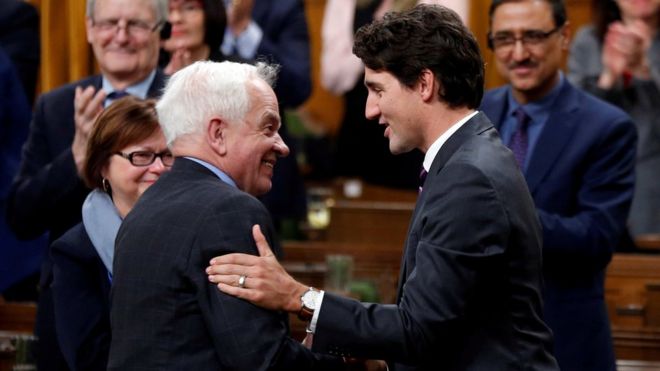
Canada's Prime Minister Justin Trudeau (R) shakes hands with former Immigration Minister John McCallumImage copyrightREUTERS
Image captionJustin Trudeau (R) appointed John McCallum ambassador to China in 2017

Prime Minister Justin Trudeau has fired Canada’s ambassador to China, John McCallum.

It follows controversial comments Mr McCallum made about an extradition case involving a senior executive from the Chinese telecoms giant Huawei.

Mr Trudeau said in a statement he had asked John McCallum to step down, but did not offer a reason.

The detention of Meng Wanzhou, at the request of the US, angered China and soured Canada’s relations with Beijing.

Ms Meng, Huawei’s chief financial officer, is accused by the US of evading sanctions on Iran. Both she and Huawei deny those allegations.

What did Justin Trudeau say?

In a statement, the Canadian prime minister said: “Last night I asked for and accepted John McCallum’s resignation as Canada’s ambassador to China.”

The veteran diplomat, Mr Trudeau added, had served Canadians honourably and with distinction with many positions in cabinet.

He also thanked the diplomat and his family for their service.

What about the ambassador’s remarks?

Mr McCallum caused controversy on Tuesday when he publicly argued that the US extradition request for Ms Meng was seriously flawed.

The next day he issued a statement saying that he “misspoke” and regretted that his comments had created “confusion”.

But on Friday he was quoted as saying it would be “great for Canada” if the US dropped the request.

Mr McCallum was appointed Canada’s ambassador to China in 2017, stepping down as the immigration minister.

Canadian media say he was eager to take over the posting because of his strong personal connection to China.

Mr McCallum’s wife is ethnically Chinese, and he had a large Chinese-Canadian population in his former constituency in Ontario.

Mr McCallum also served as Canada’s defence minister in 2002-03.

What’s the latest on Meng Wanzhou’s case?

She was arrested on 1 December in Canada’s western city of Vancouver at the request of the US.

She was later granted a C$10m (£5.7m; $7.6m) bail by a local court. But she is under surveillance 24 hours a day and must wear an electronic ankle tag.

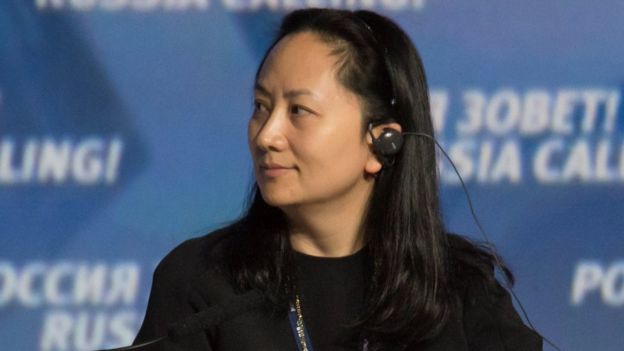
Huawei's Meng WanzhouImage copyrightREUTERS
Image captionMeng Wanzhou denies all the allegations against her

Earlier this month, US officials confirmed they planned to pursue the extradition of Ms Wanzhou.

Washington has 60 days to file a formal demand for extradition, a deadline that will be reached 30 January.

China’s foreign ministry has urged US officials to withdraw the arrest order and refrain from moving ahead with the extradition request.

Ms Meng’s case has led to rising diplomatic tensions between Canada and China.

Michael Spavor (L) and Michael Kovrig (composite image)Image copyrightAFP
Image captionCanadian nationals Michael Spavor (left) and Michael Kovrig have been put under “compulsory measures”

Earlier this month, a Canadian man was sentenced to death in China after a court said a jail term of 15 years was too lenient.

Two other Canadians – businessman Michael Spavor and former diplomat Michael Kovrg – were arrested following the detention of Ms Meng.

Some China analysts believe that the arrests were a tit-for-tat response to her detention, a claim Chinese officials have denied.

Source: The BBC

Law of Unintended Consequences

continuously updated blog about China & India

ChiaHou's Book Reviews

continuously updated blog about China & India

What's wrong with the world; and its economy

continuously updated blog about China & India