Chindia Alert: You’ll be Living in their World Very Soon
aims to alert you to the threats and opportunities that China and India present. China and India require serious attention; case of ‘hidden dragon and crouching tiger’.
Without this attention, governments, businesses and, indeed, individuals may find themselves at a great disadvantage sooner rather than later.
The POSTs (front webpages) are mainly 'cuttings' from reliable sources, updated continuously.
The PAGEs (see Tabs, above) attempt to make the information more meaningful by putting some structure to the information we have researched and assembled since 2006.
BEIJING (Reuters) – China’s factory activity likely rose for a second straight month in April as more businesses re-opened from strict lockdowns implemented to contain the coronavirus outbreak, which has now paralysed the global economy.
The official manufacturing Purchasing Manager’s Index (PMI), due for release on Thursday, is forecast to fall to 51 in April, from 52 in March, according to the median forecast of 32 economists polled by Reuters. A reading above the 50-point mark indicates an expansion in activity.
While the forecast PMI would show a slight moderation in China’s factory activity growth, it would be a stark contrast to recent PMIs in other economies, which plummeted to previously unimaginable lows.
That global slump, caused by heavy government-ordered lockdowns, as well as the cautious resumption of business in China, suggests any recovery in the world’s second-largest economy is likely to be some way off.
“The recovery so far has been led by a bounce-back in production, however, the growth bottleneck has decisively shifted to the demand side, as global growth has weakened and consumption recovery has lagged amid continued social distancing,” Morgan Stanley said in a note.
“The expected slump in external demand has likely capped further recovery in industrial production.”
The latest official data showed 84% of mid-sized and small business had reopened as of April 15, compared with 71.7% on March 24.
Hobbled by the coronavirus, China’s economy shrank 6.8% in the first quarter from a year earlier, the first contraction since current quarterly records began.
That has left Chinese manufacturers with reduced export orders and a logistics logjam, as many exporters grapple with rising inventory, high costs and falling profits. Some have let workers go as part of the cost-cutting efforts.
A China-based brokerage Zhongtai Securities estimated that the country’s real unemployment rate, measured using international standards, could exceed 20%, equal to more than 70 million job losses and much higher than March’s official reading of 5.9%.
Sheng Laiyun, deputy head at the statistics bureau, said on Sunday migrant workers and college graduates are facing increasing pressures to secure jobs, while official jobless surveys show nearly 20% of employed workers not working in March.
Chinese authorities have rolled out more support to revive the economy. The People’s Bank of China earlier in April cut the amount of cash banks must hold as reserves and reduced the interest rate on lenders’ excess reserves.
(Reuters) – Europe’s auto industry is facing a slowdown in demand for new cars, as well as disruption from the coronavirus epidemic and import tariffs between China and the United States. As a result, several companies have announced plans to cut costs and jobs.
Volkswagen said in March 2019 it would cut up to 7,000 positions and aim to deliver 5.9 billion euros ($6.7 billion) of annual savings at its core VW brand by 2023.
Volkswagen’s luxury car unit Audi (NSUG.DE) said in November it would cut one in ten jobs by 2025, up a total of 9,500, to fund its shift towards electric vehicle production.
PSA’s German unit Opel said in February it was ruling out forced redundancies until July 2025, but would reopen a voluntary leave programme for older employees.
Unions at Fiat Chrysler, which is planning a merger with PSA, said management promised to avoid redundancies and get all group employees off special furlough arrangements and back to work by 2022.
The merger aims to achieve annual savings of 3.7 billion euros.
In November, BMW management and its German labour representatives reached an agreement on changes to payout schemes and bonuses to reduce costs in Germany while avoiding “drastic measures”. BMW has said it will keep headcount stable, as hiring in software development will offset voluntary staff reductions in other areas.
In February, German business daily Handelsblatt reported Daimler (DAIGn.DE) was intensifying its cost-cutting measures and planning to cut up to 15,000 jobs. Daimler declined to comment.
Daimler Chief Executive Ola Kaellenius said in February the company would cut 1,100 leadership positions worldwide, or about 10% of its management over the next three years.
The company also said it would revamp the management of its portfolios to remove duplicate layers between Mercedes-Benz and Daimler AG.
VOLVO CARS
In July 2019, Volvo Cars announced plans to cut fixed costs by 2 billion Swedish crowns ($214 million), adding the savings drive – on which it did not provide details – would come into effect in the second half of 2019 and run into the first half of 2020.
JAGUAR LAND ROVER
In February, Britain’s biggest carmaker Jaguar Land Rover (TAMO.NS) said it would reduce or stop production on certain days at two of its British factories as it was pursuing cost-cutting measures in response to falling demand.
A month earlier, the company said it would cut around 10% of the workforce at its northern English Halewood factory, which has about 4,500 employees, as it was changing shift patterns to boost efficiency at the site.
After Renault’s first full-year loss in a decade, the French automaker said it would cut costs by 2 billion euros over the next three years and did not exclude job cuts during a performance review across its factories.
BOSCH
In January, German engineering company Bosch said it would make staff changes via shorter working hours, voluntary redundancy and severance packages, but declined to provide a global figure for headcount reductions.
German automotive supplier Continental said in November it would pare back its engine manufacturing activities, which could result in around 5,040 job losses by 2028.
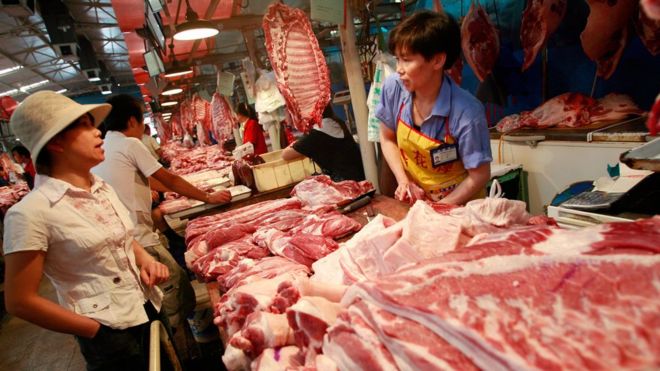
China is set to release pork supplies from its central reserves as it moves to tackle soaring prices and shortages caused by an outbreak of swine fever.
A state-backed body will auction 10,000 tonnes of frozen pork from its strategic reserves on Thursday.
China, the world’s biggest producer and consumer of pork, has struggled to control the spread of the disease.
In a bid to stabilise prices, a state-backed group that manages the pork reserves will auction imported frozen pork from countries including Denmark, France, the US and UK.
Only 300 tonnes will be sold to each bidder at the auction.
Pork is used widely in Chinese festivals, and the auction comes as the country prepares to celebrate a week-long national holiday for the 70th anniversary of the People’s Republic of China.
Julian Evans-Pritchard, senior China economist at Capital Economics, said the auction would provide slight relief to the industry but would not do much to contain prices.
“In itself, I don’t think it will be able to prevent pork prices from rising further unless they manage to get the disease under control,” he said.
Beijing created its strategic pork reserve in 2007 but the size of the stockpile is not known.
Capital Economics estimates that at most, the stockpile would hold four days’ worth of pork supplies to feed China.
About 1.2 million pigs have been culled in China in an effort to halt the spread of swine fever since August 2018, according to data from the Food and Agriculture Organization, a UN agency.
In April, Rabobank estimated Chinese pork production would fall by up to 35% this year due to swine fever.
The supply shortage has sent pork prices soaring and has eaten into household incomes.
That poses a fresh challenge for the Chinese economy, which is already facing a slowdown and a trade war between Beijing and Washington.
HONG KONG/LONDON (Reuters) – HSBC Holdings turned in a disappointing annual profit as higher costs and a stocks rout chipped away at its trading businesses, while warning that an economic slowdown in China and Britain would throw up further hurdles this year.
Chief Executive John Flint, rounding off his first year at the helm of the company, said the bank may have to scale back investment plans in order to avoid missing a key target known as ‘positive jaws’ – which tracks whether it is growing revenues faster than costs – for a second straight year.
HSBC remains alert to the downside risks of the current economic environment, economic environment and the future path of interest rates, Flint said, adding the bank was “committed” to the growth targets announced in June.
“We will be proactive in managing costs and investment to meet the risks to revenue growth where necessary, but we will not take short-term decisions that harm the long-term interests of the business,” Flint said on Tuesday, after HSBC reported a lower-than-expected 16 percent rise in 2018 profit before tax.
In June, Flint had said HSBC would invest $15-$17 billion in three years in areas including technology and China, while keeping profitability and dividend targets little changed.
ADVERTISEMENT
“The key thing is just to moderate the pace of investments … not to cancel it or change the shape of the investments,” Flint told Reuters.
The bank said it failed to achieve positive jaws in 2018 due to the negative market environment in the fourth quarter.
A combination of U.S.-China trade tensions, central banks turning off the money taps and cooling growth in former hot spots wiped 10 percent off MSCI’s 47-country world stocks index last year, its first double-digit loss in any year since the 2008 global financial crisis.
GROWING BUT SLOWLY
Flint’s comments come as an economic slowdown in China, exacerbated by a bitter Sino-U.S. trade war, challenges HSBC’s strategy of pouring more resources into Asia where it already makes more than three quarters of its profits.
China’s economic growth slowed to 6.6 percent in 2018, the weakest in 28 years, weighed down by rising borrowing costs and a clampdown on riskier lending that starved smaller, private companies of capital and stifled investment.
Pressure on the world’s second-largest economy could increase if Beijing and Washington do not reach a deal soon to end their year-long trade dispute, which is taking a growing toll on export-reliant economies from Asia to Europe.
HSBC’s profits in Asia grew by 16 percent to $17.8 billion last year, accounting for 89 percent of the group profit.
“Clearly our customers are really more cautious and are more thoughtful around this trade war with the U.S.,” Flint said.
“It’s possible that we’ll see slightly lower growth rate this year but we are still going to see a growth rate.”
Since taking over from Stuart Gulliver last February, Flint has largely stuck to the same China-focused strategy as his predecessor while attempting to revive HSBC’s ailing U.S. franchise and putting less emphasis on its investment bank.
Europe’s biggest bank by market value is also being buffeted by headwinds from Britain, which grew at its slowest in half a year in the three months to November as factories suffered from tough global trade conditions and the approach of Brexit.
HSBC joined its London-based peer Royal Bank of Scotland in warning that uncertainties related to Brexit could drive businesses under.
“The longer we have the uncertainty the worse it’s going to be for the customers. Customers are absolutely postponing investment decisions … and that’s been the part of this slowdown that we have seen in the U.K.,” Flint said.
DISAPPOINTING PROFIT
Earlier in the day, HSBC reported a profit before tax of $19.9 billion for 2018, versus $17.2 billion the year before, but below an average estimate of $22 billion, according to Refinitiv data based on forecasts from 17 analysts.
HSBC’s Hong Kong shares dropped as much as 2.7 percent after the earnings announcement.
The stock was down 1.4 percent at 0732 GMT, while the Hong Kong market index was 0.3 percent lower.
HSBC said it would pay a full-year dividend of $0.51 per share, roughly in line with analysts’ expectations. The bank was confident of maintaining the dividend at this level, it said.
The bank’s core capital ratio, a key measure of financial strength, fell to 14 percent at end-December from 14.5 percent at end-2017, mainly due to adverse foreign exchange movements.



 CHINDIA ALERT: You'll be living in their world, very soon