Archive for ‘CPC’

02/10/2019

Commentary: New China turns 70, witnessing a golden age

BEIJING, Oct. 2 (Xinhua) — While turning 70 often signals the beginning of a person’s twilight years, for the People’s Republic of China (PRC) it marks a golden age full of hope and vigor.

The PRC celebrated its 70th birthday on Oct. 1. China’s transformation from an agricultural society isolated from the West into the world’s second-largest economy open wide is nothing short of a miracle.

More importantly, it has charted a new path for developing countries to modernize.

Seven decades ago, the war-ravaged country started from scratch. Observers are astonished at China’s large-scale modernization, its reduction of the number of people living in poverty and the sheer volume of its consumer market. Their heads have been turned not only because of the speed of the transition but also by the unique path taken to realize this great transformation.

Reflecting on its past and present, and through experimentation, China has identified and will continue down the right path — socialism with Chinese characteristics.

Reform is the engine of China’s miracle. There is no ready-made solution for the development issues facing China. From creating special economic zones to building free trade pilot zones, from carrying out family-based production contracts to revitalizing state-owned enterprises, China has been one of the most successful countries in piloting reforms over the past decades. Now the reform is more in-depth and more comprehensive in economic, political, cultural, social and ecological sectors.

The Chinese government stresses being effective and responsive to the public interest. Development outlines are far-sighted. For example, the five-year plans are made to deal with comprehensive aspects that concern human development: food, transportation, communication, environment, health and education. These plans are a priority for the government.

Of course these achievements could never have been realized without the leadership of the CPC.

From the people and for the people, the CPC has always upheld its principle of striving for the happiness of the people and the rejuvenation of the nation.

At a life-or-death moment, the CPC shouldered the mission of saving the nation from existential peril. After 28 years of bloody struggle, it led the Chinese people to overthrow the “three mountains” placed on their heads and put an end to the semi-colonial and semi-feudal society of old China. Gone are the days where any attempt to bully China with “fists” or “intimidation” would succeed.

Despite overseas doubts, misunderstandings and predictions that its survival would be short-lived, the CPC has stunned the world with its leadership, innovative theories and ability to unite and organize the people.

It abolished the agricultural tax that had been in place for more than 2,600 years; it established a political system in which people are masters of their own affairs; it did its utmost to help people shake off poverty and keep nearly 1.4 billion people well-off.

No ruling party in the world can match the CPC’s record of adhering to the truth, versing itself in self-reform and self-purification, and turning impossibility into certainty in the face of difficulties and challenges, again and again.

The 70-year journey was never smooth. Trials and hardships abounded. The Chinese people dealt with floods and massive earthquakes and guarded against SARS and financial tsunamis. Yet these twists and turns never blocked China’s way forward but made it more sober, determined and mature.

Today, more than at any other time in history, China is closer to, more confident and more capable of achieving the great rejuvenation of the Chinese nation. However, lofty goals are never easily reached.

The world has been undergoing tremendous changes unseen in a century. Resistant external forces and headwinds still remain. “Zero-sum game” and “superior civilization” mentalities, among others, are prevailing.

The CPC will continue to lead the Chinese people to fight trade bullying, blackmailing and hegemonism. Only the CPC can lead China to emerge as a stronger country.

It all started long ago, and the journey is far from over.

Source: Xinhua
17/02/2019

China-Europe great example of cultural dialogue, engagement: senior Chinese official

MUNICH, Germany, Feb. 16 (Xinhua) — People-to-people and cultural exchanges are thriving, making China and Europe a great example of cultural dialogue and engagement, a senior Chinese official said here Saturday.

Yang Jiechi, a member of the Political Bureau of the Communist Party of China (CPC) Central Committee, said this in his keynote speech themed “Working for a Community with a Shared Future for Mankind by Promoting International Cooperation and Multilateralism” at the 55th Munich Security Conference.

Fifteen years since the establishment of the China-EU comprehensive strategic partnership, the two sides have developed an all-dimensional and multi-tiered framework of exchanges and cooperation covering wide-ranging areas, said Yang, who is also director of the Office of the Foreign Affairs Commission of the CPC Central Committee.

Efforts to build China-EU partnerships for peace, growth, reform and civilization have made substantial progress, Yang noted.

“It is essential that our two sides continue to draw on each other’s strengths, focus on shared interests, remove obstacles and work together to seize the opportunities presented by the Fourth Industrial Revolution and meet our people’s aspirations for a better life,” said the official.

This year marks the 70th anniversary of the founding of the People’s Republic of China. Under the leadership of the Communist Party of China, Yang said, the country has embarked on the right path, one that is suited to its national conditions and follows the trend of the times.

The Chinese economy has entered a new phase of transitioning from high-speed growth to high quality development, operating within a proper range and maintaining overall stability and continued progress, he added.

“Facing lackluster new drivers and mounting downward pressure in the global economic context, China has enough resilience and huge potential to keep the economy on a sound track for a long time to come,” Yang said.

The enormous effective demand being generated by the 1.4 billion Chinese people who are moving up the income ladder will provide the world with even more opportunities in terms of market, investment and cooperation, he reassured.

Source: Xinhua

11/02/2019

Chinese senior official to attend Munich Security Conference

BEIJING, Feb. 11 (Xinhua) — Yang Jiechi, a member of the Political Bureau of the Communist Party of China (CPC) Central Committee, will travel to Germany to attend the 55th Munich Security Conference (MSC) from Friday to Sunday, Foreign Ministry spokeswoman Hua Chunying announced Monday.

Yang, also director of the Office of the Foreign Affairs Commission of the CPC Central Committee, will attend the conference at the invitation of the MSC Chairman Wolfgang Ischinger, Hua said in the announcement.

Source: Xinhua

18/01/2019

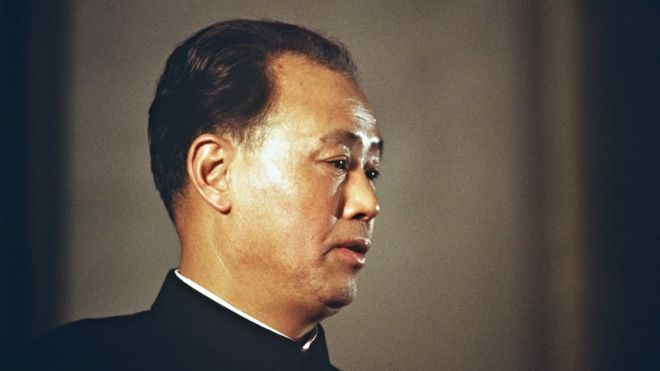
Zhao Ziyang: A reformer China’s Communist Party wants to forget

Picture dated 17 October 1980 in Beijing of Zhao Ziyang,Image copyrightGETTY IMAGES

In a small, central Beijing courtyard, family and friends are gathering to pay tribute to Zhao Ziyang – the most powerful man in China to oppose the decision to send tanks into Tiananmen Square nearly 30 years ago.

He was subsequently erased from Chinese history for what party officials deemed his “serious mistakes” that day.

To reach his traditional courtyard home, mourners and journalists alike must run a gauntlet through a twisted alleyway, with groups of police and plain-clothed guards on every corner, waiting to interrogate and prevent would-be visitors.

Today, on a cold, January day, on the anniversary of Zhao’s death from a stroke in 2005, numerous police vehicles flank every entrance. Parked outside the gate is an unmarked security car; the occupants monitoring arrivals and muttering into radios.

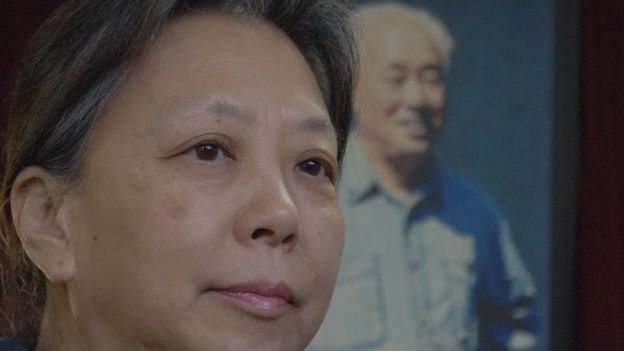
“What a miracle you all showed up here,” Zhao’s daughter, Wang Yannan, tells the small group of us who made it inside the courtyard.

Wang Yannan, the daughter of former leader Zhao Ziyang
Image captionWang Yannan hopes her father may one day be rehabilitated

China’s Communist Party has spent nearly 30 years trying to erase the events of 4 June 1989 from history and young people here have little knowledge or understanding of what happened that day. The story of Zhao Ziyang is proof those efforts still continue: the man who was the highest ranking Party official in the country at the time of those momentous events is now expunged from the record and, even in death, still regarded as a threat.

Every year, the family says, the number of people who come to pay their respects diminishes slightly. Some are stopped from entering when they arrive or – as Zhao Ziyang was for 16 years – prevented from travelling around the city.

“It’s been like this for many years. What else can we do about it?” Zhao’s son, Zhao Er’jun, is resigned to the hassle.

“Sometimes we go out and help people get in. This man used to be a secretary of my father’s – he was dragged into a dispute with the police outside. Even he was nearly prevented from coming in.”

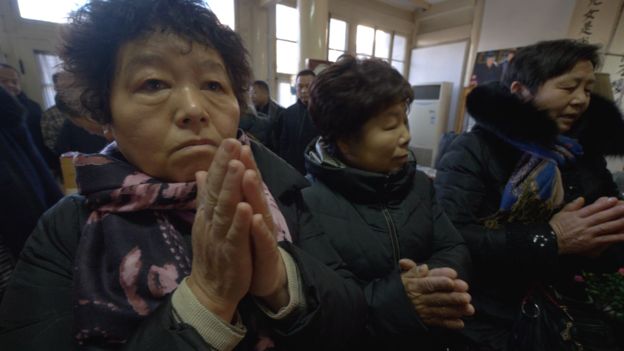
Mourners pay their respects in front of Zhao Ziyang’s tablet on the 14th anniversary of his death on Jan 17, 2019
Image captionSupporters pay their respects to Zhao Ziyang on the anniversary of his death

“Let’s talk in the room,” Er’jun adds, pointing to a tall building next to the courtyard. “There are face-recognition cameras set up over there, visitors’ faces and identities will be recorded. You got in this time, the next time it may be harder.”

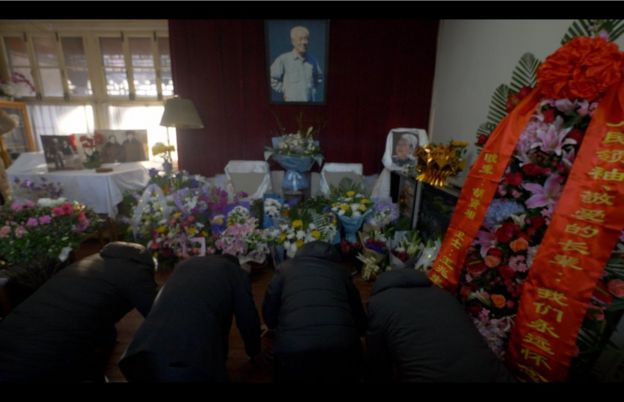
A trickle of people make their way into Zhao’s study, where his photograph, documents and possessions are displayed, alongside photographs of his late wife. It speaks of a loving family, proud of his achievements – Chinese premier, general secretary of the Chinese Communist Party and, before his purge, credited with driving crucial economic reform in China.

It’s already stuffed with flowers and burning incense. More flowers are being placed outside the door.

Most visitors tell us that they are “from his home town”. It might not be true in all cases, but it seems that you’re more likely to get past the guards by saying it. And they are here to keep not just his memory, but his principles alive.

Zhang Baolin, a former journalist, covered the years when Zhao brought wealth to much of China – but also drew criticism for corruption – and then defied his party by defending the student protests in Tiananmen.

He says: “Zhao Ziyang played such a significant role in opening up and reform. Huge progress was made within his time. So I think, to an old man like Zhao who has passed away so many years ago, we should pay our respects. [If his name] is missing in the commemoration of opening-up and reform, we think it’s very unfair.”

Mourners bow to the photographs of former leader Zhao Ziyang and his late wife Liang Boqi
Image captionSupporters prayed among flowers filling Zhao’s study

Zhao’s name is not only missing in Chinese commemorations, but – like nearly everything connected with the events in Tiananmen – from Chinese history books and virtually all official publications since 1989, when he was ousted from the Party. But those in the courtyard hope that won’t always be the case.

One visitor says: “I believe one day Zhao’s reputation will be rehabilitated, because history won’t be distorted for long. One day people will find out the truth. Yes, it’s not included in history textbooks. But in my home we talk about it all the time – I don’t want the next generation to forget.”

Zhao’s daughter Wang Yannan sighs, only cautiously optimistic that one day she might see the political rehabilitation of her father’s legacy.

“Yes, confidence is here. So is the hope. But reality is another thing.”

Zhao went to Tiananmen Square in 1989, knowing that Party hardliners were gaining the upper hand, and implored the students to leave; to save themselves and their future lives; to negotiate with the Party.

“We are already old, we do not matter any more,” he told them.

But nearly 30 years later, remembering Zhao – and his principles – matters more than ever to some.

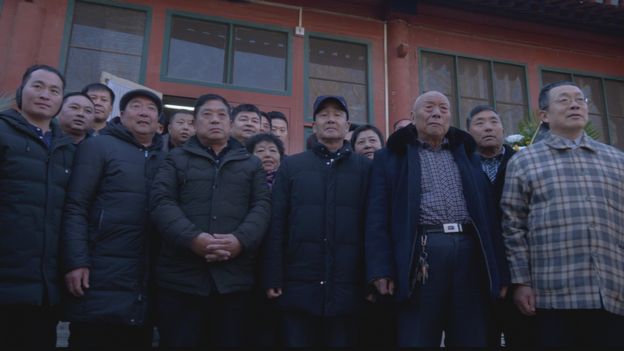
Visitors taking a group photo in front of the study of Zhao Ziyang
Image captionMost of the people who remember Zhao were alive in 1989 – few young people know of him
19/12/2018

Senior CPC official meets Turkish Justice and Development Party delegation

CHINA-BEIJING-YANG JIECHI-TURKISH DELEGATION-MEETING (CN)

Yang Jiechi(R), a member of the Political Bureau of the Communist Party of China (CPC) Central Committee and director of the Office of the Foreign Affairs Commission of the CPC Central Committee, meets with a delegation of the Turkish ruling Justice and Development Party (AKP), which is led by its deputy chairman Cevdet Yilmaz, in Beijing, capital of China, on Dec. 18, 2018. (Xinhua/Ding Lin)

BEIJING, Dec. 18 (Xinhua) — Yang Jiechi, a member of the Political Bureau of the Communist Party of China (CPC) Central Committee, on Tuesday met with a delegation of the Turkish ruling Justice and Development Party (AKP), which was led by its deputy chairman Cevdet Yilmaz.

Yang, also director of the Office of the Foreign Affairs Commission of the CPC Central Committee, said China is willing to work with the Turkish side to implement the consensus reached by the two heads of state during their sideline meeting at the G20 summit in Buenos Aires.

He said the CPC is willing to make joint efforts with the AKP to deepen the exchange on the experiences of managing the party and the country so as to promote bilateral ties.

Hailing China’s achievements since reform and opening-up 40 years ago, Yilmaz said the AKP is ready to enhance communication and exchange with the CPC to promote bilateral cooperation in fields including the economy, trade, tourism, and anti-terrorism.

17/12/2018

CPC issues regulation on punishment of Party members

BEIJING, Dec. 16 (Xinhua) — The General Office of the Communist Party of China (CPC) Central Committee has issued a trial regulation on how leading Party members groups discuss and decide the punishment of Party members.

According to the regulation, leading Party members groups should fulfil the main responsibility of ensuring the strict and full governance over the Party. Discipline inspection groups, sent by the CPC Central Commission for Discipline Inspection and the National Supervisory Commission, have the responsibility of supervision.

A discipline inspection group stationed at a department is responsible for filing and investigating cases of discipline violations committed by city-level officials of the department, the regulation said.

The discipline inspection group propose a preliminary suggestion for punishment and discuss the suggestion with the department’s leading Party members group. The case is then transferred to central discipline inspection and supervision authorities for a trial after the two groups reach a consensus, it said.

Cases of discipline violations by county-level officials of a department can be investigated and tried by the Party committee and the discipline inspection commission of the department.

The punishment should be discussed and decided by the department’s leading Party members group, and advised by the discipline inspection group stationed at the department, according to the regulation.

The regulation will go into effect on Jan. 1, 2019.

Law of Unintended Consequences

continuously updated blog about China & India

ChiaHou's Book Reviews

continuously updated blog about China & India

What's wrong with the world; and its economy

continuously updated blog about China & India