Archive for ‘Crazy Rich Asians’

25/10/2019

Mahjong: Police clamp down on China’s most loved game

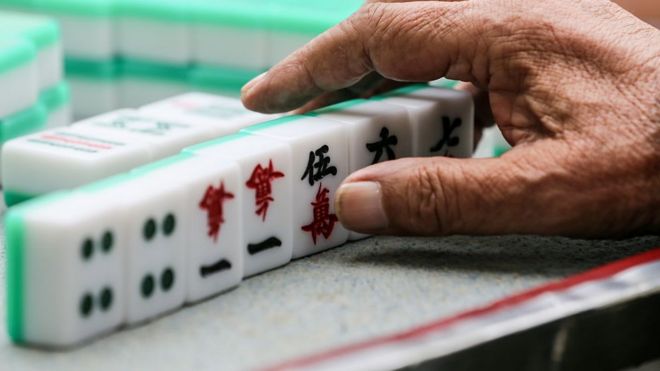
MahjongImage copyright GETTY IMAGES
Image caption Mahjong has been referred to as the “quintessence of Chinese culture”

An apparent police ban on all mahjong parlours in a Chinese city led to panic among aficionados of China’s national pastime.

Police in Yushan in southeast China first announced the ban at the weekend, saying it was to curb illegal gambling and “purify social conduct”.

This led to shock and outrage with many calling the strategic, tile-based game the “quintessence of Chinese culture”.

Police then clarified that only unlicensed parlours would be shut.

It comes after several other cities also announced parlours encouraging gambling would be shut.

Mahjong is one of the most popular games in China, especially with older people.

While it does not have to be played with money, it is common for players to gamble with small amounts. A typical mahjong game could see players bet anywhere from $1 to $15.

‘People can gamble with anything’

On 20 October, police in Yushan, a small county in China’s southeast Jiangxi province, issued a statement announcing that all mahjong parlours in the county would be “closed” by 22 October.

Authorities said the ban would be enacted in an effort to “push forward the campaign against crimes and gangs… [to] solve the gambling and noise problem [and] purify social conduct”.

Gambling is illegal in China but under Jiangxi province law, those who engage in “win-loss entertainments such as mahjong and poker involving a small amount of money… shall not be punished”.

However, the law adds that people who “[gamble] money of more than 200 yuan ($28; £21)” could be subject to punishment.
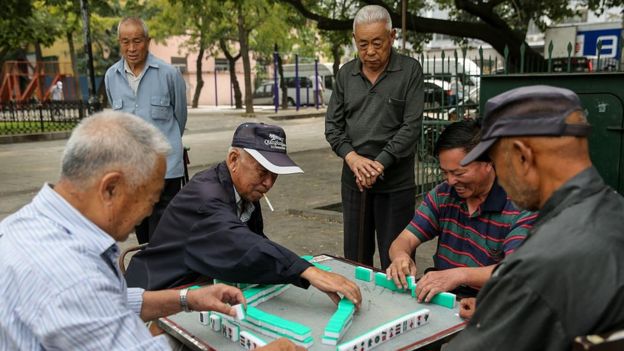
Men play mah-jong in a streetImage copyright GETTY IMAGES
Image caption It’s a familiar sight to see retirees gather in parks to play mahjong

It wasn’t long before the backlash kicked in.

Some people pointed out that while China does face a widespread problem of illegal gambling dens, many mahjong parlours are in fact, legally operated with licenses.

Another commenter on social media site Weibo said: “Not all people play mahjong for gambling,” according to state media ECNS.

“My grandparents play mahjong as part of their daily entertainment”.

Others said it was a “lazy” solution by the government in an attempt to curtail illegal gambling.

“Mahjong [itself] is not a problem. People can gamble with anything,” said one comment on Weibo.

But one social media user saw the positive side of the ban, saying: “Finally! I have been woken up numerous times [by] mahjong players.”

Mahjong is known to be quite a noisy game, as the heavy tiles often make clacking sounds as they are shuffled around.

But their joy was short lived. Just one day after they made the announcement, Yushan authorities revised their statement, saying licensed mahjong parlours would not be affected.

They also clarified that the ban was meant to target places that encouraged “illegal gambling”.

Despite this, some licensed parlour owners told local news outlets that they were also not operating amid the clampdown, but it was unclear whether that was voluntary or enforced by officials.

Several other cities in Jiangxi have also banned mahjong in recent days, but had made it clear in their announcements that registered mahjong parlours would not be affected.

line

What is mahjong?

line

The game has also gone on to gain popularity in the West – and has recently made several appearances in mainstream pop culture.

It was featured as part of a pivotal moment in the Hollywood blockbuster Crazy Rich Asians, where two main characters met for a showdown of a game at a mahjong parlour.

Source: The BBC

22/07/2019

Mulan sparks different questions about Chinese identity in East and West

  • Delicate balance for Disney in its portrayal of China’s classic tale of female heroism
  • Too Americanised, or pandering to a mainland Chinese audience?
Chinese-American actress Crystal Liu Yifei plays the title role in Disney’s Mulan. Photo: Disney
Since the trailer for Disney’s live-action film Mulan was released last weekend, both mainland Chinese in the East and the diaspora in the West have been abuzz about their cultural identity and its representation in Hollywood – albeit for different reasons.
Chinese viewers have, on one hand, been enthusiastic about the casting of Chinese-American actress Crystal Liu Yifei in the lead role and the chance for a seemingly more “authentic” Chinese story to be told on the global stage.
On the other hand, they have pointed out historical inaccuracies – such as the southern Chinese setting when the source material states that Mulan is from the north – and expressed concerns that the plot has been too “Americanised”.
Meanwhile, many Chinese-Americans were surprised to discover upon watching the trailer that the beloved 1998 animation had changed beyond recognition – most notably with the absence of talking dragon Mushu and male love interest Li Shang. Some also felt that the new film pandered too much to a mainland Chinese audience.

“The idea of a mythic mash-up of China [in the new film] … seems to play to the idea of a unified, singular China, an artistic representation of the one-China policy, which is troubling to me,” said Jeannette Ng, a British sci-fi author with Hong Kong heritage.

“A lot of the time, this conversation acts like the only Chinese people who matter are the ones who live in mainland China – that they are the only truly authentic ones and everyone else is too Westernised to count,” she said.

The online discussion indicates the delicate balance Hollywood interpretations of Chinese classics have to strike in portraying Chinese versus American values, as big US-China co-productions try their hardest to integrate the two for bigger global box office takings.

Despite ticket sales in China falling 3.6 per cent in the first half of 2019, owing to tightened government censorship, China is still projected to overtake the US box office next year, according to a recent report by professional services firm PwC.

Disney has tried hard to make the new film more true to its ancient Chinese source material, with a detailed – if inaccurate – historical setting featuring the ancient tulou roundhouses of the southeastern province of Fujian, and a star-studded, all-Asian cast with several icons of Chinese cinema such as Jet Li, Hong Kong actor Donnie Yen and Gong Li.

Disney’s live-action version of Mulan is truer to the ancient source material. Photo: Handout

“Disney’s tent pole movies are aiming at a global audience. That being said, given that China is the largest international market and the story is based on a Chinese folk tale, Disney will definitely take the Chinese audience’s taste into consideration,” said a Chinese film producer, who asked to remain anonymous, at a major US studio in Beijing.

“However, this is also a double-edged sword, as people tend to be more picky when they see things they are familiar with.”

Indeed, several Chinese media think pieces have questioned whether elements of the original legend had become too Americanised in the film, leading to an inauthentic representation of a beloved Chinese heroine.

For instance, the Disney trailer suggests that Mulan joins the army to escape an arranged marriage, breaking away from family traditions and establishing her independence as a woman unbound by gender roles.

But in the original folk song Ballad of Mulan, on which the film is based, she volunteers to take the place of her ageing father in the army – making her a symbol of filial piety, courage and patriotism in traditional Chinese culture.

Some critics say Mulan has been Americanised. Photo: YouTube

In a widely shared analysis discussing whether Disney’s Mulan was a feminist icon, Peking University Press wrote: “Perhaps this is a cross-cultural creative misunderstanding that reflects the core differences between Chinese and Western culture. If Mulan is seen as a feminist symbol, I fear this may be wishful thinking.”

However, both Chinese-Americans and Chinese nationals agree that the film, slated for release in March, is an inspiring tale for young girls.

“I feel like the people who are criticising the film are too attached and focused on the nostalgia factor. They are not seeing the bigger picture and the positive implications of this movie,” said Alex Diep, a 23-year-old American of Vietnamese-Chinese descent.

“They are disregarding that this film gives an opportunity for young Asian girls to look up to Mulan and see her as a role model,” he said.

Some Chinese have interpreted it as an inspiring fable of female strength and liberation, especially when ingrained patriarchal values and government initiatives such as the one-child policy have restricted women’s rights over the years.

“[Mulan] remains one of the very few fighters and not conventionally feminine figures in the Disney princess canon,” Ng said.

“[T]his is some sort of feminism education for a single-child generation in China that girls can fight like men do,” tweeted Chinese journalist Li Jing.

Chinese-Americans are also optimistic that it will be a sure-fire win for Asian representation on the big screen, especially after the success of last year’s romantic comedy Crazy Rich Asians.

“[Critics of the trailer] are disregarding the fact that this movie is another opportunity to showcase Asian people in a movie where we are not perceived as a negative stereotype,” Diep said.

Others feel that the film can help build a bridge between East and West.

“Mulan is a Chinese story. It comes from a completely different culture, one which I’m not at all convinced that Hollywood, or the West at large, truly understands yet,” said

New Yorker Jonathan Pu, who is of Taiwanese descent. He said he enjoyed the lighthearted animation, but that it did not define his expectations for the remake.

“If Disney can stay true to the source material and convey [filial piety] in a way that even just some of the audience can grasp, then it will go a long way towards building bridges,” Pu said.

Ultimately, the success of this American spin on Chinese culture will rest on box office sales, which Disney hopes will exceed the 1998 animation that flopped in mainland cinemas. Recent Disney live-action remakes have had a mixed reception in China – Dumbo flopped in March, while The Lion King did moderately well on its release last weekend.

“I’m sure there will be a mixed response when the movie is released but it should have enough buzz and do well,” said the Beijing film producer.

“I hope it will be able to convey the spirit of Mulan and inspire millions of young girls.”

Source: SCMP

Law of Unintended Consequences

continuously updated blog about China & India

ChiaHou's Book Reviews

continuously updated blog about China & India

What's wrong with the world; and its economy

continuously updated blog about China & India