28/04/2020
SHANGHAI (Reuters) – Apple Inc’s (AAPL.O) discounts on the iPhone 11 in China and the release of a new low-price SE model have put the company in a better position than rivals to weather a coronavirus-related plunge in global smartphone demand.
While China, which accounts for roughly 15% of Apple’s revenue, appears to be a rare bright spot, investors will be keen to get a picture of global demand when the Cupertino, California-headquartered company reports second-quarter results on Thursday.
The iPhone maker has shut retail stores in the United States and Europe following the COVID-19 outbreak, and China is the only major market where it has been able to reopen all shops.
Consumer spending is expected to be muted as the pandemic has crippled economies and Apple, the world’s second-most valuable tech company, is better armed with the launch of its new price-conscious iPhone model, analysts said.
“Apple is better positioned than most to experience a rapid recovery in a post COVID world,” Evercore analyst Amit Daryanani said in a research note. “We see demand as pushed out, not canceled.”
He added that the launch of the $399 iPhone SE suggested that Apple’s supply chain was getting back on its feet after weeks of shutdown earlier this year.
Analysts expect Apple to report a 6% drop in revenue and an 11% fall in net income in its fiscal second quarter, according to Refinitiv data.
On the other hand, Chinese brands such as Oppo and Vivo who have steadily moved to offer high-end models to challenge iPhones, stand to lose marketshare as bargain hunters choose Apple.
Earlier this month, several online retailers in China slashed prices of the iPhone 11 by as much as 18% – a tactic Apple has used in the past to boost demand. And while initial social media reaction to the new iPhone SE was muted, analysts said they were seeing a pick up in demand.
The cheaper iPhone SE could tempt iPhone owners to opt for a newer device, something they might have otherwise delayed in a weak economy, said Nicole Peng, who tracks the smartphone sector at research firm Canalys.
“People want to avoid uncertainty in a downturn,” she said. “Having a brand like Apple that can showcase quality and make people less worried about breakdowns or after-sales service can bring in buyers.”
CHEAP IS GOOD
Early data suggests that the Chinese smartphone market is recovering rapidly in the aftermath of the virus, and Apple has emerged relatively unscathed.
Sales of iPhones in China jumped 21% last month from a year earlier and more than three fold from February, government data showed, meaning March-quarter sales in the country were likely to have slipped just 1%.
To be sure, a recovery in Chinese demand won’t offset sales lost in the United States and Europe. And the company is yet to launch a smartphone enabled with 5G wireless technology like those offered by Asian rivals, a disadvantage for Apple so far.
But those same expensive 5G models may not sell well in the current climate of frugality, analysts said.
“If there are no massive subsidies (in China), I doubt there will be many smartphone users who will be eager to upgrade to 5G,” said Linda Sui, who tracks the smartphone sector at research firm Strategy Analytics.
Sui expects iPhone shipments in 2020 to be down 2 percentage points at the most, versus double digit declines at Chinese firms.
Apple also has revenue from its services business to fall back on. It has leveraged its large iPhone customer base to boost services revenue from music, apps, gaming and video.
“Apple’s Services segment should remain resilient in today’s work-from-home environment, thereby demonstrating the durability of Apple’s model,” Cowen analyst Krish Sankar said.
Source: Reuters
Posted in 5G models, 5G wireless technology, accounts, after, analyst, analysts, appears, Apple, Apple Inc’s (AAPL.O), apples, are bright spot, armed, Asian, avoid, back on its feet, better, blow, brand, breakdowns, Buyers, California-headquartered, canceled, cheaper, China, Chinese brands, climate, Company, Consumer spending, coronavirus-related, COVID, COVID-19 outbreak, crippled, Cupertino, current, demand, discounts, downturn, drop, earlier, economies, Europe, Evercore, expected, experience, fall, February, fiscal, fold, following, from, frugality, fter-sales service, global, Government, income, investors, IPhone, iPhone 11, iPhone SE, just, last month, launch, low-price, Major, maker, March, market, marketshare, model, muted, net, new, online retailers, only, Oppo, pandemic, plunge, position, Post, price-conscious, prices, put, quality, quarter, rapid, reaction, recovery, Refinitiv data, release, reopen, reports, research note, results, retail stores, Revenue, rivals, roughly, Sales, SE model, second-quarter, Shanghai, shops, showcase, shut, shutdown, slashed, slipped, smartphone, social media, Strategy Analytics, suggested, Supply chain, tactic, this year, Three, Thursday, to cushion, Uncategorized, uncertainty, United States, Virus, Vivo, weak economy, weather, weeks, World, world’s second-most valuable tech company, worried, year |
Leave a Comment »
31/03/2020
- Big shoals of acetes, which are just a few centimetres long, crippled the water pumping stations and caused a unit to go into automatic safe shutdown
- The same thing happened the next day with all units powered down, but the safety regulator says they are now in a ‘safe and controllable condition’
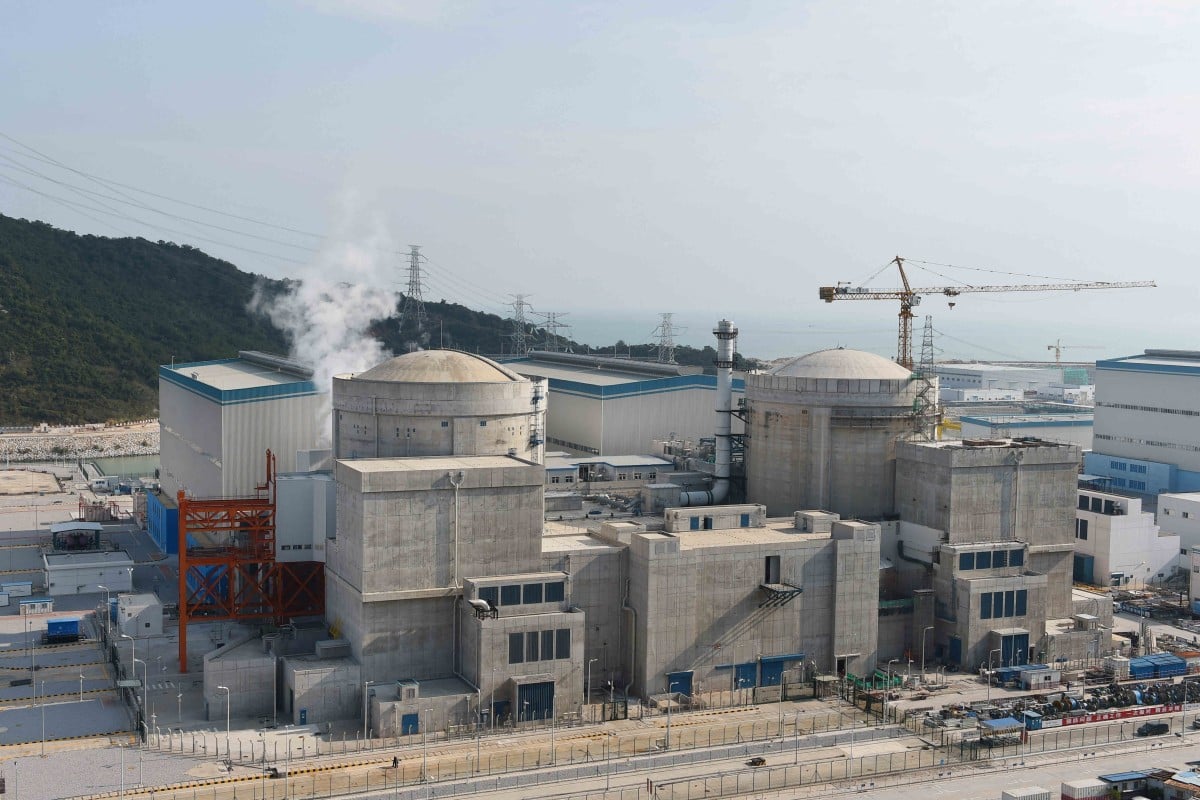
The Yangjiang Nuclear Power Station in Guangdong province is about 235km from Hong Kong. Photo: Handout
The power-generating units of a nuclear plant in southern China were shut down twice last week after its water filters were blocked by masses of small shrimp, the safety regulator said.
Big shoals of the tiny acetes – krill-like shrimp that are just a few centimetres long – flooded the seawater diversion channel and circulating water pumping stations of the Yangjiang Nuclear Power Station in Guangdong on March 24, the National Nuclear Safety Administration said in a statement.
They crippled the water pumping stations and caused one of the nuclear plant’s six power-generating units to go into automatic safe shutdown, while the other five units ran at 80 per cent of capacity.
The unit that shut down was powered up again the next day after station staff cleared the acetes and cleaned the filters.
But soon after on March 25, the same thing happened, with large shoals of acetes again finding their way into the pumping stations and causing four power-generating units to shut down automatically. The station shut off the other two units for safety reasons.
Big shoals of acetes found their way into the nuclear plant’s pumping stations. Photo: Handout
The incident on March 25 was rated a Level 1 on the International Nuclear and Radiological Event Scale, meaning it was an “anomaly” that had no safety or health consequences. Only two nuclear events have been rated at the top of the scale as Level 7 “major accidents” – the Chernobyl disaster in 1986 and Fukushima in 2011.
China’s nuclear safety regulator said the situation at the Yangjiang plant was under control.
“At present, all six units … are in a safe and controllable condition,” the statement said. “Staff at the scene are taking measures such as fishing out the acetes and cleaning the filters, before reactivating the units and bringing them back to normal operation in accordance with the relevant procedures.”
Nearly a decade after tsunami, clean-up continues at Japan’s Fukushima nuclear plant
Pan Chin, head and chair professor of nuclear engineering at City University of Hong Kong, said the two incidents were “operational events with no radiation leak”.
“The shutdown … is also an indication that the protection system of the power plant is functioning as designed,” he said.
“This incident is not unexpected,” Pan said. “The power plant uses seawater as a coolant for the condenser and occasionally aquatic animals may get close to the intake and cause such incidents.”
The Hong Kong Nuclear Society also noted that similar incidents had happened before.
“Similar events have occurred at nuclear power plants using seawater as a coolant for their power-generating units [including non-nuclear ones] throughout the world, including China,” said Luk Bing-lam, chairman of the society.
New Wufengshan power line across China’s Yangtze River completed
In 2016, a generating unit at the Lingao Nuclear Power Plant in Shenzhen was guided to a safe shutdown by an automatic reactor protection signal after its seawater intake was inundated with tiny marine crustaceans, according to Hong Kong’s Security Bureau. They blocked the filtering screen drum at the intake and tripped two seawater intake pumps.
China tech giants wake up to renewable energy, but fossil fuels still dominate as electricity source
17 Feb 2020
China’s nuclear safety regulator said it had asked all nuclear power station operators to use marine life detection systems in light of incidents such as those at Yangjiang last week.
But Pan from CityU said the acetes could be too small to be detected by a marine life warning system.
“If a system can detect the approach of marine life, large or small, early enough, leaving enough time to take some action to prevent them from approaching further … there will be no such incident,” he said, adding that the systems needed to be improved.
The Yangjiang nuclear plant in Guangdong is about 235km from Hong Kong. It is owned by the China General Nuclear Power Corporation, which operates over 20 nuclear power stations in China. CLP, one of Hong Kong’s two power companies, acquired a 17 per cent stake in the plant in 2017.
Source: SCMP
Posted in automatic safe shutdown, Chernobyl, China General Nuclear Power Corporation, City University of Hong Kong, CityU, CLP, crippled, Fukushima, Guangdong, guangdong province, Hong Kong, Hong Kong Nuclear Society, International Nuclear and Radiological Event Scale, Lingao Nuclear Power Plant, Masses, National Nuclear Safety Administration, power line, Security Bureau, Shenzhen, tiny shrimp, Uncategorized, water pumping stations, Wufengshan, Yangjiang nuclear plant, Yangjiang Nuclear Power Station, Yangtze River |
Leave a Comment »





 CHINDIA ALERT: You'll be living in their world, very soon