Archive for ‘Crop’

15/05/2020

Coronavirus lockdown: India announces free food for fleeing migrants

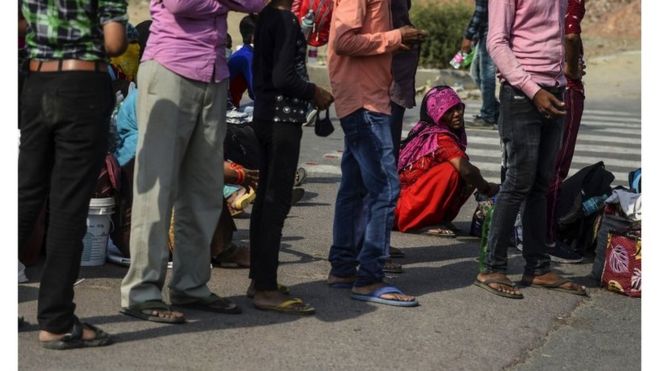
Migrant workers with their families rest at a roadside on their journey back to their hometowns in Uttar Pradesh and Bihar statesImage copyright EPA
Image caption Millions of people have fled the cities in India

India will provide free food to migrants for two months as part of a $266bn (£216bn) economic plan to combat the effect of the Covid-19 lockdown.

Finance Minister Nirmala Sitharaman said grain supplies worth $463m would benefit 80 million migrants.

Tens of thousands of migrants have been fleeing cities on foot, trying to return to their villages.

Many of these informal workers who form the backbone of city economies feared they would starve in the lockdown.

The plight of these workers, many of whom have been walking for days without adequate food and water, has caused widespread anger in the country.

Train and bus services were shut during the lockdown and even though some have been restarted for migrants, many say they cannot afford the fare and are unsure if they will be accommodated on them due to social distancing norms.

Several have died in making the journey, including 16 migrants who were run over by a train while they were sleeping on the railway tracks.
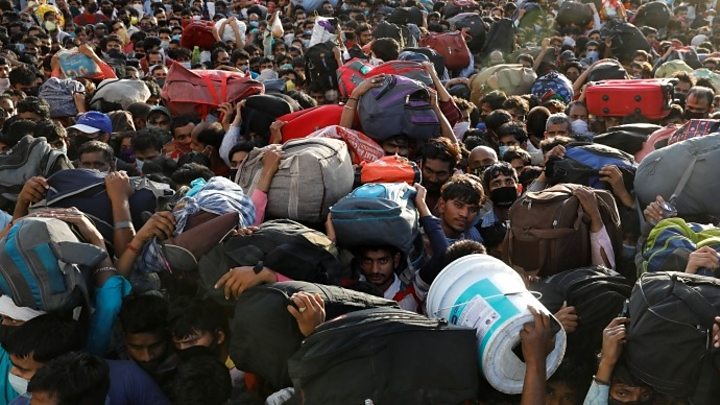
Media caption Coronavirus: Heartbreaking scenes as India lockdown sparks mass migration

Ms Sitharaman also announced that workers would be able to use ration cards – usually only valid at village level – anywhere in the country regardless of where it was issued.

The ration cards usually entitle holders to subsidised food.

She added that the move towards portable cards would benefit nearly 670 million people and will be completed by March next year.

The government will also provide affordable housing for migrant labour by converting existing vacant government funded housing complexes, among other things.

The announcements on Thursday – the second tranche of a series of economic stimulus measures – were aimed at migrant workers, street hawkers, small traders and small farmers.

Banner image reading 'more about coronavirus'

Banner

The full details of the economic package, which is equivalent to 10% of India’s gross domestic product, will be known in some days as the government is announcing a different tranche every day.

Ms Sitharaman’s announcements also included details of “special credit” to be provided to five million street hawkers who have been forced to cease working over the last month and a half.

To help farmers, the government also announced an emergency $4bn “working capital funding” which would benefit some 30 million small farmers to meet crop requirements in May and June

In March, India said it would provide around 1.7 trillion rupees in direct cash transfers and food security measures, mainly for the poor.

However, Mr Modi’s administration had been accused in some quarters of not having done enough.

Source: The BBC
05/10/2019

India’s onion crisis: Why rising prices make politicians cry

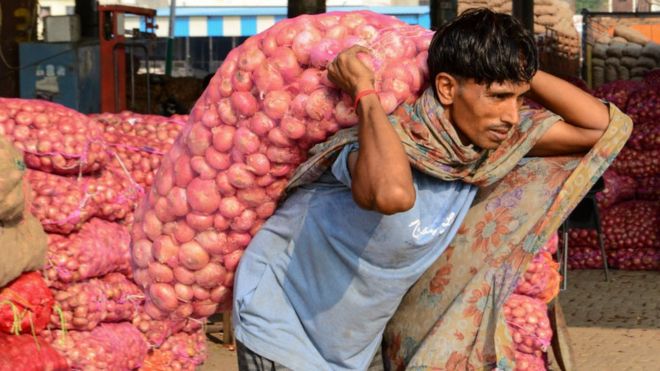
A labourer carries a sack of onions at a wholesale vegetable market on the outskirts of Amritsar on September 19, 2019.Image copyright GETTY IMAGES
Image caption The onion is India’s most “political” vegetable

Onion prices have yet again dominated the headlines in India over the past week. BBC Marathi’s Janhavee Moole explains what makes this sweet and pungent vegetable so political.

The onion – ubiquitous in Indian cooking – is widely seen as the poor man’s vegetable.

But it also has the power to tempt thieves, destroy livelihoods and – with its fluctuating price a measure of inflation – end the careers of some of India’s most powerful politicians.

With that in mind, it’s perhaps unsurprising those politicians might be feeling a little concerned this week.

So, what exactly is happening with India’s onions?

In short: its price has skyrocketed.

Onion prices had been on the rise in India since August, when 25 rupees ($0.35; £0.29) would have got you a kilo. At the start of October, that price was 80 rupees ($1.13; £0.91).

Fearing a backlash, the Bharatiya Janata Party (BJP)-led government banned onion exports, hoping it would bring down the domestic price. And it did.

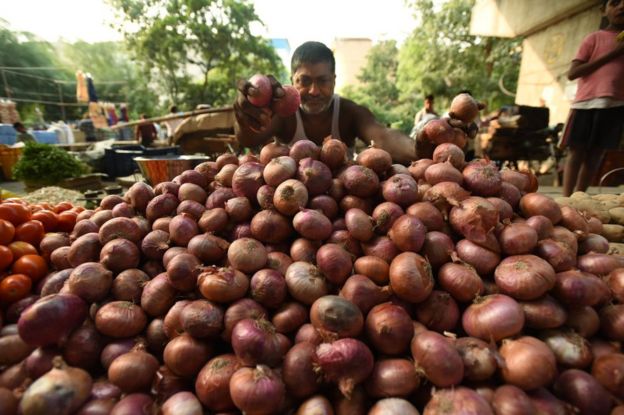
Vegetable vendors sell onions by the road, at Sector 25 on September 24, 2019 in Noida, India.Image copyright GETTY IMAGES
Image caption Onion prices peaked by the end of September

A kilo was selling for less than 30 rupees on Thursday at Lasalgaon, Asia’s largest onion wholesale market, located in the western state of Maharashtra.

However, not everyone is happy.

While high prices had angered consumers in a sluggish Indian economy, the fall in prices sparked protests by exporters and farmers in Maharashtra, where state elections are due in weeks.

And it is not just at home where hackles have been raised: the export ban has also strained trade relations between India and its neighbour, Bangladesh, which is among the top importers of the vegetable.

But why does the onion matter so much?

The onion is a staple vegetable for the poor, indispensable to many Indian cuisines and recipes, from spicy curries to tangy relishes.

“In Maharashtra, if there are no vegetables or you can’t afford to buy vegetables, people eat ‘kanda bhakari’ [onion with bread],” explains food historian Dr Mohseena Mukadam.

True, onions are not widely used in certain parts of the country, such as the south and the east – and some religious communities don’t eat them at all.

But they are especially popular in the more populous northern states which – notably – send a higher number of MPs to India’s parliament.

“Consumers in northern India wield more power over the federal government. So although consumers in other parts of India don’t complain as much about higher prices, if those in northern India do, the government feels the pressure,” says Milind Murugkar, a policy researcher.

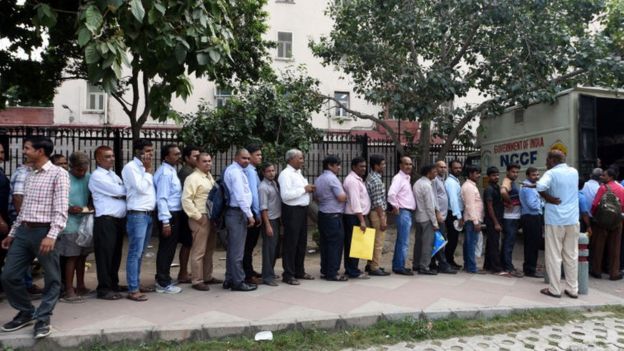
People stand in a queue to buy onions sold at Rs. 22 per kg by the Government of India, outside Krishi Bhawan on September 24, 2019 in New Delhi, India.Image copyright GETTY IMAGES
Image caption Onions are so ubiquitous that the government has been selling them at subsided rates

A drop in prices also affects the income of onion farmers, mainly in Maharashtra, Karnataka in the south and Gujarat in the west.

“Farmers see the onion as a cash crop that grows in the short term, and grows well in dry areas with less water,” says Dipti Raut, a journalist, who has been on the “onion beat” for years.

“It’s like an ATM machine that guarantees income to farmers and sometimes, their household budget depends on the onion produce,” she said.

Onions have even attracted robbers: when prices skyrocketed in 2013, thieves tried to steal a truck loaded with onions, but were caught by the police.

Why do politicians care about the onion?

Put simply, because the price moving too far one way or another is likely to anger a large block of voters, be they everyday households, or the country’s farmers.

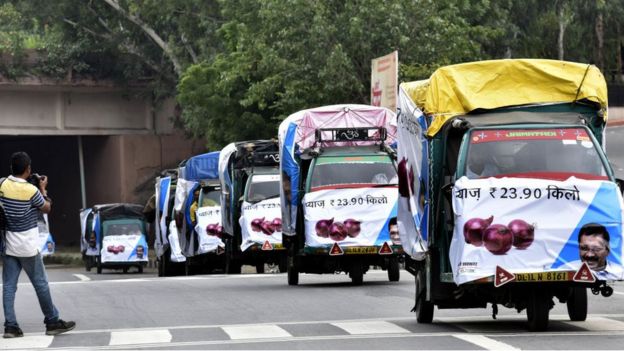
Control rate onion vans seen after flagged off by Chief Minister of Delhi Arvind Kejriwal, at Delhi secretariat, on September 28, 2019 in New Delhi, India.Image copyright GETTY IMAGES
Image caption The Delhi government transported 70 vans full of subsidised onions

Onions are so crucial they have even featured in election campaigns. The Delhi state government bought and sold them at subsidised rates in September when prices were at their peak: chief minister Arvind Kejriwal, it should be noted, is up for re-election next year.

Meanwhile, Indira Gandhi swept to power in 1980 on slogans that used soaring onion prices as a metaphor for the economic failures of the previous government.

But why did onion prices rise this year?

A drop in supply, due to heavy rains and flooding destroying the crop in large parts of India, and damaging some 35% of the onions stocks in storage, according to Nanasaheb Patil, director of the National Agricultural Co-operative Marketing Federation.

He said the flooding had also delayed the next round of produce, which was due in September.

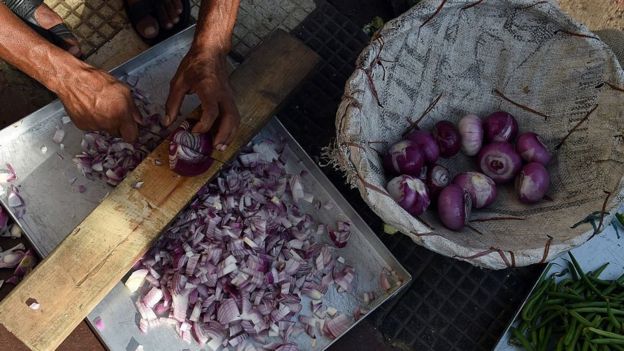
An Indian restaurant worker cuts onions for curries in New Delhi on September 11, 2015.Image copyright GETTY IMAGES

“This has become a fairly regular phenomenon in recent decades,” Mr Murugkar said. “Onion prices swing heavily with a small drop or increase in production.”

In fact, the shortage – and subsequent rise in prices – happens almost every year around this time, according to Ms Raut.

“It’s a vicious cycle and the trader lobby and middlemen benefit from even the slightest price fluctuations,” she added.

What’s the solution?

Ms Raut says more grass-root planning and better storage facilities and food processing services will ease the problem – and making a variety of cash crops and vegetables available across the country would also ease the pressure on onions.

“The government is quick to act when onion prices rise. Why don’t they act as swiftly when prices fall?” asked Vikas Darekar, an onion farmer in Maharashtra. He said the government should buy onions from farmers at a “fair price”.

Mr Murugkar, however, feels that the government should never interfere in “onion matters”.

“If you are interested in raising purchasing power of the people, they should not curtail exports. Do we have such a ban on software exports? It’s really absurd. A government which has won such a huge majority should be able to withstand the pressures from a few consumers.”

Source: The BBC

03/12/2018

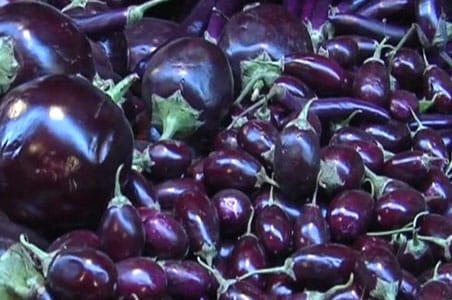
Upset Over Getting 20 Paise For Brinjal Crop, Farmer Destroys Plantation

Upset Over Getting 20 Paise For Brinjal Crop, Farmer Destroys Plantation

The Maharashtra farmer had planted brinjal on two acres of land. (Representational)


MUMBAI: After being offered a meagre 20 paise per kilogram for his brinjal production, a farmer in Maharashtra destroyed the entire plantation on his land to save himself from incurring further losses.

Rajendra Bawake, from Sakuri village of Ahmednagar, claimed he earned only Rs. 65,000 after investing Rs. 2 lakh and putting in all his energy to cultivate the brinjal crop.

Frustrated with low income, the farmer uprooted all brinjal plants from his field and threw them away on Sunday.

“I had planted brinjal on two acres of land and laid pipes for drip irrigation. I used fertilisers, pesticides and modern mulching techniques to enhance the production. The total investment came to around Rs. 2 lakh. In return, I earned only Rs. 65,000,” Mr Bawake said today.

The cultivator said he now owes dues worth over Rs. 35,000 to fertilisers and pesticide suppliers. “I don’t know how I am going to raise that money,” he said.

Mr Bawake claimed that when he tried to sell his produce at the wholesale markets in Nashik and Surat, he fetched only 20 paise per kg.

“I never got better returns in the last three-four months and so, I decided to do away with the plantation,” he added.

Mr Bawake said he rears three cows at home and needs money to buy fodder for the cattle. “I had hopes from brinjal farming, but now I don’t know how to take care of my cattle.”

Recently, an onion-grower from Nashik who had to sell his produce for little over Re 1 per kg and fetched only Rs. 1,064 for 750 kg of the vegetable, sent his earnings to prime minister Narendra Modi last month as a mark of protest.

COMMENT

Farmers from across the country gathered in New Delhi last Thursday in protest to press for various demands, including debt relief and remunerative prices for their produce.

Law of Unintended Consequences

continuously updated blog about China & India

ChiaHou's Book Reviews

continuously updated blog about China & India

What's wrong with the world; and its economy

continuously updated blog about China & India