Archive for ‘Cyclone Amphan’

27/05/2020

India heatwave: Delhi temperature hits 47C as north India reels

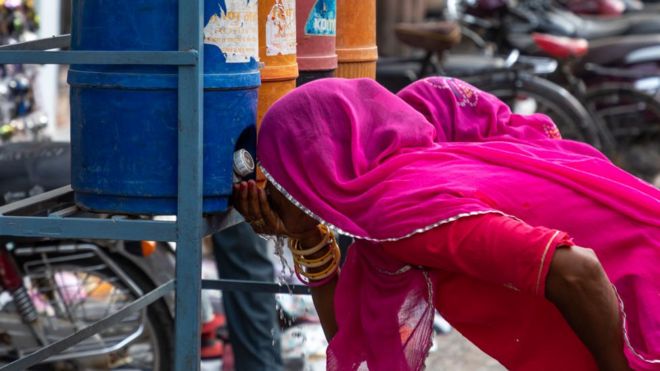
A Rajasthani woman drinks waterImage copyright GETTY IMAGES
Image caption Churu in Rajasthan state recorded a temperature of 50C

The Indian capital, Delhi, saw temperatures rise to 47.6C on Tuesday, as most of north India faced severe heatwave conditions.

The heatwave, which officials say is likely to last until the weekend, comes even as the region struggles with rising Covid-19 infections and swarms of locusts that are ravaging crops.

Churu in Rajasthan state recorded a temperature of 50C – India’s highest.

Officials have warned people to stay indoors as far as possible.

The temperatures are the highest that the country has seen in decades for this time of the year. In fact, global weather tracking website El Dorado said the region was the hottest in the world on Tuesday.

Weather officials told local media that part of the reason for the heatwave was the powerful storm – Cyclone Amphan – that struck parts of eastern India and Bangladesh last week.

“Super cyclone Amphan sucked out all the moisture from other parts of the country,” Kuldeep Shrivastava, the head of the regional weather forecasting centre told the Hindustan Times newspaper.

Heat waves in recent years have caused a number of deaths across India. There is still no data about the impact of the current temperatures on people.

However, they come even as thousands of migrants are walking on the highways after fleeing cities to try and go back to their villages. Many are walking with little food and water, and will be among the most exposed to the weather.

Previously, those who have died have included people like daily-wage labourers, rickshaw operators and vegetable vendors – those most exposed to the sun.

In addition to that, the heatwave has affected efforts to combat swarms of locusts that are destroying crops in parts of the country, including Rajasthan.

More than 100 workers are battling the insects, using vehicle-mounted sprayers, pesticides and drones in the searing heat.

Source: The BBC
18/05/2020

Cyclone Amphan: India’s east coast braces for severe storm

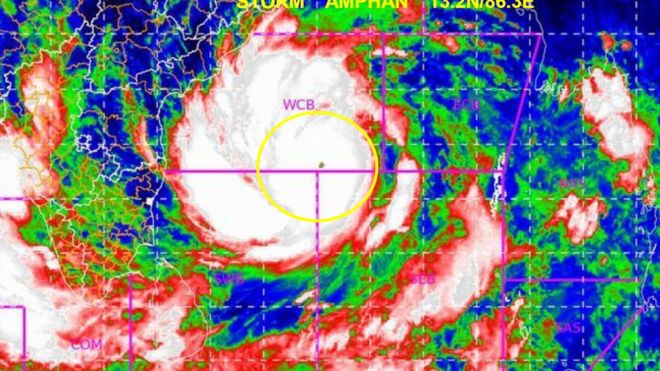
Cyclone AmphanImage copyright INDIA MET DEPARTMENT
Image caption The storm has worsened over the last 12 hours

Indian officials are on alert after Cyclone Amphan – due to make landfall on the east coast – looks likely to intensify into a “very severe” storm.

The storm is expected to make landfall on Wednesday afternoon and hit West Bengal and Odisha states. Twenty relief teams have been dispatched there.

Prime Minister Narendra Modi is due to chair a high-level meeting to further discuss preparations for the storm.

The cyclone comes amid huge levels of migration from the cities to villages.

Tens of thousands of people are fleeing cities in the wake of a lockdown to curb the spread of coronavirus. Both Odisha and West Bengal are seeing a large number of people return.

There are fears about the impact of the storm on them – many are on foot.

India’s meteorological department has issued a “yellow alert” for the region, advising fishermen not to “venture into the south Bay of Bengal during the next 24 hours, and north Bay of Bengal from 18-20 May”.

A ‘”yellow alert” or “cyclone alert” is issued “of the expected commencement of adverse weather over the coastal areas”.

Presentational white space

In a bulletin, the weather department said the storm is likely to move across the north-west Bay of Bengal, and cross West Bengal and Bangladesh coasts from noon local time on 20 May as a “very severe cyclonic storm”.

It also warned of rough seas, with storm surges that could inundate coastal areas.

The head of India’s National Disaster Relief Force (NDRF), SN Pradhan, said they were watching the situation closely and were in touch with state governments.

Last June a powerful cyclone that was expected to make landfall on India’s western coast changed its course, and moved further into the Arabian sea.

Hundreds of thousands of people had already been evacuated as the region braced for Cyclone Vayu, which was classified as “very severe”.

And in May last year India evacuated more than a million people to safety to avoid Cyclone Fani, in which 16 people were killed in Odisha.

In the Bay of Bengal, the cyclone season typically runs from April to December.

Source: The BBC

Law of Unintended Consequences

continuously updated blog about China & India

ChiaHou's Book Reviews

continuously updated blog about China & India

What's wrong with the world; and its economy

continuously updated blog about China & India
