Chindia Alert: You’ll be Living in their World Very Soon
aims to alert you to the threats and opportunities that China and India present. China and India require serious attention; case of ‘hidden dragon and crouching tiger’.
Without this attention, governments, businesses and, indeed, individuals may find themselves at a great disadvantage sooner rather than later.
The POSTs (front webpages) are mainly 'cuttings' from reliable sources, updated continuously.
The PAGEs (see Tabs, above) attempt to make the information more meaningful by putting some structure to the information we have researched and assembled since 2006.
WASHINGTON (Reuters) – The U.S. military said it sent two Navy ships through the Taiwan Strait on Wednesday, its latest transit through the sensitive waterway, angering China at a time of tense relations between the world’s two biggest economies.
Taiwan is one of a growing number of flashpoints in the U.S.-China relationship, which also include a bitter trade war, U.S. sanctions and China’s increasingly muscular military posture in the South China Sea, where the United States also conducts freedom-of-navigation patrols.
The voyage will be viewed by self-ruled Taiwan as a sign of support from the Trump administration amid growing friction between Taipei and Beijing, which views the island as a breakaway province.
The transit was carried out by the destroyer Preble and the Navy oil tanker Walter S. Diehl, a U.S. military spokesman told Reuters.
“The ships’ transit through the Taiwan Strait demonstrates the U.S. commitment to a free and open Indo-Pacific,” Commander Clay Doss, a spokesman for the U.S. Navy’s Seventh Fleet, said in a statement.
Doss said all interactions were safe and professional.
Chinese Foreign Ministry spokesman Lu Kang said Beijing had lodged “stern representations” with the United States.
“The Taiwan issue is the most sensitive in China-U.S. relations,” he told a daily news briefing in Beijing.
Taiwan’s Defense Ministry said the two U.S. ships had sailed north through the Taiwan Strait and that they had monitored the mission.
Taiwan President Tsai Ing-wen said there was no cause for alarm.
“Nothing abnormal happened during it, please everyone rest assured,” she wrote on her Facebook page.
U.S. warships have sailed through the Taiwan Strait at least once a month since the start of this year. The United States restarted such missions on a regular basis last July.
The United States has no formal ties with Taiwan but is bound by law to help provide the island with the means to defend itself and is its main source of arms.
The Pentagon says Washington has sold Taipei more than $15 billion in weaponry since 2010.
China has been ramping up pressure to assert its sovereignty over the island, which it considers part of “one China” and sacred Chinese territory, to be brought under Beijing’s control by force if needed.
Beijing said a recent Taiwan Strait passage by a French warship, first reported by Reuters, was illegal.
China has repeatedly sent military aircraft and ships to circle Taiwan on exercises in the past few years and worked to isolate it internationally, whittling down its few remaining diplomatic allies.
The U.S. Defense Intelligence Agency released a report earlier this year describing Taiwan as the “primary driver” for China’s military modernization, which it said had made major advances in recent years.
On Sunday, the Preble sailed near the disputed Scarborough Shoal claimed by China in the South China Sea, angering Beijing.
The state-run China Daily said in an editorial on Wednesday that China had shown “utmost restraint”.
“With tensions between the two countries already rife, there is no guarantee that the presence of U.S. warships on China’s doorstep will not spark direct confrontation between the two militaries,” it said.
“Mallory not only put our country at great risk, but he endangered the lives of [people] who put their own safety at risk for our national defence,” US attorney Zachary Terwilliger said in a statement.
“This case should send a message to anyone considering violating the public’s trust and compromising our national security,” he added. “We will remain steadfast and dogged in pursuit of these challenging but critical national security cases.”
The Justice Department said Mallory held a number of sensitive jobs with government agencies.
He had worked as a covert case officer for the CIA and as an intelligence officer for the Defense intelligence Agency (DIA).
“This case is one in an alarming trend of former US intelligence officers being targeted by China and betraying their country and colleagues,” Assistant Attorney General John Demers said following the sentencing.
He attempted to pass on information and received at least $800,000 (£600,000) for acting as a Chinese agent, the justice department said at the time.
CIA spy operation in China: Key dates
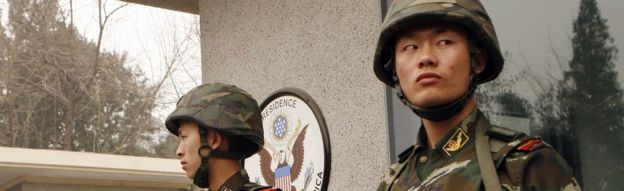
Image copyright AFPImage caption Chinese police guard the US embassy in the capital, Beijing
2010: Information gathered by the US from sources deep inside the Chinese government bureaucracy start to dry up
2011: Informants begin to disappear. It is not clear whether the CIA has been hacked or whether a mole has helped the Chinese to identify agents
2012: FBI begins investigation
May 2014: Five Chinese army officers are charged with stealing trade secrets and internal documents from US companies. Later that same month, China says it has been a main target for US spies
2015: CIA withdraws staff from the US embassy in Beijing, fearing data stolen from government computers could expose its agents
April 2017: Beijing offers hefty cash rewards for information on foreign spies
May 2017: Four former CIA officials tell the New York Times that up to 20 CIA informants were killed or imprisoned by the Chinese between 2010 and 2012
June 2017: Ex-CIA officer Kevin Mallory is arrested and charged with giving top-secret documents to a Chinese agent
January 2018: Former CIA officer Jerry Chun Shing Lee is arrested
June 2018: Former US intelligence officer Ron Rockwell Hansen is charged with attempting to spy for China




 CHINDIA ALERT: You'll be living in their world, very soon