29/11/2019
BEIJING, Nov. 28 (Xinhua) — China has started the design of Fengyun-5 meteorological satellites and the third generation polar orbit meteorological satellite observation system, according to the Science and Technology Daily Thursday.
The new satellites and observation system will conduct high-precision global 3D atmospheric detection, the report quoted Zhang Peng, deputy director of National Satellite Meteorological Center (NSMC) as saying.
China has launched a total of 17 Fengyun meteorological satellites, with seven currently in orbit. With an increasing demand for meteorological satellite data, China plans to launch another nine Fengyun satellites before 2025.
Fengyun-5 satellites will be low-orbit meteorological satellites with a network of comprehensive observation satellites, special-purpose observation satellites and constellations for extreme weather monitoring.
They will be the successor of the Fengyun-3 satellites currently in service and are expected to completely replace them by 2035.
The planned meteorological satellites, including Fengyun-5 satellites in polar orbit and Fengyun-6 satellites in geostationary orbit, will better support meteorological disaster prevention and enhance global meteorological services, the report quoted Yang Jun, director of NSMC as saying.
Source: Xinhua
Posted in Beijing, China alert, design, Fengyun-5, meteorological, National Satellite Meteorological Center (NSMC), new, observation system, plans, polar orbit, satellites, Science and Technology Daily, third generatio, Uncategorized |
Leave a Comment »
14/08/2019
- Developers say their prototype craft could dive to 1,000 metres in five minutes
- Liu Kaizhou, who also worked the Jiaolong submersible, says ‘We are in uncharted water’
Professor Liu Kaizhou, who developed the autopilot for China’s manned Jiaolong submersible, says his team has designed a vessel that can move through water like a plane moves through the air. Photo: Xinhua
Chinese engineers say they are developing a radical design for a super-fast robot submersible which the project leader, who worked on the manned deep-sea vessel Jiaolong, or Sea Dragon, claims can “fly” in water like a plane travels through the air.
At 3 metres (9.8ft) long, the prototype consists of a cigar-shaped body, with a guidance system in the bow and a jet plane style rudder and a propeller in the stern.
Outriggers house batteries and two more propellers. These are attached to the body by wing-like planes that the developers said will give the vessel the kind of lift in water that takes an aeroplane into the air and back to the earth.
Developers said the prototype will be capable of 10 knots and could dive to a depth of 1,000 metres (3,281 feet) – or surface from that depth – at about three metres a second, taking about 5½ minutes.
Professor Liu Kaizhou, lead scientist of the project at the Shenyang Institute of Automation, part of the Chinese Academy of Sciences in Liaoning province, said the design had great potential.
If a traditional submarine was like an air balloon, he said, the prototype was like an aircraft. “It is technically flying, fast and freely, like a plane for the water.”
The prototype has 20 major components on board, including a computer, and communications and surveillance equipment. These were all developed and tested by the team, but getting them to work together posed some unexpected challenges, Liu said, meaning the transition to operations in a tough marine environment was some time away.
Underwater station could be a game changer, Chinese scientist says
“We aim to make the first open sea test in about a year,” he said.
The submersible can be powered by conventional batteries or a chemical engine that mixes lithium and sulphur hexafluoride to produce heated steam for electrical generators – an energy source often used by torpedoes.
Funded by the Ministry of Science and Technology from 2017, the project was driven by China’s growing ambition to become a superpower in the world’s oceans.
The team said their submersible had the potential to become the backbone of China’s search-and-rescue operations at sea, naval intelligence gathering, high-precision sea floor mapping, or to transport minerals from the seabed to the surface.
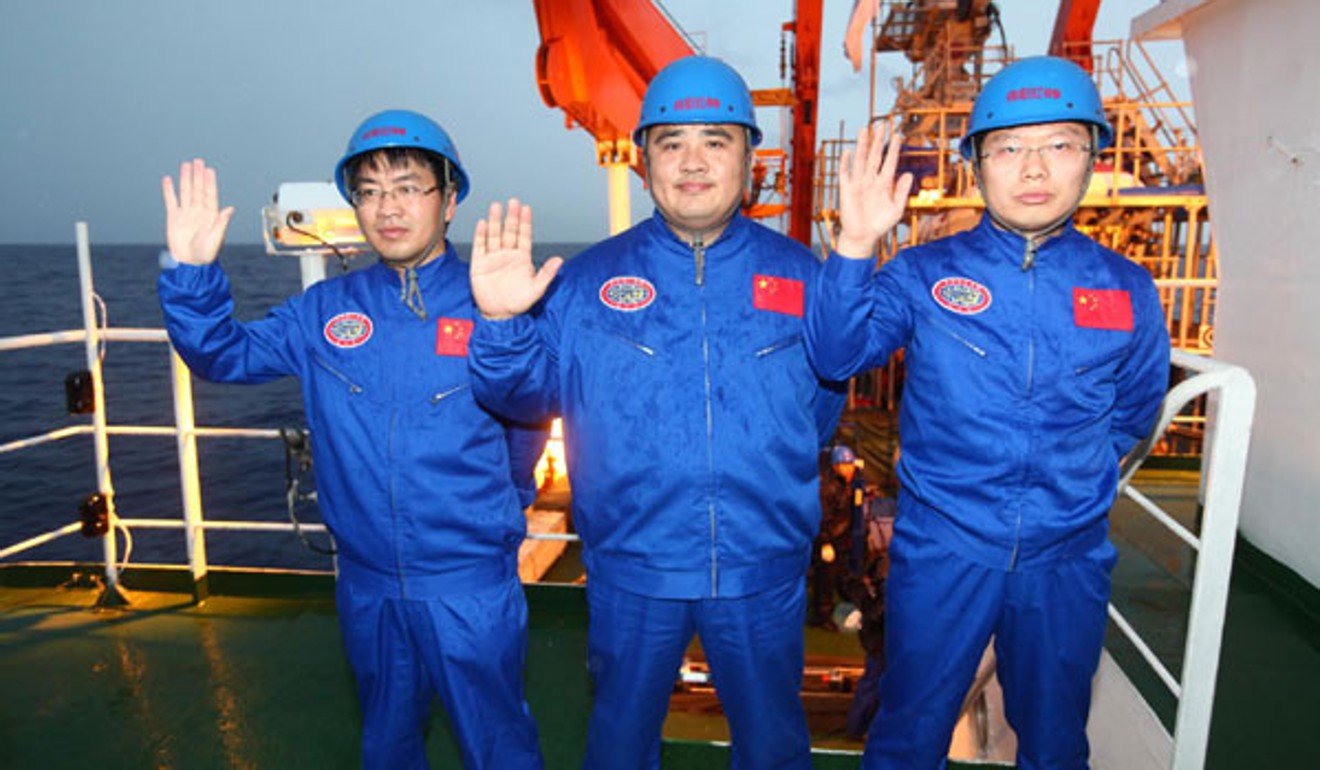
Professor Liu Kaizhou (left) with colleagues Ye Cong and Yang Bo, was instrumental in the success of China’s Jiaolong manned submersible. Photo: Xinhua
Professor Du Tezhuan, a researcher in fluid dynamics at the Institute of Mechanics of the Chinese Academy of Sciences in Beijing, said the design was a bold one but it posed the research team many hard questions.
The density of water was much higher than that of air, he said, which meant the vessel would encounter more drag and would need a strong power source.
“Without sufficient speed, the lift will be weak, and to reach high speeds, lots of energy will be needed. Flying in water is not as easy as flying in the air,” said Du, who was not involved in the project.
Why Beijing is speeding up underwater drone tests in the South China Sea
“But in theory it should work. It is worth a try.”
Liu – who led the design of the autopilot system that can take the Jiaolong to depths of more than 7,000 metres (23,000 ft) – said that after tests on the prototype were complete, other innovations were possible. These included covering the vessel with air bubbles to reduce friction.
“This technology is brand new,” he said. “We are in uncharted water and we are excited by the challenges.”
Source: SCMP
Posted in aeroplane, air, air bubbles, ambition, backbone, batteries, Beijing, bow, challenges, chemical engine, Chinese Academy of Sciences, Chinese engineers, Chinese Ministry of Science and Technology, cigar-shaped body, Communications equipment, computer, conventional batteries, covering the vessel, design, Earth, electrical generators, energy source, fly, friction, game changer, guidance system, heated steam, high-precision sea floor mapping, Institute of Mechanics, jet plane, Jiaolong submersible, Liaoning province, lithium, marine environment, Ministry of Science and Technology, naval intelligence gathering, new submersible, Outriggers, plane, propeller, propellers, prototype craft, robot submersible, rudder, search-and-rescue operations at sea, Shenyang Institute of Automation, South China Sea, stern, sulphur hexafluoride, superpower, surveillance equipment, the Sea Dragon, through water, torpedoes, transport minerals from the seabed, Uncategorized, uncharted water, Underwater station, wing-like planes, world's oceans |
Leave a Comment »
09/08/2019
- Chinese and US researchers take inspiration from the hardy insect to design a robot that moves fast and is hard to squash
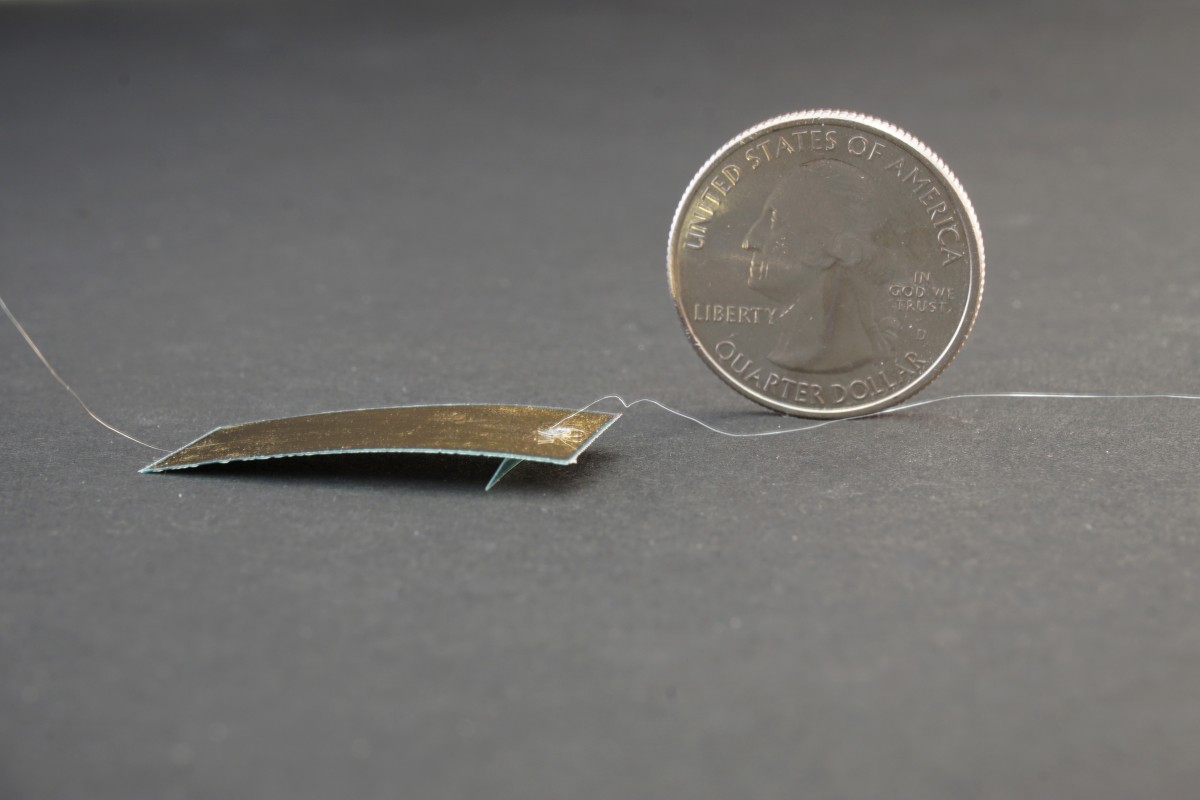
A prototype soft robot, which is about the size of a postage stamp, was developed by a group of researchers from China and the US. Its design was inspired by the capabilities of the hardy cockroach. Photo: Handout
Cockroaches are near-indestructible little creatures. These hardy insects have existed since at least 320 million years ago, outliving dinosaurs. A cockroach can also carry loads of up to 900 times its body weight, shrink to a quarter of its height to fit into small crevices and live for a week without its head.
Inspired by the qualities of this humble bug, a group of researchers from China and the United States have created a prototype of a fast-moving and near-indestructible miniature robot, which could potentially replace sniffer dogs in detecting people trapped in a rubble after a major earthquake or similar disastrous event.
Researchers from China’s Tsinghua University and the University of California, Berkeley, published their study on so-called soft robots in the academic journal Science Robotics last week.
“Although the cockroach is an annoying pest, it has certain interesting features, including the ability to move fast in a narrow space and being hard to squash,” said Zhang Min, an assistant professor at Tsinghua University’s Graduate School in Shenzhen and one of the study’s authors, in an email interview. “These features inspired us to develop a fast-moving and robust soft robot.”
Their work on soft robots was conducted under the Tsinghua-Berkeley Shenzhen Institute partnership, an initiative to collaborate with global researchers on fields such as environmental science and new energy technology.
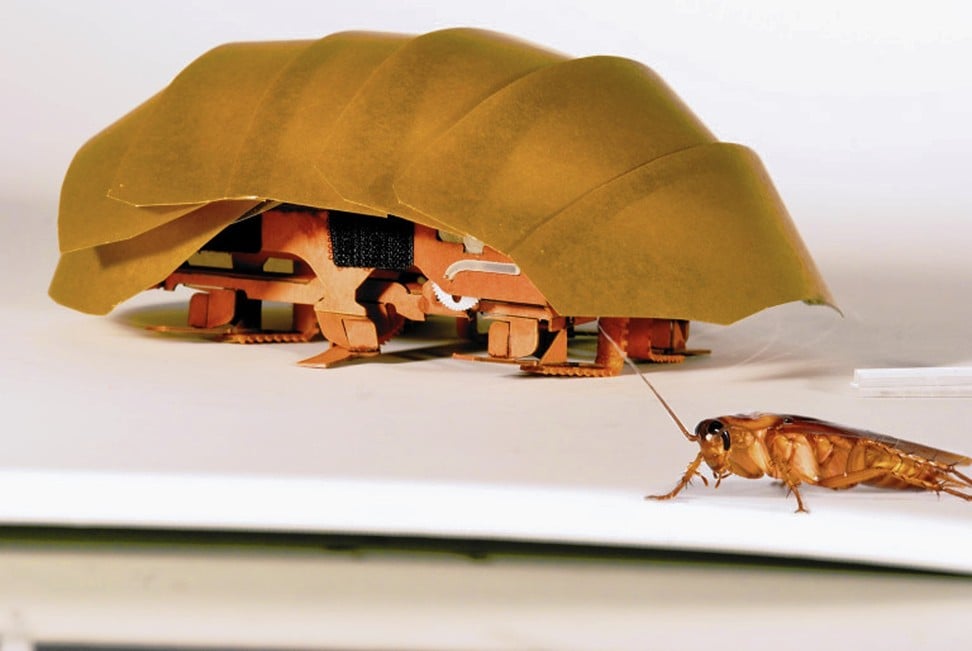
Scientists have long taken inspiration from insects, including cockroaches, for engineering robots. Researchers from UC Berkeley previously developed a palm-sized, roach-like robot – about 20 times the size of the bug – for rescue use in 2017.
By comparison, the new prototype achieved breakthroughs in terms of size and more importantly, the speed and robustness.
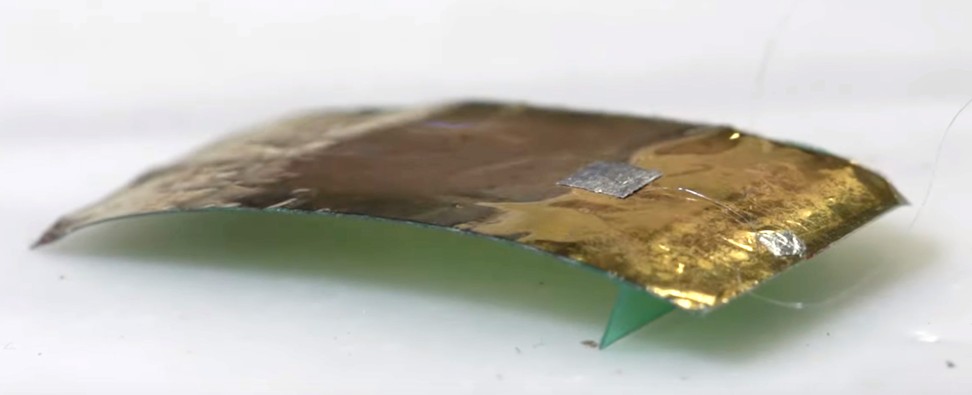
The latest robot, which is about the size of a postage stamp and weighs less than one-tenth of a gram, is composed of a flexible piezoelectric thin film and a polymer skeleton with two legs.
This screenshot from a video provides a closer look at the prototype soft robot developed by a group of researchers from China and the US. Its features were inspired by the sturdy qualities of the humble cockroach. Photo: YouTube
Despite its petite frame, this prototype showed the fastest speed among insect-scale robots in a similar weight range, as well as “ultra-robustness”, according to Lin Liwei, a professor of mechanical engineering at UC Berkeley who directed the research, in a separate email interview.
It can move as fast as a cockroach with speeds of up to 20 body lengths per second. It also continued to move after it was stepped on by an adult human weighting 60 kilograms, which is about 1 million times heavier than the robot, according to the study.
In 2017, researchers of the PolyPEDAL Lab at the University of California, Berkeley, designed a compressible robot, CRAM, that was about 20 times the size of a real cockroach. Photo: Handout
Those features sets up the robot for potential application in disaster relief, a field in which its size, agility and resilience would be invaluable to help detect survivors trapped beneath the rubble in catastrophes, such as major earthquakes.
Earthquakes have caused much devastation in China, a seismically active country with the world’s biggest population. For example, about 87,000 people died and more than 370,000 were injured when a magnitude-8 earthquake struck Wenchuan, a county in southwestern China’s Sichuan province, in 2008.
“The key innovation is the soft materials and structures used in the robot,” Lin said. “If the robot is too soft, it won’t be able to move fast. If the robot is too stiff, it can’t withstand the force of human weight.” The study detailed how the right combination of soft materials and structure enabled the robot to operate efficiently.
While the robot is currently attached to thin cables for power, the researchers are working to integrate a battery and control circuit to get rid of the existing wire in its design, helping expand its use in other applications.
“We want to make the robot carry small sensors, like a gas sensor, to provide it with more functions,” said Zhong Junwen, a researcher at UC Berkeley and one of the authors of the study, in a separate email interview. “With such a sensor, the robot can detect harmful gas leakage.”
Source: SCMP
Posted in battery, catastrophes, Chinese and US researchers, cockroach, cockroach robot, control circuit, design, Dinosaurs, disasters, earthquakes, energy technology, Environmental science, gas leakage, gas sensor, hard to squash, hardy insect, mechanical engineering, moves fast, piezoelectric thin film, polymer skeleton, PolyPEDAL Lab, postage stamp, power, Robot, Robotics, rubble, search and rescue, Shenzhen, sichuan province, small sensors, strike, thin cables, Tsinghua University, Tsinghua-Berkeley Shenzhen Institute, UC Berkeley, Uncategorized, University of California, Berkeley, Wenchuan |
Leave a Comment »



 CHINDIA ALERT: You'll be living in their world, very soon