Archive for ‘doctors and nurses’

29/05/2020

Xi Focus: Xi’s “two sessions” messages reassuring at difficult times

The closing meeting of the third session of the 13th National People’s Congress (NPC) is held at the Great Hall of the People in Beijing, capital of China, May 28, 2020. Leaders of the Communist Party of China and the state Xi Jinping, Li Keqiang, Wang Yang, Wang Huning, Zhao Leji, Han Zheng and Wang Qishan attended the meeting, and Li Zhanshu presided over the closing meeting and delivered a speech. (Xinhua/Ju Peng)

BEIJING, May 28 (Xinhua) — Eradicating absolute poverty, upholding people-centered philosophy and seeking new opportunities from challenges, Chinese President Xi Jinping brought reassuring messages at times of uncertainty and difficulty.

Xi spoke on a wide range of topics at this year’s “two sessions,” which closed on Thursday.

The two sessions are the country’s annual meetings of the National People’s Congress (NPC) and the National Committee of the Chinese People’s Political Consultative Conference (CPPCC).

Xi, also general secretary of the Communist Party of China (CPC) Central Committee and chairman of the Central Military Commission, participated in deliberations with national legislators and joined in discussions with political advisors.

Chinese President Xi Jinping, also general secretary of the Communist Party of China Central Committee and chairman of the Central Military Commission, takes part in a deliberation with his fellow deputies from the delegation of Inner Mongolia Autonomous Region at the third session of the 13th National People’s Congress (NPC) in Beijing, capital of China, May 22, 2020. (Xinhua/Ju Peng)

PEOPLE FIRST

An NPC deputy himself, Xi joined deliberations with lawmakers from north China’s Inner Mongolia Autonomous Region on May 22, the first day of the annual session of the national legislature.

“People first” was the keyword in the discussions. Xi referred to the recovery of an 87-year-old COVID-19 patient after 47 days of care by a team of 10 doctors and nurses.

“Many people worked together to save a single patient. This, in essence, embodies doing whatever it takes (to save lives),” he said.

China mounted swift and sweeping actions to contain the disease. It has mobilized the best doctors, most advanced equipment and high-demand resources. The eldest patient to have been cured is 108 years old.

“President Xi emphasized people and lives are the top priorities,” said Huhbaater, a professor of Inner Mongolia Agricultural University and an NPC deputy who heard Xi speak.

NEW OPPORTUNITIES

China decided not to set a specific annual economic growth target for 2020, but set eyes on winning the battle against poverty and finishing building a moderately prosperous society in all respects.

Xi touched upon the absence of a numerical growth target. “Had we imposed a target, the focus would have been strong stimulus and a simple grasp on growth rate. That is not in line with our social and economic development purposes,” he said.

Xi urged efforts in seeking new opportunities amid challenges as he joined discussions with national political advisors from the economic sector on May 23.

“Our economy is still characterized by ample potential, strong resilience, large maneuver room and sufficient policy instruments,” Xi said.

China has the largest industrial system in the world with the most complete categories, strong production capabilities and complete supporting sectors, as well as over 100 million market entities and a talent pool of 170 million people.

The Chinese president anticipates faster growth in the digital economy, intelligent manufacturing, life and health, new materials and other strategic emerging industries, highlighting the creation of new growth areas and drivers.

Xi stressed steady progress in creating a new development pattern where domestic and foreign markets can boost each other, with the domestic market as the mainstay.

He called for unwavering efforts to make economic globalization more open, inclusive and balanced so that its benefits are shared by all, and to build an open world economy.

Chinese President Xi Jinping, also general secretary of the Communist Party of China Central Committee and chairman of the Central Military Commission, joins a deliberation with deputies from Hubei Province at the third session of the 13th National People’s Congress (NPC) in Beijing, capital of China, May 24, 2020. (Xinhua/Li Xueren)

PUBLIC HEALTH PROTECTION

On May 24, Xi joined deliberations with lawmakers from central China’s Hubei Province, which was the hardest hit by COVID-19.

“We must face the problems upfront, step up reform and waste no time in addressing the shortcomings, insufficiencies and loopholes exposed by the epidemic,” he said, stressing fortifying the public health protection network.

Xi noted several priorities: reforming the disease prevention and control system; boosting epidemic monitoring, early warning and emergency response capacity; perfecting the treatment system for major epidemics; and improving public health emergency laws and regulations.

ENHANCING NATIONAL DEFENSE

When attending a plenary meeting of the delegation of the People’s Liberation Army and People’s Armed Police Force, Xi commended their role in battling COVID-19 and stressed achieving the targets and missions of strengthening the national defense and armed forces for 2020.

The epidemic has brought a profound impact on the global landscape and on China’s security and development as well, he said.

He ordered the military to think about worst-case scenarios, scale up training and battle preparedness, promptly and effectively deal with all sorts of complex situations, and resolutely safeguard national sovereignty, security and development interests.

Noting that this year marks the end of the 13th five-year plan for military development, Xi said extraordinary measures must be taken to overcome the impact of the epidemic to ensure major tasks on the military building are achieved.

Source: Xinhua

26/01/2020

Xinhua Headlines: Quiet and busy — Lunar New Year’s Eve in Wuhan, center of coronavirus fight

The Lunar New Year’s Eve in Wuhan, ground zero of the novel coronavirus outbreak in central China, is nothing but special. Behind the seemingly quiet streets, people in all walks of life are racing against time to fight against the invisible enemy.

WUHAN, Jan. 25 (Xinhua) — There were far fewer cars on the streets and bustling crowds were not seen in the shopping malls in the central Chinese city of Wuhan on Jan. 24 — the Eve of the Chinese Lunar New Year.

The scene was quite different from the occasion in the previous years because of the novel coronavirus that has claimed over 40 lives and infected over a thousand nationwide. With a population of over 10 million, Wuhan, the capital city of Hubei Province, is the center of the epidemic.

Photo taken on Jan. 24, 2020 shows a medical aid team of Army Medical University leaving for Wuhan in southwest China’s Chongqing. On the Chinese Lunar New Year’s Eve, a group of 150 medical workers from the Army Medical University left for Wuhan, the center of the novel coronavirus (2019-nCoV) outbreak, to provide medical aid. (Xinhua)

Yang Yingchen, a volunteer of the Red Cross Society of China’s Wuhan branch, had a busy day answering calls.

“People from across the nation called to check on accounts and addresses to make donations,” said Yang. “Many would say ‘Come on, Wuhan’ to us, which makes me feel especially warm and deeply moved.”

Chen Li, a doctor in a Wuhan hospital, spent the Chinese Lunar New Year’s Eve at home to quarantine herself. She is a little bit worried about having had contact with infected patients, but luckily she has no signs of symptoms for the time being.

“Before joining the fight against the epidemic, I had sent my four-year-old son to my parents. I has disinfected all the articles in my house,” she said.

Chen’s husband is at the forefront of the fight against the epidemic. “We haven’t seen each other for over a week,” said Chen. On Saturday morning, she put on protective clothing again and returned to work.

“Actually, I can’t be isolated for too long. There’s still a lot of work to be done,” she said. “I just don’t know when I can see my boy again.”

Aerial photo taken on Jan. 24, 2020 shows mechanical equipment working at the construction site of a special hospital in the Caidian District of western suburb of Wuhan, central China’s Hubei Province. The central China metropolitan of Wuhan will follow Beijing’s SARS treatment model to build a special hospital for admitting patients infected in the outbreak of pneumonia caused by the novel coronavirus. (Xinhua/Xiao Yijiu)

The virus had resulted in 41 deaths in China by the end of Friday, mostly in Wuhan, according to the National Health Commission. Nationwide, a total of 1,287 cases were confirmed, including 237 in critical condition.

Confirmed cases were also reported in China’s Hong Kong, Macao and Taiwan, as well as Thailand, Japan, the Republic of Korea, the United States, Vietnam, Singapore, Nepal and France.

Wuhan is following Beijing’s SARS treatment model in 2003 to build a makeshift hospital with a capability of 1,000 beds for admitting infected patients. Construction on the facility began Thursday night. It will be completed and put into use prior to Feb. 3, less than 10 days away.

“It’s going to be another all-nighter. We need to speed up work and complete the hospital as soon as possible,” said Lyu Jun, a young truck driver at the construction site. This is his first Spring Festival away from home.

For ordinary people, this year’s Lunar New Year’s Eve lacks some gatherings but is still a time to extend greetings and wishes.

Yin Yeqiong, from Hunan Province, refunded her tickets back home after much debate. “I had it in my mind to still go home, but finally decided to stay in Wuhan,” she said. “Our stay will help reduce panic in other places.”

Liu Jie, a dough sculptor, put on a New Year costume and watched the Spring Festival Gala with his family. “We’re now at a critical period, so I texted New Year wishes to friends and relatives this year. I believe this is the best way,” he said.

Liu Jiapeng, a children’s book editor, stayed in Wuhan during the Spring Festival for the past four decades. “I always stayed with my family, and we would have every meal together,” said Liu. “But this year, I haven’t had one meal with them.”

On the day of the Lunar New Year’s Eve, he and his wife bought some goods for their parents, brought them to their house and briefly chatted. As they were waiting for the elevator, Liu looked back and saw his father standing at the windowsill, watching them leave.

Medical workers of Army Medical University assemble before leaving for Wuhan in southwest China’s Chongqing, Jan. 24, 2020. On the Chinese Lunar New Year’s Eve, a group of 150 medical workers from the Army Medical University left for Wuhan, the center of the novel coronavirus (2019-nCoV) outbreak, to provide medical aid. (Xinhua)

China is mobilizing medical resources nationwide to aid Wuhan and control the epidemic. Doctors, nurses and experts from across the nation have been selected to join the battle, and manufacturers have restarted their plants to produce medical consumables that have been running short in many places.

A national research team of 14 experts, headed by renowned respiratory scientist Zhong Nanshan, has been set up to help prevent and control the outbreak on Friday.

“This is going to be an unforgettable Spring Festival,” said Chen Ying, a writer. “Because I feel that at this moment, there are so many families that I do not know, in every corner of this city, praying for our home.”

“My New Year wish is simple,” said Liu Jie. “I hope the virus will soon be conquered and everyone in Wuhan and the whole nation would be safe and healthy.”

Source: Xinhua

25/01/2020

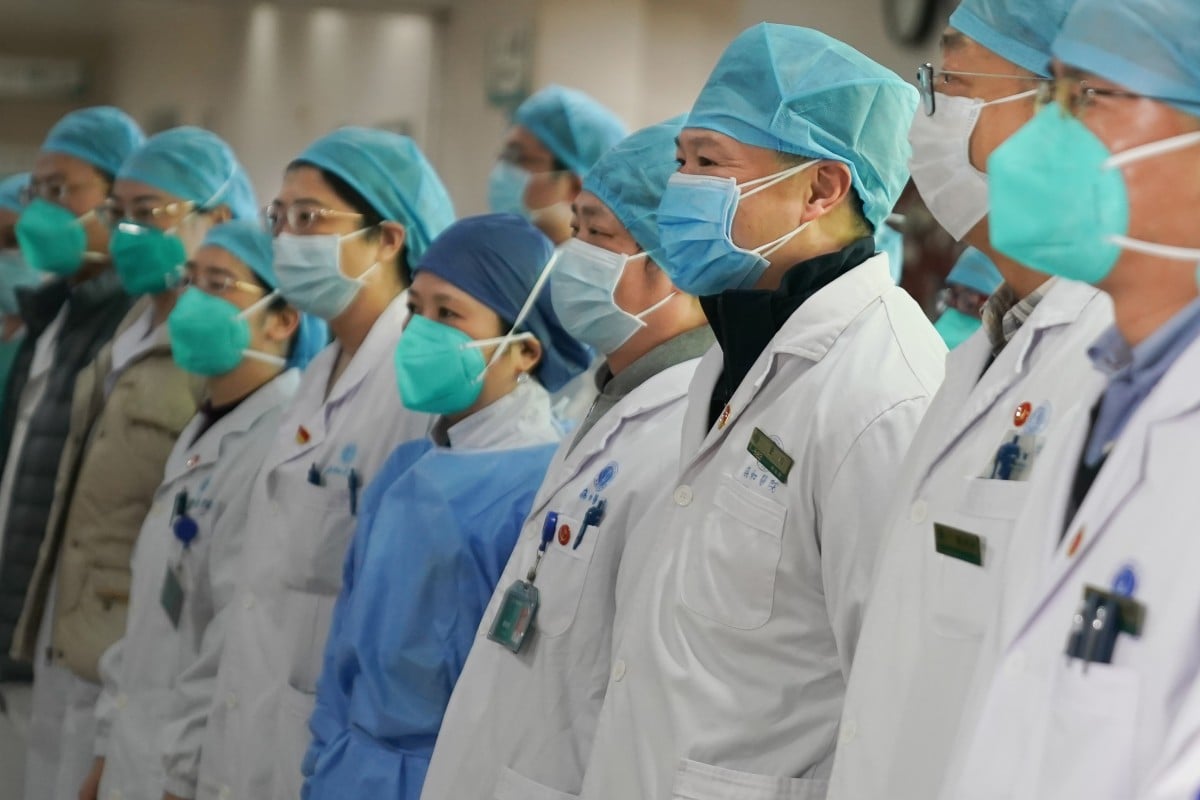
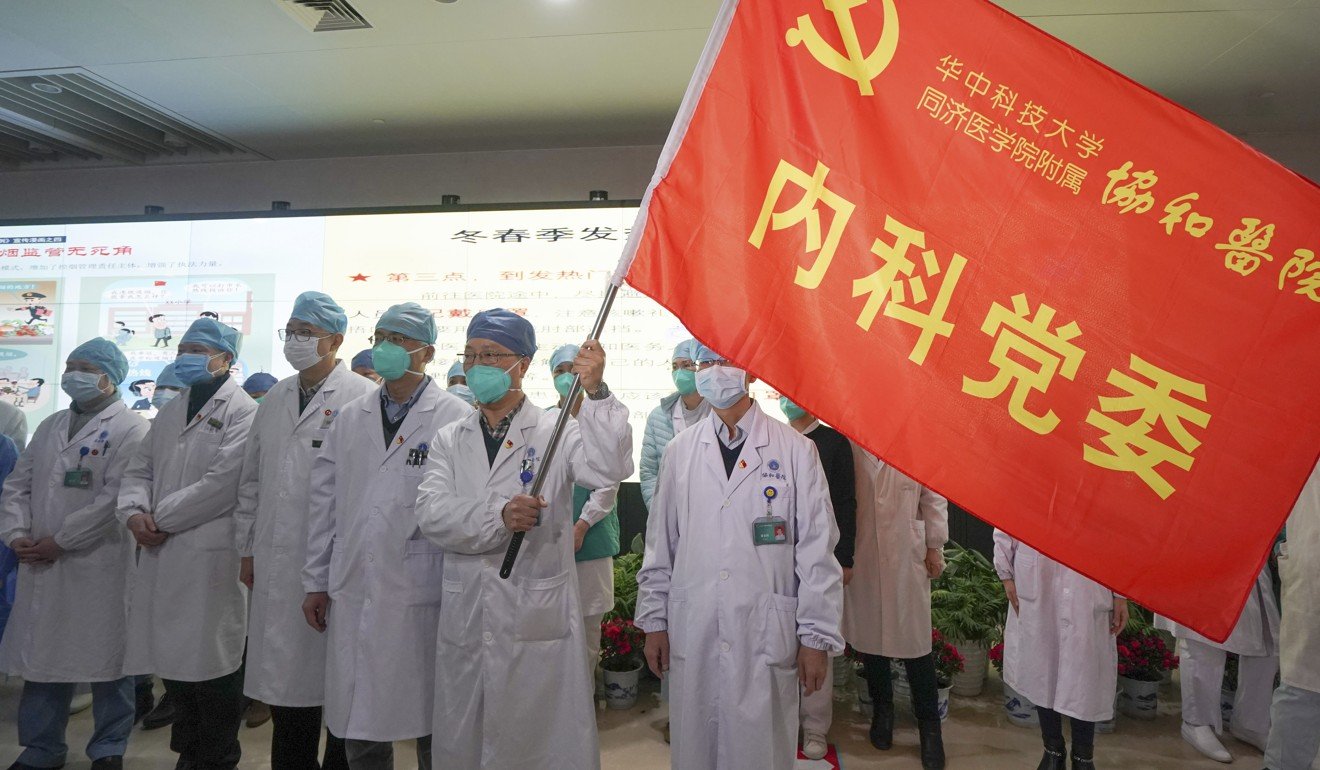
China deploys 1,230 doctors and nurses to help fight coronavirus as private firms pledge money, supplies

  • Teams from Shanghai, Guangdong – including experts who helped tackle Sars – arrive in Wuhan to lend their support
  • Tencent, JD.com, Lenovo among raft of private firms offering financial aid to those battling deadly outbreak
Doctors and nurses from across China are being dispatched to help tackle the coronavirus epidemic in Hubei province. Photo: Xinhua
Chinese authorities and private enterprises are stepping up their support for embattled medical teams in Hubei province as they continue to fight the coronavirus epidemic, while neighbouring governments ramp up their efforts to prevent its further spread.
Hospitals across Wuhan – the city at the centre of the outbreak – have been overwhelmed by the flood of patients and doctors are becoming increasingly frustrated at the lack of support, both in terms of supplies and personnel, they have received.
But national bodies say they are responding to the crisis.
On Saturday, China’s National Health Commission (NHC) said that six medical teams comprising 1,230 staff had been set up and dispatched to help fight the deadly virus in Hubei.
Three medical units from Shanghai, Guangdong and the armed forces had already arrived in the province, it said, though did not make clear if they were in addition to or part of the six teams.

Chen Dechang, a doctor from Ruijin Hospital in Shanghai who is among those sent to Hubei, said it was important there were more medical staff on the scene.

“We can help save more patients in the intensive care unit if we are on the front line,” he said.

Authorities in Shanghai have also sent 81 ECMO (extracorporeal membrane oxygenation) life-support machines to Jinyintan Hospital, which is one of the designated facilities treating patients in Wuhan.

The ECMO technique – which involves removing blood from a person’s body, removing the carbon dioxide and oxygenating red blood cells before pumping them back into the patient – has already been used on one critically ill patient at Wuhan University’s Zhongnan Hospital, according to Shanghai-based news outlet Thepaper.cn.

Though the report did not say how effective the treatment had been.

Medical teams in Wuhan have been under huge pressure since the outbreak began. Photo: Xinhua
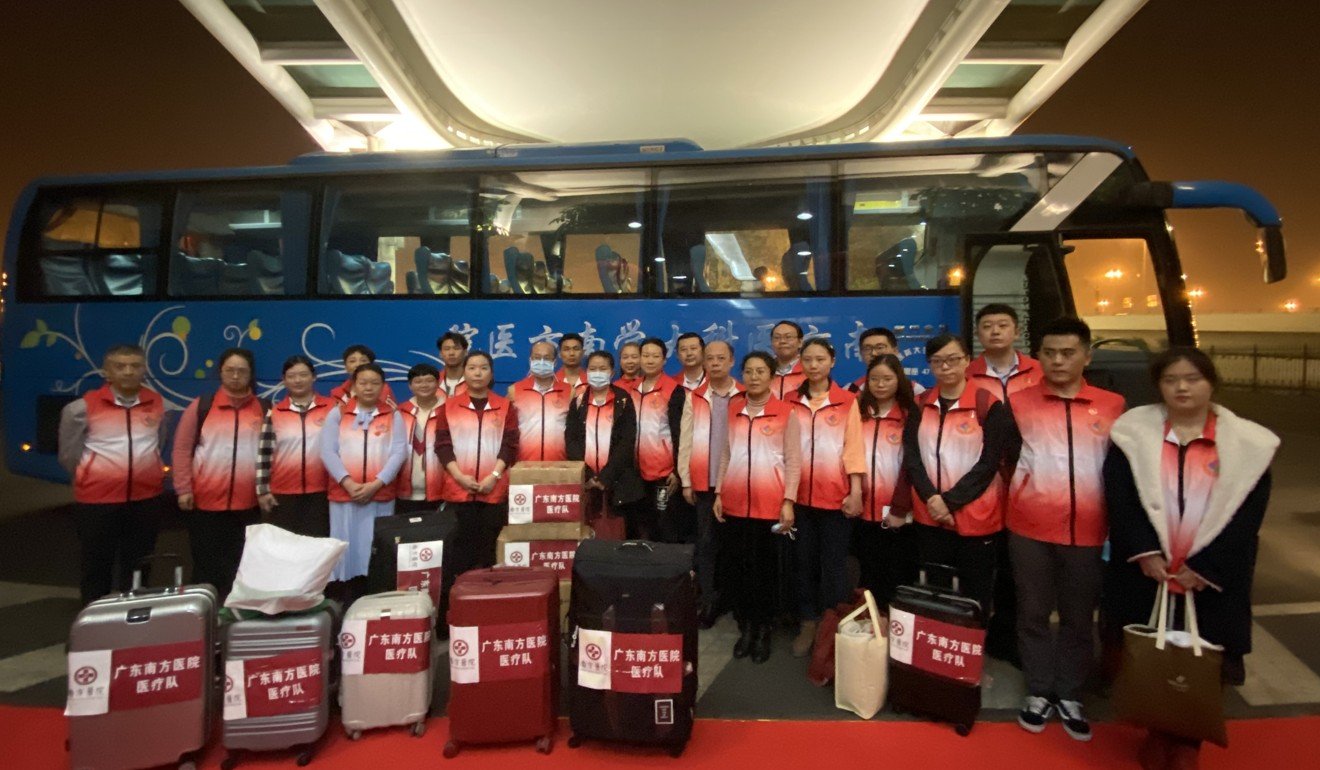
The team from Guangdong comprised 42 doctors and 93 nurses, the NHC said. The deployment came after a group of current and former medical staff from Southern Medical University in Guangzhou – who had helped tackle the Sars (severe acute respiratory syndrome) outbreak in 2002-03 – signed a petition saying they were willing to help in Wuhan.

“We are a team of experienced practitioners who fought Sars,” they said in the petition, a copy of which was posted on the social media accounts of Communist Party mouthpiece People’s Daily.

“We cannot back away from our responsibility to help 17 years later as people are facing the outbreak of a new coronavirus. We are willing to be deployed to the front line to make our contributions.”

A team of 135 doctors from Chongqing arrived in Wuhan on Friday evening, the NHC said, without elaborating.

A medical team from Guangdong province prepares to travel to Wuhan. Photo: Xinhua
As well as the wave of medical support, several private companies said they had provided financial support to help fight the epidemic.
According to Chinese media reports, Shanghai Ocean Forest Assets has donated 10 million yuan (US$1.4 million) to the cause, while Shanghai-based asset management firm, Jinglin Assets is coordinating efforts to buy urgently needed medical supplies from South Korea and Japan.
Shenzhen’s Fantasia Holdings said it would donate 6 million yuan and send medical supplies, including surgical masks, to Wuhan, while tech giant Tencent said it would donate 300 million yuan from its charity. E-commerce platform JD.com said it had donated 1 million surgical masks and 60,000 other medical items.
Chinese smartphone manufacturer Xiaomi said on Friday it had sent a first batch of medical equipment – masks and thermometers worth more than 300,000 yuan – to Wuhan, while tech firm Lenovo said on Saturday it would donate all of the IT equipment required by the new specialist treatment centre being built in the city.
Authorities set a target to have the 1,000-bed facility up and running within six days of starting construction.

Aside from the support from the private sector, state lender China Development Bank on Friday issued a 2 billion yuan emergency loan to Wuhan, while a day earlier, China’s finance ministry said it had allocated 1 billion yuan to authorities in Hubei to help tackle the epidemic.

Across the country, authorities have introduced a number of measures to help prevent the further spread of the coronavirus, including the closure of all cinemas in Shanghai.

Wuhan residents stockpile food, medical supplies
25 Jan 2020

Also on Saturday it was reported that Liang Wudong, a doctor at Xinhua Hospital in Wuhan, had become the first medical professional to die after treating people infected with the virus.

Liang, 62, was suspected of having contracted the virus last week and had been transferred to Jinyintan Hospital for treatment. He died at 7am on Saturday, Thepaper.cn reported.

According to official figures, 41 people have been killed by the coronavirus and there have been more than 1,280 confirmed cases. The vast majority are in the Chinese mainland, but there have also been confirmed cases in Hong Kong, Macau, Taiwan and eight other countries, including the United States and Europe.

Tens of millions of people in cities across Hubei are effectively on lockdown after the introduction of travel bans to help control the spread of the virus.

Source: SCMP

Law of Unintended Consequences

continuously updated blog about China & India

ChiaHou's Book Reviews

continuously updated blog about China & India

What's wrong with the world; and its economy

continuously updated blog about China & India