Archive for ‘domestic market’

09/05/2020

Xinhua Headlines: World’s factory turns to domestic market amid global coronavirus recession

— As the continued global spread of COVID-19 is weighing on the world economy, China’s foreign trade is under considerable downward pressure.

— Many export-oriented companies in China are turning to the domestic market for a lifeline while grappling with dropping overseas orders as major markets remain in the grip of the pandemic.

by Xinhua writers Zhang Yizhi, Li Huiying, Hu Guanghe, Xu Ruiqing

FUZHOU, May 9 (Xinhua) — Walking back and forth between shelves of neatly stacked shoes, some 20 live streamers dashed at the instructions of their followers on the phone, grabbing a shoe now and then from the shelves for a close-up in front of the camera.

At around eight o’clock every night, the supply chain platform 0594 in the city of Putian, east China’s Fujian Province, springs to life as live streamers flock to the exhibition area to sell shoes produced by the local manufacturers, many of which are troubled by the cancellations or delays of overseas orders amid the global coronavirus pandemic.

“To get rid of the excess inventory, many manufacturers in Putian are turning to live streaming to explore the domestic market,” said Chen Xing, general manager of 0594. “We are now cooperating with over 40 manufacturers and there will be more of them joining us in the future.”

The platform is also building an internet celebrity incubator and has so far organized seven rounds of influencer training courses enrolling more than 200 attendees.

Huang Huafang, 39, signed up for the two-day crash course in late March and soon after started her first live streaming session. She works from around 2 p.m. to 10 p.m., attracting over 500 followers and selling more than 20 pairs of shoes every day.

Though she is not a well-known live streamer, she is optimistic about the future. “There is a long way to go, but I believe live streaming is a trend. It is an essential skill for anyone who wants to market online,” said Huang.

A staff sells shoes through live streaming at an e-commerce warehouse in Putian, southeast China’s Fujian Province, May 7, 2020. (Xinhua/Lin Shanchuan)

According to Chen, the platform 0594 sold almost 130,000 pairs of shoes in April alone. As the domestic economic outlook continues to pick up, the sales target of May has been set at 200,000 pairs.

Like manufacturers in Putian, a city with a large number of export-oriented enterprises, many Chinese factories are turning to the domestic market for a lifeline, while grappling with dropping overseas orders as major markets remain in the grip of the pandemic.

ADAPT OR DIE

With decades of experience in manufacturing and developing products for overseas clients, some export-oriented companies in China are rolling out products catering to the domestic market.

After months of gloomy business, Wu Songlin, general manager of Putian-based Hsieh Shun Footwear Co., Ltd., heaved a sigh of relief as trucks loaded with therapeutic shoes tailored to the home market left his factory.

It was the first shipment for the domestic market since Wu and his partners started the company in 2010. In the past, his company only had two clients, one from Europe and the other from Japan. Business used to run smoothly and life was good.

But his factory was on the brink of a shutdown in March when the coronavirus pandemic started to ravage the global economy. No new orders came in and shipments of existing orders were requested to be delayed until June.

People work in a footwear workshop in Putian, southeast China’s Fujian Province, April 27, 2020. (Xinhua/Lin Shanchuan)

“Orders were canceled after completion of production, and our capital flow is stuck in our inventory. The pressure is mounting to keep the factory running,” Wu said. “By the end of June, workers would be left with no work to do as soon as we complete the existing orders.”

After losing almost all their orders from overseas clients, the desperate shoemaker turned to the domestic market. He called one of his old business partners and secured an order for massage footwear, which is selling like hot cakes in the domestic market as health tops the agenda in the time of the novel coronavirus.

The factory produced 10,000 pairs of massage shoes in April, and the number is expected to reach 30,000 in May, enough to keep the production lines running.

Thanks to the company’s quick adaptation, about 200 workers kept their jobs in the factory, while 20 percent were furloughed and the remaining workers were arranged to work in other companies as part of the city’s employee sharing program.

“If domestic orders keep coming in, our operation will hopefully get back to normal by September when the monthly output of massage shoes will reach 90,000,” Wu said. “By then the company will live and thrive without any orders from overseas customers.”

A woman works in a workshop of Hsieh Shun Footwear Co., Ltd. in Putian, southeast China’s Fujian Province, May 7, 2020. (Xinhua/Lin Shanchuan)

But switching to another market is not easy, explained Wu. In the past, export-oriented factories were only in charge of manufacturing, while brands would take care of sales, promotion as well as customer support.

“If you are selling to the domestic market, you need to have your own brand and marketing capacity,” he said. “Working with e-commerce platforms could be one way out, but it’s more important to understand domestic consumers and meet their needs.”

CUSTOMIZE THE FUTURE

For years, many export-focused manufactures have been trying to climb up the value chain and tap the uncharted waters of the domestic market. As the pandemic continues to spread, there is a strong push for them to embrace customized manufacturing.

In an experience store located in downtown Putian, customers line up waiting to have their feet measured on a smart device. After a few seconds, they get their readings on the phone, and a few swipes and clicks later, they place their orders with unique features, colors, and shapes.

Adjacent to the experience store, there is a flexible manufacturing workshop, which gives quick responses to orders and produces shoes following the customized demands of individual buyers.

SEMS, a longstanding sports footwear manufacturer that has established a partnership with several international brands, started to adopt flexible manufacturing years ago in an effort to adapt to the evolving domestic market.

A customer has her feet measured on a smart device in sports footwear manufacturer SEMS in Putian, southeast China’s Fujian Province, May 8, 2020. (Xinhua/Lin Shanchuan)

Customization gives consumers the benefit of products that fit their needs, and at the same time allows factories to utilize improved workflows and technology to maintain high output and omit the process of inventory and distribution, said Zhu Yizhen, the executive vice president of the company.

“Currently we only sell over 100 pairs of customized shoes a day, but we are at the dawn of a new era,” Zhu said. “We hope more companies awaken to the developing trend and join in the practice of mass customization.”

Customer to manufacturer, or C2M, which allows consumers to place orders directly to factories for customized products, has become a buzzword among export-oriented manufacturers hoping to reach domestic consumers amid the pandemic.

Li Junjie, who runs a ceramic flowerpot plant in Fujian’s Dehua County, one of the manufacturing centers of ceramics in China, did not sell a single pot to his overseas customers since the coronavirus outbreak in late January.

The factory used to export 30 percent of its flowerpots to the United States and Spain, but Li managed to make up for the lost deals by selling on domestic e-commerce platforms. Instead of bulk orders placed by foreign clients, domestic consumers tend to purchase customized products in small amounts.

Photo shows the automatic production line of a customized workshop in sports footwear manufacturer SEMS in Putian, southeast China’s Fujian Province, May 8, 2020. (Xinhua/Lin Shanchuan)

With the big data provided by e-commerce platforms, Li can tell which items will be a hit so as to increase their production and develop new products based on a thorough analysis of different consumer groups.

“Our online sales almost doubled over the past year, and we have sold over 100,000 customized pots this year, thanks to the C2M business model,” Li said.

Li’s company is one of many Chinese small and medium-sized enterprises (SMEs) that have benefited from the e-commerce giant Alibaba’s Spring Thunder Initiative, which is aimed at helping export-focused SMEs expand into new markets.

The initiative will also help some SMEs to transform and develop their business in the Chinese market through measures such as resource support, fee reductions, and fast-track processing.

Source: Xinhua

08/05/2020

China urged to focus on domestic economy in next five-year plan to counter more hostile world

  • As China prepares its 14th five-year plan, researchers at one state-affiliated think tank predicted a more hostile global situation
  • Beijing urged to strengthen home-grown innovation and use vast domestic market to power economy post-coronavirus
A think tank linked to China’s State Council has encouraged Beijing to focus on home-grown technology and its vast consumer market over the next five years. Photo: Xinhua

China’s will face an increasingly hostile world over the next five years, meaning its policy plan should be focused on its vast domestic market, home-grown technological innovation and improving its  citizen’s welfare, according to recommendations in a new paper.

The report by the Chinese Academy of Social Sciences (CASS), a think tank affiliated with the State Council, foresees the next five years presenting “major changes unseen in a century” for China, as “the strategic game between superpowers has intensified, while international systems and orders are reshuffled”.

While the report does not mention the coronavirus specifically, its recommendations suggest that China should become more self-reliant in response to the pandemic. This view represents one side of a lively debate among policymakers and scholars in China, ahead of the next five-year plan, which will come into place next year.

Between 2021 and 2025, the globalised economy which helped China grow into an economic power will be radically different, the report said, meaning it must adapt if it is to continue to thrive.

“The disadvantages of economic globalisation have increasingly stood out. Populism has risen as the global economy weakens, while countries are divided as imbalances expand. The old multilateral [trading] system is under pressure,” read the paper, part of a wave of preliminary studies offering advice ahead of China’s 14th five-year plan, a blueprint for economic and social development.
China is the only major economy that publishes a five-year policy plan and has been doing so since 1953, in a tradition borrowed from the Soviet Union. China’s own plans are broad strategic guidelines, rather than Moscow’s previously detailed command economy production worksheets.

China is currently in the final year of its 13th five-year plan, the stage during which the Soviet Union collapsed. The 14th plan is expected to be published in early-2021, but brainstorming about challenges and policy options is well under way among academics and state planning officials.

That debate is expected to feature prominently in the coming meetings of the “Two Sessions,” the Chinese People’s Political Consultative Congress, which is due to meet in Beijing on May 21, and the National People’s Congress, which will begin to meet a day later.

A common point in the debate is that the lessons of the past few years have shown the need to be more self-reliant. Even before the coronavirus outbreak, the US-China trade war and the growing superpower rivalry have made many think that Beijing can no longer rely on the goodwill of trading partners to continue the expansion it has enjoyed since the late-1970s.
Coronavirus pandemic creates ‘new Cold War’ as US-China relations sink to lowest point in decades
In December 2017, US President Donald Trump declared China a “strategic competitor” in anticipation of the Chinese economy reaching two-thirds the size of America’s, which happened in 2018. Since then, the two have engaged in a tit-for-tat tariff battle, while the coronavirus has served to sharpen tensions and fuel arguments for further decoupling.

“Uncertainties and instabilities are clearly increasing,” read the analysis published in the academic journal Economic Perspectives this week.

Without citing coronavirus directly, the CASS researchers suggested that China should “stick to its developmental direction and concentrate on doing its own things well”.

China now has a middle income group of between 500 and 700 million people and that alone can be a source empowering China’s economic growth for the next five years, the report said.

However, China must also attempt to smooth out a major weakness, namely unbalanced growth, including the yawning wealth gap between urban and rural groups.

In terms of innovation, the researchers led by Huang Qunhui said China should rely less on foreign technologies. “China’s innovation capacity is still lagging behind developed countries. Breakthroughs in core technologies are in urgent need,” read the report.

The Made in China 2025 plan, published in 2015, stated Beijing’s ambitions to dominate future technologies such as robotics and artificial intelligence. However, after loud complaints from the US and European Union, China has been forced to play down such bold innovative goals.

Source: SCMP

06/03/2019

China to make forced technology transfer illegal as Beijing tries to woo back foreign investors

  • Issue a key demand made by US President Donald Trump as part of the ongoing US-China trade war
  • China expected to pass new foreign investment law next week during National People’s Congress

26 Feb 2019

Foreign direct investment in China amounted to US$135 billion in 2018, an increase of 3 per cent from a year earlier, according to Chinese government data. Photo: EPA

Foreign direct investment in China amounted to US$135 billion in 2018, an increase of 3 per cent from a year earlier, according to Chinese government data. Photo: EPA
Beijing will make it illegal to force foreign investors to transfer their technology to Chinese partners while also lowering market barriers for foreign firms to enter the domestic market, a senior economic planning official said on Wednesday, highlighting an effort to lure overseas investment inflows.
China is expected to pass a new law next week intended to protect the interests of foreign investors, both as a response to demands from the United States that have formed part of the ongoing trade war negotiations, and to help shore up economic growth, which slowed last year to its lowest rate in 28 years.
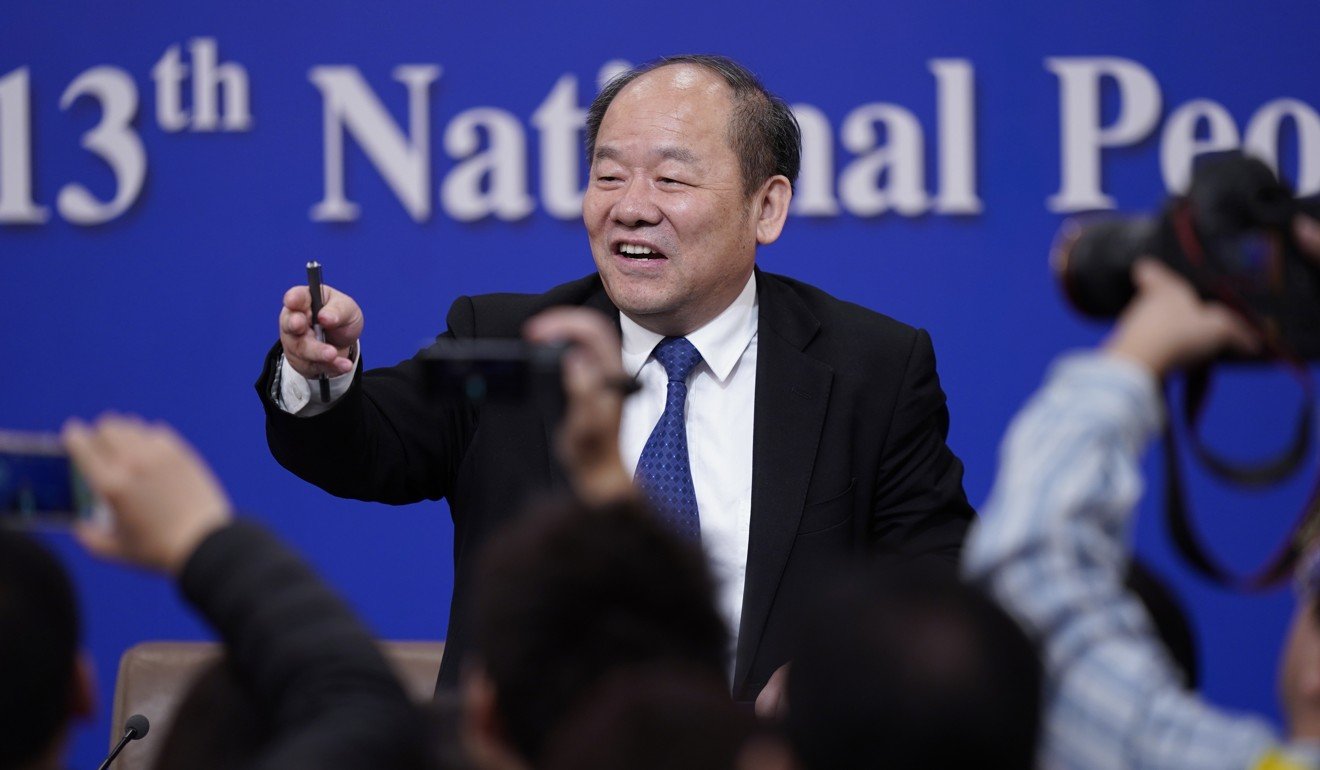
Foreign investors will be allowed to set up ventures in which they have full ownership, instead of being forced into joint ventures with local partners, in more industries, said Ning Jizhe, a vice-chairman of the National Development and Reform Commission, in Beijing on Wednesday during the National People’s Congress.

But foreign investment into the world’s second biggest economy have slowed over last decade, which could deprive China of access to advanced technologies and marginalise the country in the development of future global supply chains.

Beijing is trying to lure more foreign capital and technology to support its plan to upgrade its manufacturing industries and boost the development of new, hi-tech sectors.

“China will roll out more opening-up measures in the agriculture, mining, manufacturing and service sectors, allowing wholly foreign-owned enterprises in more fields,” Ning said.

China law to protect intellectual property, ban forced tech transfer
Since December, China has been rushing to draft legislation for a new foreign investment law, a key clause of which prohibits local government’s from forcing transfer of technology in return for being allowed to conduct business in their jurisdictions.
The National People’s Congress is expected to endorse the new 

“After passing the law, the government will take serious measures to obey and implement it,” Ning added.

He said that China will remove market entry restrictions for foreign investors to ensure that domestic and foreign firms “are treated as equals.”

Ning Jizhe, a vice-chairman of the National Development and Reform Commission. Photo: EPA

However, the jury is still out whether Beijing’s promises of fair treatment, market access and protection for intellectual property rights will be enough to generate a steady inflow of hi-tech investment.

The US has long complained that China has been unwilling to implement previous commitments under the World Trade Organisation to open up its market – allegation Beijing denies.

Shen Jianguang, chief economist at JD Digits, an arm of Chinese e-commerce firm JD.com, said restrictions on foreign investment will exist in China despite the government’s promises.

China’s domestic market remains large and attractive for some foreign investors, he said.

“Foreign investors are still very interested in the Chinese market, if the openness of the economy is sufficient,” Shen added.

Source: SCMP

20/02/2019

China to deepen reforms of agriculture sector to boost rural areas

  • Policy statement outlines broad goals including plan to revive domestic soybean production
A farmer picks tea leaves in Mianxian county, Shaanxi province. Beijing’s policy document reiterated a strategy to improve income levels and living standards in China’s countryside. Photo: Xinhua
China will deepen reforms of its agriculture sector to promote its rural economy, the government said in its first policy statement of 2019, as it seeks to bolster growth and offset trade challenges.

Beijing’s statement, released late on Tuesday, comes after the world’s second-largest economy saw its weakest growth in 28 years in 2018 and remains entangled in a trade war with Washington.

“Under the complicated situation of increasing downward pressure on the economy and profound changes in the external environment, it is of special importance to do a good job in agriculture and rural areas,” the government said in the document issued by the State Council and published by official news agency Xinhua.

The biggest winners in Shenzhen, ‘China’s Silicon Valley’? Pig and chicken farmers

Known as the “No 1 document”, this year’s policy reiterated a rural rejuvenation strategy first laid out in 2017 to improve income levels and living standards in China’s countryside.

It also highlighted a plan to boost domestic soybean production but did not offer further details.

Chinese President Xi Jinping visits a farm in northeastern Heilongjiang province during an inspection tour in September. Photo: Xinhua via AP

Industry analysts said on Wednesday they were eagerly awaiting further details to assess the impact of the plan, which had already been flagged by Agriculture Minister Han Changfu earlier this month.

China has been overhauling its crop structure in recent years, reducing support for corn after stocks ballooned, and seeking to promote more planting of oilseeds that it mostly imports.

That goal has become increasingly important since a trade war with the United States, which led China to slap tariffs on soybean imports, tightening domestic supplies.

Han has previously urged authorities in China’s northeast to support soybean production through subsidies and called for rotating of soybeans with other crops including corn and wheat.

Beijing also aims to support the production of rapeseed in the Yangtze River Basin, according to the document.

The garlic case that foreshadowed the US-China trade war

As in previous years, it also called for stable grain production, but also an increase in imports of agriculture products where there are shortages in the domestic market.

“The focus now is on retaining production capacity, in the form of high quality farmland, and using the international market to make up production shortfalls,” said Even Rogers Pay, an agriculture analyst at China Policy, a Beijing-based consultancy.

The reference to imports is positive for trade partners like the United States, said Cherry Zhang, analyst with Shanghai JC Intelligence, who said it raised the likelihood that China will buy more US agriculture products.

China’s DJI turns its eye to enterprise uses like agriculture after conquering global commercial drone market

Shares of Chinese livestock companies, along with pig and poultry breeders, rose on Wednesday following the release of the policy paper.

The document also outlines plans to accelerate development of a new farm subsidy policy system and further crack down on the smuggling of agriculture products.

Additionally, the government said it plans to strengthen the monitoring and control of African swine fever outbreaks, after more than 100 cases were reported in China since August.

Other plans include continuing to tackle rural pollution and promoting recycling of agricultural waste such as manure and agricultural film.

Source: SCMP

Law of Unintended Consequences

continuously updated blog about China & India

ChiaHou's Book Reviews

continuously updated blog about China & India

What's wrong with the world; and its economy

continuously updated blog about China & India