

- Few signs of Eid celebrations after crackdown that has seen a reported million Uygurs and other minorities interned in camps
- Muslims in far western Chinese region say they are now ‘too scared’ to practise their faith in public
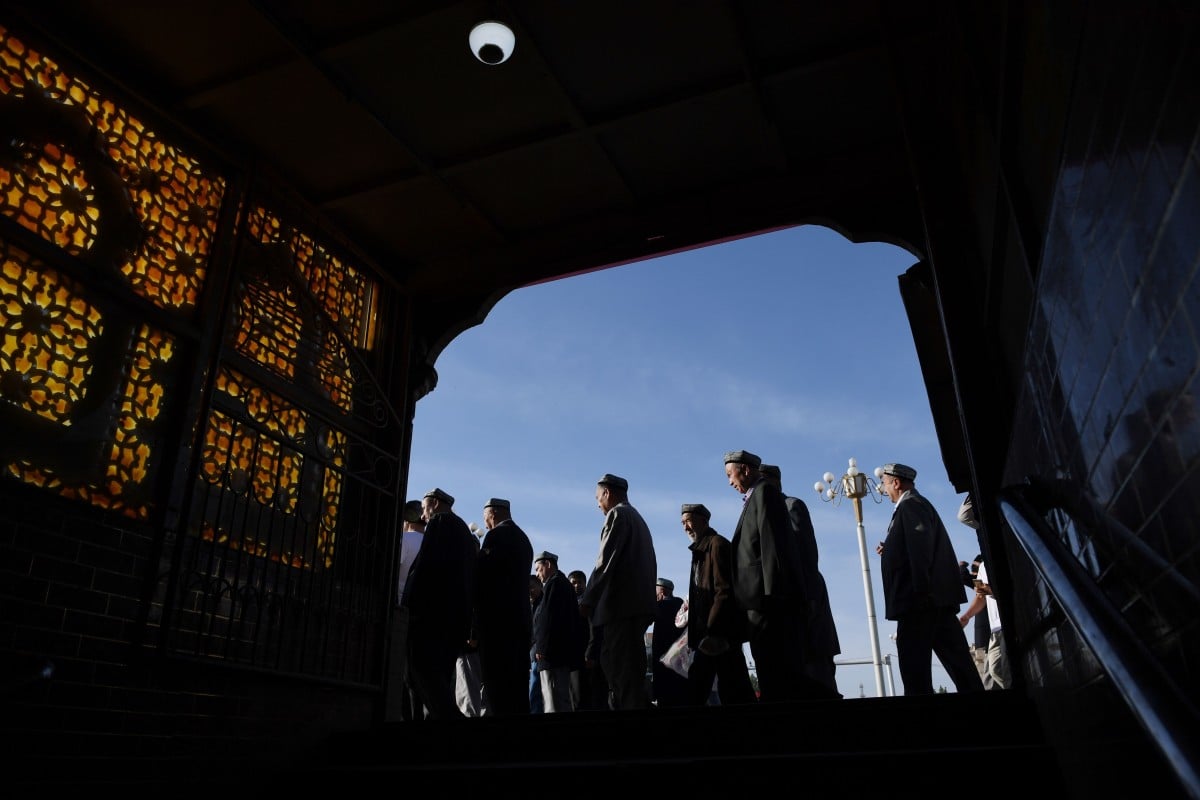
In the mosques that are open, worshippers go through metal detectors while surveillance cameras monitor them inside.
“The situation here is very strict, it takes a toll on my heart,” said one Uygur, who requested anonymity for fear of reprisals. “I don’t go any more,” he added, referring to mosques. “I’m scared.”
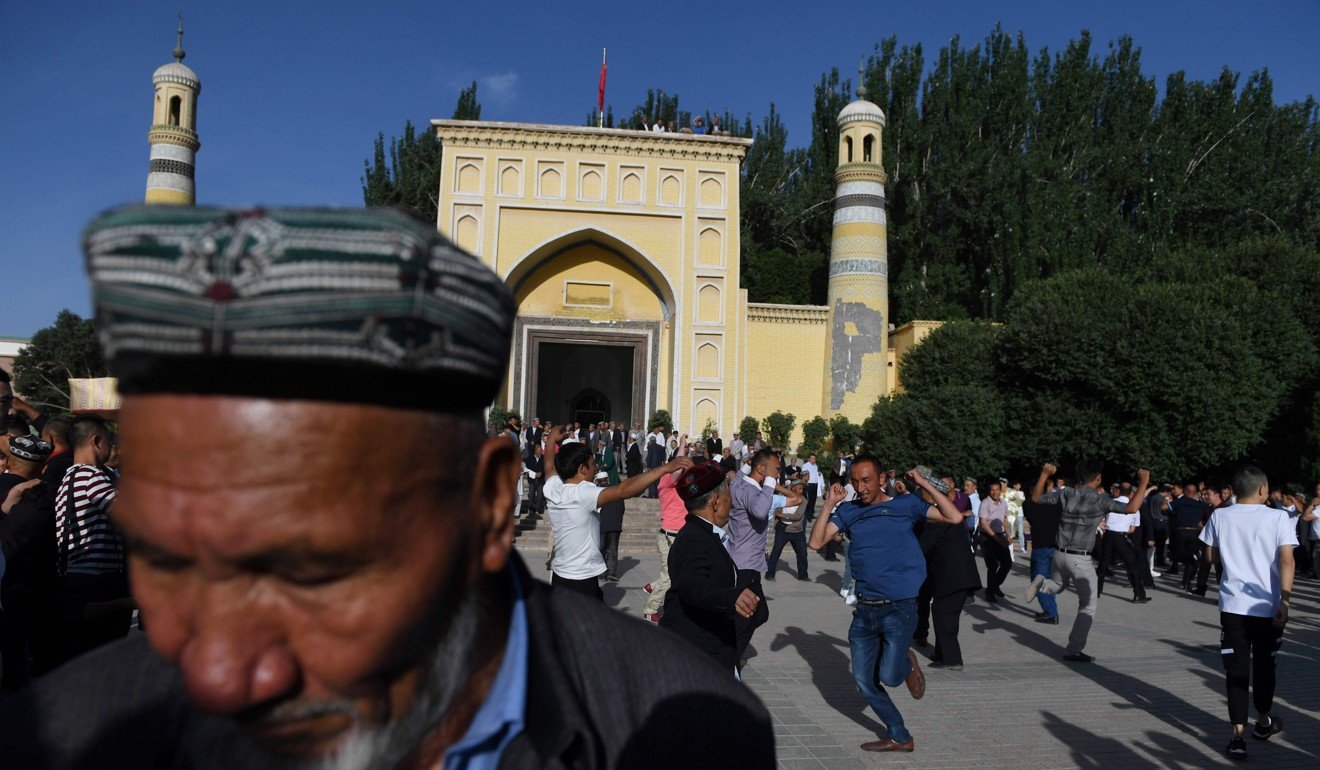
In the ancient Silk Road city of Kashgar, no longer does the sunrise call for prayer echo throughout the city – a ritual the manager of the city’s central mosque once proudly shared with touristsOn Wednesday, locals celebrating Eid al-Fitr quietly filed into the entrance of state-approved Idkah Mosque – one of the largest in China – as police and officials fenced off the wide square surrounding the building and plain clothes men monitored every person’s actions.
It was another low-key Ramadan for Muslims in Xinjiang, where restaurants were busy serving food to customers throughout the day, a time when practising Muslims fast.
In Hotan on Friday – a holy day for believers – the only mosque in the city was empty after sundown, an important prayer session when Muslim families typically break their daily Ramadan fast.
Earlier in the day, at least 100 people attended a midday session but the vast majority were elderly men.
Human Rights Watch decodes surveillance app used to classify people in China’s Xinjiang region
The ruling Communist Party “sees religion as this existential threat”, said James Leibold, an expert on ethnic relations and policy in China at La Trobe University.
Over the long term, the Chinese government wants to achieve “the secularisation of Chinese society,” he told AFP.
The Xinjiang government told AFP that it “protects religious freedoms” and citizens can celebrate Ramadan “within the scope permitted by law”, without elaborating.
The authorities have thrown a hi-tech security net across the region, installing cameras, mobile police stations and checkpoints in seemingly every street in response to a spate of deadly attacks blamed on Islamic extremists and separatists in recent years.
An estimated one million Uygurs and other Turkic-speaking ethnic groups are held in a vast network of internment camps.
After initially denying their existence, Chinese authorities last year acknowledged that they run “vocational education centres” aimed at steering people clear of religious extremism by teaching them Mandarin and China’s laws.
In those centres, it was a different Ramadan.
The Xinjiang government told AFP that people in the centres are not allowed to hold religious activities because Chinese law forbids it within education facilities, but they are free to do so “when they return home on weekends”.
In recent years, Chinese authorities have ramped up controls on public displays of religion and Islamic traditions in Xinjiang.
AFP reporters did not see any veiled women and few men sporting long beards during a week-long visit to the region. Former internment camp inmates have said they were incarcerated for these outward signs of their religion.
Places of worship too have become targets of Beijing’s draconian security measures.
Human Rights Watch decodes surveillance app used to classify people in China’s Xinjiang region
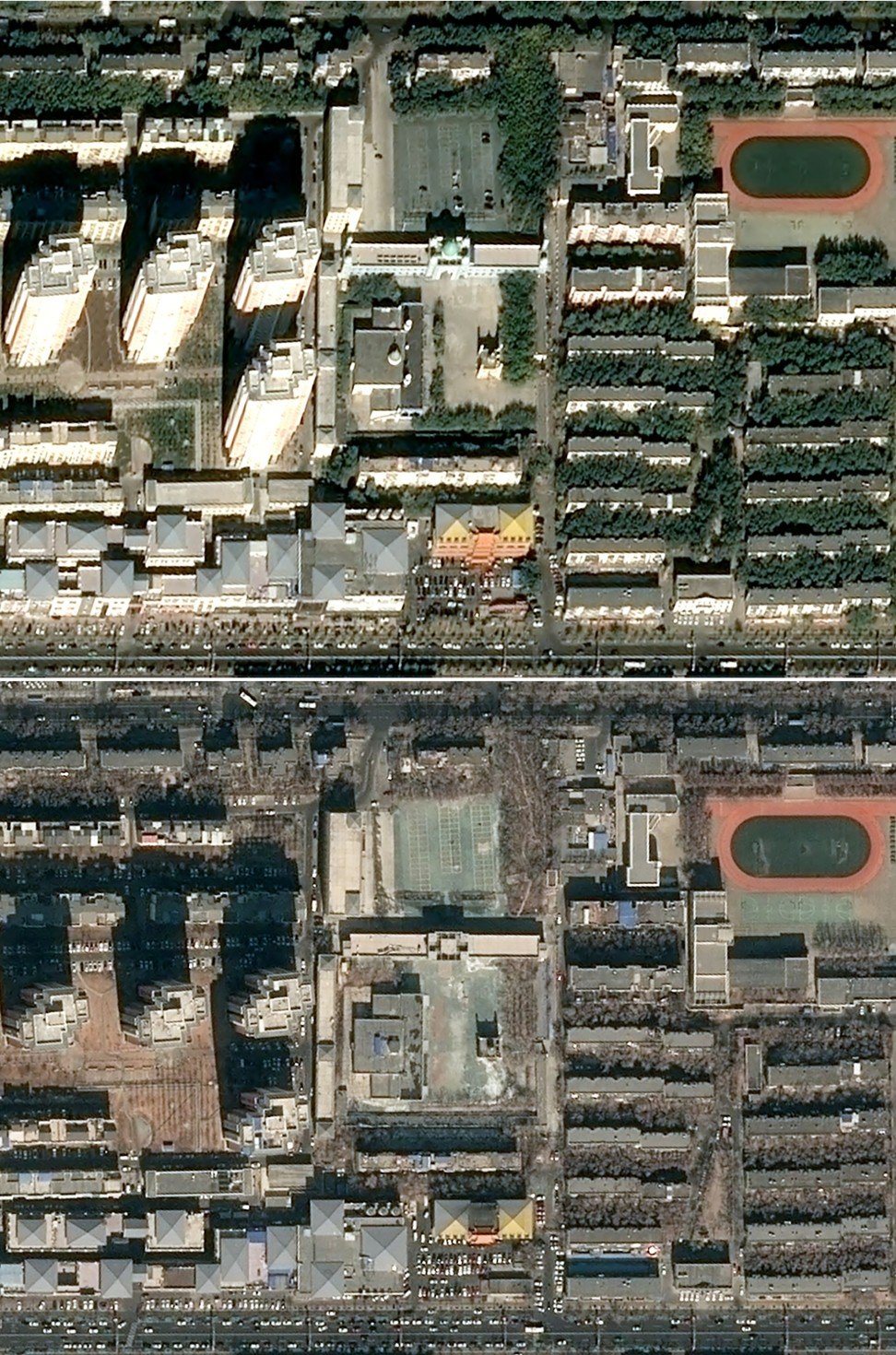
In the satellite images analysed by AFP and Earthrise Alliance, 30 religious sites were completely demolished while six had their domes and corner spires removed.
AFP reporters visited about half a dozen sites, and found that some mosques had been repurposed into public spaces.
Police officers blocked journalists from entering Artux, just north of Kashgar, where the town’s grand mosque and dozens of other community mosques were destroyed.
The area is some 22 kilometres (14 miles) away from an enormous complex believed to be a re-education centre. Visible from a nearby village, the facility has razor-wired walls, watchtowers and imposing block buildings.In Kashgar, two cameras perched on the columns of a former mosque point at its entrance. There is no minaret or dome – instead, a shop selling dresses lies to its right alongside houses.
A demolished mosque in Hotan has been converted into a garden, paved with concrete walkways and sparsely planted trees.
On the outskirts of town, situated between a cemetery and sand dunes, two white flags and a pile of burned refuse and debris was all that was left of an old shrine named Imam Asim.
China’s top Xinjiang official Chen Quanguo should face sanctions over alleged abuses, US lawmakers say
Uygurs consider these mosques and shrines “their ancestral heritage,” said Omer Kanat, director of the Uygur Human Rights Project.
“The Chinese government just wants to erase everything … that is different from Han, everything which belongs to Uygur culture or Islamic culture in the region,” he said.
Juma Maimaiti, the official imam of Idkah Mosque, told AFP in an interview arranged by the propaganda department that the demolition of mosques “has never happened here”.
“But our government has proceeded to protect some key mosques,” he added, and said that the city of Kashgar has over 150 mosques.

Though Beijing’s restrictions on religious piety, such as fasting, are not new, observers say conditions have deteriorated to the point where celebrations for the holy month in Xinjiang are reduced or largely invisible.
Islamic greetings and openly fasting in public are no longer permitted, said Darren Byler, a lecturer at the University of Washington who focuses on Uygur culture.
While there are Uygurs who continue to practise their faith, they are “internalising it at this moment – they’re not expressing it openly,” he said.
EU calls out Beijing on human rights but activists want harder line against China’s Xinjiang and Tibet policy
At state-backed mosques, religious activity is controlled as Beijing pursues a five-year plan to “Sinicise” Islam as the “only way for a healthy development of Islam” in the country, said Yang Faming, president.
Source: SCMP

 CHINDIA ALERT: You'll be living in their world, very soon