Archive for ‘E-commerce’

26/04/2019

Chinese top legislator meets Malaysian prime minister

(BRF)CHINA-BEIJING-LI ZHANSHU-MALAYSIAN PM-MEETING (CN)

Li Zhanshu (R), chairman of the Standing Committee of the National People’s Congress, meets with Malaysian Prime Minister Mahathir Mohamad, who is here to attend the Second Belt and Road Forum for International Cooperation, in Beijing, capital of China, April 25, 2019. (Xinhua/Zhang Ling)

BEIJING, April 25 (Xinhua) — Li Zhanshu, chairman of the Standing Committee of the National People’s Congress, on Thursday met with Malaysian Prime Minister Mahathir Mohamad, who is here to attend the Second Belt and Road Forum for International Cooperation.

Li said China is willing to work with Malaysia to implement the consensus reached by the leaders of the two countries and outcomes to be achieved at the Second Belt and Road Forum for International Cooperation.

He asked for enhanced cooperation between the two countries in agriculture, fishery, e-commerce, technological innovation and people-to-people exchanges, as well as parliamentary exchange and mutual learning in state governance, legislation and supervision.

Mahathir said Malaysia welcomes the Belt and Road Initiative and is willing to learn from China’s development experience and strengthen bilateral cooperation in all areas.

Source: Xinhua

19/04/2019

Amazon plans to shut online store in China

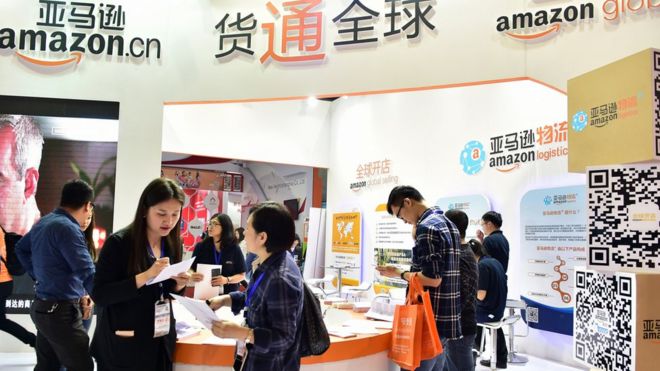
Visitors at an Amazon booth during the 2016 China International Electronic Commerce Expo in Yiwu, east China's Zhejiang province.Image copyright GETTY IMAGES

Amazon plans to shut its online store in China that allows shoppers to buy from local sellers as it downsizes operations in the country.

The firm said it would no longer run the domestic marketplace from July, but Chinese shoppers will still be able to order goods from Amazon’s global store.

It will also continue to operate its cloud business in China.

The retail retreat comes as Amazon faces tough competition from local rivals Alibaba and JD.com.

Reuters first reported Amazon’s plans to close its domestic marketplace in China by mid-July to focus on more lucrative businesses selling overseas goods and cloud services. Amazon’s profitable cloud computing division hosts huge swathes of the corporate world on its data servers.

A spokesperson for the company said in a statement that it was “working closely with our sellers to ensure a smooth transition and to continue to deliver the best customer experience possible”.

Consumers accessing Amazon Chinese web portal, Amazon.cn, after 18 July will see a selection of goods from its global store, Bloomberg reported.

Amazon bought Joyo.com, a Chinese books, music and video retailer, for $75m (£57.4m) in 2004. It rebranded the company as Amazon.cn in 2007.

But it has struggled to compete with dominant players JD.com and Alibaba’s Tmall marketplace in China.

The shift away from the world’s second largest economy comes as the company pours huge investment into India.

Amazon has committed to spending $5.5bn on e-commerce in India, where it competes with local rival Flipkart.

Last year, it launched a Hindi version of its mobile website and smartphone app in an attempt to attract millions of new customers in the country.

Source: The BBC

06/03/2019

China to make forced technology transfer illegal as Beijing tries to woo back foreign investors

  • Issue a key demand made by US President Donald Trump as part of the ongoing US-China trade war
  • China expected to pass new foreign investment law next week during National People’s Congress

26 Feb 2019

Foreign direct investment in China amounted to US$135 billion in 2018, an increase of 3 per cent from a year earlier, according to Chinese government data. Photo: EPA

Foreign direct investment in China amounted to US$135 billion in 2018, an increase of 3 per cent from a year earlier, according to Chinese government data. Photo: EPA
Beijing will make it illegal to force foreign investors to transfer their technology to Chinese partners while also lowering market barriers for foreign firms to enter the domestic market, a senior economic planning official said on Wednesday, highlighting an effort to lure overseas investment inflows.
China is expected to pass a new law next week intended to protect the interests of foreign investors, both as a response to demands from the United States that have formed part of the ongoing trade war negotiations, and to help shore up economic growth, which slowed last year to its lowest rate in 28 years.
Foreign investors will be allowed to set up ventures in which they have full ownership, instead of being forced into joint ventures with local partners, in more industries, said Ning Jizhe, a vice-chairman of the National Development and Reform Commission, in Beijing on Wednesday during the National People’s Congress.

But foreign investment into the world’s second biggest economy have slowed over last decade, which could deprive China of access to advanced technologies and marginalise the country in the development of future global supply chains.

Beijing is trying to lure more foreign capital and technology to support its plan to upgrade its manufacturing industries and boost the development of new, hi-tech sectors.

“China will roll out more opening-up measures in the agriculture, mining, manufacturing and service sectors, allowing wholly foreign-owned enterprises in more fields,” Ning said.

China law to protect intellectual property, ban forced tech transfer
Since December, China has been rushing to draft legislation for a new foreign investment law, a key clause of which prohibits local government’s from forcing transfer of technology in return for being allowed to conduct business in their jurisdictions.
The National People’s Congress is expected to endorse the new 

“After passing the law, the government will take serious measures to obey and implement it,” Ning added.

He said that China will remove market entry restrictions for foreign investors to ensure that domestic and foreign firms “are treated as equals.”

Ning Jizhe, a vice-chairman of the National Development and Reform Commission. Photo: EPA

However, the jury is still out whether Beijing’s promises of fair treatment, market access and protection for intellectual property rights will be enough to generate a steady inflow of hi-tech investment.

The US has long complained that China has been unwilling to implement previous commitments under the World Trade Organisation to open up its market – allegation Beijing denies.

Shen Jianguang, chief economist at JD Digits, an arm of Chinese e-commerce firm JD.com, said restrictions on foreign investment will exist in China despite the government’s promises.

China’s domestic market remains large and attractive for some foreign investors, he said.

“Foreign investors are still very interested in the Chinese market, if the openness of the economy is sufficient,” Shen added.

Source: SCMP

04/02/2019

Cross-border e-commerce pilot zone opens bonded import business to cut price, logistic time

GUANGZHOU, Feb. 3 (Xinhua) — A cross-border e-commerce pilot zone in south China started its first bonded import business on Sunday, a practice believed to benefit businesses in terms of lower logistics cost and provide consumers with cheap and fine products, local officials said.

The comprehensive cross-border e-commerce pilot zone in Zhuhai, Guangdong Province, ushered in the new business hoping to give full play to the proximity of Hong Kong and Macao.

Zhuhai is connected to the Hong Kong airport since the Hong Kong-Zhuhai-Macao Bridge opened to traffic in October last year.

The business model allows e-commerce platforms to purchase a large quantity of goods from overseas according to their market forecasts and consumer demands. The goods will be imported and stored in the special customs-supervised area before being delivered to consumers as personal items.

Such practices enable e-commerce enterprises to buy quality products from around the world at a lower price with less logistic time, according to Lin Xibin, a local commerce official.

The bonded import business program is expected to attract businesses from China’s Hong Kong and Macao, as well as businesses from Portuguese and Spanish speaking countries and regions.

Zhuhai is one of the 22 cities that was identified as a venue for comprehensive cross-border e-commerce pilot zones by the State Council, or China’s cabinet, in July last year.

China’s e-commerce market has developed at a double-digit pace for years. E-commerce transaction totaled 22.69 trillion yuan in the first three quarters of 2018, up 11.2 percent year on year.

Source:Xinhua

01/02/2019

New e-commerce rules jolt Amazon.com in India as products vanish

NEW DELHI/MUMBAI (Reuters) – India’s revised e-commerce rules caused widespread disruption on Amazon’s India website when they kicked in on Friday, forcing the company to take down its key grocery service and remove a wide range of products such as sunglasses and floor cleaners.

The products began to disappear from Amazon India late on Thursday as it began complying with the regulations before a midnight deadline, two sources with direct knowledge of the matter told Reuters.

In December, India modified foreign direct investment rules for its burgeoning e-commerce sector, which has drawn major bets from not only Amazon.com but also the likes of Walmart Inc, which last year bought a majority stake in homegrown e-commerce player Flipkart.

India’s new e-commerce investment rules bar online retailers from selling products via vendors in which they have an equity interest, and also from making deals with sellers to sell exclusively on their platforms.

Numerous items sold by Amazon vendors such as Cloudtail, in which Amazon holds an indirect equity stake, were no longer available on its India site. Amazon Pantry, a grocery service primarily managed by company affiliates, was also discontinued, though grocery products could be purchased individually.

“Pantry is completely empty, how I am suppose to grocery shop,” Twitter user Pamela wrote on the social network. “Whatever government rules are, (I) don’t care, you guys fix it, I need to shop.”

Amazon, which saw record sales and profit during the holiday season, has forecast first-quarter sales below Wall Street estimates due to the uncertainty in India – one of its key growth markets.

The situation in India is “a bit fluid right now,” but the country remains a good long-term opportunity, Amazon Chief Financial Officer Brian Olsavsky said. The company’s main goal was to minimize the impact of the new rules on customers and sellers, he added.

Flipkart CEO Kalyan Krishnamurthy warned last month that it faced “significant customer disruption” if the new rules were implemented from Feb. 1. On Friday, the company said it was disappointed the government acted in “haste”, but assured compliance.

“We are committed to doing everything we can to be compliant with the new rules,” Flipkart India executive Rajneesh Kumar said in a statement, without explaining how the website was impacted.

POLITICS, INVESTOR SETBACK

The new policy was announced after complaints from small Indian traders who said the e-commerce giants used their control over inventory from affiliated vendors to create an unfair marketplace where they could offer discounts. Such arrangements will now be barred.

Both Amazon and Walmart unsuccessfully lobbied against the latest rules and pushed for a delay in their implementation. The U.S. government too urged India to protect the investments of the two retailers, Reuters reported last week.

But Indian Prime Minister Narendra Modi’s administration stood firm as the move was widely seen as one to appease small traders in the run-up to a general election due by May.

Industry sources have said the new rules will dent foreign investor sentiment and force the big online retailers to change their business structures, raising compliance costs.

“The company has no choice as they are fulfilling a compliance requirement, the customers will suffer,” said one of the sources. “It is very upsetting for foreign investors.”

Both companies have bet heavily on India being a big growth driver: Amazon has committed to investing $5.5 billion there, while Walmart last year spent $16 billion on Flipkart.

Amazon’s own range of Presto-branded home cleaning goods and other Amazon Basics products such as chargers and batteries vanished from its website late on Thursday.

Clothing from Indian department store chain Shopper’s Stop was also no longer available, as Amazon owns 5 percent of the company.

The Confederation of All India Traders (CAIT), which supported tougher scrutiny of large e-commerce players, said the removal of products by Amazon was a step in the “right direction”.

Exclusive deals with sellers, in compliance with the revised rules, will also be discontinued on Amazon India, the two sources said.

It was unclear how long the disruption will last. On Friday, Amazon’s own range of Echo smart speakers, which were earlier removed as they were sold by a company affiliate, returned for sale via other sellers on the platform.

However, buyers would now need to wait for up to 36 days to get some of the speakers delivered even under Amazon’s fast-delivery Prime service, which often delivers goods in a day or two.

Source: Reuters

25/01/2019

Exclusive: Hindu group RSS urges India’s Modi to resist U.S. push to ease e-commerce curbs

NEW DELHI (Reuters) – A Hindu nationalist group close to Prime Minister Narendra Modi’s party has urged him to resist pressure from the United States and not defer new regulations for the e-commerce sector, according to a letter seen by Reuters.

The economic wing of the group, Rashtriya Swayamsevak Sangh (RSS), which is the fountainhead of the ruling party, has written to Modi saying that changing the policy implementation date, under pressure from Washington, will hurt 130 million small Indian entrepreneurs.

“There is no need to buckle under these pressures. India must continue to chart the way best for itself and the entrepreneurs,” the Swadeshi Jagran Manch said in its letter, which was reviewed by Reuters.

The new rules, to be implemented from Feb. 1, will deal a blow to Walmart Inc and Amazon.com’s ambitions in the country. They mandate that e-commerce companies will not be allowed to sell products from firms in which they have an equity interest.

Reuters reported on Thursday the United States government had told Indian officials the new rules will hinder the investment plans of the two companies.

The rules, which will force the companies to change their business structures and raise operational costs, have sparked an extensive lobbying effort from both Amazon and Walmart, which last year invested $16 billion in Indian e-commerce company Flipkart.

Both Amazon and Walmart have sought an extension of the Feb. 1 deadline, but government sources have said that was unlikely to happen as Modi needs millions of traders by his side in an upcoming national election due by May.

On Friday, the Confederation of All India Traders, which has supported tougher scrutiny of large e-commerce players, said “the entire trading community will vote against the government if they extend the deadline”.

The e-commerce spat is the latest in a number of disputes over trade and investment relations between India and the United States.

Walmart spokesman Greg Hitt told Reuters this week the company had “engaged the (United States) administration on this issue”.

The RSS has long advocated self-reliance and opposed the opening up of the Indian economy to foreign players.

Small Indian retailers have alleged that e-commerce companies use their control over inventory from their affiliates to create an unfair marketplace that allows them to sell some products at lower prices, which hurts the businesses of brick-and-mortar retailers. Such arrangements would be barred under the new policy.

In front-page advertisements in newspapers last week, Walmart-owned Flipkart highlighted how the platform had helped transform local struggling businesses selling badminton racquets and sarees, a traditional dress.

Source: Reuters

28/12/2018

Modi’s clampdown on e-commerce in India may not win back votes of small retailers

NEW DELHI (Reuters) – India’s new curbs on e-commerce companies may not be enough to win over small store owners and traders in next year’s general election, with the key voting bloc still seething over what it sees as broken promises by Prime Minister Narendra Modi.

From Feb. 1, e-commerce firms such as Amazon.com and Walmart-owned Flipkart Group will not be able to sell products from companies in which they have an equity interest or form exclusive agreements with sellers.

Intended to prevent predatory pricing and deep discounting, the curbs follow intense lobbying by India’s many millions of small shopkeepers and the middlemen who serve them, particularly after Walmart this year spent $16 billion to acquire Flipkart.

The sector, which includes an estimated 25 million small store owners, largely supported Modi in the 2014 general election. While seeing the new rules as a step in the right direction, many small businesses feel too much damage has been done after Modi went back on promises that he would not allow the entry of foreign companies into the domestic retail sector.

“We clapped and voted for Modi believing in his promises. But what have we got is just a slap on our face,” said Pankaj Revri, president of a furniture market association in central Delhi.

The curbs, announced on Wednesday, surprised foreign e-commerce firms as little had been done by the government despite over three years of lobbying by domestic retailers.

Modi’s Hindu nationalist Bharatiya Janata Party is widely viewed as panicking after losing five state elections this month. The government, which must hold a general election by May, is also expected to come up with new support programs for farmers as their opposition grows due to low crop prices.

An opinion poll by TV channel ABP News this week predicted Modi’s party could fall short of a majority if the opposition forms an effective alliance in the national election.

EARNINGS HALVED

B.C. Bhartia, president of the Confederation of All India Traders, said some small businesses had seen earnings more than halve in the last few years as they struggle to compete with low prices offered by the American-controlled behemoths.

“The last minute policy change is too little and too late,” he said.

In particular, retailers and traders believe Modi turned a blind eye to what they say was the use of policy loopholes by major e-commerce companies to offer heavy discounts that allowed them to seize market share for goods such as electronic items.

Asked about those accusations, Amazon India said in a statement that it had always operated “in compliance with the laws of the land” and that had more than 400,000 small and medium businesses on its marketplace.

Flipkart declined to comment on the specific allegations.

Small Indian businesses have also been bruised by other Modi policies, including a sudden ban on the use of high-value currency notes in late 2016 and the launch of a national sales tax in 2017, both of which raised compliance costs.

Bhartia said if the government was serious about the concerns of small traders, it should prosecute violators of trade rules and appoint an independent regulator to curb malpractice.

FILE PHOTO: The logo of Flipkart is seen on the company’s office in Bengaluru, India, May 9, 2018. REUTERS/Abhishek N. Chinnappa

A government official told reporters on Thursday the administration could consider demands for a regulator in its new e-commerce policy, expected to be released in the coming months.

A September report by PricewaterhouseCoopers estimated online commerce in India would grow 25 percent a year for next five years, hitting $100 billion a year by 2022.

The new curbs could harm those growth prospects and discourage some foreign investors, said investment consultants.

“Sentiment is definitely hurt,” said Harminder Sahni of retail consultant Wazir Advisors, adding that the policy suggested online retail business should only be done by Indians.

Amazon said in its statement it was evaluating the new guidelines to engage as necessary with the government so it could remain true to its vision of “transforming how India buys and sells and generating significant direct and indirect employment.”

Flipkart said the advent of e-commerce had created hundreds of thousands of jobs and “the industry was set to be a major growth driver for the Indian economy and create millions of jobs in the future.”

“It is important that a broad market-driven framework through the right consultative process be put in place in order to drive the industry forward,” it added.

The government boasts of attracting nearly $223 billion foreign investment in the last four years, compared with about $152 billion in the previous four years.

Law of Unintended Consequences

continuously updated blog about China & India

ChiaHou's Book Reviews

continuously updated blog about China & India

What's wrong with the world; and its economy

continuously updated blog about China & India