Archive for ‘agriculture’

18/09/2014

India’s rice output, exports to climb on revival of monsoon | Business Standard News

India’s summer-sown rice output is likely to cross the previous year’s level due to a pick up in monsoon rains, raising prospects for higher overseas sales in 2015 by the world’s biggest exporter of the grain, trade officials said.

Robust exports from India could keep a lid on global prices that have surged 12% in the past three months and help cut bulging government stockpiles built as a result of bumper harvests over the past several years.

“There were concerns over production due to poor rainfall in June. The pick-up in rains from mid-July changed the situation. Now, the crop is in good shape,” said B.V. Krishna Rao, managing director of Pattabhi Agro Foods Pvt Ltd, a leading exporter.

In June, monsoon rains were 43% lower than the 50-year average, raising concerns about output of the rice crop that guzzles a lot of water. But rains picked up in the past few weeks, narrowing the rainfall deficit to 11%.

“Overall rice production will definitely be higher than last year but it is a little early to quantify by how much,” said Rajen Sundareshan, executive director of the All India Rice Exporters Association.

via India’s rice output, exports to climb on revival of monsoon | Business Standard News.

05/09/2014

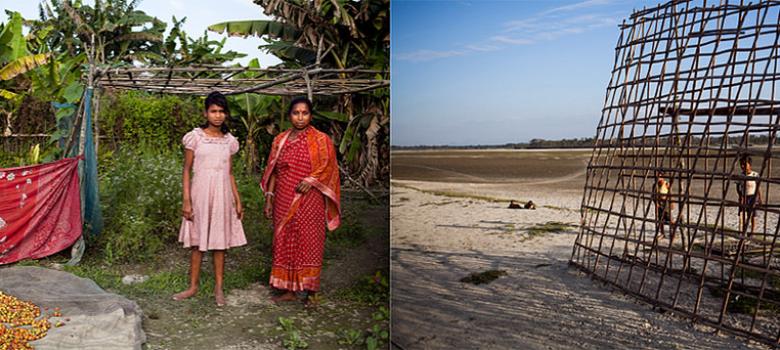
In Assam, villagers struggle to protect their land from the roaring Brahmaputra

Descending from the plateaus of Tibet and flowing through China, India and Bangladesh, the Brahmaputra is one of India’s mightiest rivers, its width running up to 10 kilometers at some places. On its 3,000-kilometer journey, the Brahmaputra provides a livelihood to thousands of communities living on its banks. They depend on it for food, water and farming. In 1950, however, the great earthquake in Assam altered the topography of the river valley and the people of Assam have since been struggling with intense droughts and floods.

Since the earthquake, Assam has witnessed severe cases of river erosion. According to official records, 36 villages, 10 schools, six tea gardens and hundreds of humans and animas have been washed away. The situation has been exacerbated by increasing deforestation and erratic climate changes.

In 2012, floods in Assam displaced over a million people and affected close to 4,500 villages. Today, these villagers from Tinsukia district in Upper Assam are struggling to protect their land and livelihoods from the eroding banks and the rising waters of the mighty Brahmaputra.

via Scroll.in – News. Politics. Culture..

18/08/2014

Drought in Northeast China Is the Worst in 63 Years – Businessweek

Southern China is a rice-growing region, while the northeast is the country’s wheat and corn-growing “bread basket.” This summer the northern province of Liaoning is suffering the worst drought in 63 years, according to the local meteorological bureau: The province has seen the lowest precipitation since the government began keeping records in 1951. The dry summer threatens immediate drinking water supplies and autumn harvests.

A farmer stands at the bottom of the Zhifang Reservoir, near Dengfeng, China

The agricultural research service Shanghai JC Intelligence predicts that China’s corn yields may drop 1.5 percent this year, which could drive up domestic corn prices and compel farmers to use alternative grains for animal feed.

(China also imports from the U.S., but since last fall, Chinese inspectors have rejected an increasing number of shipments found to contain unapproved genetically modified organisms (GMO) varieties.)

Other regions have also suffered under the drought, including the northern provinces of Inner Mongolia and Jilin, and central Henan province. In Inner Mongolia, 300,000 people have faced drinking-water shortages, according to state-run Xinhua newswire. More than 270,000cattle have also gone without water. Xinhua reported economic losses to the poor northwestern province total $37 million so far.

Harvests of soybean and barley may also be hurt by the drought, as well as livestock health.

via Drought in Northeast China Is the Worst in 63 Years – Businessweek.

08/07/2014

The Chinese Turn Their Rooftops (and Closets) Into Minifarms – Businessweek

Roger Mu, an entrepreneur from Texas now living in Shanghai, scoured local markets for jalapeño peppers but to no avail. Homesick for homemade salsa, he eventually decided to grow his own. Since he was iving in a cramped Shanghai apartment with no outdoor lawn or garden, this wasn’t a simple proposition. But he did have some space available: in the closet.

The Chinese Turn Their Rooftops (and Closets) Into Minifarms

Mu studied manuals about hydroponics, a technique for growing plants that doesn’t require soil but rather uses nutrient-infused water to deliver plant nutrition. The plants’ roots find support by growing around pebbles, sand, woodchips, or anything granular they can weave around, rather than soil. It’s perfect for limited space—and limited small-scale farming. Mu used a special light borrowed from a video-production company to jump-start photosynthesis.

The first batch of 60 peppers turned out to be delicious. Next he tested his technique with heirloom tomatoes and cucumbers. Success—he had everything he needed to make the perfect salsa. Mu also realized that his homegrown vegetables were healthier than many store-bought options. “Food safety and quality in China is a bit iffy,” he says, “considering all the pesticides, fertilizers, and pollution dumped into fields here.”

via The Chinese Turn Their Rooftops (and Closets) Into Minifarms – Businessweek.

27/06/2014

Scientists Say Water Shortages Threaten China’s Agriculture – Businessweek

China has a fifth of the globe’s population but only 7 percent of its available freshwater reserves. Moreover, its water resources are not evenly distributed. The lands north of the Yangtze River—including swaths of the Gobi desert and the grasslands of Inner Mongolia—are the driest, but more than half of China’s people live in the north.

An ancient stone bridge was discovered on the dried up lakebed of Poyang lake in Jiujiang, eastern China in 2013

Water is not well managed in China. Nearly two-thirds of water withdrawals in China are for agriculture. Due to the use of uncovered irrigation channels (leading to evaporation) and other outdated techniques, a significant portion of that water never reaches the field.

A new paper by scientists in China, Japan, and the U.S. published in the Proceedings of the National Academy of Sciences sounds the alarm: “China faces … major challenges to sustainable agriculture,” the authors write. Failure to conserve water resources could threaten China’s food security, a longtime priority for the country’s leaders.

via Scientists Say Water Shortages Threaten China’s Agriculture – Businessweek.

08/06/2014

China Wants America’s Milk, and U.S. Dairy Exports Benefit – Businessweek

Increased demand for dairy products around the world, particularly in China, is doing for U.S. farmers what decades of farm policy could not: sell off all the milk their cows can produce at record-high prices.

Hunter Haven Dairy Farm in Pearl City, Ill.

The good fortune of U.S. dairy farmers is due to exploding demand from an emerging global middle class, but also to misfortunes elsewhere. In China, domestic dairy has been hampered by production problems and lingering distrust among consumers about safety. In New Zealand, the global leader in dairy exports, a 2013 drought reduced the country’s ability to meet foreign customers’ needs. In the first quarter of 2014, the value of U.S. dairy exports grew 39 percent.

“China buying has been through the roof,” says Alan Levitt, spokesman for the U.S. Dairy Export Council. “We shifted from a period of structural oversupply to structural undersupply.” Exports have been rising steadily during the past decade, but they surged in the past year—evidence that the U.S. can be a viable player in the global dairy market.

via China Wants America’s Milk, and U.S. Dairy Exports Benefit – Businessweek.

Enhanced by Zemanta
21/05/2014

Does China Pose a Threat to Global Food Security? It Says No – China Real Time Report – WSJ

Twenty years ago, environmental advocate Lester Brown got in hot water with Beijing for writing a book called “Who Will Feed China?”

China was displeased with the suggestion in his book that the country’s growing population and water scarcity could drastically burden the world’s food resources. Beijing publicly criticized the author – then began a series of reforms including improving farming techniques and adopting a national policy of self-sufficiency in grain consumption that vindicated Mr. Brown’s arguments. It paved the way for a gradual rapprochement with the American, now 80.

Détente is over.

On Wednesday, China’s agriculture ministry issued a statement again criticizing Mr. Brown. It took umbrage with an essay he wrote titled “Can the World Feed China?” a riff on his earlier book. The essay details Mr. Brown’s concerns that rising domestic pressures on food consumption could result in spiking food prices and political unrest as China joins in a global “scramble for food.”

It isn’t clear why Mr. Brown was singled out for criticism; many analysts have in one form or other also articulated these trends, though arguably not as directly or pungently. But the move underscores how increasingly sensitive China is to the growing impression that it can’t feed itself and that its acquisitions of global food assets are posing a risk to food security for the rest of the world. China has been keen in recent years to head off any impression that it’s on a global grab for natural resources.

Mr. Brown wasn’t immediately available for comment.

The government is unhappy with the notion it’s being blamed for sharpening global competition for food. Mr. Brown’s essay said China’s rising grain imports  mean “it is competing directly with scores of other grain-importing countries.” He also warned that China’s purchase last year of U.S. pork producer Smithfield Foods “was really a pork security move.” So too, he said, was China’s deal with Ukraine to provide $3 billion in loans in exchange for corn. “Such moves by China exemplify the new geopolitics of food scarcity that affects us all,” he wrote.

Not likely, ministry spokesman Bi Meijia said in the government’s statement. Mr. Bi said 97% of China’s grain consumption comes from its own output, not imports.

“On the issue of food security, China not only does not pose a threat to the world, but makes a contribution to global food security,” he said. China intends to continue its existing policies, he said.

Mr. Bi said rising grain imports aren’t due to domestic shortages, but because global prices are lower than domestic prices. The ministry also pointed out that imports accounted for just 2.6% of domestic grain production volume in 2013, and just 4% of global output.

via Does China Pose a Threat to Global Food Security? It Says No – China Real Time Report – WSJ.

Enhanced by Zemanta
02/05/2014

Agriculture: Bring back the landlords | The Economist

CHINA’S Communist Party has always had a problem with big landowners. In Communist culture, they are synonymous with evil. In January on the country’s most-watched television show—a gala at lunar new year—viewers were treated to a scene from a Mao-era ballet featuring young peasants fired with zeal for revenge against a despotic rural landlord. Some critics rolled their eyes about such a throwback to the party’s radical past, but few complained about the stereotyping of landowners. Yet when it comes to letting individual families control large tracts of farmland, Communist Party leaders are beginning to have a change of heart.

Since January last year the term “family farm” has come into vogue in the party’s vocabulary. It refers not to the myriad tiny plots, each farmed by a single family, that are characteristic of the Chinese countryside; but to much larger-scale operations of a kind more familiar elsewhere, such as Europe or America. The trigger for this was the term’s use in a Communist Party directive known as “document number one”, the name traditionally given to the party’s new-year policy pronouncement on rural issues. It said the consolidation of household plots into family farms should be given “encouragement and support”.

On his first trip outside the capital after being appointed prime minister in March last year, Li Keqiang visited a 450-hectare (1,110-acre) family farm in the coastal province of Jiangsu. He said that boosting production was impossible on the tiny plots that most rural households farm (the average is less than half a hectare). “It can only be done through concentrating the land into larger farms”, Mr Li said. With more government support, “the earth could yield gold”, he told residents; a notion that would surprise the 260m people who have left the countryside to work in cities over the last three decades. Many villages are now home mainly to the elderly and left-behind children. During a visit to Switzerland two months later Mr Li again stopped by at a family farm (of a more modest 40 hectares). Chinese media said he wanted to pick up tips from Europe’s “advanced experiences” in running them. Chen Xiwen, a senior party policymaker on rural affairs, was even quoted as saying last year that he would like China to have vast “family farms like America’s”, but that he was worried about the impact on rural employment if farmland were to be managed by so few hands.

As is often the case whenever party policy appears to shift in the countryside, reality on the ground had long been changing before official rhetoric began to catch up. (Peasants started dismantling Mao’s disastrous “people’s communes” before the party began formally doing so in 1982.) The exodus from the countryside has allowed entrepreneurial farmers to build up their holdings by renting land from neighbours who no longer need it. They have not been able to buy it since all rural land is owned “collectively” by villagers. But they have been allowed to take over the right to farm it, and keep any profits. The party does not harp on about evil landlords of yore, since the new big-farmers are, legally speaking, merely tenants. In March last year the agriculture ministry took its first survey of family farms, though it has yet even to define the term precisely. It found there were already 877,000 of them, with an average size of around 13 hectares. They covered 13% of China’s arable land. Since 2008 the area of farmland rented out to other farmers has more than tripled.

via Agriculture: Bring back the landlords | The Economist.

Enhanced by Zemanta
15/04/2014

China in numbers: beans means trouble as commodity markets highlight rising credit risks | The Times

500,000 . . . is the total tonnage of soya bean cargoes on which Chinese importers have defaulted recently, unsettling markets already nervous about the world’s second biggest economy.

Soya bean meal is unloaded at Fangchenggang

Those defaults look alarming. Commodity markets can provide livid symptoms of an economic malaise and the numbers seem to offer evidence of rising credit risk in China. The country’s first corporate bond default earlier in the year merely sharpened sensitiv-ity to any sign of contagion.

Shipping industry sources in Singapore and Tokyo believe that there are six soya bean cargoes at Chinese ports that cannot be unloaded and the same number still at sea. Their total value is somewhere around £180 million, which makes this China’s highest-stakes soya bean default since 2004. This in a country that imports nearly two thirds of all the soya beans traded worldwide.

Explanations are focused on China’s tightening credit markets and the inability of soya bean buyers to secure the necessary letters of credit from banks. It does not take much of a leap to wonder what that type of credit contraction is having on an economy that has been fuelled lately by an epic creation of new credit.

As with other vulnerable sectors in China, the companies that process soya beans have been making losses: suddenly the banks are unprepared to take risks on them and the cargoes have been stranded.

The defaults have highlighted other market distortions that go far beyond the inability of an oilseed processor to turn a profit from a hill of beans. Trading companies have routinely used soya bean cargoes, in common with shipments of copper and other commodities, as collateral to secure cheap financing for potentially more lucrative deals and businesses. Because the interest payable on letters of credit is low and the payment terms generous, some have sold the product itself at a loss simply to get their hands on the cash.

The reality of these defaults, though, is that they are probably a good thing — or at least part of a well-intentioned plan. Beijing has been uncharacteristically relaxed about these defaults for the same reason that it has been uncharacteristically relaxed about internet giants such as Alibaba infuriating the banks by introducing innovative financial products. Beijing knows it has to reform the financial sector, realises that it will face huge resistance and is looking for leverage. Creating a series of micro crises forces China’s banks to become better at what they are supposed to do. Defaults (on soya beans and bonds) have been noisily paraded in state media to show the banks that they are expected to start pricing risk accurately and coldly.

via China in numbers: beans means trouble as commodity markets highlight rising credit risks | The Times.

Enhanced by Zemanta
15/04/2014

As Growth Slows in India, Rural Workers Have Fewer Incentives to Move to Cities – WSJ.com

As a teenager, Ram Singh left this remote rural village and moved to fast-growing New Delhi to chase the spoils of his country’s economic boom.

For 14 years, he toiled in tiny, primitive factories making everything from auto parts to components for light switches. His wages barely kept pace with the cost of living and eventually he gave up on city life.

Today, he is back on the farm, scratching out a living from a small plot of land near his birthplace where he grows corn, wheat, potatoes and mustard.

“Whenever someone leaves his village for the city, he thinks, ‘I will earn money,'” says Mr. Singh, who isn’t certain of his age but says he is around 30 years old. “Everyone has dreams, but it’s not always in their power to turn them into reality.”

Just a few years after India was hailed as a rising economic titan poised to rival China—even surpass it—growth in gross domestic product has slowed to a pace not seen in a decade. The Indian economy expanded at an annual rate of 4.7% in the last quarter of 2013. That may be sizzling by Western standards, but it is a serious comedown for a country whose GDP growth peaked at 11.4% in 2010. Inflation is high, workers aren’t finding jobs, and industrialization and urbanization are stalling.

via As Growth Slows in India, Rural Workers Have Fewer Incentives to Move to Cities – WSJ.com.

Enhanced by Zemanta
Law of Unintended Consequences

continuously updated blog about China & India

ChiaHou's Book Reviews

continuously updated blog about China & India

What's wrong with the world; and its economy

continuously updated blog about China & India