Archive for ‘aviation’

22/05/2017

China, Russia formalize Shanghai venture to build wide-body jet | Reuters

China and Russia on Monday completed the formal registration of a joint venture to build a proposed wide-body jet, kickstarting the full-scale development of a program that aims to compete with market leaders Boeing (BA.N) and Airbus (AIR.PA).

State planemakers Commercial Aircraft Corporation of China (COMAC) [CMAFC.UL] and Russia’s United Aircraft Corp (UAC) said at a ceremony in Shanghai the joint venture would aim to build a “competitive long range wide-body commercial aircraft”.

COMAC, which is increasingly looking to break the hold Boeing and Airbus have over the global commercial jet market, successfully completed the maiden flight of its home-grown C919 narrow-body passenger jet earlier this month.

“The long-haul, wide-body passenger jet is a strategic project for China and Russia, followed closely by the two governments,” said Guo Bozhi, general manager of COMAC’s wide-body department.

COMAC and UAC first announced the twin-aisle jet program in 2014 but the project has so far been slow to materialize.

In November, the firms said they had set up a joint venture in Shanghai and unveiled a mock-up of the wide-body jet, based around a basic version that would seat 280 and have a range of up to 12,000 kilometers (7,500 miles).

UAC president Yuri Slyusar said the firms were aiming to complete the wide-body jet’s maiden flight and first delivery between 2025-2028. He added the plane would look to take 10 percent of the market from the Boeing 787 and Airbus 350.

Previously, the firms had been aiming for a maiden flight of the jet in 2022 and delivery from 2025 or later.

While the target is tough, it is more realistic than recent aircraft programs that have sought results in 5-7 years and then come in late, industry analysts said. COMAC’s first homegrown jet, the ARJ-21, obtained permission to enter domestic service more than 10 years behind its original schedule.

COMAC and UAC hold equal shares in the joint venture.

Last July, Boeing forecast the world’s airlines would need 9,100 wide-body planes over 20 years to 2035, with a wave of replacement demand to come between 2021-2028.China has plowed billions of dollars over the past decade into a domestic jet development program as it looks to raise its profile in the global aviation market and boost high-tech manufacturing at home.

Source: China, Russia formalize Shanghai venture to build wide-body jet | Reuters

05/05/2017

China’s first big passenger plane takes off for maiden flight – BBC News

After about 90 minutes in the air the plane landed safely back at Pudong airport in Shanghai.

China’s first large domestically made passenger aircraft has completed its maiden flight, mounting a major challenge to Boeing and Airbus.

After about 90 minutes in the air the plane landed safely back at Pudong airport in Shanghai.

The plane is a key symbol of Beijing’s soaring ambitions to enter the global aviation market.

The jet by state-owned firm Comac has been planned since 2008 but the flight was repeatedly pushed back.For Friday’s maiden flight, the plane carried only its skeleton crew of five pilots and engineers and took off in front of a crown of thousands of dignitaries, aviation workers and enthusiasts.

Ahead of the flight, state television said the plane would fly at an altitude of only 3,000 metres (9,800 feet), some 7,000 metres lower than a regular trip, and reach a speed of around 300 kilometres (186 miles) per hour.

The C919 is designed to be a direct competitor to Boeing’s 737 and the Airbus A320.

It’s estimated that the global aviation market will be worth $2tn (£1.55tn) over the next 20 years.

China’s new pride of the skies

Robin Brant tours the C919

  • The C919 is a single-aisle twin-engine plane with a capacity to seat up to 168 passengers.
  • It will have a range of between 4,075 and 5,555km (2,532 – 3,452 miles).
  • According to Chinese media, it will cost around $50m, less than half of a Boeing 737 or Airbus A320.

The plane still relies on a wide array of imported technology though, it is for instance powered by engines from French-US supplier CFM International.

Orders have already been placed for more than 500 of the planes, with commitments from 23 customers, say officials, mainly Chinese airlines. The main customer is China Eastern Airlines.

Europe’s aviation safety regulator has started the certification process for the C919 – a crucial step for the aircraft to be successful on the international market.

China has had ambitions to build its own civil aircraft industry since the 1970s, when leader Mao Zedong’s wife, Jiang Qing, personally backed a project.

But the Y-10, built in the late 1970s, was impractical due to its heavy weight and only three of the aircraft were ever made.

Source: China’s first big passenger plane takes off for maiden flight – BBC News

25/07/2016

China Unveils ‘World’s Largest Amphibious Aircraft’ – China Real Time Report – WSJ

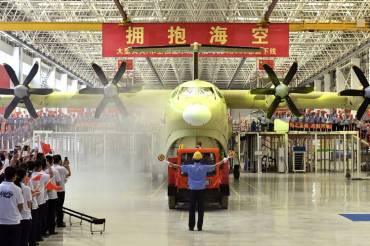
Chinese media said the AG600 giant aircraft, which rolled off a production line in Zhuhai in southern China on Saturday, will be used for marine rescue missions and forest fire fighting.

Source: Video: China Unveils ‘World’s Largest Amphibious Aircraft’ – China Real Time Report – WSJ

23/06/2016

Tata patriarch’s aviation ambitions a step closer as India opens up | Reuters

Officially at least, Ratan Tata, patriarch of one of India’s wealthiest business families, retired in late 2012. In reality, he has been a driving force behind Tata’s bet on airlines and a rare public campaign to open up the booming aviation sector.

The $100 billion Tata group conglomerate is a major beneficiary of the decision last week to open up aviation in India, making it easier for start-ups to fly overseas sooner.

The decision is no panacea for Tata, whose airlines – Vistara and AirAsia India – have had a slow start in a competitive market dominated by IndiGo, owned by InterGlobe Aviation (INGL.NS), and Etihad-backed Jet Airways (JET.NS), both of which opposed the rule change.

But it marks a victory for 78-year-old Ratan Tata, and ends more than two years of airlines lobbying, of Twitter rows and of frequent public statements from the usually circumspect steel-to-salt group.

“This was a David-and-Goliath kind of situation,” said a source close to Tata group. “There was huge lobbying from the other side.

“Ultimately, sources familiar with the talks said, it was Ratan Tata, a trained pilot, who was key to sealing the deal, capitalising on his clout.In a message earlier this year, he called for “a new open market economy” and said airlines lobbying against a rule change was “reminiscent of protectionist and monopolistic pressures by vested interests’ entities who seem to fear competition.

“A spokesman for Tata Sons, which promotes the group, denied Ratan Tata was directly involved, saying he had “nothing to do with operations or management of either of the airlines” after his retirement, and that views he expressed were personal.

Source: Tata patriarch’s aviation ambitions a step closer as India opens up | Reuters

16/06/2016

India Makes It Easier for Local Airlines to Fly Overseas – India Real Time – WSJ

India’s federal government on Wednesday relaxed the criteria for domestic airlines to fly overseas as part of a new civil-aviation policy aimed at driving growth in the sector.

Local carriers will no longer be restricted by the number of years they have operated domestically to fly abroad, Civil Aviation Minister Ashok Gajapathi Raju said.

Until now, they were required to complete five years of domestic service and have at least 20 planes in operation before being permitted to fly overseas. The government scrapped the time requirement but carriers must still reach the same criterion for planes or deploy 20% of their fleet on domestic routes.

Newer carriers such AirAsia India Pvt.—the local joint venture of Malaysia-based AirAsia Bhd.—and Vistara—the Indian airline venture of Singapore Airlines Ltd., have been pushing for a relaxation of the rules.

The new National Civil Aviation Policy was welcomed by Amar Abrol, CEO of AirAsia India, which started operating in India in June 2014. “The NCAP gives us clear direction to ramp up our operations in India and grow our business in the domestic segment before we scale our operations to fly international,” he said in a statement.

Both AirAsia and Vistara will need to increase their fleets significantly to qualify for starting international flights. AirAsia now has six planes and Vistara has 11.

Source: India Makes It Easier for Local Airlines to Fly Overseas – India Real Time – WSJ

22/07/2015

Airbus China plant plans to deliver first A330 plane in 2018 | Reuters

Airbus’ (AIR.PA) China plant is expected to deliver its first A330 wide-body passenger jet in 2018, one of the European planemaker’s Chinese partners said on Wednesday.

A worker uses a drill to screw bolts into the wing of an A320 plane that is under construction at the Airbus factory located in the northern Chinese city of Tianjin September 14, 2010.  REUTERS/David Gray

Airbus earlier this month signed an agreement to establish an A330 ‘cabin completion center’ in the northeastern Chinese city of Tianjin, where the firm already has a final assembly plant for smaller A320 jets.

The agreement was signed with the Aviation Industry Corp of China [SASADY.UL] and the Tianjin Port Free Trade Zone. Airbus hopes the increased presence in China would lead to more demand for the profitable but ageing wide-body A330 jets.

In a statement posted on its website, the Tianjin Port Free Trade Zone, said it expects construction of the plant to be completed by the fourth quarter of 2017, with the first plane to be delivered to customers in early 2018.

The plant will help further China’s goal of building its own jets to cater to what is expected to become the world’s biggest air transport market. Currently it depends mostly on imported jets from Airbus and Boeing (BA.N).

Facilities for cabin decoration, painting, and flight testing of the A330 series would also be established in the next 10 years, the Tianjin Port Free Trade Zone said.

The agreement to build the A330 plant, which will be capable of fitting out 2 planes a month, came after China placed an order for 45 A330 aircraft worth at least $11 billion, together with provisional purchases of another 30 planes.

via Airbus China plant plans to deliver first A330 plane in 2018 | Reuters.

08/04/2015

China to open 10 new air corridors to ease congestion -China Daily | Reuters

China plans to open 10 new air corridors to help ease chronic air traffic congestion and address the problem of frequent flight delays, the official China Daily said on Wednesday, citing a senior aviation official.

China Eastern Airlines planes are seen on the tarmac at Hongqiao International Airport in Shanghai, in this July 29, 2014 file photo. REUTERS/Aly Song

“Over the past 10 years, the number of flights using China’s airspace has been increasing 10 percent year-on-year, but our airspace that can be used by civilian airlines is only one-third of that in the United States,”, Chen Jinjun, director of the air traffic management division of the Civil Aviation Administration of China (CAAC), was quoted as saying.

The new routes will allow aircraft to travel to and return from a destination along two separate lanes, Chen said. On exsting routes they take the same lane at different altitudes.

Chen did not provide a timetable for the initiative or the location of the new routes. Chen and CAAC’s air traffic control officials were not immediately available for comment.

Last week, the CAAC opened the GuangzhouLanzhou air corridor, which can handle more than 400 flights every day and covers 32 airports in six provinces.

China has been scrambling to build airports across the country to keep pace with its fast-growing civil aviation market, but its military-controlled airspace has made flight delays the norm.

via China to open 10 new air corridors to ease congestion -China Daily | Reuters.

26/03/2015

Hainan Airlines to buy 30 Boeing 787-9 jets, worth $7.7 billion by list price | Reuters

Hainan Airlines Co Ltd (600221.SS), China’s fourth-largest carrier, said on Wednesday it plans to order 30 Boeing Co (BA.N) B787-9 jets as it seeks to expand international routes to tap into growing demand for overseas travel from China.

The Boeing logo is seen at their headquarters in Chicago, April 24, 2013.  REUTERS/Jim Young

The order would be the biggest this year for the jet, worth $7.7 billion (5 billion pounds) according to list prices. It would also boost the aircraft maker’s 787 programme backlog to 855 planes.

China’s airline passengers are increasingly looking beyond the mainland for travel opportunities. In 2014, Chinese travellers made more than 100 million trips overseas in a year for the first time, up sharply from 8.4 million in 1998, official data show.

Hainan Airlines added two long-haul routes to North America and Western Europe last year and plans major international expansion this year, Cai Zhiquan, a brand manager told Reuters. On Thursday. it reported net profit jumped 20 percent in 2014 to 2.59 billion yuan ($417 million).

“We’ll be flying from major hubs in China to second- or third-tier cities overseas,” said Cai. “At the same time, we’ll also open up more routes from inland Chinese cities to major hub cities elsewhere.”

via Hainan Airlines to buy 30 Boeing 787-9 jets, worth $7.7 billion by list price | Reuters.

22/10/2014

Airbus Helicopters expects China to become biggest market by 2020 | Reuters

Airbus Helicopters, the world’s largest civil helicopter maker, expects China and Hong Kong to become its biggest global market within six years as Beijing starts to lift restrictions on the use of low altitude airspace from 2015.

A general view of an EC145 helicopter being assembled at the Airbus production facility in Donauwoerth, Southern Germany October 9, 2014.    REUTERS/Michaela Rehle

The Airbus Group NV’s (AIR.PA) helicopter division expects to increase its annual sales in China to 150 units by 2020 from around 30-40 helicopters now, its China president Norbert Ducrot told Reuters.

Sales in the United States, the firm’s biggest market, average around 120-150 aircraft per year.

“The China market is very small with a big potential,” Ducrot said in an interview in Beijing. “I am pretty sure around 2020, China will be the first market for Airbus Helicopters.”

“Before (our customers) were mostly state companies, police and fire fighting, but now we can see the emergence of civil private helicopter operators,” he added.

China simplified flight approval procedures for private aircraft late last year, but the fledgling market for helicopters and small aircraft has been constrained by the military’s control of low altitude airspace.

A dearth of small airports, maintenance facilities, mechanics and pilots have also hampered the sector’s growth.

Ducrot said he expects demand for helicopters and small aircraft to pick up gradually when China starts to open up its low altitude airspace next year.

As infrastructure improves and the military opens up more airspace by 2020, Ducrot estimates there will be 50,000 helicopters in China over the next 30 years. There are only about 330 helicopters currently in operation in China, including Hong Kong.

via Airbus Helicopters expects China to become biggest market by 2020 | Reuters.

Law of Unintended Consequences

continuously updated blog about China & India

ChiaHou's Book Reviews

continuously updated blog about China & India

What's wrong with the world; and its economy

continuously updated blog about China & India