Archive for ‘Electricity’

06/06/2014

India Fights Electricity Theft as Modi Pledges Energy Upgrade – Businessweek

Inspectors from billionaire Anil Ambani ’s electricity provider, BSES Rajdhani Power , entered a village near New Delhi on May 21, hunting for meters that were tampered with to show artificially low power consumption. Residents stoned and beat them with iron rods, a police report shows. Inspectors visiting a nearby village in 2012 were bound and urinated on, say two company officials who asked not to be identified, because the information isn’t public.

India Fights to Keep the Lights On

The attacks highlight how hard it is for India’s power industry to stem electricity theft, which is contributing to blackouts and costs $17 billion in lost revenue annually, according to calculations by Bloomberg. It’s a big challenge for new Prime Minister Narendra Modi , who has pledged to boost energy output. Billing rates “are too low, and theft is too high. If you look at the power losses, 80 percent is theft,” says Ratul Puri, chairman of Hindustan Powerprojects , a privately held power plant operator.

The government requires electricity distributors to sell power to consumers below cost. That forces them to borrow heavily to pay power-generation companies. Distributors that sell to consumers in Delhi state, including BSES, owed 141 billion rupees ($2.4 billion) to state-run power generators as of April 30, India’s Ministry of Power says. To help electricity retailers, the government has come up with a plan that shifts some of this debt to regional governments and eases payment terms on the rest.

via India Fights Electricity Theft as Modi Pledges Energy Upgrade – Businessweek.

Enhanced by Zemanta
16/05/2014

China to build new hi-tech power network to help fight pollution | South China Morning Post

China will build the world’s largest high-power electricity transmission network as part of the country’s efforts to battle smog and pollution.

7e99a2afad02bc229b6b2a9780156981.jpg

The State Grid Corporation of China – the world’s largest state-owned utilities company – said on its website that the central government would soon approve plans for the construction of 12 power lines connecting the energy-rich interior with heavily industrialised coastal areas. The initial investment is estimated to be at least 210 billion yuan (HK$264 billion).

The 12 projects include eight ultra-high-voltage (UHV) lines, which offer distinct advantages over conventional power lines by transmitting electricity over significantly longer distances with far greater efficiency. Energy losses from UHV power lines are five to six times lower than the conventional ones, studies show.

Despite some concerns about the project – especially the vulnerability of such a broad network to system-wide failures – the emerging technology is being hailed as an ultimately far cleaner, more efficient way to deliver electricity across the country.

State Grid claims UHV power lines can reduce the density of PM2.5 smog particles, which are considered most dangerous to human health, by 4-5 per cent in central and eastern regions and cut coal consumption by 200 million tonnes a year.

via China to build new hi-tech power network to help fight pollution | South China Morning Post.

Enhanced by Zemanta
23/04/2014

Energy-Hungry China Plans to Accelerate Approvals for New Nuclear Reactors – Businessweek

China slowed down the approval process for new nuclear power plants in the wake of Japan’s 2011 Fukushima disaster. Now it intends to speed things up again.

The construction site of the No. 2 reactor at the Changjiang Nuclear Power Plant on Hainan Island, China, on Sept. 25, 2012

On Friday, China’s State Energy Commission met in Beijing to review energy forecasts and discuss safety considerations regarding nuclear power. According to a statement released on the commission’s website on Sunday, it now intends to expedite the approval process for new reactors in China.

In 2013, China approved the construction of just two new nuclear reactors, with a combined generating capacity of 2.1 gigawatts. This year, it intends to green-light another 8.6 GW of nuclear energy, according to an article in Monday’s state-run China Daily newspaper.

via Energy-Hungry China Plans to Accelerate Approvals for New Nuclear Reactors – Businessweek.

Enhanced by Zemanta
16/04/2014

A Green Group Sees Hope in ‘The End of China’s Coal Boom’ – NYTimes.com – NYTimes.com

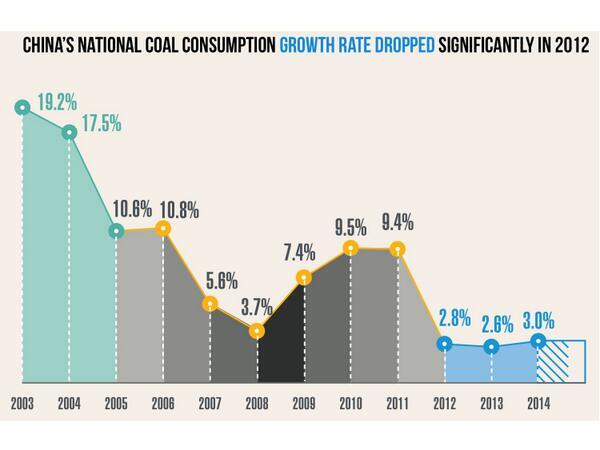
A report from Greenpeace charts slowing growth in China’s coal use.

Through much of its history, Greenpeace has been big on what I call “woe is me, shame on you” messaging on the environment. As I explained at a TEDx event in Portland, Ore., over the weekend, fingerpointing (including Greenpeace’s) is appropriate in many instances, but doesn’t work well with human-driven global warming. The blame game too often ends up resembling a circular firing squad.

This is why “The End of China’s Coal Boom,” a valuable new report from Greenpeace’s East Asia office, is so refreshing and worth exploring. I was led to it by a Twitter item from the group’s outgoing director, Phil Radford, that focused on a telling graphic:

View image on Twitter

via A Green Group Sees Hope in ‘The End of China’s Coal Boom’ – NYTimes.com – NYTimes.com.

Enhanced by Zemanta
16/04/2014

India Signs Power Contracts for 700 Megawatts of Solar Capacity – Businessweek

India signed contracts to purchase solar power from companies building 700 megawatts of capacity awarded in a national auction.

English: Photovoltaic system with 19 Megawatts...

English: Photovoltaic system with 19 Megawatts peak near Thüngen/Bavaria Deutsch: Solarpark/photovoltaikanlage mit 19 Megawatt Spitzenleistung nahe Thüngen/Bayern (Photo credit: Wikipedia)

The government is waiting to sign purchase agreements for the remaining 50 megawatts from the auction in February, Tarun Kapoor, joint secretary at the Ministry of New and Renewable Energy, said today in an interview in New Delhi. The agreements, which lock in rates for the power generated for 25 years, bind developers to complete the plants within 13 months.

Two developers dropped out after winning bids, including St. Peters, Missouri-based SunEdison Inc. (SUNE:US), which said last week it gave up a 20-megawatt project because local equipment shortages and prices make it unviable. The other developer that Kapoor didn’t identify forfeited its project after failing to get permission from its parent to proceed, he said.

via India Signs Power Contracts for 700 Megawatts of Solar Capacity – Businessweek.

Enhanced by Zemanta
25/03/2014

China’s Rush to Build Dams Leaves Resettled Communities in Limbo – Businessweek

China’s 12th Five-Year Plan for Energy Development, released last January, includes the admirable goal of generating 11.4 percent of energy from renewable sources by 2015. But at least one part of its plan is controversial among environmentalists and civil society advocates: the government’s aim to install 160 GW of new hydropower capacity, raising China’s total hydropower capacity to 290 GW. That would be more installed capacity than in all of Europe combined.

Currently 84 large dams are planned or under construction in southwestern China. The Woodrow Wilson Center’s China Environment Forum has just released an interactive map of the dams, viewable here. At least 70 dam sites are situated in regions that the nonprofit Conservation International has classified as biodiversity hotspots.

One major concern is China’s lousy past record for conducting environmental and social impact assessments for large infrastructure projects, such as the controversial Three Gorges Dam. Unfortunately, there is little evidence that China is learning from its experience.

via China’s Rush to Build Dams Leaves Resettled Communities in Limbo – Businessweek.

Enhanced by Zemanta
21/03/2014

BBC News – Megadams: Battle on the Brahmaputra

China and India have their eye on the energy potential of the vast Brahmaputra river. Will a new wave of “megadams” bring power to the people – or put millions at risk? The BBC World Service environment reporter Navin Singh Khadka reports from Assam, India.

map

On the banks of the Brahmaputra it is hard to get a sense of where the river starts and ends. It begins far away as a Tibetan mountain stream. On the floodplains of Assam, though, its waters spread as far as the eye can see, merging with the horizon and the sky.

From here it continues through north-eastern India into Bangladesh, where it joins with the Ganges to form a mighty river delta.

For centuries the Brahmaputra has nourished the land, and fed and watered the people on its banks.

Today, though, India and China’s growing economies mean the river is increasingly seen as a source of energy. Both countries are planning major dams on long stretches of the river.

In Assam the plans are being greeted with scepticism and some fear.

The fear is that dams upstream could give China great power over their lives. And many in Assam worry whether China has honourable intentions.

Brahmaputra voices: What next for their river?

Brahmaputra stories: The businessman, the activist, the expert and the official

After a landslide in China in 2000, the river was blocked for several days, unknown to those downstream.

When the water forced its way past the blockage Assam faced an oncoming torrent. There was no advance warning. There are concerns this could happen more frequently.

Some also believe that China may divert water to its parched north – as it has done with other southern rivers.

India’s central government says China has given them assurances about the new Tibetan dams.

“Our foreign ministry has checked with China and we have been told that the flow will not be affected, and we will make sure that the people’s lives are not affected by the dams,” Paban Singh Ghatowar, minister for the development of north-eastern India, told the BBC.

By engaging in a race to dam the Brahmaputra as quickly as possible, China and India will cause cumulative environmental impacts beyond the limits of the river’s ecosystem”

Peter Bosshard

International Rivers Network

Do massive dams ever make sense?

Beijing says the dams it is building on the Tibetan stretch of the river will ease power shortages for people in that region.

“All new projects will go through scientific planning and feasibility studies and the impact to both upstream and downstream will be fully considered,” China’s foreign ministry told the BBC.

It said three new dams at Dagu, Jiacha, and Jeixu were small-scale projects: “They will not affect flood control or the ecological environment of downstream areas,” the foreign ministry said.

Despite the statements, there is no official water-sharing deal between India and China – just an agreement to share monsoon flood data.

via BBC News – Megadams: Battle on the Brahmaputra.

Enhanced by Zemanta
07/03/2014

BBC News – Chaori Solar in landmark Chinese bond default

Solar panel maker Shanghai Chaori Solar Energy Science & Technology has defaulted on interest payments owed on its bond, say media reports quoting the firm.

Solar panels

It is the first Chinese firm ever to default on its onshore corporate bonds.

On Tuesday, the firm warned it would be unable to make a 89.8 million yuan ($14.6m; £8.7m) interest payment on a one billion yuan bond issued in 2012.

The default is seen as a test case for the Chinese government.

Investors have assumed in the past that the Chinese government would bail out any Chinese corporation in danger of defaulting.

The move to allow Chaori to default signals a new stance.

“There’s never been a corporate bond default, [so] investors have been conditioned that there is no such thing as risk in China,” Leland Miller, president of research firm China Beige Book, told the BBC.

“The Chinese leadership is trying to break down this misunderstanding that everything is backstopped.”

Chaori Solar said it planned to pay 4 million yuan ($654,000) of the interest payment due on the billion yuan bond, which was taken out two years ago.

via BBC News – Chaori Solar in landmark Chinese bond default.

Enhanced by Zemanta
06/03/2014

Coal India plans to set up power plant in 2015/16 | Reuters

The company has often said its output would be 300 million tonnes more than the current figure of about 475 million given enough rail tracks to carry the fuel from new and remote mines.

Insufficient connectivity is one of the reasons the company has lagged output targets for more than six straight years – leading to shortages at power producers and crippling outages.

“The country either needs coal or power,” said CB Sood, an executive director at the company. “If we are not able to evacuate coal, we should set up pit-head power plants.”

Speaking on the sidelines of a coal conference in the resort state of Goa, Sood said the company was seeking a joint venture partner to set up the plant.

via Coal India plans to set up power plant in 2015/16 | Reuters.

Enhanced by Zemanta
04/03/2014

India Plans to Manufacture Equipment at Solar Park as Glut Eases – Businessweek

India plans to add solar-equipment manufacturing capacity at a new park in Andhra Pradesh state, saying demand from plants under construction will help the industry recover from a glut of panels.

Solar Energy Corp. of India, the state-run company spearheading the industry’s development, signed an agreement with Andhra Pradesh Industrial Infrastructure Corp. for a solar park in the state that will have 1,000 megawatts of power capacity, as well as factories to produce modules and cells, Rajendra Nimje, managing director of SECI, said in an interview.

The plans come as panel prices appear to be bottoming out after falling more than 60 percent in two years amid a global supply glut. Local manufacturers, such as Indosolar Ltd. (ISLR), Moser Baer India Ltd. and Websol Energy System (WESL) Ltd., who idled about half of their 1,000 megawatts of production capacity, will get fresh orders as new projects are built, Nimje said.

via India Plans to Manufacture Equipment at Solar Park as Glut Eases – Businessweek.

Enhanced by Zemanta
Law of Unintended Consequences

continuously updated blog about China & India

ChiaHou's Book Reviews

continuously updated blog about China & India

What's wrong with the world; and its economy

continuously updated blog about China & India