Archive for ‘solar power’

17/05/2020

China’s Chang’e-4 probe survives 500 Earth days on Moon’s far side

BEIJING, May 17 (Xinhua) — China’s Chang’e-4 probe has survived 500 Earth days on the far side of the moon while conducting a scientific exploration of the virgin territory.

The lander and rover of the Chang’e-4 probe have resumed work for the 18th lunar day on the far side of the moon after “sleeping” during the extremely cold night.

The lander woke up at 3:25 a.m. Sunday (Beijing time), and the rover awoke at 11:53 a.m. Saturday. Both are in normal working order, according to the Lunar Exploration and Space Program Center of the China National Space Administration (CNSA).

The Chang’e-4 probe, launched on Dec. 8, 2018, made the first-ever soft landing on the Von Karman Crater in the South Pole-Aitken Basin on the far side of the moon on Jan. 3, 2019.

A lunar day equals 14 days on Earth, and a lunar night is the same length. The Chang’e-4 probe switches to dormant mode during the lunar night due to the lack of solar power.

The rover Yutu-2, or Jade Rabbit-2, has driven 447.68 meters, and is now 292 meters away from the lander. It has conducted scientific detection on lunar rocks, the lunar soil on its track and some impact craters.

Scientists used the Lunar Penetrating Radar on Yutu-2 to study the geological structure with a depth of 40 meters, unveiling the secrets buried under the surface of the far side of the moon, enriching our understanding about the history of celestial collisions and volcanic activities and shedding new light on the geological evolution on the moon.

Scientists also analyzed the data of the infrared imaging spectrometer on Yutu-2 and revealed the material composition on the moon’s far side, verifying that the lunar mantle is rich in olivine, which deepens our understanding of the formation and evolution of the moon.

China plans to launch its first Mars exploration mission Tianwen-1 in July. Due to the modification of the ground communication facilities, the rover and the lander will conduct in-situ detection during the 18th lunar day, said the CNSA.

The scientific tasks of the Chang’e-4 mission include conducting low-frequency radio astronomical observation, surveying the terrain and landforms, detecting the mineral composition and shallow lunar surface structure and measuring neutron radiation and neutral atoms.

The Chang’e-4 mission embodies China’s hope to combine wisdom in space exploration with four payloads developed by the Netherlands, Germany, Sweden and Saudi Arabia.

Source: Xinhua

14/05/2020

India’s carbon emissions fall for first time in four decades

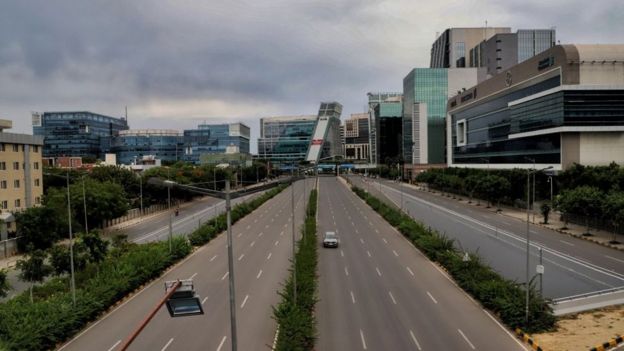
A view of clear blue and white skies, clean air in the city during the nationwide lockdown to curb spread of coronavirus (Covid-19) at sector-30 near Delhi-Gurugram expressway on April 20, 2020 in Gurugram, India.Image copyright GETTY IMAGES

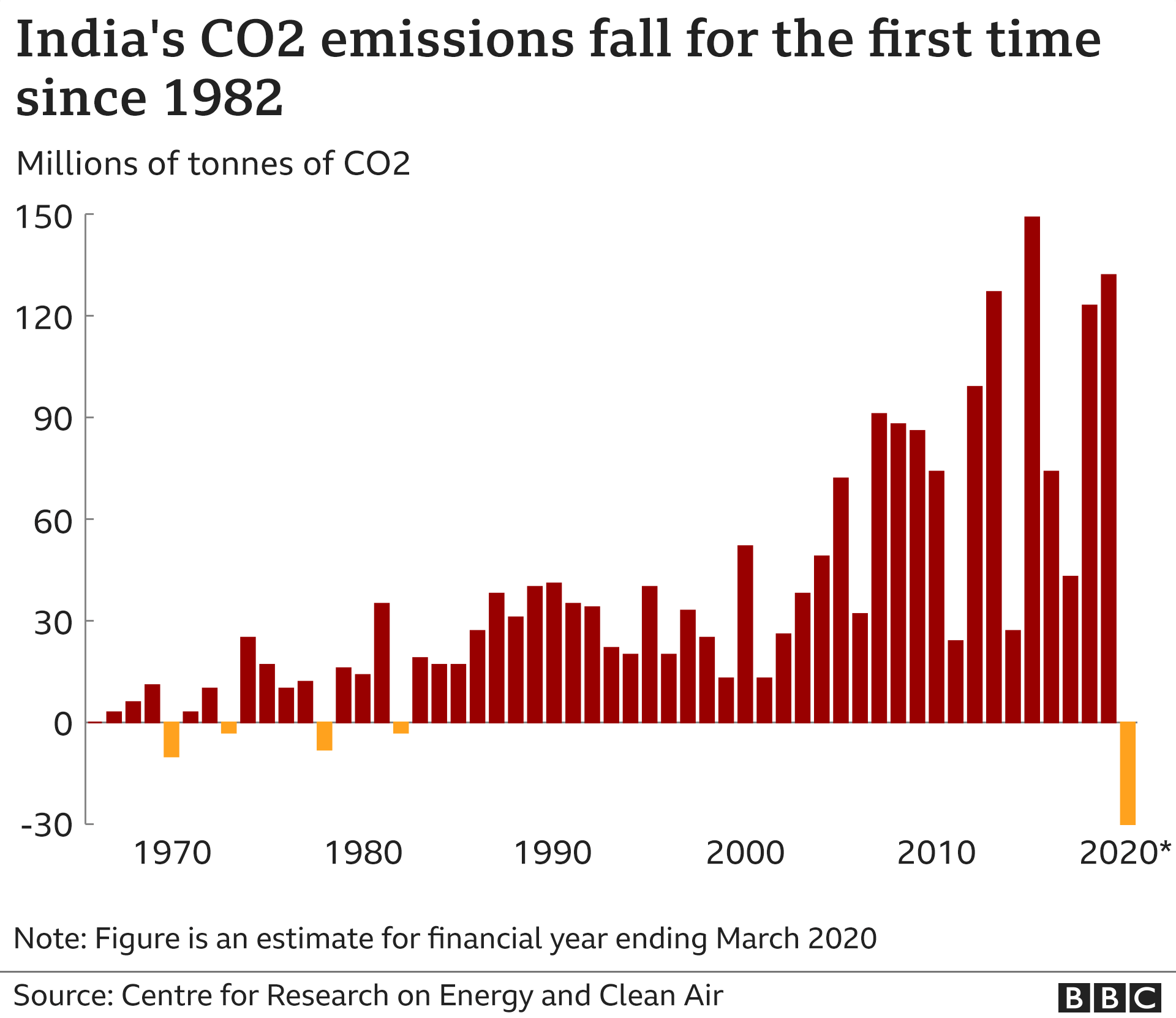
India’s CO2 emissions have fallen for the first time in four decades – and not just as a result of the country’s coronavirus lockdown.

Falling electricity use and competition from renewables had weakened the demand for fossil fuels even before the coronavirus hit, according to analysis by the environmental website, Carbon Brief. However, it was the sudden nationwide lockdown in March that finally tipped the country’s 37-year emissions growth trend into reverse.

The study finds that Indian carbon dioxide emissions fell 15% in March, and are likely to have fallen by 30% in April.

Virtually all of the drop-off in power demand has been borne by coal-fired generators, which explains why the emissions reductions have been so dramatic.

India emissions fall chart

Coal-fired power generation was down 15% in March and 31% in the first three weeks of April, according to daily data from the Indian national grid.

But even before India’s sudden coronavirus lockdown, the demand for coal was weakening.

The study finds that in the fiscal year ending March 2020, coal deliveries were down by around 2%, a small but significant reduction when set against the trend – an increase in thermal power generation of 7.5% a year set over the previous decade.

Indian oil consumption shows a similar reduction in demand growth.

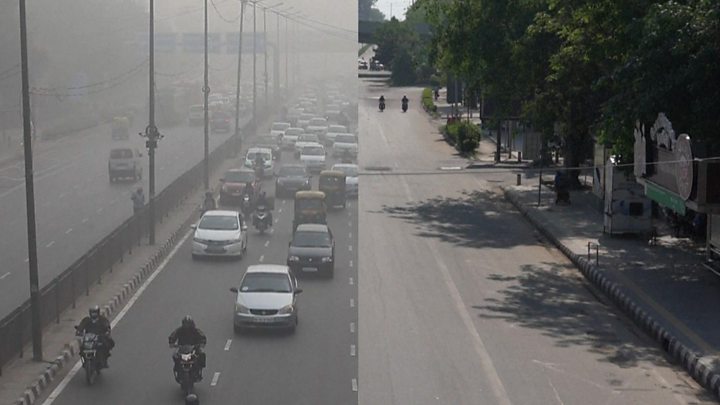
Vehicles move through DLF Cybercity during nation wide lockdown amid Covid-19 coronavirus pandemic in GurugramImage copyright GETTY IMAGES
Image caption The nationwide lockdown finally tipped a 37-year emissions growth trend into reverse

It has been slowing since early 2019.

And, once again, the trend has been compounded by the impact of the Covid-19 lockdown measures on the transport industry.

Oil consumption was down 18% year-on-year in March 2020.

Meanwhile, the supply of energy from renewables has increased over the year and has held up since the pandemic struck.

This resilience the renewables energy sector shows in the face of the sudden reduction in demand caused by coronavirus is not confined to India.

Media caption Delhi smog disappears during India’s lockdown

According to figures published by the International Energy Agency (IEA) at the end of April, the world’s use of coal was down 8% in the first quarter of the year.

By contrast, wind and solar power saw a slight uptick in demand internationally.

A key reason that coal has taken the brunt of the fall in electricity demand is that it cost more to run on a day-to-day basis.

Once you have installed a solar panel or a wind turbine, operating costs are very low and, therefore, tend to get priority on electricity grids.

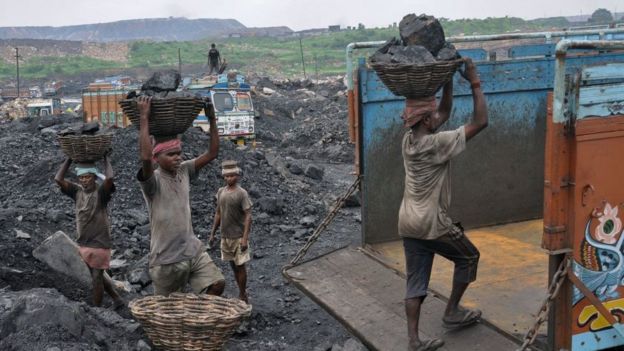
This photo taken on December 7, 2017 shows Indian labourers loading coal onto trucks at an open mine in Dhanbad in the eastern Indian state of Jharkhand.Image copyright GETTY IMAGES
Image caption India’s use of coal has plummeted, in line with that of other countries

Thermal power stations – those powered by coal, gas or oil – by contrast, require you to buy fuel in order to generate power.

But analysts warn that the decline in fossil fuel use may not last.

They say when the pandemic subsides, there is a risk that emissions will soar again as countries attempt to kick-start their economies.

The US has already started to relax environmental regulations and the fear is other nations could follow suit.

However, the analysis from Carbon Brief suggests there are reasons to think India could buck this trend.

The coronavirus crisis has brought the long-brewing financial troubles in the Indian coal sector to a head, and the Indian government is finalising a relief package which could top 900bn rupees ($12bn; £9.6bn).

But, at the same time, the government is talking about supporting renewable energy as part of the recovery.

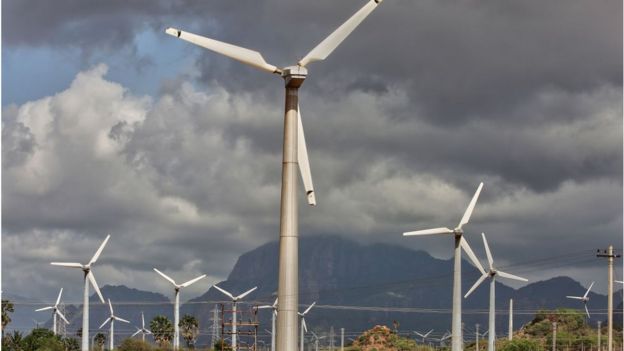
Wind turbines generate electricity in Punniyavalanpuram, Tamil Nadu, India.Image copyright GETTY IMAGES
Image caption Renewables have the economic edge in India, offering far cheaper electricity than coal

Renewables have the economic edge in India, offering far cheaper electricity than coal.

The report claims that new solar capacity can cost as little 2.55 rupees per kilowatt hour, while the average cost for electricity generated from coal is 3.38 rupees per hour.

Investing in renewables is also consistent with the country’s National Clean Air Programme, launched in 2019.

Environmentalists hope the clean air and clear skies Indians have enjoyed since lockdown will increase public pressure on the government to clean up the power sector and improve air quality.

Source: The BBC

17/04/2020

China’s Chang’e-4 probe resumes work for 17th lunar day

BEIJING, April 17 (Xinhua) — The lander and rover of the Chang’e-4 probe have resumed work for the 17th lunar day on the far side of the moon after “sleeping” during the extremely cold night.

The lander woke up at 1:24 p.m. Friday (Beijing time), and the rover awoke at 8:57 p.m. Thursday. Both are in normal working order, according to the Lunar Exploration and Space Program Center of the China National Space Administration.

The Chang’e-4 probe, launched on Dec. 8, 2018, made the first-ever soft landing on the Von Karman Crater in the South Pole-Aitken Basin on the far side of the moon on Jan. 3, 2019.

A lunar day equals 14 days on Earth, and a lunar night is the same length. The Chang’e-4 probe, switching to dormant mode during the lunar night due to the lack of solar power, has survived about 470 Earth days on the moon.

The rover Yutu-2, or Jade Rabbit-2, has worked much longer than its three-month design life, becoming the longest-working lunar rover on the moon.

Carrying scientific instruments such as panoramic camera, lunar penetrating radar, infrared imaging spectrometer and neutral atom detector, the rover will continue to move northwest to conduct scientific detection.

The scientific tasks of the Chang’e-4 mission include conducting low-frequency radio astronomical observation, surveying the terrain and landforms, detecting the mineral composition and shallow lunar surface structure and measuring neutron radiation and neutral atoms.

The Chang’e-4 mission embodies China’s hope to combine wisdom in space exploration with four payloads developed by the Netherlands, Germany, Sweden and Saudi Arabia.

Source: Xinhua
05/06/2017

Why China’s wasting huge amounts of cleanly-produced electricity and how to fix it | South China Morning Post

China’s scramble to curb pollution has made it the world leader in renewable energy development, yet increasing amounts of that green electricity have gone unused as the country struggles to integrate wind and solar power into an outdated electricity network dominated by coal.

The problem threatens to slow China’s progress in clearing its air and controlling the greenhouse gas emissions that make it the top contributor to climate change. It also runs counter to a desire by Chinese leaders to fill the leadership gap left by President Donald Trump’s move to withdraw the US from the Paris climate accord.

As international energy ministers gather in Beijing this week to promote renewables, China’s difficulty in maximising its green resources underscores uncertainty over how best to transition to cleaner electricity.

“They installed too much too fast,” said Qiao Liming, China director for the Global Wind Energy Council. “A real market should allow electricity to flow between two provinces. That is currently lacking” in China, she said.China wasted enough renewable energy to power Beijing for an entire year, says Greenpeace

Thousands of new wind turbines and solar panels were installed in China’s remote provinces over the past several years as the country’s leaders sought to alleviate choking urban smog without slowing economic expansion. China now has more renewable power capacity than any other nation.Two nagging problems have dampened that success, however, according to industry representatives and outside observers: China’s sprawling power grid has been unable to handle the influx of new electricity from wind and solar, while some provincial officials have retained a preference for coal.In western China’s Gansu province, 43 per cent of energy from wind went unused in 2016, a phenomenon known in the energy industry as “curtailment”. In the neighbouring Xinjiang region, the curtailment figure was 38 per cent and in northeast China’s Jilin province it was 30 per cent. The nationwide figure, 17 per cent, was described by Qiao’s organisation as shockingly high after increasing for several years in a row.

The problem has shown some signs of improvement this year, according to the China Electricity Council. Power demand in general increased in the first quarter, giving a boost to renewables after the economy regained momentum from 2016’s slowdown.However, experts say wasted energy will continue to be a drag on Chinese renewable power potential until the country’s electrical grid is modernised and provincial officials end their preference for coal, which provides almost two-thirds of the country’s energy.

The problem is worst in winter when many coal plants provide electricity for the power grid and send out excess heat to keep homes and businesses warm.

That’s led provincial officials to keep coal plants running and to reject available wind-generated electricity despite pressure from the central government to use more renewables, said Lu Xi, a professor at Tsinghua University’s School of Environment in Beijing.

“On paper they express quite clear attitudes to promote renewables, but in reality they promote coal interests,” said Frank Yu, a renewables specialist with the consulting firm Wood Mackenzie.

To help address the issue, China’s National Energy Administration has pushed for more wind turbines to be installed closer to Beijing and coastal cities where demand is highest. That should allow renewable energy to bypass part of the dated transmission system that has been blamed for impeding its use. It also would give more populated provinces a greater stake in making sure renewables get used.China has leadership role in fight against climate change

In a separate effort, at this week’s energy ministers meeting in Beijing, Chinese officials are expected to launch a campaign to make its power supply system more flexible. The goal is to create a power grid that can more easily absorb the highs and lows associated with weather dependent wind and solar electricity, said Christian Zinglersen, the head of the Clean Energy Ministerial, which is hosting the meeting.

Still, the problem of electricity going unused could get worse before it gets better, said Zhang Liutong, a senior manager with the Lantau Group, a Hong Kong-based energy consulting firm. More solar and wind is planned in Chinese provinces that already have more power-generating capacity than they use. Additional coal plants also are slated to come online, Zhang said.

China’s difficulties, while more pronounced than in other countries, are not unique. Western countries have experienced their own renewable struggles as utilities tried to integrate weather dependent wind and solar power into electricity grids built around coal plants, which are more polluting but also more reliable.

But over the next two decades, events in developing nations including China and India are expected to play a magnified role in addressing climate change. The United States, meanwhile, appears headed for a diminished presence as Trump and fellow Republicans back away from the climate policies of former President Barack Obama.

Almost all of the increased electricity demand during that period is expected to come from developing nations, according to projections from the International Energy Administration.

China alone will account for about half the total.

China’s struggles to maximise its use of renewables will not necessarily prevent it from meeting international emissions targets that aim to keep global warming below two degrees Celsius compared to pre-industrial levels. But it will make it much more expensive unless China is able to adapt its power supply system while it is still in development, Zinglersen said.

“This is a case of political leadership catching up with the reality on the ground,” he said. “The more flexible a system you can have the more renewables you can allow for.”

We recommend for you

Source: Why China’s wasting huge amounts of cleanly-produced electricity and how to fix it | South China Morning Post

02/06/2017

China flips the switch on world’s biggest floating solar farm | South China Morning Post

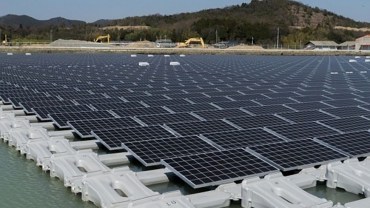
The world’s biggest floating solar power plant is up and running in China, as the country increasingly looks to renewable sources for its energy.

It comes at a time when Beijing is expected to take a bigger role in global efforts to tackle climate change, after the United States pulled out of the landmark 195-nation Paris deal.

The new solar farm in the city of Huainan, in the central, coal-rich Anhui province, can generate 40 megawatts of electricity – enough to power 15,000 homes. That’s according to Sungrow Power Supply, the Chinese firm that built the plant. It was connected to the city’s power grid in May.

The solar farm occupies an area that for years saw intensive coal mining. Subsidence and heavy rain created the lake where the solar panels have been installed.

Those panels float on the surface of the water, which ranges in depth from four to 10 metres.While Sungrow did not disclose the exact size of the plant, its capacity is double that of the solar farm previously considered the world’s biggest. That plant is also located in Huainan and was built by Xinyi Solar in 2016.

With US out of Paris climate deal, China’s now able to lead … but is it willing?Earlier in 2016, a floating solar farm began operating on the outskirts of London with capacity to generate just over 6 megawatts of electricity – it was considered the biggest at the time, according to a report in The Guardian.

Floating solar farms take advantage of areas that would otherwise go unused and the water helps to cool the surface of the panels, reducing the risk of overheating.

China is now the largest solar energy producer in the world – its capacity reached 77.42 gigawatts at the end of last year, according to the National Energy Administration. Renewables make up 11 per cent of the country’s energy use, but that number could go up to 20 per cent by 2030.

Earlier this year, the world’s biggest solar farm was unveiled in a remote part of the Tibetan plateau, in western Qinghai province. The sprawling Longyangxia Dam Solar Park covers some 27 square kilometres – almost the size of Macau. It can generate enough power to supply 200,000 homes.

Other large-scale solar projects in the country include the installation of 300 panels above a fish farm in Zhejiang province and a 6-million panel solar farm in the Ningxia autonomous region, which will be the biggest when it is completed.

Chinese companies are also involved in solar projects in other countries. State-owned National Complete Engineering Corporation is working with GCL System Integration Technology to build a 1-gigawatt solar plant in the exclusion zone around the Chernobyl reactor – the site of the worse nuclear accident in history.

China’s embrace of renewable energy presents a stark contrast to the climate policies of the United States, which has announced it will exit the landmark Paris climate agreement. US President Donald Trump has slammed his predecessor Barack Obama for “wasting” taxpayer money on solar companies, called wind farms both “disgusting looking” and “bad for people’s health”, and proposed an administrative budget that would slash renewable energy spending by 70 per cent.

Source: China flips the switch on world’s biggest floating solar farm | South China Morning Post

02/11/2016

India to launch clean energy equity fund of up to $2 billion – sources | Reuters

The Indian government and three state-run firms will jointly set up an equity fund of up to $2 billion for renewable energy companies to tap into to help New Delhi meet its clean energy goals, two government sources told Reuters on Wednesday.

Private and public companies will be able to dip into an initial amount of more than $1 billion starting next fiscal year, said the sources with direct knowledge of the decision taken after a meeting of government officials more than a month ago. India’s government hopes the Clean Energy Equity Fund (CEEF) will attract pension and insurance funds from Canada and Europe.

Around $600 million of the initial pool will come from the National Investment and Infrastructure Fund, under the finance ministry, and the rest from state entities NTPC Ltd, Rural Electrification Corp and the Indian Renewable Energy Development Agency, according to one of the sources.

The sources declined to be named as they are not authorised to talk to the media. Officials at the finance ministry, new and renewable energy ministry, NTPC, Rural Electrification, and Indian Renewable Energy Development Agency did not immediately respond to requests for comment.

Prime Minister Narendra Modi has set a target of raising India’s renewable energy target to 175 gigawatts by 2022, more than five times current usage, as part of the fight against climate change by the world’s third-biggest greenhouse gas emitter and to supply power to all of the country’s 1.3 billion people.

The program will depend on getting as much as $175 billion in funding with 70 percent of that likely in bank loans and the rest as equity, the sources said.

The government reckons loans are not a problem but providing equity to investors may be difficult due to uncertainties over returns, one of the sources said.

“As we expand our clean energy capacity, there may be a shortage of equity next year,” said the source. “Private equity is seen as risky in India but if the government itself creates a fund, that gives a lot of confidence.”

India’s clean energy push was set back earlier this year when U.S. solar company SunEdison filed for bankruptcy. The company is now looking to secure partners to see through its planned India projects.

Nevertheless, companies are still keen to invest in clean energy.

Japan’s Softbank Corp, Taiwan’s Foxconn and India’s Bharti Enterprises have pledged to invest about $20 billion in India’s renewable sector. Global solar giants like First Solar Inc, Trina Solar Ltd and Fortum are also expanding their presence.

Source: India to launch clean energy equity fund of up to $2 billion – sources | Reuters

30/06/2016

India to get over $1 billion from World Bank for Modi’s solar goals | Reuters

The World Bank said on Thursday it would lend India more than $1 billion for its huge solar energy programme, after Prime Minister Narendra Modi sought climate change funds from its visiting head.

Modi is banking on India’s 300 days a year of sunshine to generate power and help fight climate change rather than committing to emission cuts like China.

The World Bank loan is the global lender’s biggest solar aid for any country and comes as India has set a goal of raising its solar capacity nearly 30 times to 100 gigawatts by 2020 and is attracting mega investment proposals from top companies and institutions.

“Prime Minister Modi’s personal commitment toward renewable energy, particularly solar, is the driving force behind these investments,” World Bank President Jim Yong Kim said in a statement released after he met Modi. “The World Bank Group will do all it can to help India meet its ambitious targets, especially around scaling up solar energy.

“India is the largest client of the World Bank, which lent it around $4.8 billion between 2015 and 2016.

Modi’s office said he told Kim about the need for climate change financing for countries like India that are “consciously choosing to follow an environmentally sustainable path”.

India wants the share of non-fossil fuel in total installed power capacity to jump to 40 percent by 2030 from 30 percent currently, but there are challenges including weak finances of state distribution companies forced to sell subsidised power, difficulties hooking up solar projects to grids, and access to affordable capital.

Still India reckons its renewable energy industry could generate business opportunities worth $160 billion this decade, making it a lucrative market that has already attracted big global players such as Japan’s Softbank Corp, Taiwan’s Foxconn, First Solar, Trina Solar Ltd and Finland’s state-controlled utility Fortum Oyj.

German development bank KFW has already agreed to offer India low-interest loans of around 1 billion euro over the next five years to fund roof-mounted solar panels, and the construction of solar energy farms and self-contained solar power facilities not connected to the grid.

Source: India to get over $1 billion from World Bank for Modi’s solar goals | Reuters

18/04/2015

Apple Grows its Own Solar Farms in China – China Real Time Report – WSJ

Call it savvy public relations or plain good investing, but Apple is becoming a solar-power developer in China.

News Thursday that the Cupertino, Calif.-based company is partnering with SunPower., a major U.S. solar-panel maker, to build two solar power plants in China’s southwestern Sichuan province, highlights Apple’s attempts to offset its growing carbon footprint in China, where it is expanding at a rapid pace.

Although financial terms weren’t disclosed, SunPower said Thursday that Apple will co-own the projects, which have the combined capacity of 40 megawatts.

Apple has previously said it wants to be carbon neutral everywhere it operates, but that admirable goal is considerably absent in China, where the bulk of its products are made. Until now, unhappiness over air pollution mainly has been directed at the Chinese government, but Apple — already under fire over labor and customer-support issues –could become a major target. Initiatives like these could go a long way toward making sure its image in China remains favorable.

Apple tends to be financially involved in clean-energy projects only when they provide electricity for its operations. Apple and SunPower, for example, have partnered together in the U.S. to develop six solar power plants, all of which provide at least some power to Apple’s facilities.

In this case, however, Apple’s solar plants are being built in Sichuan’s remote Aba Tibetan and Qiang autonomous prefectures, far from Apple’s corporate offices, retail stores or manufacturing partners. The region is known for its rolling grasslands, where herders take yaks and sheep to graze, and where multi-colored Tibetan prayer flags are strung up along the slopes of hills.

In an interview on Thursday with China’s official Xinhua news agency, Apple’s vice president of environmental initiatives, Lisa Jackson, said the solar plants will be located in grasslands primarily used for raising yaks. Ms. Jackson, who was previously head of the U.S. Environmental Protection Agency, said Apple will take care to minimize the impact of construction on the environment. An Apple spokeswoman said Friday in an email that Apple and its local partners won’t use cement to install solar panels or dig trenches for wires during construction.

Apple has been expanding quickly in China as it attempts to go after the country’s burgeoning middle class. The company currently has 21 retail stores in mainland China and hopes to double that number by the end of next year. Although Apple’s latest efforts to produce clean energy in China might be a drop in the bucket when compared with amount of fossil fuels consumed by its manufacturing partners, Ms. Jackson told Xinhua that the company hopes to lead by example for its more than 330 suppliers.

Apple’s latest projects join a wave of new solar farms under construction in western China. Solar-panel makers, Chinese policy banks and other clean-energy developers are all piling into the business after China revived its solar industry amid the country’s ambitious targets to add as much as 18 gigawatts of solar-power capacity by the end of this year.

via Apple Grows its Own Solar Farms in China – China Real Time Report – WSJ.

15/02/2015

Modi calls for innovation in renewable energy – The Hindu

Prime Minister Narendra Modi on Sunday called for innovation and research to develop renewable energy to provide affordable electricity to every household.

Prime Minister Narendra Modi at the Renewable Energy Global Investors Meet meet in Delhi on Sunday. Photo: Ramesh Sharma

Inaugurating the first Renewable Energy Global Investors Meet (RE-Invest), Mr. Modi called for collaboration between the 50 nations with abundant solar power to develop technological solutions.

Stating that the role of energy in development was very important, he said, “We want to increase speed and at the same time scale new heights of development and one of the sectors is energy.”

“We are focussing on renewable energy not for laurels but to lighten homes of the poor and bring a change in their lives,” he said. “We have ponds, can we think of solar panels on top of these ponds? We need to think of innovative ideas.”

He said the cost of electricity from solar photovoltaic cells has come down from Rs. 20 per unit to Rs. 7.50 and research and innovation can help bring it down further.

Hybrid power generation involving solar and wind energy should be encouraged as it will help save on transmission and power evacuation infrastructure cost, he said.

Mr. Modi also called for developing domestic manufacturing of renewable energy equipment to create jobs.

Conserving energy, he said, is the need of the hour.

via Modi calls for innovation in renewable energy – The Hindu.

06/02/2015

Companies set to back huge India solar expansion | Reuters

India could start installing 20,000 megawatts of solar power capacity as early as April after companies pledged to support the government’s drive for clean energy, an official told Reuters.

A worker cleans photovoltaic solar panels inside a solar power plant at Raisan village near Gandhinagar, in Gujarat, February 11, 2014. REUTERS/Amit Dave/Files

Details of the plan, which has drawn commitments from U.S., German and Chinese companies, will be announced on Friday, said Upendra Tripathy, secretary of the Ministry of New and Renewable Energy.

“We have got commitments from very established industry, both foreign and domestic for next year,” he said in an interview at his office.

Foreign companies will be allowed to decide where they manufacture the required equipment, he said.

via Companies set to back huge India solar expansion | Reuters.

Law of Unintended Consequences

continuously updated blog about China & India

ChiaHou's Book Reviews

continuously updated blog about China & India

What's wrong with the world; and its economy

continuously updated blog about China & India