Archive for ‘coal’

25/05/2016

China to replace direct coal combustion with electricity in new plan | Reuters

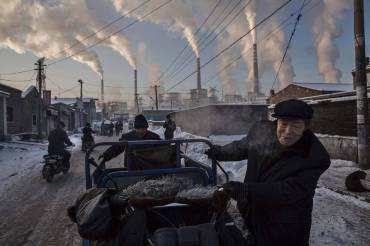
China will reduce the amount of coal burned directly in industrial furnaces and residential heating systems in order to tackle a major source of smog, the country’s energy regulator said on Wednesday.

The National Energy Administration (NEA) said in a joint announcement with other government bodies that around 700 million to 800 million tonnes of coal is burned directly in China every year, much of it in the countryside, where access to electricity is limited.

Directly burned coal amounts to about 20 percent of China’s total coal consumption volume, much higher than the 5 percent rate in Europe and the United States.

China will aim to replace direct burning with electricity, including renewable power as well as ultra-low emission coal-fired generators, the NEA said.

China currently relies on coal for around 64 percent of its total primary energy needs and for three-quarters of its total power generation. Emissions from the direct combustion of coal are around five times higher than those from coal-fired power plants, which are subject to strict anti-pollution regulations.

During the 2016-2020 period, China plans to raise electricity’s share of the country’s overall energy mix to 27 percent, up about 1.5 percentage points from now and raising total power consumption by around 450 billion kilowatt-hours a year, the NEA said.

Experts have estimated that China will need an additional 600 GW of coal-fired power capacity over the 2015-2030 period in order to replace direct coal combustion.

Source: China to replace direct coal combustion with electricity in new plan | Reuters

26/04/2016

China Bans Some New Coal Power Plants – China Real Time Report – WSJ

China Bans Some New Coal Power Plants A coal-fired power plant in Shanxi, China. Beijing has announced a ban on new coal plants in areas with surplus power supply.

Beijing has announced a ban on new coal plants in areas with surplus power supply.

China’s government is banning construction of new coal-fired power plants in areas with surplus power supply, a move that could weigh on already-struggling coal markets. As WSJ’s Brian Spegele reports:

The new measures outlined Monday by China’s top economic planner, the National Development and Reform Commission, underscore the central government’s deep concern with overcapacity across China’s economy, a result of weakening industrial demand as growth slows.

Beijing has previously said it aimed to curb thermal power overcapacity; analysts said the fact that it now came from an official NDRC communiqué was the clearest signal yet that it won’t tolerate new coal capacity in regions that already have excess supply.

Weaker demand for coal inside China could ultimately lead to higher exports, which would exacerbate the huge supplies of coal sloshing around global markets. The higher supplies could drive down global benchmark prices and hit the bottom lines of major U.S. and international coal producers.

The global commodities downturn has proven particularly tough on global coal companies. St. Louis-based Peabody Energy Corp. and Arch Coal Inc. are among the large U.S. miners to file for chapter 11 bankruptcy protections in recent months. The U.S. sector has shed 31,000 jobs since 2009.

Source: China Bans Some New Coal Power Plants – China Real Time Report – WSJ

26/05/2015

Coal-fired plants in Beijing on way out with new ban|Society|chinadaily.com.cn

Beijing will ban new coal-fired thermal power plants after the four existing ones are expected to be replaced by gas-fired plants by 2017, according to the municipal economic planner.


http://www.gettyimages.com/detail/137085643

The replacement is being made in an attempt to reduce coal consumption to achieve better air quality.

“The closure of the coal-fired power plants will greatly improve air quality, considering that 22 percent of air pollutants are from coal consumption,” said Zhang Wangcai, deputy director of the Beijing Development and Reform Commission’s Energy Bureau.

Two gas-fired thermal power plants have been operating since October and have reduced coal consumption by 3.95 metric tons annually, he said.

Beijing has also restricted coal consumption by companies and households for heating in the past two years by supplying them with gas or other cleaner fuels instead.

“By the end of this year, we will reduce coal consumption by 8 million tons,” Zhang said, adding that a reduction of 7.1 million tons has already been achieved.

Li Xiang, deputy head of atmospheric environment management at the Beijing Environmental Protection Bureau, said the reduction of coal consumption at the two power plants has been a major reason for the better air quality in the capital in the first four months of this year.

She said people in the capital have seen a distinct improvement in air quality in the first four months, during which there were 57 days when the quality was better than the national standard – eight days more than during the same period last year.

The concentration of PM2.5 – air particles of 2.5 micrometers or less in diameter that can penetrate the lungs and harm health – has been lowered by 19 percent and the number of days with serious pollution reduced by 42 percent year-on-year.

On Thursday, authorities launched efforts to reduce air pollution in support of the bid to host the 2022 Winter Olympics.

Zhang said the government will make further efforts to reduce emissions of air pollutants, including restricting coal consumption as planned, which will further improve air quality.

In addition to the two thermal power plants already operating, another will start working in July and a fourth will be ready to operate in November next year, he said.

By 2017, Beijing will have all its power generated by clean-energy gas, and coal consumption will be cut by 9.2 million tons annually – the equivalent amount used for the four coal-burning thermal power plants.

Gas consumption will increase to 24 billion cubic meters in 2017, of which 98 percent will be supplied through a variety of channels including foreign countries, Zhang said, adding that Beijing consumed 11.3 billion cubic meters of gas last year.

The Ministry of Environmental Protection released the list of air quality in April in the 74 major cities on Monday.

In April, seven of the 10 cities with the worst air pollution were in Hebei province, but the region of Beijing, Tianjin and Hebei province has witnessed a clear improvement in air quality, said Luo Yi, head of the ministry’s Environmental Supervision Bureau.

The PM2.5 concentration in the region has been reduced on average by 18.3 percent year-on-year and was 16.3 percent lower in April than in March, he said.

via Coal-fired plants in Beijing on way out with new ban|Society|chinadaily.com.cn.

22/03/2015

Chinese capital shuts third coal-fired plant in war on smog | Reuters

China’s smog-hit capital Beijing has shut down the third of its four coal-fired power plants as part of its campaign to cut pollution, with the final one scheduled to close next year, the official Xinhua news agency said on Friday.

A security personnel walks near Tiananmen Gate on a heavily hazy day in Beijing October 24, 2014.  REUTERS/Jason Lee

In 2013, the city promised in its clean air action plan to bring annual coal consumption down to less than 10 million tonnes by 2017, a reduction of 13 million tonnes in just four years.

It said it would shut down all four of its coal-fired power plants within four years, a move that would cut annual coal consumption by around 9 million tonnes.

Officials also plan to reduce coal combustion in heating systems and industrial facilities, partly by switching to natural gas and by relocating some factories out of the city, and to phase out coal consumption completely by 2020.

A 400-megawatt facility owned by the Guohua Electric Power Co. Ltd was shut on Friday and replaced with a gas-fired plant. It followed the closure of a 93-year-old power station run by Beijing Jingneng Power on Thursday.

It shut its first coal-fired plant, the 600-MW Gaojing facility owned by the China Datang Corporation, last July.

Average levels of hazardous airborne particles known as PM2.5 stood at 85.9 micrograms per cubic meters in 2014, down 4 percent compared with the previous year, but still far higher than the national air quality standard of 35 micrograms.

Beijing plans to bring readings down to 60 by 2017, the municipal environmental bureau said earlier this year.

Only eight of the 74 Chinese cities monitored by the Ministry of Environmental Protection met smog standards in 2014. Seven of the 10 worst-performing cities were in the province of Hebei, which surrounds Beijing.

via Chinese capital shuts third coal-fired plant in war on smog | Reuters.

03/02/2015

Mines Shut as China Burns Less Coal – China Real Time Report – WSJ

Yu County, a sprawling mountainous area in China’s northern industrial province of Hebei, is known for its ancient temples and coal mines. These days, the temples remain, but the mines are vanishing. As the WSJ’s Chuin-Wei Yap and Rhiannon Hoyle report:

“We used to have around 300 coal mines in the area. Now it’s down to 70-plus,” said a manager of a local pit who identified himself only as Mr. Cheng. Shrinking profit margins and a failure to meet safety standards have led many to close, Mr. Cheng said. His own midsize company, Kanghe Coal Mining Co., was swallowed by a larger competitor, state-owned Kailuan Group Co., last year.

What is happening in Yu County is an illustration of the bleak times for the global coal industry. Tougher environmental standards coupled with shrinking demand have led to the closing of mines across China and sent coal prices to their lowest in six years. China’s coal output likely fell 2.5% in 2014, the first annual decline in 14 years, the China Coal Industry Association said last week. And while full-year data aren’t yet available, official statistics show China consumed 1.1% less coal in the first three quarters of 2014 than a year earlier.

via Mines Shut as China Burns Less Coal – China Real Time Report – WSJ.

31/01/2015

Record Coal India share sale boosts privatisation drive | Reuters

India has raised about $3.6 billion by selling a 10 percent stake in state-run Coal India Ltd in the largest ever equity deal in the local market, giving a welcome boost to the government‘s faltering divestment drive.

Workers drill at an open cast coal field at Dhanbad district in Jharkhand September 18, 2012. REUTERS/Ahmad Masood/Files

The share sale will move the government closer to the still distant target of raising $10 billion by selling minority stakes in state-owned companies to trim the fiscal deficit to a seven-year low by the end of March.

Until now, the government had raised barely $300 million.

The strong investor response to the Coal India issue is expected to bolster New Delhi’s plans to offload shares in other state firms including Oil and Natural Gas Corp and Power Finance Corp Ltd.

Overseas and local portfolio investor demand for Coal India shares exceeded supply, in a vote of confidence in recovery in Asia’s third-largest economy, and in its growing demand for energy as industrial production increases.

via Record Coal India share sale boosts privatisation drive | Reuters.

18/12/2014

China Plans to Dethrone King Coal – Businessweek

China is, by far, the largest consumer of coal worldwide. In 2011, China accounted for nearly half the coal burned globally, according to data compiled by the U.S. Energy Information Administration. China is also the world’s largest emitter of greenhouse gases that cause global warming. That’s the bad news.

China's Coal Demand May Peak Before 2020

The good news is that China’s coal usage is “very likely to peak before 2020,” according to a report (PDF) published by the National Bureau of Asian Research (NBR). The author, Li Zhidong, a professor at Nagaoka University of Technology in Japan, examined data from China’s National Bureau of Statistics to find that the country’s appetite for coal is rising at a dramatically slower rate today than a few years ago. In 2011, China’s coal usage jumped 9 percent; last year, it rose only 2 percent.

Several factors are behind the trend. The first is simply that China’s manufacturing sector has slumped, meaning that factories required less additional electricity.

A more lasting factor, however, is that China’s push to expand renewable energy usage has made coal account for a declining share of power generation. In 2010, coal-fired power plants supplied 75.6 percent of China’s electricity; that dipped to 73.3 percent by 2013. Whether or not the economy picks up, the share of coal power is likely to continue to decline. In just the past three years, China has busily installed new dams, windmills, solar panels, and nuclear plants, adding 64 gigawatts of hydropower, 46 Gw of wind power, 15 Gw of solar power, and 4 Gw of nuclear power, according to NBR.

via China Plans to Dethrone King Coal – Businessweek.

21/10/2014

India Steps Closer to Ending 40-Year-Old Monopoly on Coal – Businessweek

India stepped closer to ending a four-decade-old government monopoly on mining and selling coal as Prime Minister Narendra Modi seeks to tackle fuel shortages.

India Coal Mine

The government approved a decree enabling it to permit commercial mining in future, Finance Minister Arun Jaitley said at a briefing in New Delhi yesterday, without giving a timeline. The ordinance also allows auctions of coal mines to private companies for their own use, he said.

Modi made curbing blackouts a priority after sweeping to office in May on a pledge to revive growth in Asia’s third-largest economy from near the slowest pace in a decade. State-owned Coal India Ltd. (COAL) has missed output targets in at least the past four years, and easing its grip may allow companies such as Sesa Sterlite Ltd. (SSTL) and NMDC Ltd. (NMDC) to profit from the world’s fifth-biggest reserves.

Enabling private companies to mine and sell coal would be “one of the key game-changing reforms,” said Sonal Varma, an economist at Nomura Holdings Inc. in Mumbai. “Fuel availability has been a big concern for the economy.”

Opening up the coal industry risks stoking protests by some of Coal India’s about 325,000 workers and executives, at the same time as the government prepares to sell a 10 percent stake in the company that would fetch about 228 billion rupees ($3.7 billion).

Coal India accounts for more than 80 percent of the country’s production. The government wants to spur competition in the industry, Jaitley told the NDTV 24×7 television channel today.

via India Steps Closer to Ending 40-Year-Old Monopoly on Coal – Businessweek.

26/08/2014

Top India court says coal allocations were illegal – Businessweek

India’s Supreme Court said Monday that all government allocations of coal reserves to private companies from 1993 to 2010 were conducted illegally, and it will hold a hearing to decide whether to cancel them.

More than 200 coal blocks, or areas of unmined reserves, were allocated during that period to companies for their use in power plants or steel or cement factories. The companies were allowed to sell excess coal on the open market, but the court said commercial sales from the reserves must be suspended until it makes its decision at a hearing on Sept. 1.

The court’s ruling extends beyond the initial case — dubbed “Coalgate” by the Indian media — in which the previous Congress party-led government was accused of costing the treasury hundreds of billions of dollars by selling or allocating about 155 coal blocks in 2004-09 without competitive bidding. A report by the country’s Comptroller and Auditor General leaked to the media in March 2012 estimated those losses to have been around $210 billion.

The scandal along with other high-profile cases of alleged corruption were seen as a key reason for the Congress party’s loss in this year’s elections to Prime Minister Narendra Modi‘s pro-business Bharatiya Janata Party.

The court said in its ruling Monday that between 1993 and 2010 there had been “no fair and transparent procedure” in the coal allocation process, “resulting in unfair distribution of the national wealth.”

“Common good and public interest have, thus, suffered heavily,” said the court, led by Chief Justice R.M. Lodha.

via Top India court says coal allocations were illegal – Businessweek.

13/08/2014

Beijing cuts coal use by 7 percent in first half of year – China – Chinadaily.com.cn

Beijing cut coal consumption by 7 percent in the first half of 2014 as part of its efforts to tackle smog, the city’s environmental protection bureau said.

Beijing cuts coal use by 7 percent in first half of year

Beijing is at the front line of a “war on pollution” declared by the central government earlier this year in a bid to head off public unrest about the growing environmental costs of economic development.

The city has already started to close or relocate hundreds of factories and industrial plants.

The coal-fired power generators at Beijing’s Gaojing Thermal Power Plant are decommissioned on July 23. Provided to China Daily

It will also raise vehicle fuel standards and is mulling the introduction of a congestion charge.

To reduce coal consumption, it is in the process of shutting down all of its aging coal-fired power plants and replacing them with cleaner natural gas-fired capacity or with power delivered via the grid.

Based on last year’s coal consumption level of 19 million metric tons, the 7 percent cut would amount to around 1.33 million tons per year.

Beijing has said previously that it plans to reduce total coal use by 2.6 million tons in 2014, and aims to slash consumption to less than 10 million tons per year by 2017.

The Beijing environmental bureau said the city had cut sulfur dioxide emissions by 5.4 percent over the first six months of the year.

It also took 176,000 substandard vehicles off the road.

Previous data issued by the Ministry of Environmental Protection showed that concentrations of hazardous airborne particles known as PM2.5 stood at 91.6 micrograms per cubic meter in Beijing in the first half of the year, down 11.2 percent year-on-year but still more than twice the recommended national limit of 35 mcg.

Much of the pollution that hits Beijing drifts in from the surrounding province of Hebei, a major industrial region that is home to seven of China’s 10 most polluted cities.

Under new plans to integrate Beijing with Hebei and the port city of Tianjin, the region will be treated as a “single entity” with unified industrial and emission standards.

Hebei said last week that it had cut coal consumption by 7.53 million tons in the first half of 2014, amounting to just over half of its target of 15 million tons for the year.

The province agreed last year to cut coal use by 40 million tons by 2017, and it is also planning to shed at least 60 million tons of excess steel capacity over the same period.

via Beijing cuts coal use by 7 percent in first half of year – China – Chinadaily.com.cn.

Law of Unintended Consequences

continuously updated blog about China & India

ChiaHou's Book Reviews

continuously updated blog about China & India

What's wrong with the world; and its economy

continuously updated blog about China & India