Chindia Alert: You’ll be Living in their World Very Soon
aims to alert you to the threats and opportunities that China and India present. China and India require serious attention; case of ‘hidden dragon and crouching tiger’.
Without this attention, governments, businesses and, indeed, individuals may find themselves at a great disadvantage sooner rather than later.
The POSTs (front webpages) are mainly 'cuttings' from reliable sources, updated continuously.
The PAGEs (see Tabs, above) attempt to make the information more meaningful by putting some structure to the information we have researched and assembled since 2006.
NEW DELHI (Reuters) – Hundreds of foreign companies are actively procuring components for India and Pakistan’s nuclear programmes, taking advantage of gaps in the global regulation of the industry, according to a report by a U.S.-based research group.
Using open-source data, the nonprofit Centre For Advanced Defense Studies (C4ADS) report provides one of the most comprehensive overviews of networks supplying the rivals, in a region regarded as one of the world’s most dangerous nuclear flashpoints.
“India and Pakistan are taking advantage of gaps in global non-proliferation regimes and export controls to get what they need,” said Jack Margolin, a C4ADS analyst and co-author of the report.
It is seldom possible to determine whether individual transactions are illegal by using publicly available data, Margolin said, and the report does not suggest that companies mentioned broke national or international laws or regulations.
But past reports by the think tank, whose financial backers include the Carnegie Corporation and the Wyss Foundation, have often led to action by law enforcement agencies.
Spokesmen from the offices of India’s Prime Minister Narendra Modi, and Pakistan’s Prime Minister Imran Khan did not respond to requests for comment. Pakistan’s military, which plays a major role in decision-making for the nuclear weapons programme, also declined to comment.
To identify companies involved, C4ADS analysed more than 125 million records of public trade and tender data and documents, and then checked them against already-identified entities listed by export control authorities in the United States and Japan.
Pakistan, which is subject to strict international export controls on its programme, has 113 suspected foreign suppliers listed by the United States and Japan. But the C4ADS report found an additional 46, many in shipment hubs like Hong Kong, Singapore and the United Arab Emirates.
“In Pakistan’s case, they have a lot more stringent controls, and they get around these by using transnational networks… and exploiting opaque jurisdictions,” Margolin said.
The father of Pakistan’s atomic bomb, AQ Khan, admitted in 2004 to selling nuclear technology to North Korea, Iran and Libya. He was pardoned a day later by Pakistani authorities, which have refused requests from international investigators to question him.
India has a waiver that allows it to buy nuclear technology from international markets. The Indian government allows inspections of some nuclear facilities by the International Atomic Energy Agency, but not all of them.
Neither India or Pakistan have signed the international Treaty on the Non-Proliferation of Nuclear Weapons, adhered to by most nuclear powers. Consequently, they are not obliged to submit to IAEA oversight over all of their facilities.
C4ADS identified 222 companies that did business with the nuclear facilities in India that had no IAEA oversight. Of these, 86 companies did business with more than one such nuclear facility in India.
“It’s evidence that more needs to be done, and that there needs to be a more sophisticated approach taken to India,” Margolin said. “Just because the product is not explicitly bound for a military facility, that doesn’t mean that the due diligence process ends there.”
India and Pakistan have gone to war three times – twice over the disputed Kashmir region – since they won independence from British colonial rule in 1947.
Having for years secretly developed nuclear weapons capability, the two declared themselves nuclear powers following tit-for-tat atomic tests in 1998.
A few years later, in 2002, the two foes almost went to war for a fourth time, following an attack by Pakistan-based militants on the parliament in New Delhi. And a year ago, a suicide attack by a Pakistan-based militant group in a part of Kashmir controlled by India sparked another flare up in tensions.
Both countries are estimated to have around 150 useable nuclear warheads apiece, according to the Federation of American Scientists, a nonprofit group tracking stockpiles of nuclear weapons.
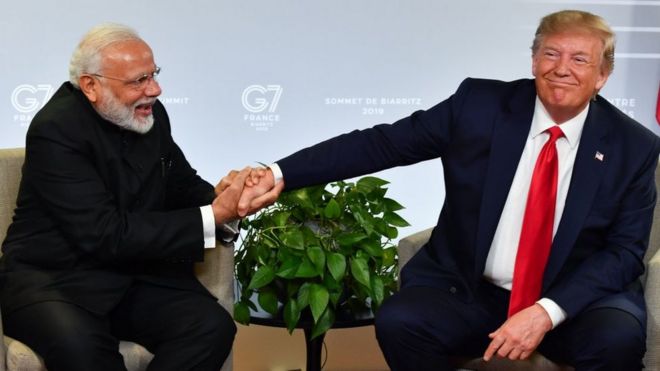
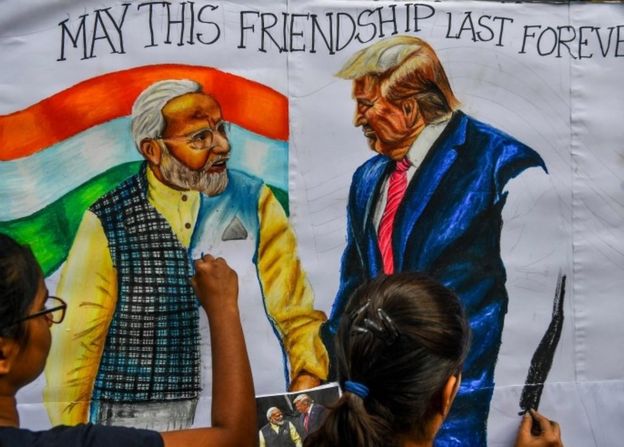
Image copyright GETTY IMAGESImage caption Mr Trump is making his first official visit to India
US President Donald Trump is expecting a raucous welcome on his first official state visit to India on Monday and Tuesday.
He follows a long line of leaders who have made the journey. Some of his predecessors were greeted enthusiastically; others stumbled through diplomatic gaffes; one even had a village named after him.
Can history be a guide to how this diplomatic tryst might go? Here’s a brief look at past visits, ranked in order of how they went.
The good: President Eisenhower
Let’s begin at the beginning.
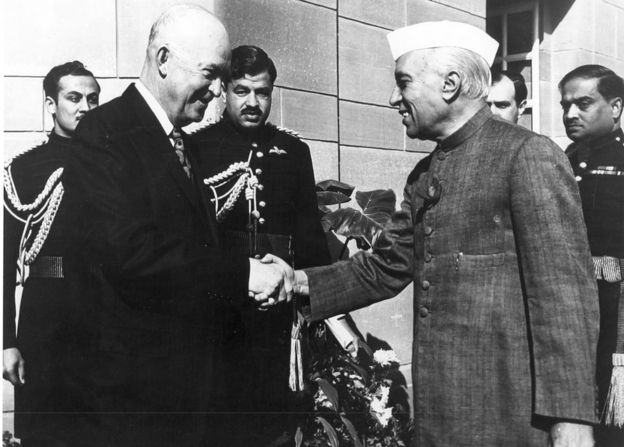
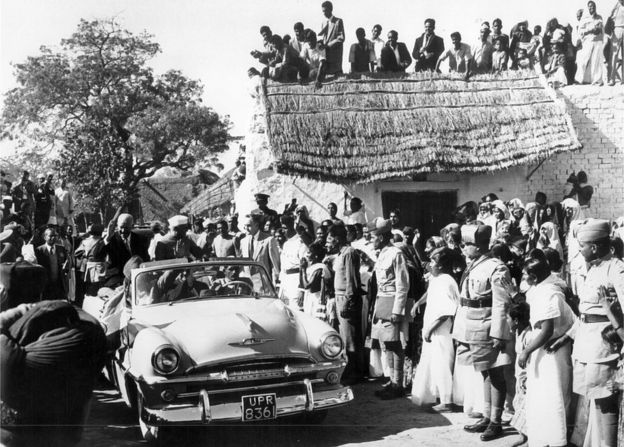
Dwight D Eisenhower, the first US president to visit India, was greeted with a 21-gun salute when he landed in the national capital, Delhi, in December 1959. Huge crowds lined the streets to catch a glimpse of the World War Two hero in his open-top car – Mr Trump is expecting a similar reception in Ahmedabad city, where he will be doing a road show.
Image copyright US EMBASSY ARCHIVESImage caption Dwight D Eisenhower, pictured with Prime Minister Jawaharlal Nehru, was the first US president to make the trip
The warmth between President Eisenhower and Indian Prime Minister Jawaharlal Nehru helped during what was a rocky phase in US-India ties. This was early in the Cold war, when the US and Pakistan had become become close allies, and India insisted on staying neutral or “non-aligned”. Like today, relations with China were at the core of the India-US equation, with Washington pressuring Delhi to take an aggressive stance with Beijing on the issue of Tibet.
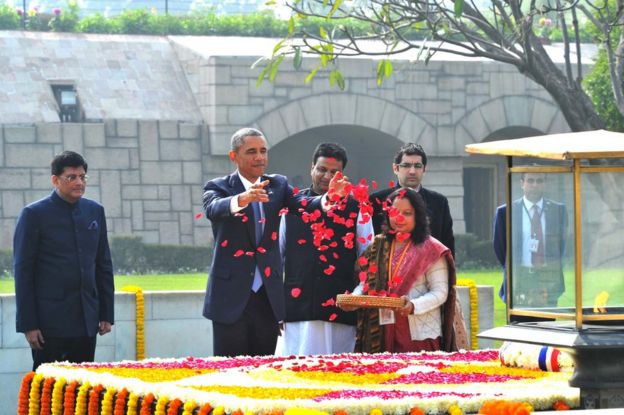
But, on the whole, Eisenhower’s four-day trip was billed a success. And nearly every US president on a state visit to India has emulated his itinerary: he laid flowers at Mahatma Gandhi’s memorial, took in the splendour of the Taj Mahal, addressed parliament and spoke at Delhi’s iconic Ramlila grounds, which, according to one news report, attracted one million people.
When he left, Nehru said he had taken with him “a piece of our heart”.
Image copyright US EMBASSY ARCHIVESImage caption President Eisenhower was greeted by large crowdsThe game-changer: Bill Clinton
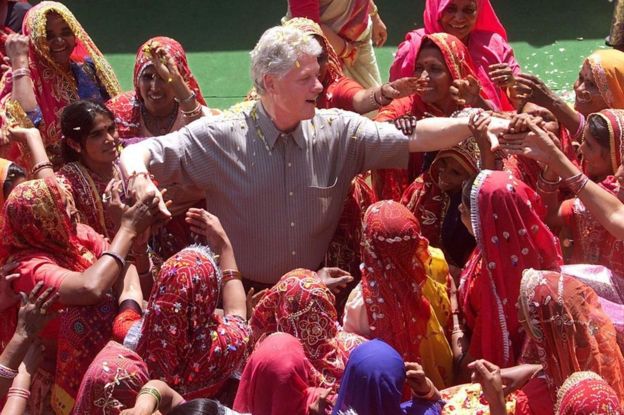
If there was a game-changing visit, it would be Bill Clinton’s in March 2000 with Prime Minister Atal Bihari Vajpayee. Mr Clinton’s arrival came after a two-decade lull – neither Ronald Reagan nor George Bush Snr made the journey East. It came at a tricky time as Washington had imposed sanctions on Delhi following its 1999 test of a nuclear bomb.
But, according to Navtej Sarna, a former Indian Ambassador to the US, the five-day trip was “a joyous visit”. It included stops in Hyderabad, a southern city that was emerging as a tech hub, and Mumbai, India’s financial capital. “He came and saw the economic and cyber potential of India, and democracy in action,” says Mr Sarna.
Image copyright GETTY IMAGESImage caption Bill Clinton’s visit was described as “joyous”Mr Clinton also danced with villagers, took a tiger safari and sampled Delhi’s famously creamy black dal (lentils) at a luxury hotel that has since been associated with the president.
The country’s reaction is perhaps best expressed in this New York Times headline: “Clinton fever – a delighted India has all the symptoms.”
The nuclear deal: George W Bush
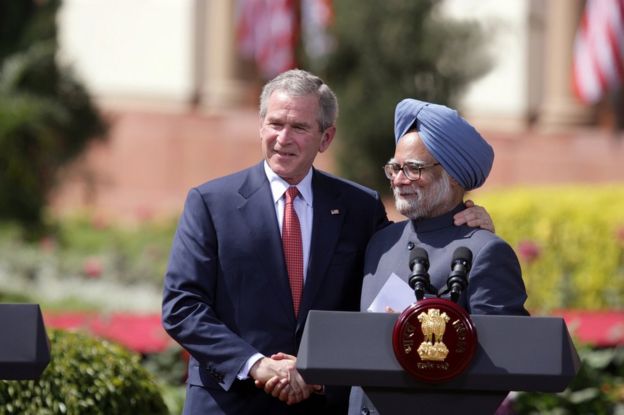
George W Bush, as Forbes magazine once put it, was the “best US president India’s ever had”. His three-day visit in March 2006 was a highlight in the two countries’ strategic relationship – especially in matters of trade and nuclear technology, subjects they have long wrangled over. His strong personal dynamic with Prime Minister Manmohan Singh was hard to miss – after he left office, Mr Bush, a keen artist, even painted a portrait of Mr Singh.
The two leaders are credited for a historic but controversial nuclear deal, which was signed during Mr Bush’s visit. It brought India, which had for decades refused to sign the Nuclear Non-Proliferation Treaty (NPT), out of isolation. Energy-hungry India got access to US civil nuclear technology in exchange for opening its nuclear facilities to inspection.
Image copyright US EMBASSY ARCHIVESImage caption George W Bush and Manmohan Singh had a very good relationshipHowever, while the visit was substantive, it was not as spectacular as others – there was no trip to the Taj, nor an address to parliament. But the timing was important. Anti-US sentiment over the invasion of Iraq was running high – left-wing MPs had staged a protest against Mr Bush’s visit, and there were demonstrations in other parts of India.
Double visit: Barack Obama
Barack Obama was the only president to make two official visits. First, in 2010 with Prime Minister Manmohan Singh, and then in 2015 with Prime Minister Narendra Modi.
On his first visit – in a break from the past – he landed in Mumbai, instead of Delhi, with a large trade delegation. This was not just about economic ties but a show of solidarity following the Mumbai terror attacks of 2008, which killed 166 people. Mr and Mrs Obama even stayed at the Taj Mahal hotel, one of the main targets.
It was significant that the US president declared support for India to join a reformed and expanded UN Security Council, says Alyssa Ayres, a former US deputy assistant secretary of state for South Asia. “That all these years later nothing has changed in the UN system is another matter, but that was a major policy shift for the United States.”
Image copyright US EMBASSY ARCHIVESImage caption Barack Obama visited India twiceMr Obama returned in 2015 as chief guest at India’s Republic Day celebrations, at PM Modi’s invitation. Trade, defence and climate change were at the heart of the talks. The trip also emphasised an Indo-Pacific strategy, where both leaders expressed unease over Beijing’s provocations in the South China Sea.
The not-so-good: Jimmy Carter
Although Jimmy Carter’s two-day visit in 1978 was a thaw in India-US relations, it was not free of hiccups.
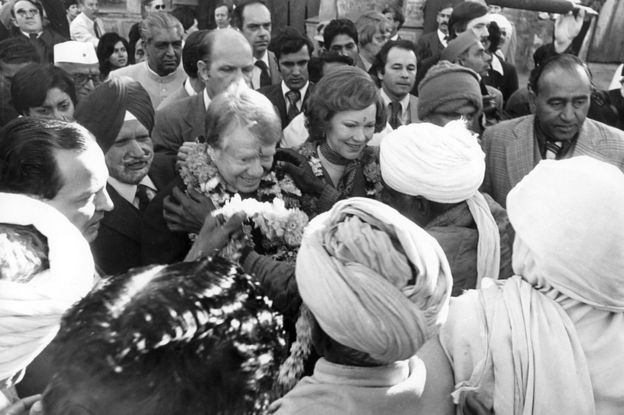
With some 500 reporters in tow, Carter followed a packed itinerary: he met Prime Minister Morarji Desai, addressed a joint session of parliament, went to the Taj Mahal, and dropped by a village just outside Delhi.
The village, Chuma Kheragaon, had a personal connection: Carter’s mother, Lillian, had visited here when she was in India as a member of the Peace Corps in the late 1960s. So when Carter and his wife, Rosalynn, made the trip, they gave the village money and its first television set. It was even renamed “Carterpuri”, a moniker it still holds.
Image copyright US EMBASSY ARCHIVESImage caption Jimmy Carter being greeted by villagers of ‘Carterpuri’But beyond the photo-ops, India and the US were sparring. India was building its nuclear programme, and had conducted its first test in 1974. The US wanted India to sign the NPF, which sought to stop the spread of nuclear weapons. But India refused, saying the agreement discriminated against developing countries.
In a leaked conversation that made headlines and threatened to derail the visit, Mr Carter promised his Secretary of State, Cyrus Vance, a “very cold and very blunt” letter to Desai. The two leaders signed a declaration, promising greater global co-operation, but Carter left India without the assurances he had hoped for.
The ugly: Richard Nixon
Richard Nixon was no stranger to India when he arrived in August 1969 for a day-long state visit. He had been here as vice-president in 1953, and before that on personal trips. But, by all accounts, he wasn’t a fan.
“Nixon disliked Indians in general and despised [Prime Minister] Indira Gandhi,” according to Gary Bass, author of Blood Telegram: Nixon, Kissinger and a Forgotten Genocide. And, he adds, the feeling was said to be mutual.
This was also at the height of the Cold War, and India’s non-alignment policy “appalled” American presidents. Mr Bass says that under Gandhi, India’s neutrality had turned into a “noticeably pro-Soviet foreign policy”.
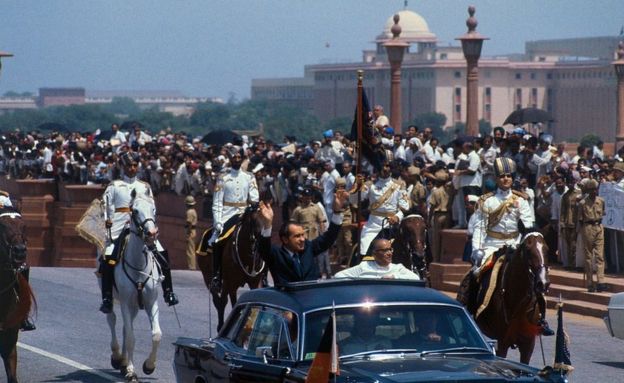
Image copyright GETTY IMAGESImage caption Richard Nixon waves to the crowds alongside Mohammad Hidyatullah, India’s acting presidentThe relationship only turned frostier after the trip as India backed Bangladesh (then East Pakistan) in its fight for independence from Pakistan, a close American ally. The differences were laid bare when Gandhi visited the White House in 1971. Declassified state department cables later revealed that Nixon referred to her as an “old witch”.
And the future: Donald Trump
The US and India have certainly had their ups and downs, but during the last official visit in 2015, Mr Obama and Mr Modi signed a declaration of friendship: “Chalein saath saath (Let’s move forward together)…” it began.
President Trump’s visit will take the relationship forward, but it’s unclear how.
Image copyright AFP
His arrival in Ahmedabad, the main city in PM Modi’s home state of Gujarat, followed by a big arena event, is expected to draw a massive crowd. It will echo President Eisenhower’s rally in Delhi years ago, perhaps cementing the personal ties between the two leaders.
But while Mr Trump’s trip will be packed with pageantry, it could be light on policy. Unlike other presidential visits, this one is not expected to yield concrete agreements, with the trade deal Mr Trump so badly wants looking unlikely.
Senior industry official Wang Shoujun predicts up to 30 reactors could be built over next decade
Calls for more financial and policy support for sector to optimise export trade
A Hualong One ZH-65 steam generator, part of China’s home-grown nuclear technology which it is hoping to export as part of its Belt and Road Initiative. Photo: Xinhua
As many as 30 nuclear reactors could be built by China over the next decade as part of the Belt and Road Initiative, a senior industry official told a meeting of the country’s top political advisory body this week.
Wang Shoujun, a standing committee member of the China People’s Political Consultative Conference, told delegates on Wednesday that China needed to take full advantage of the opportunities provided by the belt and road plan and give more financial and policy support to its nuclear sector.
China-built reactors may have advantage over foreign competitors
“‘Going out’ with nuclear power has already become a state strategy, and nuclear exports will help optimise our export trade and free up domestic high-end manufacturing capacity,” he said, according to a report on the CPPCC’s official website.
Wang said China needed to improve research and development, localise the production of key nuclear components, and grow both the domestic and foreign nuclear markets to give full play to the country’s “comprehensive advantages” in costs and technology.
Wang, also the former chairman of the state-owned China National Nuclear Corp, said nuclear projects under the belt and road plan could earn Chinese firms as much as 1 trillion yuan (US$145.52 billion) by 2030, according to more details of his speech published by BJX.com.cn, a Chinese power industry news portal.
He said 41 nations taking part in the belt and road plan already had nuclear power programmes or were planning to develop them, and China only needed to secure a 20 per cent market share to create five million new jobs in the sector, according to the news portal.
The CPPCC did not immediately respond to a request for comment.
China is in the middle of a reactor building programme which it hopes will serve as a shop window to promote its home-grown designs and technologies overseas, especially its own third-generation reactor design known as Hualong One.
But the pace of construction at home has slowed amid technological problems and delays at some key projects, as well as a suspension of new approvals that lasted more than three years.
Wang, according to BJX.com.cn, said there was overcapacity among local nuclear manufacturers, but the domestic market value for nuclear equipment could reach more than 48 billion yuan a year within two years. He did not say how much it was worth currently.
India’s cabinet approved plans on Wednesday to build 10 nuclear reactors with a combined capacity of 7,000 megawatts (MW), more than the country’s entire current capacity, to try fast-track its domestic nuclear power programme.
The decision by Prime Minister Narendra Modi’s government marks the first strategic response to the near collapse of Westinghouse, the U.S. reactor maker that had been in talks to build six of its AP1000 reactors in India.Westinghouse, owned by Japan’s Toshiba, filed for Chapter 11 bankruptcy in March after revealing billions of dollars in cost overruns at its U.S. projects, raising doubts about whether it can complete the India deal.
India has installed nuclear capacity of 6,780 MW from 22 plants and plans to add another 6,700 MW by 2021-22 through projects currently under construction. The 10 additional reactors would be the latest design of India’s Pressurised Heavy Water Reactor.
“This project will bring about substantial economies of scale and maximise cost and time efficiencies by adopting fleet mode for execution,” the government said in a statement.
“It is expected to generate more than 33,400 jobs in direct and indirect employment. With manufacturing orders to domestic industry, it will be a major step towards strengthening India’s credentials as a major nuclear manufacturing powerhouse.”
Westinghouse has said it plans to continue construction of its AP1000 plants in China and expects to bid for new plants in India and elsewhere, without elaborating on how it plans to do so.
Indian companies such as Larsen and Toubro, Kirloskar Brothers Limited and Godrej & Boyce welcomed the government’s move.
Sanjay Kirloskar, chairman of Kirloskar Brothers Limited, said: “nuclear power plants will go a long way in reducing the perennial energy deficit,” while Larsen and Toubro’s director S.N. Roy called the move “bold and historic.”
Prime Minister Narendra Modi headed to Japan on Thursday to seal a landmark nuclear energy pact and strengthen ties, as China’s regional influence grows and Donald Trump’s election throws U.S. policies across Asia into doubt.
India, Japan and the United States have been building security ties and holding three-way naval exercises, but Trump’s “America First” campaign promise has stirred concern about a reduced U.S. engagement in the region.
Such an approach by Washington could draw Modi and his Japanese counterpart Shinzo Abe even closer, said foreign policy commentator and former Indian ambassador M.K. Bhadrakumar.
Officials in New Delhi and Tokyo said a deal that will allow Japan to supply nuclear reactors, fuel and technology is ready for signing after six years of negotiations to find a way around Tokyo’s reservations about such an agreement with a country that has not signed the nuclear Non-Proliferation Treaty (NPT).
India says the NPT is discriminatory and it has concerns about nuclear-armed China as well as its long-time rival Pakistan.
Japan, the only country to have suffered a nuclear attack, has been seeking assurances from New Delhi that it would not conduct nuclear tests any more.
Indian foreign ministry spokesman Vikas Swarup said the two sides had reached a broad agreement on nuclear collaboration as early as last December and had since been trying to finalise the document.
A “legal, technical scrub” of the agreed text has now been done, he said, but added that he could not pre-judge the outcome of Modi’s summit talks with Abe over Friday and Saturday.
A Japanese ruling party lawmaker said the two sides will sign an agreement during Modi’s visit. A Japanese foreign ministry spokesman declined to comment.
JAPANESE AIRCRAFT ALSO DISCUSSED
The nuclear agreement with Japan follows a similar one with the United States in 2008 which gave India access to nuclear technology after decades of isolation.
That step was seen as the first big move to build India into a regional counterweight to China.
India hopes to lift ties with the United States to a new height, Modi said in a message to U.S. President-elect Donald Trump on Tuesday.
A final deal with Japan could also benefit U.S. firms.
India is in advanced negotiations with U.S.-based Westinghouse Electric, owned by Japan’s Toshiba, to build six nuclear reactors in southern India, part of New Delhi’s plan to ramp up nuclear capacity more than ten times by 2032.
“Japan is keen to put aside it’s staunch non-proliferation principles and engage with the lucrative Indian programme,” said Manpreet Sethi, nuclear affairs expert at the Centre for Air Power Studies, a New Delhi think-tank.
But the agreement will still have to be ratified by the Japanese parliament, she said.
Japan’s Yomiuri newspaper said the main accord will likely be accompanied by a separate document stipulating that Tokyo will suspend nuclear cooperation if India conducts a nuclear test. Initially, Japan wanted that inserted into the agreement itself, but India resisted, it said.India has declared a moratorium on such testing since its last explosions in 1998.
The two countries have also been trying to close a deal on the supply of amphibious rescue aircraft US-2 to the Indian navy, which would be one of Japan’s first sales of military equipment since Abe lifted a 50-year ban on arms exports.
India’s Defence Acquisitions Council met earlier this week to consider the purchase of 12 of the planes made by ShinMaywa Industries, but failed to reach a decision.
An Indian government source said opinion within the military was divided over whether to buy the aircraft when it was struggling to find resources to replace ageing and accident-prone submarines and address a shortage of helicopters.
A Japanese defence source said Japan was considering a cost reduction, which would mean a price cut for India as well as for the Japanese navy which it supplies. A US-2 currently costs about 13 billion yen ($123 million).
UPON learning (via a terse government statement) that their bustling port city in eastern China had been tipped as the likely site of a plant to recycle used nuclear fuel, residents of Lianyungang took to the streets last month in their thousands. Police, whose warnings against demonstrations were ignored, deployed with riot gear in large numbers but only scuffled with the protesters, who rallied, chanted and waved banners in the city centre for several days. “No one consulted us about this,” says one woman who participated in the protests. “We love our city. We have very little pollution and we don’t want a nuclear-fuel plant anywhere near us. The government says it is totally safe, but how can they be sure? How can we believe them?” she asks.
Such scepticism is shared by many in Lianyungang, which already hosts a nuclear-power plant (pictured), and elsewhere in China, where the government plans to expand nuclear power massively. China started its first nuclear plant in 1994. There are now 36 reactors in operation, and another 20 under construction (see map). A further four have been approved, and many more are in the planning stages. Only one new plant has been built in America, in contrast, since 1994; four more are under construction. By 2030 China is projected to get 9% of its power from nuclear, up from 2% in 2012. In absolute terms, its nuclear generation capacity will have increased eightfold over the same period, to 750 billion kilowatt-hours a year, roughly America’s current level.
After disaster struck Japan’s Fukushima nuclear power station in 2011, the Chinese authorities briefly halted this pell-mell rush toward the nuclear future, announcing a moratorium on the construction of new plants, urgent safety checks on existing ones and a prolonged policy review to decide whether nuclear power would remain a part of China’s energy strategy. The following year, however, the government resolved to carry on with its nuclear-energy programme.
The need is clear. Despite slowing economic growth, energy consumption per person is projected to rise dramatically, with no plateau in sight before 2030. Pollution from coal-fired power plants, China’s main source of electricity, causes widespread respiratory disease and many premature deaths each year, a source of persistent public anger. China has also made ambitious promises to reduce greenhouse-gas emissions. If it hopes to meet such targets, it will need to embrace nuclear, “because the only other truly reliable 24/7 source of electric power is coal,” says Zha Daojiong of Peking University.China’s utilities are also keen. The state-owned firms that run all the country’s nuclear plants are thought to earn a good return on their investment (their accounts are too murky to be certain), in part because their official backing allows them to finance new reactors very cheaply, and in part because regulators have fixed power tariffs in a favourable manner. One estimate put the return on nuclear assets between 2002 and 2012 at 7% a year, compared with 3% for coal- and gas-fired plants.
China even harbours ambitions to export its growing expertise in nuclear power. After relying first on Russian designs, and more recently importing American and French ones, China has also developed indigenous nuclear reactors. A recently approved deal with Britain, valued at $23 billion, will see China help finance a French-designed nuclear-power station and possibly build one of its own design later.
But China’s nuclear push has its critics. These include those who live near proposed nuclear facilities. Many, like the protesters in Lianyungang, are happy to have the power they need to run their air-conditioners but want to keep the unpleasant parts of the operation far from their doorsteps. Chinese now has a word for NIMBY: linbi, a fusion of the words for “adjacent” and “shun”. The government has repeatedly backed down in the face of public demonstrations, twice agreeing to relocate a uranium-enrichment plant, for example. It has also put the decision about the reprocessing plant in Lianyungang on hold.
Yet attitudes to nuclear power may be less hostile than in many Western countries. A study published in 2013 found an even split between supporters and opponents of expanding China’s nuclear-power industry. Compared with their counterparts in the rich world, Chinese citizens showed much greater “trust and confidence in the government” as the manager of nuclear policy and operations, the emergency responder in case of accidents and the provider of reliable information about the industry. The lead researcher for that study, He Guizhen of the Chinese Academy of Sciences, says that even protesters like those in Lianyungang are not implacably opposed. “Their message is not really that you can’t build these things no matter what, but that we are concerned about safety, especially after Fukushima, and we demand that you take safety seriously,” she says.
It appears this message is getting through. Early this year the government acknowledged in a white paper that its system for responding to a nuclear accident had “certain inadequacies”. In April officials revealed plans to draft a national nuclear-safety law. In May officials announced 600m yuan ($91m) in funding for six new nuclear-emergency squads, which would be ready for action by 2018. In August—on the same day that protesters marched in Lianyungang—China conducted its first “comprehensive nuclear-security emergency drill”. This week the government said officials must consult locals before settling the location of new nuclear facilities.
Deborah Seligsohn of the University of California, San Diego, says that because China’s nuclear-power industry is centrally run and limited to a handful of companies, authorities are able to keep tight control over safety standards, and that they have not hesitated to slow projects down when seeing signs of strain. Supervision, however, falls to several different agencies and levels of the bureaucracy. The burden of inspecting and managing the growing number of plants, she says, could be better handled by a more independent regulator in charge of its own budget.
In July China Energy News, a newspaper, reported that “quality problems” with domestically manufactured pump-valves were forcing some plants to shut down unexpectedly. (Most plants have since switched to imported valves.) More alarmingly, regulators this month revealed that a radiation-monitoring system at the Daya Bay nuclear-power station, which is within 50km of the huge cities of Shenzhen and Hong Kong, had been turned off inadvertently for three months before anyone noticed. Since no radiation leaked, the government deemed the oversight an event of “no safety significance”—one of several such lapses this year. The residents of Shenzhen and Hong Kong, presumably, would not see it in quite the same way.
Prime Minister Theresa May said on Sunday she wanted her security advisers to review a delayed nuclear power investment from China – a source of diplomatic tension – as she arrived in the country to attend a G20 summit.
May upset Chinese officials in July by delaying a $24 billion project that would see French firm EDF (EDF.PA) build Britain’s first new nuclear power plant in decades with the help of $8 billion from China.
Speaking during her first visit to China, May was asked whether she would ask the National Security Council, a team of ministers supported by intelligence officers, to look at the potential security implications of the Hinkley deal.
“I will be doing exactly as you’ve said,” May replied, saying it would be part of her decision-making process. The comment marked the first official acknowledgement that national security was a factor in her decision.
The initial delay caught investors by surprise and has cast doubt over whether May, who took office in July following Britain’s vote to leave the European Union, will continue to court China as a major source of infrastructure investment.
“This is the way I operate,” May earlier told reporters en route to the summit, which will include a one-to-one with Chinese PresidentXi Jinping.
“I look at the evidence, …take the advice and consider that and come to my decision.
“A final decision is expected later this month.
May, a former interior minister, is wary of the risks of allowing China to invest in nuclear projects, according to a former cabinet colleague. The EDF deal is viewed as a precursor to Chinese involvement in another two nuclear plants.
Asked whether she trusted China, May said: “Of course we have a relationship with them… What I want to do is build on that relationship.
“She also stressed a need to broaden the group of nations that Britain can trade with and tap for cash to help reinvigorate its power, transport and technology infrastructure.”This is the G20, this is about talking to a number of world leaders. I’m going to give the message that Britain is very much open for business… I want to be talking about the opportunities for free trade around the world.”
China is leading opposition to a push by the United States and other major powers for India to join the main club of countries controlling access to sensitive nuclear technology, diplomats said on Thursday as the group discussed India’s membership bid.
Other countries opposing Indian membership of the Nuclear Suppliers Group (NSG) include New Zealand, Ireland, Turkey, South Africa and Austria, diplomats said.
The 48-nation NSG aims to prevent the proliferation of nuclear weapons by restricting the sale of items that can be used to make those arms.
India already enjoys most of the benefits of membership under a 2008 exemption to NSG rules granted to support its nuclear cooperation deal with Washington, even though India has developed atomic weapons and never signed the nuclear Non-Proliferation Treaty (NPT), the main global arms control pact.
Opponents argue that granting it membership would further undermine efforts to prevent proliferation. It would also infuriate India’s rival Pakistan, which responded to India’s membership bid with one of its own and has the backing of its close ally China.
“By bringing India on board, it’s a slap in the face of the entire non-proliferation regime,” a diplomatic source from one of a handful of countries resisting India’s push said on condition of anonymity.
A decision on Indian membership is not expected before an NSG plenary meeting in Seoul on June 20, but diplomats said Washington had been pressuring hold-outs, and Thursday’s closed-door meeting was a chance to see how strong opposition is.U.S. Secretary of State John Kerry wrote to members asking them “not to block consensus on Indian admission to the NSG” in a letter seen by Reuters and dated Friday.
China, however, showed no sign of backing down from its opposition to India joining unless Pakistan becomes a member. That would be unacceptable to many, given Pakistan’s track record — the father of its nuclear weapons program sold nuclear secrets to countries including North Korea and Iran.
“China, if anything, is hardening (its position),” another diplomat said.
Most of the hold-outs oppose the idea of admitting a non-NPT state such as India and argue that if it is to be admitted, it should be under criteria that apply equally to all states rather than under a “tailor-made” solution for a U.S. ally.
Mexico’s president said on Wednesday his country supports India’s membership bid, but one Vienna-based diplomat said it still opposed the idea of it joining under conditions that did not apply equally to all.





 CHINDIA ALERT: You'll be living in their world, very soon