Archive for ‘carbon emission’

26/04/2014

China’s Pollution Police Are Watching – Businessweek

At 7 a.m. on a recent March morning, Xu Xiaoshun hops behind the wheel and turns the key. His Chang’an Leopard truck puffs out some black smoke and shivers to life as Xu begins his daily gamble. Every morning, including weekends, he leaves the one-room apartment he shares with his wife, drives almost 10 kilometers (six miles) to a market, picks up construction materials, and delivers them to job sites in and around Hangzhou, a city of 8.8 million. Often, his route takes him through areas of the city where his truck is banned because of its dirty emissions. “This truck isn’t allowed on some roads,” Xu says as he steps on the gas. “But when an order comes, I must take a risk.”

China's Pollution Police Are Watching

As air pollution in China becomes a national crisis—only three of the 74 cities monitored last year had acceptable air quality, according to a March report from the Ministry of Environmental Protection—Hangzhou and other cities have declared war on dirty cars and trucks. High-emission vehicles such as Xu’s must display yellow stickers on their windshields. (Cleaner cars are marked with green ones.) In Hangzhou, yellow-tagged cars and trucks are banned from the city’s main areas from 6 a.m. to midnight.

About 13 percent of China’s 224 million vehicles had yellow labels as of 2012, but they accounted for more than half of carbon monoxide emissions and more than 80 percent of airborne particulates, government statistics show. Cities across the nation must meet a national goal of forcing all yellow-label vehicles off the roads by 2017. In Hengshui, one of China’s most polluted cities, officials have mandated a phaseout of diesel-powered vehicles more than nine years old, triggering grumblings from owners in online forums.

via China’s Pollution Police Are Watching – Businessweek.

Enhanced by Zemanta
16/04/2014

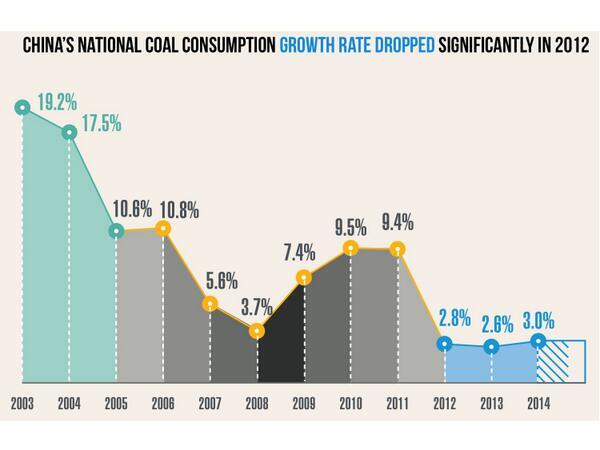
A Green Group Sees Hope in ‘The End of China’s Coal Boom’ – NYTimes.com – NYTimes.com

A report from Greenpeace charts slowing growth in China’s coal use.

Through much of its history, Greenpeace has been big on what I call “woe is me, shame on you” messaging on the environment. As I explained at a TEDx event in Portland, Ore., over the weekend, fingerpointing (including Greenpeace’s) is appropriate in many instances, but doesn’t work well with human-driven global warming. The blame game too often ends up resembling a circular firing squad.

This is why “The End of China’s Coal Boom,” a valuable new report from Greenpeace’s East Asia office, is so refreshing and worth exploring. I was led to it by a Twitter item from the group’s outgoing director, Phil Radford, that focused on a telling graphic:

View image on Twitter

via A Green Group Sees Hope in ‘The End of China’s Coal Boom’ – NYTimes.com – NYTimes.com.

Enhanced by Zemanta
26/03/2014

China’s Hangzhou latest city to restrict car sales | Reuters

China’s eastern city of Hangzhou will start restricting car sales from Wednesday, joining major cities, including Shanghai and Beijing, in the fight against snarling traffic and heavy smog in the world’s largest automobile market.

Cars drive on the Three Ring Road amid the heavy haze in Beijing February 26, 2014. REUTERS/Jason Lee

The Hangzhou government said on Tuesday the curbs would take effect while it canvassed public opinion on details of the move.

It is proposing limiting sales to 80,000 units every 12 months, to be split evenly over that period, the government said on the city’s official website (www.hangzhou.gov.cn).

A final decision on details of the curbs will be released at the end of April, the government added.

China’s leaders have declared a “war” on pollution, as they seeks to calm public ire over water, air and soil pollution that often reaches levels experts consider hazardous.

This has seen an increasing number of Chinese cities limit sales of gasoline vehicles, a key contributor to air pollution.

The trend is pushing carmakers to shift their focus towards smaller cities and speed the development of electric vehicles, which are free from similar curbs.

The Hangzhou government said the decision aimed to tackle both pollution and traffic jams.

via China’s Hangzhou latest city to restrict car sales | Reuters.

Enhanced by Zemanta
05/03/2014

* China to ‘declare war’ on pollution, premier says | Reuters

China is to “declare war” on pollution, Premier Li Keqiang said on Wednesday at the opening of the annual meeting of parliament, with the government unveiling detailed measures to tackle what has become a hot-button social issue.

Chinese Premier Li Keqiang gives an address during a news conference with French Prime Minister Jean-Marc Ayrault (not pictured) in the Great Hall of the People in Beijing December 6, 2013 file photo. REUTERS/Mark Ralston/Pool

It is not uncommon for air pollution in parts of China to breach levels considered by some experts to be hazardous. That has drawn much public ire and is a worry for the government, which fears any discontent that might compromise stability.

“We will resolutely declare war against pollution as we declared war against poverty,” Li told the almost 3,000 delegates to the country’s largely rubber-stamp legislature in a wide-ranging address carried live on state television.

Curbing pollution has become a key part of efforts to upgrade the economy, shift the focus away from heavy industry and tackle the perennial problem of overcapacity, with Li describing smog as “nature’s red-light warning against inefficient and blind development”.

“This is an acknowledgement at the highest level that there is a crisis,” said Craig Hart, expert on Chinese environmental policy and associate professor at China’s Renmin University.

“Their approach is going to have to be pro-economy. I think they will pump money into upgrading plants. This could be another green stimulus although it is not being packaged that way.”

China has published a series of policies and plans aimed at addressing environmental problems but it has long struggled to bring big polluting industries and growth-obsessed local governments to heel.

Li said efforts would focus first on reducing hazardous particulate matter known as PM 2.5 and PM 10 and would also be aimed at eliminating outdated energy producers and industrial plants, the source of much air pollution.

China will cut outdated steel production capacity by a total of 27 million tonnes this year, slash cement production by 42 million tonnes, and also shut down 50,000 small coal-fired furnaces across the country, Li said.

The 27 million tonnes of steel, equivalent to Italy’s production capacity, amounts to less than 2.5 percent of China’s total, and industry officials have warned that plants with another 30 million tonnes of annual output went into construction last year.

The targeted cement closures amount to less than 2 percent of last year’s total production.

The battle against pollution will also be waged via reforms in energy pricing to boost non-fossil fuel power. Li promised change in “the way energy is consumed and produced” through the development of nuclear and renewables, the deployment of smart power transmission grids, and the promotion of green and low-carbon technology.

The National Development and Reform Commission (NDRC), the country’s economic planner, said in its report that new guidelines would be issued on relocating key industries away from urban centers to help tackle smog.

via China to ‘declare war’ on pollution, premier says | Reuters.

Enhanced by Zemanta
31/01/2014

Environment: Browner, but greener | The Economist

China stands out for its greenness in a new environmental ranking

CHINA is the world’s biggest polluter, so it is no surprise that it fares poorly on some measures of pollution in a new global index of environmental performance. The shock is that it also stands out for its world-beating greenness in other areas on the same index.

The Environmental Performance Index (EPI), a joint product of America’s Yale and Columbia universities, is the latest volume in a long-running biennial ranking of 178 countries on a variety of measures of environmental performance. New this year are assessments of performance in waste-water treatment and combating climate change, as well as the clever use of satellite data (to track trends in forestry and air pollution) in order to top up traditional computer modelling and official data.

The report’s conclusions are more cheerful than most green report cards. The experts believe countries are doing well in improving access to safe drinking water and sanitation, and in bringing down child mortality. However, the global trends are worrying in other areas like fisheries, wastewater treatment and air quality. Overall, Switzerland came out top. Somalia came last. China was 118th, a middling ranking that beats India (155th) but falls well below South Africa (72nd), Russia (73rd) and Brazil (77th).

However, that average masks a huge divergence in China’s performance in two areas. Using satellite data, the boffins worked out, for the first time, what global exposures were to fine particulate matter (known as PM2.5) from 2000 to 2012. China ranked at the bottom on air pollution, with nearly all of its population exposed to levels of PM2.5 pollution deemed unhealthy by the World Health Organisation (WHO). Though less frequently criticised than Beijing, Delhi’s air is also terrible—but China as a whole fares worse. In 2012 the average human exposure to PM2.5 for all of China was 48 micrograms per cubic metre, but the national figure for India was only 32 units (the WHO says anything above 10 units is unhealthy).

The surprise is that China has done very well on carbon. The experts calculate that, unusually among big emerging economies, it slowed the rate at which its greenhouse-gas emissions have grown in the past decade. That is partly a natural result of its development, which has led to investment in better technology and cleaner industries, but it is also thanks to policies to improve efficiency and boost renewable energy.

Environmentalists the world over can breathe a little easier knowing that the biggest global polluter has started to slow the rise in its greenhouse-gas emissions and may one day even reduce them. If only China’s urban residents could breathe a little easier, too.

via Environment: Browner, but greener | The Economist.

Enhanced by Zemanta
27/01/2014

* China to Cut Dependence on Coal for Energy as Smog Chokes Cities – Bloomberg

China to Cut Dependence on Coal for Energy as Smog Chokes Cities

China plans to cut its dependence on coal as the world’s biggest carbon emitter seeks to clear smog in cities from Beijing to Shanghai.

English: Shanghai Smog

English: Shanghai Smog (Photo credit: Wikipedia)

The nation is aiming to get less than 65 percent of its energy from coal this year, according to a government plan released today. Energy use per unit of gross domestic product will decline 3.9 percent from last year, compared with 2013’s target for a 3.7 percent decrease.

The plan may help President Xi Jinping’s drive to reduce pollution as environmental deterioration threatens public health and the economy. More than 600 million people were affected by a “globally unprecedented” outbreak of smog in China that started last January and spread across dozens of provinces, the Institute of Public & Environmental Affairs based in Beijing said Jan. 14.

“China previously targeted to cut coal consumption to below 65 percent in 2017,” Helen Lau, an analyst at UOB-Kay Hian Ltd. in Hong Kong, said by phone today. “Now they have officially pulled it earlier to 2014, which reflects that they want to speed up restructuring energy consumption and are determined to reduce air pollution.”

China’s coal use accounted for 65.7 percent of its total energy consumption in 2013, the 21st Century Herald newspaper reported Jan. 13, citing an official it didn’t name.

via China to Cut Dependence on Coal for Energy as Smog Chokes Cities – Bloomberg.

Enhanced by Zemanta
16/01/2014

China’s Hebei closes more than 8,000 polluting firms in 2013 | Reuters

China shut down 8,347 heavily polluting companies last year in northern Hebei province, which has the worst air in the country, state news agency Xinhua said on Thursday, as the government moves to tackle a problem that has been a source of discontent.

Residents ride bicycles along a street amid heavy haze in Xingtai, Hebei province November 3, 2013. Dense smog has periodically shrouded major cities in north and northeast China in recent years, raising increasing public discontent, Xinhua News Agency reported. REUTERS/China Daily

Local authorities will block new projects and punish officials in regions where pollution is severe due to lax enforcement, Xinhua cited Yang Zhiming, deputy director of the Hebei provincial bureau of environmental protection, as saying.

High pollution levels have sparked widespread public anger and officials concerned about social unrest have responded by implementing tougher policies.

Hebei, the country\’s biggest steel producer, is home to as many as seven of its 10 most polluted cities, Xinhua said, citing statistics published monthly by the Ministry of Environmental Protection.

Pollution in Hebei often spreads to neighboring Beijing and Tianjin. On Thursday, Beijing was blanketed in its worst smog in months. An index measuring PM2.5 particles, especially bad for health, reached 500 in much of the capital in the early hours.

Some small high-polluting plants are being relocated to remote areas to avoid oversight, Xinhua quoted Yang as saying. He said the government would \”beef up the industrial crackdown\”.

China has drawn up dozens of laws and guidelines to improve the environment but has struggled to enforce them in the face of powerful enterprises.

via China’s Hebei closes more than 8,000 polluting firms in 2013 | Reuters.

Enhanced by Zemanta
09/01/2014

* China sets targets for curbing air pollution | Reuters

China has set new targets for its provinces to reduce air pollution by 5 to 25 percent, state media said late on Tuesday, underscoring the government\’s concern about a source of public anger.

English: Air pollution

English: Air pollution (Photo credit: Wikipedia)

China regularly issues directives to try to tackle air pollution in major cities, but these have had limited effect.

Former health minister Chen Zhu said air pollution in the country causes premature deaths of 350,000 to 500,000 people yearly, state media reported on Tuesday. Chen wrote the article in a December issue of the Lancet medical journal.

Air quality in large parts of northern and southern China reached unhealthy levels on Tuesday.

Under the new regulations, Beijing, its neighboring city of Tianjin and northern Hebei province will have to cut the amount of PM 2.5 particles, which are especially bad for health, by 25 percent annually, state news agency Xinhua said, citing the ministry of environmental protection.

China\’s commercial capital, Shanghai, the eastern provinces of Jiangsu, Zhejiang, Shandong and northern Shanxi will have to impose cuts of 20 percent. Reductions of 15 percent were set for Guangdong and Chongqing and 10 percent for the Inner Mongolia Autonomous Region, Xinhua said.

The State Council, or cabinet, is mulling a system to evaluate each local government\’s progress and those who fail to reach goals will be \”named and shamed\”, said the China Daily newspaper.

Air quality in cities is of increasing concern to China\’s stability-obsessed leaders, anxious to douse potential unrest as a more affluent urban population turns against a growth-at-all-costs economic model that has poisoned much of the country\’s air, water and soil.

Authorities have invested in various projects to fight pollution and empowered courts to mete out the death penalty in serious cases.

via China sets targets for curbing air pollution | Reuters.

Enhanced by Zemanta
30/12/2013

Opportunity glimmers through China’s toxic smog | Reuters

As China\’s smog levels crept past record highs in early December, the phone lines at pollution-busting kit maker Broad Group lit up with Chinese customers worried about hazardous pollution levels that have gripped China this year.

The financial district of Pudong is seen on a hazy day in Shanghai, in this file picture taken January 21, 2013. China's government is struggling to meet pollution reduction targets and has pledged to spend over 3 trillion yuan ($494 billion) to tackle the problem, creating a growing market for companies that can help boost energy efficiency and lower emissions. REUTERS-Aly Song-Files

China\’s government is struggling to meet pollution reduction targets and has pledged to spend over 3 trillion yuan ($494 billion) to tackle the problem, creating a growing market for companies that can help boost energy efficiency and lower emissions.

\”Recently, we haven\’t been able to make products fast enough to keep up with demand,\” said Hu Jie, a general manager at Broad Group, which makes pollution-related products ranging from hand-held monitors to eco-friendly buildings. Sales roughly doubled this year from 2012, Hu said, without giving details.

Pollution problems in China, the world\’s second-biggest economy, are by no means new. But heightened public anger – and a growing political will to deal with the issue – has created opportunities for firms with sustainable know-how to earn a slice of China\’s clean-technology market, which is set to triple to $555 billion by 2020, according to the U.S. Department of Commerce.

Companies like U.S. clean-energy expert Fuel Tech Inc, design engineer WS Atkins Plc and others have seized the opening by boosting staff numbers and clinching contracts.

\”China has reached a saturation level which people can no longer tolerate,\” said Feng An, president and executive director of the U.S.-China Clean Tech Center, which takes U.S. clean technology companies to China to meet potential partners.

\”Five years ago people could pollute and get away with it. Now they can\’t. This year you can really see the difference.\”

THE COST OF SMOG

Pollution cost China\’s economy at least 1.1 trillion yuan ($181 billion) in 2010, the environment ministry estimated this year – equal to 2.5 percent of GDP that year. Pollution has been tied to \”cancer villages\” and reduced life-expectancy. Smog even closed down the major northern city of Harbin in October.

Acknowledging public anxiety over the issue, Premier Li Keqiang said in March that China should not sacrifice the environment to pursue economic growth, giving a boost to \”green\” companies.

U.S. environmental engineering company LP Amina, which helps coal power plants reduce emissions by retrofitting burners to make them more efficient, saw its China sales double this year, said the firm\’s marketing manager Jamyan Dudka, without providing specific figures. Coal accounts for more than two-thirds of China\’s primary energy consumption.

China is pushing to reduce nitrogen oxide (NOx) pollutants from power plant emissions and offering subsidies to get firms on board. The cost of retrofitting all China\’s power plants over a 5-year period is around $11 billion, said Dudka.

U.S.-listed Fuel Tech, which also focuses in this area, sees China at the forefront of its business development plans, and has increased its China-based staff to more than 30 people, CEO Doug Bailey said on an analyst call last month.

GREEN BUILDING

Companies such as UK-listed Atkins and Australian developer Lend Lease Corp Ltd are also leveraging their global expertise in sustainable construction.

Atkins is working with local governments to develop sustainable construction guidelines and will partner with two Chinese cities to put them into action. China\’s contribution to the company\’s 88 million pounds ($144.6 million) in Asia-Pacific revenues increased to 40 percent this year, it said. The region accounts for around 5 percent of global sales.

via Opportunity glimmers through China’s toxic smog | Reuters.

28/12/2013

China targets cement, batteries, metals in anti-pollution push | Reuters

China will raise standards for the production of cement, batteries, leather and heavy metals as part of its efforts to cut air, water and soil pollution, the environment ministry said on Friday.

The sun is seen behind smoke billowing from a chimney of a heating plant in Taiyuan, Shanxi province December 9, 2013. REUTERS/Stringer

Beijing, facing growing public anger over smog, contaminated food and unclean water, has said it will tackle the environmental costs of more than three decades of unbridled growth.

It has promised to get tough with under-regulated industries such as cement, iron and steel and coal but the central government has traditionally struggled to impose its will on powerful industrial sectors and local governments.

via China targets cement, batteries, metals in anti-pollution push | Reuters.

Law of Unintended Consequences

continuously updated blog about China & India

ChiaHou's Book Reviews

continuously updated blog about China & India

What's wrong with the world; and its economy

continuously updated blog about China & India