Archive for ‘Environment’

08/05/2014

A Silver Lining in Beijing Smog: Soaring Pollution Penalty Revenues – Businessweek

Looking for a silver lining in Beijing’s gray smog? The city’s environmental protection bureau says fees collected from polluters are soaring, already totaling 88 million yuan ($14 million) this year. That’s way up from 8.34 million yuan in penalties levied over the same period last year, according to the China Daily.

Tiananmen Square during severe pollution on Feb. 25 in Beijing

The surge in penalties isn’t because the smog’s been worse. In January, the fines went up more than 10-fold for major pollutants, including sulfur dioxide, nitrogen dioxide, and ammonia nitrogen.

The higher fees are already helping encourage companies to retire some of their worst habits. “Many companies used to ignore the old discharge fee because it was simply too insignificant,” said Zhong Chonglei, head of the Beijing Environmental Monitoring Team, at a press conference on May 6. “The increased fee has made many companies realize the importance of emission reduction.”

via A Silver Lining in Beijing Smog: Soaring Pollution Penalty Revenues – Businessweek.

Enhanced by Zemanta
26/04/2014

China’s Pollution Police Are Watching – Businessweek

At 7 a.m. on a recent March morning, Xu Xiaoshun hops behind the wheel and turns the key. His Chang’an Leopard truck puffs out some black smoke and shivers to life as Xu begins his daily gamble. Every morning, including weekends, he leaves the one-room apartment he shares with his wife, drives almost 10 kilometers (six miles) to a market, picks up construction materials, and delivers them to job sites in and around Hangzhou, a city of 8.8 million. Often, his route takes him through areas of the city where his truck is banned because of its dirty emissions. “This truck isn’t allowed on some roads,” Xu says as he steps on the gas. “But when an order comes, I must take a risk.”

China's Pollution Police Are Watching

As air pollution in China becomes a national crisis—only three of the 74 cities monitored last year had acceptable air quality, according to a March report from the Ministry of Environmental Protection—Hangzhou and other cities have declared war on dirty cars and trucks. High-emission vehicles such as Xu’s must display yellow stickers on their windshields. (Cleaner cars are marked with green ones.) In Hangzhou, yellow-tagged cars and trucks are banned from the city’s main areas from 6 a.m. to midnight.

About 13 percent of China’s 224 million vehicles had yellow labels as of 2012, but they accounted for more than half of carbon monoxide emissions and more than 80 percent of airborne particulates, government statistics show. Cities across the nation must meet a national goal of forcing all yellow-label vehicles off the roads by 2017. In Hengshui, one of China’s most polluted cities, officials have mandated a phaseout of diesel-powered vehicles more than nine years old, triggering grumblings from owners in online forums.

via China’s Pollution Police Are Watching – Businessweek.

Enhanced by Zemanta
26/04/2014

Government Study Finds 60 Percent of China’s Groundwater Polluted – Businessweek

At 59.6 percent of sites monitored by the Chinese government, the groundwater quality was “very polluted” or “relatively polluted”—that is, unfit for drinking—in 2013, according to a study released on Tuesday by China’s Ministry of Land and Resources.

A polluted canal in Beijing

The government tested 4,778 sites in 203 cities. The study showed that China’s water quality had worsened somewhat from the previous year, when 57.4 percent of test sites were classified as polluted.

Groundwater supplies about a fifth of China’s total water consumption. In the water-short north and northwest of China, groundwater accounts for 50 percent to 80 percent of water usage.

via Government Study Finds 60 Percent of China’s Groundwater Polluted – Businessweek.

Enhanced by Zemanta
16/04/2014

A Green Group Sees Hope in ‘The End of China’s Coal Boom’ – NYTimes.com – NYTimes.com

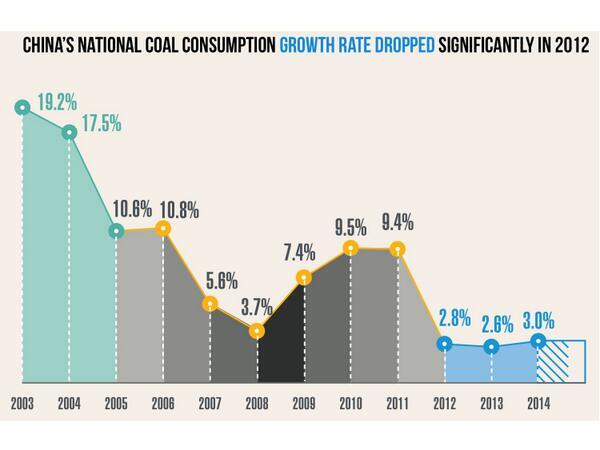
A report from Greenpeace charts slowing growth in China’s coal use.

Through much of its history, Greenpeace has been big on what I call “woe is me, shame on you” messaging on the environment. As I explained at a TEDx event in Portland, Ore., over the weekend, fingerpointing (including Greenpeace’s) is appropriate in many instances, but doesn’t work well with human-driven global warming. The blame game too often ends up resembling a circular firing squad.

This is why “The End of China’s Coal Boom,” a valuable new report from Greenpeace’s East Asia office, is so refreshing and worth exploring. I was led to it by a Twitter item from the group’s outgoing director, Phil Radford, that focused on a telling graphic:

View image on Twitter

via A Green Group Sees Hope in ‘The End of China’s Coal Boom’ – NYTimes.com – NYTimes.com.

Enhanced by Zemanta
08/04/2014

Growth Not Good Enough: Chinese City Changes the Rules – China Real Time Report – WSJ

Fast growth is no longer the fast track on the official career path.  At least that’s what the city of Shenyang is trying to tell its Communist Party cadres.

According to the People’s Daily, the Shenyang government is changing its rating system for officials, lowering the scores for economic development and GDP growth while adding points for “reform and innovation” and  environmental protection (in Chinese).

Shenyang, the capital of Liaoning province and the largest city in northeastern China, used to be the home of the nation’s iron and steel industry and was best known for its forest of smokestacks and chimneys. Now the city is hoping to reduce its dependence on heavy industry and erase its reputation for soot and smog.

The newspaper said that “food and drug safety” and “public health and safety” will be added to improving people’s livelihood, increasing employment and ensuring housing security in the calculations of which officials get promoted – and which fall behind.

An official at the municipal government confirmed that the change had been made though he was unable to provide further details on the actual scoring system.

China’s Communist Party chief Xi Jinping said in November last year that China could no longer “choose its heroes according to economic growth records alone.” Improvements in daily life, social progress, environmental protection and other indicators all had to be taken into account, he added.

Premier Li Keqiang, speaking at the annual session of parliament in March, also tried to address mounting public concerns over the pollution that has accompanied economic growth by saying that China was no longer chasing fast growth at any price. He said employment was now the government’s top concern.

Chen Haibo, mayor of Shenyang, has echoed those sentiments.

“The threshold for environmental protection will be much higher this year,” he said at a meeting of the local legislature early this year.

The mayor also noted that Shenyang’s economic growth target would be 9% this year – its lowest level in over a decade. Last year, growth in Shenyang came in at 10%, down from 11% the previous year, according to the provincial government’s official news site.

China has some of the best environmental laws on the planet, but the rewards for breaking them have long outweighed the penalties. If Shenyang follows through, and other cities follow suit, it could be very good news for China’s environment.

via Growth Not Good Enough: Chinese City Changes the Rules – China Real Time Report – WSJ.

Enhanced by Zemanta
02/04/2014

BBC News – China Maoming environmental protest violence condemned

Authorities have condemned an environmental protest in southern China that turned violent, calling it “serious criminal behaviour“.

Residents ride past a burning public security kiosk during a protest against a chemical plant project, on a street in Maoming, Guangdong province, 1 April 2014

Residents in Maoming, Guangdong province, on Sunday protested against the construction of a petrochemical plant that manufactures paraxylene.

Violence broke out, with reports of several injured protesters. On Tuesday, the protests spread to Guangzhou.

Protests are rare in China, where it is illegal to protest without a permit.

Hundreds of Maoming residents marched on the streets on Sunday, protesting against the proposed plant. Some protesters said turnout was more than 1,000.

Clashes with police broke out, with reports of tear gas being fired at protesters. Photos and videos posted on Chinese social media appeared to show injured protesters, police chasing demonstrators with batons, and burning cars.

Smaller protests appeared to continue, spreading to Guangzhou, the provincial capital, on Tuesday.

via BBC News – China Maoming environmental protest violence condemned.

Enhanced by Zemanta
26/03/2014

China’s Hangzhou latest city to restrict car sales | Reuters

China’s eastern city of Hangzhou will start restricting car sales from Wednesday, joining major cities, including Shanghai and Beijing, in the fight against snarling traffic and heavy smog in the world’s largest automobile market.

Cars drive on the Three Ring Road amid the heavy haze in Beijing February 26, 2014. REUTERS/Jason Lee

The Hangzhou government said on Tuesday the curbs would take effect while it canvassed public opinion on details of the move.

It is proposing limiting sales to 80,000 units every 12 months, to be split evenly over that period, the government said on the city’s official website (www.hangzhou.gov.cn).

A final decision on details of the curbs will be released at the end of April, the government added.

China’s leaders have declared a “war” on pollution, as they seeks to calm public ire over water, air and soil pollution that often reaches levels experts consider hazardous.

This has seen an increasing number of Chinese cities limit sales of gasoline vehicles, a key contributor to air pollution.

The trend is pushing carmakers to shift their focus towards smaller cities and speed the development of electric vehicles, which are free from similar curbs.

The Hangzhou government said the decision aimed to tackle both pollution and traffic jams.

via China’s Hangzhou latest city to restrict car sales | Reuters.

Enhanced by Zemanta
21/03/2014

India’s Diesel Fuel Subsidy Breeds Toxic Air Pollution – Businessweek

Molecular biologist George Easow’s move to India to start a clinical diagnostics business lasted just three weeks before he decided to give up and return to the U.K. Within days of the family’s move to New Delhi, his 7-month-old daughter, Fiona, was wheezing and gasping for air because of smog. “She could hardly breathe,” says her father.

India's Diesel Cars Are Proving Lethal

Fiona was kept indoors and put on medication. Nothing worked. “We had to make a call,” Easow says, adding that her symptoms disappeared once they were back in the U.K. and haven’t returned. For the 16.8 million residents of India’s capital, the wheezing continues. The bad news is, it’s going to get worse.

Cities across India suffer from some of the poorest air quality in the world. The problem is so severe that it’s costing the country 1.1 trillion rupees ($18 billion) annually in the shortened life spans of productive members of the urban population, according to a June World Bank report.

STORY: Who Has Dirtier Air: China or India?

While Beijing and Shanghai air pollution caused by coal-burning factories are well known, Delhi residents suffer even more by some measures, though the main source of the smog is cars and trucks running on cheap diesel. Indian government subsidies for the fuel add up to $15 billion a year. Farmers and truckers, both big voting blocs, rely on cheap diesel.

India’s diesel-powered vehicles pump out exhaust gases with 10 times the carcinogenic particles found in gasoline exhaust. The result: Delhi’s air on average last year was laced with double the toxic particles per cubic meter reported in Beijing, leading to respiratory diseases, lung cancer, and heart attacks. “I have no doubt, 100 percent, that diesel exhaust is contributing to a rise in asthma, respiratory illnesses, and hospitalizations,” says Dr. T.K. Joshi, director of Delhi’s Centre for Occupational and Environmental Health at Maulana Azad Medical College.

via India’s Diesel Fuel Subsidy Breeds Toxic Air Pollution – Businessweek.

Enhanced by Zemanta
05/03/2014

* China to ‘declare war’ on pollution, premier says | Reuters

China is to “declare war” on pollution, Premier Li Keqiang said on Wednesday at the opening of the annual meeting of parliament, with the government unveiling detailed measures to tackle what has become a hot-button social issue.

Chinese Premier Li Keqiang gives an address during a news conference with French Prime Minister Jean-Marc Ayrault (not pictured) in the Great Hall of the People in Beijing December 6, 2013 file photo. REUTERS/Mark Ralston/Pool

It is not uncommon for air pollution in parts of China to breach levels considered by some experts to be hazardous. That has drawn much public ire and is a worry for the government, which fears any discontent that might compromise stability.

“We will resolutely declare war against pollution as we declared war against poverty,” Li told the almost 3,000 delegates to the country’s largely rubber-stamp legislature in a wide-ranging address carried live on state television.

Curbing pollution has become a key part of efforts to upgrade the economy, shift the focus away from heavy industry and tackle the perennial problem of overcapacity, with Li describing smog as “nature’s red-light warning against inefficient and blind development”.

“This is an acknowledgement at the highest level that there is a crisis,” said Craig Hart, expert on Chinese environmental policy and associate professor at China’s Renmin University.

“Their approach is going to have to be pro-economy. I think they will pump money into upgrading plants. This could be another green stimulus although it is not being packaged that way.”

China has published a series of policies and plans aimed at addressing environmental problems but it has long struggled to bring big polluting industries and growth-obsessed local governments to heel.

Li said efforts would focus first on reducing hazardous particulate matter known as PM 2.5 and PM 10 and would also be aimed at eliminating outdated energy producers and industrial plants, the source of much air pollution.

China will cut outdated steel production capacity by a total of 27 million tonnes this year, slash cement production by 42 million tonnes, and also shut down 50,000 small coal-fired furnaces across the country, Li said.

The 27 million tonnes of steel, equivalent to Italy’s production capacity, amounts to less than 2.5 percent of China’s total, and industry officials have warned that plants with another 30 million tonnes of annual output went into construction last year.

The targeted cement closures amount to less than 2 percent of last year’s total production.

The battle against pollution will also be waged via reforms in energy pricing to boost non-fossil fuel power. Li promised change in “the way energy is consumed and produced” through the development of nuclear and renewables, the deployment of smart power transmission grids, and the promotion of green and low-carbon technology.

The National Development and Reform Commission (NDRC), the country’s economic planner, said in its report that new guidelines would be issued on relocating key industries away from urban centers to help tackle smog.

via China to ‘declare war’ on pollution, premier says | Reuters.

Enhanced by Zemanta
20/02/2014

Indian govt clears plan to create new forest cover – The Hindu

Government on Thursday cleared a plan to create new forest cover and improve the quality of existing forests with an expenditure of Rs. 13,000 crore in the 12th Plan.

File photo of affrostation initiatives taken on mine-spoit lands in Salem. Government has approved Rs. 13,000 crore outlay to increase the tree cover in the nation.

Besides the two components, which are to be implemented through various measures including decentralisation of forest governance, the proposed National Mission for a Green India (GIM) as a Centrally Sponsored Scheme will also strive to achieve increased forest-based livelihood income of households living in and around the forests.

The Cabinet Committee on Economic Affairs chaired by Prime Minister Manmohan Singh on Thursday approved the proposal of the Ministry of Environment and Forests.

The objectives of the Mission during 12th Plan period includes increased forest/tree cover and improved quality of forest cover in two to eight million hectares, along with improved ecosystem services including biodiversity, hydrological services, increased forest-based livelihood income of households, living in and around the forests, and enhanced annual CO2 sequestration (process of capture and long term storage of CO2).

via Govt clears plan to create new forest cover – The Hindu.

Enhanced by Zemanta
Law of Unintended Consequences

continuously updated blog about China & India

ChiaHou's Book Reviews

continuously updated blog about China & India

What's wrong with the world; and its economy

continuously updated blog about China & India