Archive for ‘Environment’

08/06/2016

In boost to Paris climate pact, India says it aims to join this year | Reuters

India has agreed to work toward joining the Paris Agreement on climate change this year, India and the United States said on Tuesday, giving a jolt of momentum to the international fight to curb global warming.

At a time of heightened tensions in Asia over China’s assertive pursuit of territory, the two countries also pledged to expand military cooperation and outlined principles for cooperation on cyber issues.

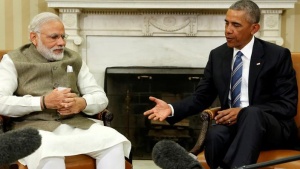
President Barack Obama welcomed Indian Prime Minister Narendra Modi to the White House for their seventh meeting since Modi took office in 2014, underscoring the warm relationship between the leaders and the world’s two largest democracies. Modi is to address the U.S. Congress on Wednesday.

“We discussed how we can, as quickly as possible, bring the Paris Agreement into force,” Obama told reporters. Climate change is a legacy issue for the U.S. president who leaves office in January.

India’s potential entrance into the agreement this year would help accelerate its enactment, perhaps years ahead of schedule. India is the world’s third-largest greenhouse gas emitter after China and the United States.

The two countries also welcomed preparations that could lead to the building of six nuclear reactors in India by U.S.-based Westinghouse, in what would be the culmination of some 10 years of work to resolve civil-nuclear issues.

The joint statement said India and the U.S. Export-Import Bank were working to complete a financing package for the project and that the Nuclear Power Corporation of India and Westinghouse had confirmed engineering and site design work would begin immediately.It said Westinghouse and the Nuclear Power Corporation of India would work toward finalizing the contract by June 2017 – a year later than Westinghouse’s chief executive, Daniel Roderick, said he hoped for in an interview with Reuters in late March.

Modi told an event organized by the U.S. India Business Council that relations between India and the United States were “closer than ever.” He said the planned reactor purchases would mark new era in nuclear and scientific cooperation.Modi’s address to a joint session of Congress will be a significant personal step. Although this has become a tradition for Indian prime ministers, he was once banned from the United States over massacres of Muslims.

More than 1,000 people, mostly Muslims, were killed in sectarian riots in Gujarat in 2002 when Modi had just become the state’s chief minister. Modi has denied any wrongdoing, and India’s Supreme Court in 2010 ruled there was no case.In the joint statement, the United States said it now recognized India as a “Major Defense Partner” and would work on technology sharing “to a level commensurate with that of its closest allies and partners.

“The text of a logistics agreement, which will allow the countries’ militaries to use each other’s land, air and naval bases, would be signed soon, a U.S. official said.

Tensions between the United States and Pakistan as well as regional concerns about China have served as a backdrop to increased security cooperation.Senator John McCain, chairman of the U.S. Senate Armed Services Committee, said the address to Congress was “entirely appropriate” given the new partnership.”

There’s no doubt there are significant tensions and challenges in the region, which argues for closer coordination between our militaries,” he said.While Modi is generally popular with U.S. lawmakers, they criticize what they see as lingering unfriendliness to U.S. firms and a stifling bureaucracy, in spite of Modi’s pro-business image. They also question New Delhi’s record on human rights.Modi got a boost on Tuesday when Amazon Inc AMZN.O Chief Executive Jeff Bezos said his company would invest an additional $3 billion in India, boosting its committed investment in the country to over $5 billion.

Source: In boost to Paris climate pact, India says it aims to join this year | Reuters
08/06/2016

This Is How Many Years Air Pollution Will Cut From Your Life Expectancy in India – India Real Time – WSJ

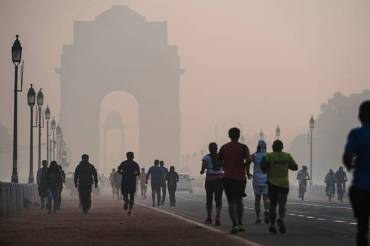
Living in India’s capital city New Delhi could shorten your life by six years because of the intensity of the air pollution there, a new report says.

Inhaling tiny air pollutants reduces the life expectancy of Indians by an average of 3.4 years, with Delhi residents losing 6.3 years, the most of all states, according to a new study by the Indian Institute of Tropical Meteorology.

Those living in West Bengal and Bihar, which have high levels of air pollution, face a reduction in life expectancy of 6.1 years and 5.7 years respectively.

The study, which used data from the latest population census of 2011, found that exposure to particulate matter 2.5 results in 570,000 premature deaths each year with an additional 12,000 caused by exposure to ozone.PM 2.5 is tiny particulate matter that is smaller than 2.5 micrometers in diameter. The air pollutants, originating from dust, soot and smoke, can penetrate deep into the lungs, increasing the risk of heart and lung diseases.

Source: This Is How Many Years Air Pollution Will Cut From Your Life Expectancy in India – India Real Time – WSJ

07/06/2016

Forest fires and logging threaten India’s progress on climate goals | Reuters

Since the end of April, fires in parts of Uttarakhand and Himachal Pradesh have destroyed or damaged 26,000 hectares of forests, and killed three people, officials say.

The forest fires, touched off by timber smugglers, poachers and farmers, have been a particular problem this year as a result of high temperatures and low rainfall, experts say.

Nationwide, the country is losing an average of a million hectares to fires each year, according to a 2014 report from the government’s National Institute of Disaster Management (NIDM).

The losses, combined with those from surging illegal logging, mean India has lost 2,511 square kilometres of dense and moderately dense forest since 2013, according to the Environment Ministry’s 2015 Forest Survey of India report.

That loss is a significant worry for a country trying to dramatically reduce its climate-changing emissions. As part of pledges made toward a new global deal to curb climate change, agreed in Paris in December, India has said it will increase its ability to store carbon in forests and land by up to 3 billion tons by 2030.

But criminal activity, extreme weather and flawed data all stand in the way of India’s quest to go greener, experts say, and the problem in Uttarakhand illustrates how hard achieving those goals may be.

Source: Forest fires and logging threaten India’s progress on climate goals | Reuters

31/05/2016

China releases new action plan to tackle soil pollution | Reuters

China aims to curb worsening soil pollution by 2020 and stabilize and improve soil quality by 2030, the cabinet said in an action plan published on Tuesday.

The central government will set up a special fund to tackle soil pollution, as well as a separate fund to help upgrade technology and equipment in the heavy metal sector, the cabinet said in a statement on its website (www.gov.cn).

The government will also continue to eliminate outdated heavy metal capacity, the cabinet said.

Last year, the environment minister said 16 percent of China’s soil exceeded state pollution limits. Treatment costs for heavy metal or chemical contamination are high, and China has struggled to attract private funds for soil remediation.

According to Reuters calculations, the cost of making all of China’s contaminated land fit for crops or livestock would be around 5 trillion yuan ($760 billion), based on average industry estimates of the cost of treating one hectare.

Analysts have estimated the soil remediation market could be worth as much as 1 trillion yuan, but authorities have struggled to determine who should pay for rehabilitating contaminated land. Much of the responsibility for the costs now lies with impoverished local governments.

Researchers with Guohai Securities said earlier this year that there are currently 100 key soil remediation projects under way in China with an estimated total cost of 500 billion yuan. With no natural profit motive to encourage private companies to get involved, the clean-up programs have relied mostly on government funding.

China’s five-year plan published in March said the country would give priority to cleaning up contaminated soil used in agriculture. It promised also to strengthen soil pollution monitoring systems and promote new clean-up technologies.

Lawmakers said during the annual session of parliament in March that the country would introduce legislation to help tackle soil pollution by next year.

Companies involved in the sector include Beijing Orient Landscape and Ecology, Tus-Sound Environmental Resources, Beijing Originwater Technology and Guangxi Bossco Environmental Protection Technology.

($1 = 6.5836 Chinese yuan)

Source: China releases new action plan to tackle soil pollution | Reuters

26/04/2016

China Bans Some New Coal Power Plants – China Real Time Report – WSJ

China Bans Some New Coal Power Plants A coal-fired power plant in Shanxi, China. Beijing has announced a ban on new coal plants in areas with surplus power supply.

Beijing has announced a ban on new coal plants in areas with surplus power supply.

China’s government is banning construction of new coal-fired power plants in areas with surplus power supply, a move that could weigh on already-struggling coal markets. As WSJ’s Brian Spegele reports:

The new measures outlined Monday by China’s top economic planner, the National Development and Reform Commission, underscore the central government’s deep concern with overcapacity across China’s economy, a result of weakening industrial demand as growth slows.

Beijing has previously said it aimed to curb thermal power overcapacity; analysts said the fact that it now came from an official NDRC communiqué was the clearest signal yet that it won’t tolerate new coal capacity in regions that already have excess supply.

Weaker demand for coal inside China could ultimately lead to higher exports, which would exacerbate the huge supplies of coal sloshing around global markets. The higher supplies could drive down global benchmark prices and hit the bottom lines of major U.S. and international coal producers.

The global commodities downturn has proven particularly tough on global coal companies. St. Louis-based Peabody Energy Corp. and Arch Coal Inc. are among the large U.S. miners to file for chapter 11 bankruptcy protections in recent months. The U.S. sector has shed 31,000 jobs since 2009.

Source: China Bans Some New Coal Power Plants – China Real Time Report – WSJ

19/04/2016

Will Delhi’s Extreme Traffic Restrictions Have an Impact on Air Pollution This Time? – India Real Time – WSJ

Delhi has implemented severe restrictions on which cars are allowed on the road again in hopes of combating the megacity’s horrendous air-pollution problem.

Volunteers remind commuters the reason for restriction placed on vehicle movement in New Delhi, India, Friday, April 15, 2016.

Similar air-clearing measures had mixed results during the peak Winter smog season but this time citizens are hoping for better results.

For the two weeks starting April 15, most cars in the Indian capital will only be allowed on the roads every other weekday. In the so-called odd-even program, cars with license plate numbers that end in odd numbers are allowed on the roads on odd-numbered days and Sundays while cars with even license plate numbers are allowed on even days and Sundays. For the first few days of the plan most offices and schools were closed for a string of national holidays and the weekend, so Monday is the true test of whether the restrictions are working.

Delhi to Revive Odd-Even Restrictions to Battle Pollution “Today is the litmus test for the odd-even plan. Like the last time, we all need to cooperate to make it a success,” Delhi’s Transport Minister Gopal Rai tweeted from his verified account on Monday. There are 2.6 million private cars and almost 5 million motorcycles and scooters registered in Delhi, according to the latest figures from the capital’s Transport Ministry.

There are many exceptions to the regulations, meaning the number of cars on the streets will not be slashed by half. Women driving alone or with children, disabled drivers, emergency services, cars with diplomatic plates and motorcyclists are all exempt from the restrictions as are military vehicles and taxis.

Source: Will Delhi’s Extreme Traffic Restrictions Have an Impact on Air Pollution This Time? – India Real Time – WSJ

22/03/2016

Indians Have the Worst Access to Safe Drinking Water in the World – India Real Time – WSJ

India has the highest number of people in the world without access to safe water, a report released to mark World Water Day showed Tuesday.

The country has 75.8 million people, at least 5% of its 1.25 billion population, without access to clean water, the report by WaterAid, a water and sanitation nonprofit headquartered in London, says.

The majority of those people come from impoverished communities–living on around $4.31 a day–and are forced to collect dirty water from open ponds and rivers or spend most of what they earn buying water from tankers, the report  says.

Source: Indians Have the Worst Access to Safe Drinking Water in the World – India Real Time – WSJ

16/02/2016

India and China Have Most Deaths From Pollution – China Real Time Report – WSJ

More than half of the 5.5 million deaths related to air pollution in 2013 happened in India and China, according to a new study.

About 1.4 million people in the South Asian nation and 1.6 million in its northern neighbor died of illnesses related to air pollution in 2013, researchers at the University of British Columbia in Canada said.

The Indian and Chinese fatalities accounted for 55% of such deaths worldwide, the study said.

Researchers studied risk factors for death and disease around the world and found that air pollution, both indoors and outdoors, was one of the leading contributors to global fatalities.

The inhalation of emissions from power plants, vehicles, the burning of crop stubble before replanting, and wood or open fires in homes are some of the leading causes of deaths from air pollution, the report said.

The number of premature deaths linked to air pollution worldwide will increase over the next two decades unless more aggressive targets are set to curb it, researchers studying India and China’s air said at a meeting Friday in Washington D.C.

A major contributor of poor air quality in India is linked to the burning of wood and cow dung for cooking and keeping warm, particularly in the winter months. These methods are popular among India’s rural and urban poor, who don’t have access to electricity or cleaner fuels.

Household air pollution from cooking with wood “is primarily a problem in rural areas of developing countries of the world,” said Michael Brauer, a professor at the University of British Columbia’s School of Population and Public Health, in Canada.

Over the past few months, levels of tiny insidious particles, known as PM 2.5, in the Indian capital New Delhi have often exceeded amounts deemed safe by the United Nations World Health Organization.

Taking their lead from Beijing, Indian authorities in January experimented with restricting cars on roads for two weeks in New Delhi to reduce emission levels. Delhi Chief Minister Arvind Kejriwal said Thursday the city would revive the restrictions for 15 days, starting April 15.

Scientists said vehicle emissions contribute only 20% to 40% of pollution in Delhi, saying other sources of the particulate matter include the burning of dung, rubbish and leaves and the use of diesel backup generators, which kick in when Delhi’s patchy electricity supply cuts out, as well as emissions from small-scale industries such as brick kilns.

A federal environmental court in New Delhi said Feb. 4 it wanted officials to improve air quality by asking authorities to reduce the number of traditional cremations that use wood to burn bodies, a widespread practice in majority Hindu India.

In China, outdoor air pollution from burning coal was found to be the biggest contributor to poor air quality, causing an estimated 366,000 deaths in the country in 2013. Scientists predict 1.3 million premature deaths will take place in China by 2030 if coal combustion remains unchecked.

“One of the unique things about air pollution is you cannot run, you cannot hide from it. We know that if you improve air quality everybody benefits, so from a health perspective reducing levels of air pollution is actually an incredibly efficient way to improve the health of the entire population,” Mr. Brauer said.

Source: India and China Have Most Deaths From Pollution – China Real Time Report – WSJ

01/01/2016

Launching of odd-even scheme in New Delhi: Overwhelmed by response of odd-even scheme, says Arvind Kejriwal – The Hindu

Delhi Chief Minister Arvind Kejriwal on Friday said he was “over-whelmed” by the response of people towards the odd-even scheme in New Delhi.

Delhi Chief Minister Arvind Kejrwal The scheme has been successful so far, the Aam Aadmi Party convenor said. “I am truly overwhelmed by the response we have received so far. There are very less even-numbered cars on the roads. The plan seems to have been successful,” Mr. Kejriwal told the media. He said the people of Delhi have accepted the scheme “whole-heartedly”, adding “I am confident that in next five years people will show the way to rest of the country”.

The odd-even scheme for private vehicles started in New Delhi on Friday. The move aims at reducing air pollution levels.

Source: Launching of odd-even scheme in New Delhi: Overwhelmed by response of odd-even scheme, says Arvind Kejriwal – The Hindu

10/12/2015

China to introduce tough emissions controls for ships | Reuters

China will introduce tough controls on ship emissions at three key port areas from January to reduce sulfur dioxide which results in acid rain, causing respiratory difficulties and sometimes premature death, said the Ministry of Transport.

Shipping containers are seen on a ship docked at a port in Rizhao, Shandong province, China, December 6, 2015. REUTERS/Stringer

If strictly implemented the move would force oil suppliers to increase the supply of cleaner marine fuel, industry experts said. The ministry gave no details on how the new emissions rules would be enforced or penalties for non-compliance.

The new rules will apply to merchant ships navigating or anchoring in the waters of Pearl River Delta, Yangtze River Delta and the Bohai Bay rim, with a goal to cut sulfur dioxide by 65 percent by 2020 from the 2015 level, according to a document issued by the Ministry of Transport.

Similar emissions control areas exist in the North Sea and the north American coast.

Ships berthed at ports within the three Chinese emissions control zones will start using bunker fuel with a maximum sulfur dioxide (SO2) content of 0.5 percent from January 2016, the ministry said.

Hong Kong made it mandatory in July for merchant ships to switch to fuel with a SO2 content of 0.5 percent from high sulfur fuel. Neighboring Shenzhen port launched a voluntary fuel switching scheme in July this year that is expected to cost 200 million yuan ($31.07 million) in subsidies over three years.

Enforcement of the new emission measures will initially be up to individual ports, but the controls will be toughened in 2017 to cover all key ports in the three control areas.

They will be tightened further from the start of 2019, when ships entering control zones, not just berthed or anchored, will have to use 0.5 percent SO2 bunker fuel or below. Fishing, sports and military vessels will be exempt, said the ministry.

Oil consultancy ICIS estimated that majority of fuel use in China’s shipping sector is currently using fuel with 1-2 percent SO2 content.

The International Maritime Organization (IMO), a U.N. body which regulates merchant shipping, plans to introduce a global cap on ship emissions in either 2020 or 2025.

The IMO will carry out a review in 2018 that will include an assessment of the availability of low-sulfur fuel that will be used to decide the actual implementation date.

Source: China to introduce tough emissions controls for ships | Reuters

Law of Unintended Consequences

continuously updated blog about China & India

ChiaHou's Book Reviews

continuously updated blog about China & India

What's wrong with the world; and its economy

continuously updated blog about China & India