Archive for ‘growth’

14/12/2018

Lowest retail sales growth for 15 years dash China’s hopes that consumption will offset trade war

Beijing had high hopes that tax cuts for individuals would lift consumer spending and boost an economy which is showing the effects of the trade war, but overall retail sales in November proved disappointing.

Even record spend on Singles’ Day’ on November 11 could not prevent retail sales from posting their weakest growth rate in 15 years.

November’s retail sales, which covers both corporate and consumer spending, stood at 3.52 trillion yuan, down from 3.55 trillion yuan in October, according to data released by the National Bureau of Statistics on Friday.

The growth rate fell to 8.1 per cent compared to November 2017, below the 8.6 per cent rate in October. The figure was also below the 8.8 per cent growth forecast by a Bloomberg poll of economists. Adjusted for inflation, the growth was even lower, at 5.8 per cent.

As the US-China trade war continues to weigh on exports, Beijing is counting on households and companies to spend more to stabilise growth.

However, weak consumption underscores the difficulties the Chinese leadership is having in its efforts to keep the economy stable.

The government expected that its October move to raising the threshold for taxable personal income to 5,000 yuan per month would release unlock spending power equivalent to hundreds of billions of yuan.

It appears likely that some consumers saved their extra income for the November 11 shopping festival, when they can benefit from large discounts.

Shen Li, a physical therapist from Beijing, said his monthly after-tax income increased by 1,000 yuan due to the tax cut, which he used to purchase items such as household appliances on Singles’ Day.

Singles’ Day, China’s version of the US’ Black Friday, is often seen as a gauge of Chinese consumers’ spending power, but in the past it has not been able to drive up total retail sales figures.

This year’s Singles’ Day sales across Alibaba’s e-commerce platforms totalled US$30.8 billion, dwarfing the online sale numbers for Black Friday and Cyber Monday combined. But the growth rate of total transactions fell to 27 per cent, from last year’s 39 per cent.

The late October launch of Apple’s new iPhone XR, which is cheaper than the earlier iPhone XS series, did not boost telecom sales in China, which dropped 5.9 per cent in November year on year, to 48.5 billion yuan.

However, a plunge in car sales was the main culprit for weak consumption. Auto sales were down 10 per cent on a year earlier, to 345.9 billion yuan, according to the statistics bureau figures, as auto dealers struggled to clear their inventories.

This matched industry surveys from the China Passenger Car Association (CPCA), which reported this week that retail sales of sedans, multi-purpose vehicles and sport utility vehicles plunged 18 per cent to 2.05 million units last month, which makes a full-year decline very likely in the world’s largest auto markets.

Ding Shuang, chief China economist from Standard Chartered Bank, said weak auto sales were caused by the expiration of tax rebates for smaller cars, a slowdown in consumer loans partly due to the crackdown in online peer-to-peer lending platforms, and subdued property investment, since new homes are often sold together with garages.

Local commentators worried about ‘downgrading’ of consumption in 2018 as spending on premium goods slowed.

The growth of real estate investment from January to November remained stable at the 9.7 per cent rate seen in the January to October period.

“The decline of consumers’ abilities and willingness to spend is going to first cut down on big ticket items like cars,” said Jiang Chao, chief economist from Haitong Securities. “Auto accounts for two-thirds of China’s consumption of consumer durables.”

Rising household debt has given Chinese policymakers few options to boost spending other than cutting taxes. China’s household debt-to-GDP rose to 49.3 per cent in the first quarter, which was lower than in advanced economies but higher than the average 40 per cent among emerging economies, according to the Bank of International Settlements.

“Household debt will continue to rise and so debt service costs will remain a drag on consumption. But the debt service burden on households should not get much worse unless there is a big acceleration in credit growth (which we do not expect),” Ernan Cui, an analyst from research firm Gavekal Dragonomics, wrote in a report.

“Local commentators worried about ‘downgrading’ of consumption in 2018 as spending on premium goods slowed,” Cui said. “The biggest boom in products favoured by affluent households is probably over, but consumption upgrading will continue as long as income growth does.”

NBS spokesman Mao Shengyong said at a press conference on Friday that China still had the potential to maintain a stable and fast rate of consumption growth next year, given the rise in the number of middle class citizens.

Economists are eyeing new individual tax deductions that will go into effect next year and more tax relief for private companies to prevent the economy from slowing further.

A more complex tax deduction policy which takes in six types of expenses – from elderly care to medical costs- could inject an additional 80 billion yuan in consumers spend, according to Cui’s estimate.

Beijing has also indicated that it will tighten the collection of social insurance contributions that employers are required to pay, but analysts fear that this could negate the benefits of the tax deductions for employees.

09/12/2018

China’s November export, import growth shrinks, showing weak demand

BEIJING (Reuters) – China reported far weaker than expected November exports and imports, showing slower global and domestic demand and raising the possibility authorities will take more measures to keep the country’s growth rate from slipping too much.

November exports only rose 5.4 percent from a year earlier, Chinese customs data showed on Saturday, the weakest performance since a 3 percent contraction in March, and well short of the 10 percent forecast in a Reuters poll.

Analysts say the export data showed that the “front-loading” impact as firms rushed out shipments to beat planned U.S. tariff hikes faded, and that export growth is likely to slow further as demand cools.

The customs data showed that annual growth for exports to all of China’s major partners slowed significantly.

Exports to the United States rose 9.8 percent in November from a year earlier, compared with 13.2 percent in October.

To the European Union, shipments increased 6.0 percent, compared with 14.6 percent in October. Exports to South Korea fell from a year earlier, while in October they rose 7.7 percent.

SLOWEST IMPORT GROWTH SINCE 2016

Import growth was 3 percent, the slowest since October 2016, and a fraction of the 14.5 percent seen in the poll. Imports of iron ore fell for a second time, reflecting waning restocking demand at steel-mills as profit margins narrow.

“The sluggishness in imports and exports is in full swing,” said Wang Jun, chief economist of Zhongyuan Bank in Beijing.

The soft imports “show a relatively significant pullback in domestic demand”, he added.

In recent months, Chinese exports had expanded robustly, which economists said reflected front-loading of cargoes before a now-postponed plan to hike U.S. tariffs of $200 billion of Chinese goods to 25 percent from 10 percent on Jan. 1.

The November trade numbers came out less than a week after Presidents Donald Trump and Xi Jinping agreed to a 90-day truce delaying that tariff hike as they negotiate a trade deal. November’s China numbers might add a sense of urgency.

Stirring fears of a reignition of trade tension, the daughter of Huawei Technologies’ founder, a top executive at the Chinese technology giant, was arrested in Canada on Dec. 1 and faces extradition to the United States, threatening to drive a wedge between the U.S. and China.

TALKS ‘GOING VERY WELL’

U.S. President Donald Trump on Friday sounded an optimistic note about trade negotiations with China as his top economic advisers downplayed friction from the arrest of Meng Wanzhou.

“China talks are going very well,” Trump said on Twitter, without providing any details.

In a note, analysts at Haitong Securities in Shanghai said “Growth in shipments of Chinese goods on U.S. 200 billion tariff list has started to pull back, indicating that frontloading effects may be starting to recede.”

“Now with U.S. and China agreeing not to escalate trade tensions any longer, China will start purchasing U.S. agricultural goods, which may narrow China-U.S. trade surplus in the future,” they said.

China’s November trade surplus with the United States was a record $35.55 billion. The October surplus was $31.78 billion. But China’s imports from the U.S. in November fell 25 percent from a year earlier, while the annual decline in October was only 1.8 percent.

For trade with all countries, China’s surplus was $44.74 billion for November, compared with forecasts of $34 billion and October’s surplus of $34.02 billion.

On Thursday, the U.S. reported that its global trade deficit in October jumped to a 10-year high, and that the deficit with China surged 7.1 percent to a record $43.1 billion.

THE WEAKER YUAN

Economists say one factor helping keep up Chinese exports this year is that the yuan CNY=CFXS has weakened more than 5 percent against the dollar, helping to make Chinese products more competitive abroad.

Jonas Short, head of the Beijing office of brokerage Everbright Sun Hung Kai, said the weaker yuan “should boost industrial exports over the coming months. Typically there is a six-month lag between the value of industrial export orders and currency movements.”

Economists in recent months have penciled in a deterioration in China’s export outlook in 2019, factoring in higher U.S. tariffs on a wider range of Chinese goods.

Chinese policymakers are expected to offer more policy support and deliver more support measures if domestic and external conditions continue to deteriorate.

China’s central bank has cut the amount of cash that banks must hold as reserves four times this year, as policymakers seek to steady the slowing economy amid the trade war with the United States.

The government aims for growth of around 6.5 percent this year, compared with 2017’s 6.9 percent pace.

Yang Yewei, an analyst at Southwest Securities in Beijing, said that as global demand cools, “domestic growth-boosting measures should be more effective”.

04/12/2018

Premier Li urges efforts to build up growth momentum

CHINA-JIANGSU-LI KEQIANG-ECONOMY-MEETING (CN)

Chinese Premier Li Keqiang presides over a meeting with leading officials of some provinces and Guangxi Zhuang Autonomous Region on current economic trends and development for next year in Nanjing, capital of east China’s Jiangsu Province, Nov. 30, 2018. (Xinhua/Pang Xinglei)

NANJING, Dec. 3 (Xinhua) — In the face of challenges at home and abroad, Premier Li Keqiang has called for firmer, bolder efforts to expand reform and opening-up, build up growth momentum and push forward high-quality development.

Li made the remarks at a meeting about current economic trends and development for next year, held recently in Nanjing, capital of east China’s Jiangsu Province. It was attended by a number of leading provincial-level officials.

China has taken multiple, targeted measures to ensure a stable economy, with major full-year targets expected to be fulfilled, Li said. However, he warned of rising downward pressures amid complicated circumstances at home and abroad.

China will maintain the continuity and stability of policies, with measures to “ensure the proper intensity and tempo and improve the fine-tuning, and guide the market to form stable expectations,” he said.

The supply-side structural reform will remain as a major task, and the government will step up support for manufacturing, services and other forms of the real economy, in particular small and private enterprises, according to Li.

China will moderately expand domestic demand and propel consumption upgrades, Li said.

He said China will improve the efficiency of government funds, grant private capital easier market access and accelerate building major projects.

He urged governments of all levels to give priority to employment and build a business environment that is convenient, stable, transparent and fair.

The premier also promised lower taxes and fees, and stressed the role of the labor force in sustainable development.

Li also called on governments to take differentiated measures and make use of the country’s economic advantages to ensure the economy will perform well.

03/12/2018

Slowing Growth, Below Par GST Collections, Fiscal Deficit New Headache for Govt

Slowing Growth, Below Par GST Collections, Fiscal Deficit New Headache for Govt

(Image for representational purpose)
New Delhi: Three separate economic data points released last week could create a new headache for the government, which is still putting out the fires it ignited by releasing the GDP back series data in the same week.

Economic growth is a major worry particularly now, since there has already been intense politics over the rate of growth during the two terms of the UPA government (through the back series data) versus the present regime, very close to the 2019 Lok Sabha elections. And with the fate of the ruling BJP hanging in balance as crucial state polls are at various stages of completion, the narrative of robust economic growth during the current government’s last few months in office becomes even more crucial.

But this, a benign narrative about having ushered in robust economic growth, is not easy to craft. First, the November gross GST collections came in, showing that the anecdotal Rs 1 lakh crore monthly collection mark has been missed again. The Finance Ministry put out a statement which showed that collections totalled Rs 97,637 crore last month.

The second pain point emerged when it became known that GDP growth slowed down in the second quarter versus the April-June period and after galloping for four consecutive quarters. India remains among the fastest growing economies in the world and several external factors were to blame for this state of affairs but the data on Q2 growth has been used by analysts to predict that economic growth in the second half of the fiscal year – October to March – will be even slower than the first half.

And finally, the fiscal deficit number released by the government for April-October also proved worrisome, as the country has already breached the target set out for the entire fiscal in these seven months.

Of course, not every chance of things improving in the coming months can be ruled out. The Centre could dip into the states’ share in GST collections, it could postpone certain expenditure items, overall tax collections could surprise or there could be a last minute burst of activity on disinvestment.

Any or all of these actions could make the government remain within its fiscal deficit target. As ratings agency Care Ratings pointed out, the government meeting the fiscal deficit target of 3.3% for the year would be contingent on:

—Realisation of disinvestment target of Rs 80,000 crore (less than a sixth has been achieved till now)

—Higher GST collections. The collections so far have been lower than the target for 5 out of the total 7 months.

—The government has lowered gross borrowings by Rs 70,000 crore which will enable it to maintain the fiscal deficit target of 3.3%

But till all of the above happen, the narrative of robust growth under the present regime remains weak. The September quarter GDP growth stood at 7.1% versus 8.6% in the June quarter. The government described the numbers as “reasonable”, saying GDP growth in the first six months was at 7.6% and GVA (Gross value Added) at 7.4%.

“Growth in the second quarter is on higher base compared to the growth of the first quarter. Manufacturing growth on a base of 7.1% in Q2 2017-18 has been 7.4% in Q2 2018-19. Construction sector has grown by 7.8%. The Gross Fixed Capital Formation as a ratio of GDP has increased by almost 1.3 percentage points over Q2 of last year. Exports for Q2 have grown by 13.4%. The government consumption for the quarter has also significantly increased by 12.7%…. The Indian economy is on track to maintain a high growth rate in the current global environment.”

Ratings agency India Ratings noted that the Q2 GDP and GVA growth numbers were marginally lower than its expectations but “on the whole, second quarter GDP numbers do not ring in any alarm or indicate any serious deviation from the expected growth numbers. No doubt the sudden spurt in crude oil prices and depreciation in rupee had somewhat destabilising impact on the economy lately but over the past month they have corrected equally fast. India Ratings therefore believes that the FY19 may still end up with a GDP growth of 7.3%.”

And Care Ratings lowered growth forecast for the fiscal to 7.4% from 7.5% earlier due to “subdued pickup in economic activity in the second quarter and given the constraints in the financial system that would have a bearing on overall economic growth in the remainder of the financial year”.

As for GST collections, they tot up to Rs 7.76 lakh crore between April and November or a shortfall of about Rs 24,000 crore, averaging at about Rs 97,000 crore each month against Rs 1 lakh crore target. Achieving the revenue collection target is crucial as it has a direct bearing on the fiscal deficit. In the last eight months, tax mop-up has crossed Rs 1 lakh crore only twice — in April and October.

So with GDP growth cooling off, GST collections remaining below par and fiscal deficit remaining a worry, all eyes will be on the rabbits the Finance Minister produces from his hat in the interim Budget. If the ruling dispensation does not fare well in the state polls, perhaps a slew of fiscal sops cannot be ruled out. ​

(Author is a senior journalist. All views expressed are personal)

18/01/2018

China’s growth in 2017

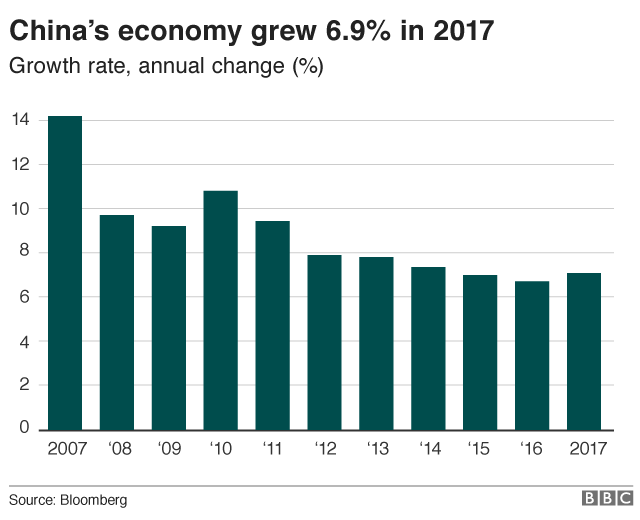
China’s economy grew by 6.9% in 2017 according to official data – the first time in seven years the pace of growth has picked up.

The figure beats Beijing’s official annual expansion target of about 6.5%.

China is a key driver of the global economy and so the better-than-expected data is likely to cheer investors around the world.

But many China watchers believe the GDP numbers are much weaker than the official figures suggest.

This month alone, the governments of Inner Mongolia and of the large industrial city of Tianjin have admitted their economic numbers for 2016 were overstated.

Taking the figures at face value, the 2017 growth rate is China’s highest in two years. And it represents the first time the economy has expanded faster than the previous year since 2010.

However as Beijing ramps up efforts to reduce risky debt and to increase air quality, analysts said this may impact 2018 growth.

The numbers released on Thursday also showed that in the last three months of 2017, the economy grew at an annual rate of 6.8% – slightly higher than analysts had been expecting.


Analysis

Robin Brant, BBC China Correspondent, Shanghai

Two things stand out.

First, it looks like stronger exports – as the world economy picked up – and the final sputter of (another) government infrastructure investment spurt helped make 2017 better than expected.

But that’s the model China is trying – gently – to get away from.

Second, is it true?

China’s figures can be so stable, so in line with government targets, that it’s hard to really believe them.

In the run up to these figures being published there’s also been an unusual spate of honesty from several provincial governments, who’ve admitted faking their GDP or fiscal figures. All of which fed into the national picture.


China’s debt has risen significantly in recent years, with worrying numbers around local government loans, corporate and household debt and non-performing bank loans.

The International Monetary Fund (IMF) said recently that the country’s debt had ballooned and was now equivalent to 234% of the total output. It said Beijing needed to concentrate less on growth and instead help improve banks’ finances, among other efforts.

Beijing meanwhile says it has been taking steps to contain risky debt despite the impact that might have on economic growth – efforts the IMF said it recognised.

The government has promised to continue tackling local government debt, among other efforts, and on Thursday vowed to help state-owned enterprises “leverage and cut debt … and to repay their bonds on time this year”.

China's economic growth

Blue skies v economic growth

China’s strict anti-pollution measures, which were introduced across 28 cities last year, are also expected to hurt economic growth in the short term.

The measures have included shutting down or cutting back production at factories in heavy industry like cement and steel.

Households have also been asked to switch to natural gas and electricity from coal, in an effort to curb pollution.

However this policy left millions without proper heating, and so was temporarily abandoned in December.

Chinese officials have said Beijing’s air quality improved sharply in the winter of 2017 and heralded their efforts as a “new reality” for the country.

Tags:
28/02/2017

India’s annual economic growth slows to 7 percent in December quarter | Reuters

India’s annual economic growth slowed to 7.0 percent in the three months through December from a revised 7.4 percent expansion in the previous quarter, government data showed on Tuesday.

Analysts polled by Reuters had forecast 6.4 percent growth for the October-December period.

The central statistics office also retained the growth forecast for the fiscal year ending in March 2017 at 7.1 percent.

Source: India’s annual economic growth slows to 7 percent in December quarter | Reuters

17/01/2017

China Overtakes India as World’s Fastest-Growing Economy, IMF Says – China Real Time Report – WSJ

China took back in the crown in 2016 thanks ‘primarily’ to Modi’s cash cancellation

 China 6.7
India* 6.6
Asean-5 4.8
Mexico 2.2
U.K.  2
Eurozone 1.7
U.S. 1.6
Japan 0.9
South Africa 0.3
Russia -0.6
Nigeria -1.5
Brazil -3.5
*India estimate is for the year that ends March 31, 2017. The Asean-5 countries are Indonesia, Malaysia, Philippines, Thailand and Vietnam.

Source: China Overtakes India as World’s Fastest-Growing Economy, IMF Says – China Real Time Report – WSJ

Tags:
06/09/2016

Early Look: China’s Economy Likely Perked Up as Summer Wound Down – China Real Time Report – WSJ

After a summer lull, China’s economy is likely to have picked up, if only slightly, in August, according to economists.

The stirring in business activity, while lackluster, points to stabilization in the world’s second-largest economy, a survey of 15 economists by The Wall Street Journal showed. August data numbers to be released in coming days are expected to show that factory output improved marginally and new bank credit picked up, while investment and retail sales slowed, though not by much, the survey said.“We expect the upcoming August data release to show China’s economic activity finding a slightly firmer footing after July’s more-than-expected weakening,” said economists at UBS Securities Asia Ltd.

A surprising rise in a key gauge of manufacturing activity earlier this month buoyed the outlook for many economists.Industrial output, a rough proxy for economic growth, likely grew 6.2% in August from a year earlier, compared with a 6.0% increase in July, the survey showed. Fixed-asset investment outside rural households, a key gauge of construction activity, likely expanded 7.9% for the January-to-August period, slightly slower than an 8.1% increase over the first seven months.

Retail sales likely climbed 10.1% in August, a tick down from July’s 10.2% growth.

Among the other positive signs, the consumer-price index, a main gauge of inflation, moderated, likely rising 1.6% from a year earlier last month and slightly slower than the 1.8% growth in July, the survey found. Meanwhile, the producer-price index, a gauge of factory gate prices, likely dropped 0.9% from a year earlier last month, improving from a 1.7% decline in July and continuing a march out of deflationary territory where it has been for more than four years.

The better performance should give policymakers confidence to stay the course and refrain from interest-rate cuts or other aggressive easing measures, economists said.

At the same time, the faint improvements are largely the result of better performance of large firms that benefit more from policy support, economists said, while growing piles of debt and percolating bubbles in the property market are a looming concern for policymakers.

“At this moment, the key constraint faced by China’s monetary policy is not inflation, but the property market and the financial market,” said economists at Macquarie Capital Ltd.

Chinese banks probably gave out 792.5 billion yuan ($118.69billion) in new credit last month, well above July’s 463.6 billion yuan, the survey of economists showed. The economists mainly attributed the rebound to seasonal patterns, since banks tend to pick up the pace of lending at the end of each quarter.

In July almost all the new credit went to medium- and long-term household loans, predominantly mortgage lending. Lending to corporate borrowers, however, recorded a net drain of 2.6 billion yuan, the first negative growth in 11 years.

Household mortgage loans may have continued to surge in August. Recent data show a jump in housing transactions in many cities, and housing prices continue to rise. Credit demand from the corporate sector likely remained sluggish, though may have improved mildly, economists of Standard Chartered Bank.

Trade also remained anemic. Outbound shipments likely declined 4.0% from a year earlier in August, compared with July’s drop of 4.4%, while imports likely dropped by 5.0%, improving notably from July’s 12.5% dip, the same poll showed. Improvements in imports reflect last year’s low base, likely slightly better industrial production activity, and continued easing of import price deflation, UBS economists noted.

That would bring the country’s trade surplus to $59.40 billion last month, widening from July’s $52.31 billion. A large trade surplus should lend support to the country’s hoard of foreign currencies, which is expected to have dropped only slightly last month. The nation’s total reserves likely fell by about $2 billion last month to $3.199 trillion, the survey showed.

Source: Early Look: China’s Economy Likely Perked Up as Summer Wound Down – China Real Time Report – WSJ

02/09/2016

Jobs elusive as India clings to fastest-growing economy tag | Reuters

It’s been two years since India emerged as the world’s fastest-growing major economy, but the rapid expansion has done little to improve the lot of Ashok Kumar.

Parked up and sitting on the kerb, the 25-year-old truck driver is going nowhere fast. He is the sole breadwinner for the 13 people in his extended family and his monthly salary is stuck at $150.

With new, better-paid jobs hard to come by, Kumar lacks options. He fears becoming unemployed like his elder brother, who recently returned to their village in Uttar Pradesh after months of searching in vain for work.

Data out on Wednesday showed India’s economic growth slowed to 7.1 percent in the quarter to June, a 15-month low. That is faster than other major economies, but not fast enough to create enough new jobs to absorb all the one million people who join the workforce every month.

A government survey found that job creation fell by more than two-thirds in 2015. Analysts at HDFC Bank estimate that for every percentage point the economy grows, employment now adds just 0.15 of a percentage point – down from 0.39 in 2000.

It’s a major challenge for Prime Minister Narendra Modi, who has promised to create 250 million jobs over the next decade.

“For one job, there are at least 20 candidates,” said Kumar. “If you want the job, you can’t afford to bargain.”

Nearly two-thirds of India’s 1.3 billion people are under 35 years old. This rising demographic “bulge” will create the largest working-age population in the world. At the same time China, which has long curbed family size, will age as a society.

Whether this so-called demographic dividend will translate into the kind of economic gains seen in Japan and Korea, or lead to upheavals, depends on India’s ability to generate jobs.

Yet, despite average annual growth of 6.5 percent between 1991 and 2013, India added less than half the jobs needed to absorb new job seekers.

MORE WORKERS, FEWER JOBS

Under Modi, India has opened up further to foreign investment, hoping to generate more manufacturing jobs. A loan scheme for small businesses has been set up and there are plans for a $1.5 billion fund for startups.

Modi has also launched a programme to train over 4 million people in different skills in six years.Pronab Sen, country director for the International Growth Centre, a British-backed think tank, said such measures were “laudable”, but they aimed at boosting supply when more demand was needed.

“India has become a demand-starved economy,” Sen said. “If there is no demand, there will be no incentive to produce more which, in turn, will mean no new jobs.”

The level of desperation for work is staggering. In August, nearly half a million people, including post-graduates, applied for 1,778 jobs as sweepers in the city of Kanpur.

This was not a one-off. Last year, in Uttar Pradesh, 2.3 million people sought 368 low-level government jobs that required a primary education and ability to ride a bicycle.

Competition for such jobs has become fiercer as the public sector’s share in formal employment is declining.

Two years of drought has caused distress in farming, while the construction business has suffered a prolonged downturn – making work scarcer in the two sectors that employ the bulk of India’s unskilled workforce.

Satellite cities around the capital, like Greater Noida were, until recently, bustling with construction activity.

Now, Greater Noida’s skyline is dotted with half-built, abandoned, high-rises. Cranes and diggers stand idle.

In Delhi and the surrounding National Capital Region, housing starts fell 41 percent year-on-year in the first half of the year, according to consultancy Knight Frank. Across India, starts were down 9 percent from a year earlier.

Bhuwan Mahato, a contractor who supplies workers to construction projects around Noida, says demand for labour is down by at least 25 percent.

“I wish I hadn’t joined this business,” said Mahato, a 30-year-old migrant from the state of Bihar. “But, truthfully, there are no other opportunities, either.”

Source: Jobs elusive as India clings to fastest-growing economy tag | Reuters

01/09/2016

Indian manufacturing growth at 13-month high in August | Reuters

Indian factory activity expanded at its fastest pace since mid-2015 in August, helped by surging new orders, while only modest price increases should give the central bank scope to ease policy further, a survey showed.

The data will cheer policymakers after an official report on Wednesday showed Indian annual economic growth slowed in the April-June quarter to 7.1 percent, short of expectations for 7.6 percent in a Reuters poll.

The Nikkei/Markit Manufacturing Purchasing Managers Index rose to 52.6 in August from July’s 51.8, marking its eighth month above the 50 level that separates growth from contraction.

“Manufacturing PMI data show that the positive momentum seen at the beginning of the second semester has been carried over into August, with expansion rates for new work, buying levels and production accelerating further,” said Pollyanna De Lima, economist at survey compiler Markit.

The new orders sub-index, which takes into account both domestic and external demand, was 54.8 in August – its highest since December 2014 and indicating robust demand for Indian manufactured goods.

That pushed factories to increase production and the output sub-index climbed to a 12-month peak in August.But price growth lost momentum last month, with raw material costs increasing at their weakest rate in six months and output prices barely rising at all, suggesting consumer inflation could cool in coming months.

“In light of these numbers, the Reserve Bank of India has scope to loosen monetary policy in the upcoming meeting to further support economic growth in India,” De Lima said.On Oct. 4, the RBI is due to announce its first policy decision under newly-appointed governor Urjit Patel, who economists expect to broadly follow in outgoing chief Raghuram Rajan‘s footsteps.

Economists in a Reuters poll last month predicted the RBI would cut the repo rate by 25 basis points to 6.25 percent in the final three months of the year.

They see little steam left in the RBI’s current easing cycle, in which the policy repo rate has come down by 150 basis points since January 2015, to its lowest in more than five years.Consumer inflation in India was 6.07 percent in July, well above the RBI’s March 2017 medium-term target of 5 percent.

Source: Indian manufacturing growth at 13-month high in August | Reuters

Law of Unintended Consequences

continuously updated blog about China & India

ChiaHou's Book Reviews

continuously updated blog about China & India

What's wrong with the world; and its economy

continuously updated blog about China & India