Chindia Alert: You’ll be Living in their World Very Soon
aims to alert you to the threats and opportunities that China and India present. China and India require serious attention; case of ‘hidden dragon and crouching tiger’.
Without this attention, governments, businesses and, indeed, individuals may find themselves at a great disadvantage sooner rather than later.
The POSTs (front webpages) are mainly 'cuttings' from reliable sources, updated continuously.
The PAGEs (see Tabs, above) attempt to make the information more meaningful by putting some structure to the information we have researched and assembled since 2006.
Photo taken on April 14, 2020 shows containers at the Lianyungang Port in Lianyungang City, east China’s Jiangsu Province. China’s foreign trade showed signs of stabilizing in March with export and import both beating bearish market expectations, official data showed Tuesday. (Photo by Geng Yuhe/Xinhua)
NEW DELHI (Reuters) – India is set to impose a nationwide ban on plastic bags, cups and straws on Oct. 2, officials said, in its most sweeping measure yet to stamp out single-use plastics from cities and villages that rank among the world’s most polluted.
Prime Minister Narendra Modi, who is leading efforts to scrap such plastics by 2022, is set to launch the campaign with a ban on as many as six items on Oct. 2, the birth anniversary of independence leader Mahatma Gandhi, two officials said.
These include plastic bags, cups, plates, small bottles, straws and certain types of sachets, said the officials, who asked not to be identified, in line with government policy.
“The ban will be comprehensive and will cover manufacturing, usage and import of such items,” one official said.
India’s environment and housing ministries, the two main ministries leading the drive, did not respond to emails from Reuters to seek comment.
In an Independence Day speech on Aug. 15, Modi had urged people and government agencies to “take the first big step” on Oct. 2 towards freeing India of single-use plastic.
Concerns are growing worldwide about plastic pollution, with a particular focus on the oceans, where nearly 50% of single-use plastic products end up, killing marine life and entering the human food chain, studies show.
The European Union plans to ban single-use plastic items such as straws, forks, knives and cotton buds by 2021.
China’s commercial hub of Shanghai is gradually reining in use of single-use plastics in catering, and its island province of Hainan has already vowed to completely eliminate single-use plastic by 2025.
India lacks an organized system for management of plastic waste, leading to widespread littering across its towns and cities.
The ban on the first six items of single-use plastics will clip 5% to 10% from India’s annual consumption of about 14 million tonnes of plastic, the first official said.
Penalties for violations of the ban will probably take effect after an initial six-month period to allow people time to adopt alternatives, officials said.
Some Indian states have already outlawed polythene bags.
The federal government also plans tougher environmental standards for plastic products and will insist on the use of recyclable plastic only, the first source said.
It will also ask e-commerce companies to cut back on plastic packaging that makes up nearly 40% of India’s annual plastic consumption, officials say.
Cheap smartphones and a surge in the number of internet users have boosted orders for e-commerce companies, such as Amazon.com Inc (AMZN.O) and Walmart Inc’s (WMT.N) Flipkart, which wrap their wares – from books and medicines to cigarettes and cosmetics – in plastic, pushing up consumption.
Chinese Premier Li Keqiang (L) holds a welcoming ceremony for visiting Uzbek Prime Minister Abdulla Aripov before their talks in Beijing, capital of China, Aug. 27, 2019. (Xinhua/Yin Bogu)
BEIJING, Aug. 27 (Xinhua) — Chinese Premier Li Keqiang held talks Tuesday with visiting Uzbek Prime Minister Abdulla Aripov, and the two sides agreed to cement cooperation.
Li said China attaches great importance to China-Uzbekistan relations and is willing to maintain close high-level exchanges with Uzbekistan, promote trade and investment liberalization and facilitation, and strengthen communication and coordination in international and regional affairs.
Li said China is ready to seek synergy between the Belt and Road Initiative and Uzbekistan’s development strategy, deepen cooperation in production capacity, interconnection and agriculture, and make efforts to ensure the stability of energy cooperation.
He expected the two sides to promote cooperation in culture, tourism and higher education, so as to consolidate the people-to-people foundation of bilateral ties.
China is willing to continue to expand the scale of bilateral trade, import Uzbek products that meet the needs of the Chinese market, and support capable Chinese companies investing in Uzbekistan in accordance with market rules, Li said, hoping Uzbekistan will create a good business environment.
Aripov said Uzbekistan is ready to continue to participate in the Belt and Road Initiative, deepen cooperation in various fields, and welcome Chinese enterprises to expand investment in Uzbekistan, so as to push bilateral relations to a higher level.
The two leaders witnessed the signing of a series of cooperation documents after the talks.
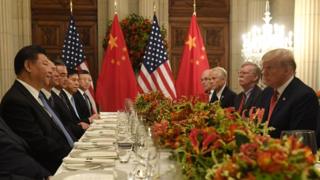
Failure to strike a deal would have seen tariffs on $200bn worth of Chinese goods rise from 10% to 25% at the start of next year, and would have opened the way for tariffs on additional Chinese goods.
On Monday, China’s foreign ministry said the presidents of China and the US had instructed their economic teams to work towards removing all tariffs following the G20 meeting,
But it didn’t say if that was a plan with specifics or something that was merely desirable.
Asian markets rallied after news of the trade war truce. In China, Hong Kong’s Hang Seng index climbed 2.5% and the Shanghai Composite index jumped 2.6%. Japan’s Nikkei 225 index rose 1%.
The gains spread to Europe, with the UK’s FTSE 100 index, the Cac 40 in France and Germany’s Dax index all up by about 2% in early trade.
The trade war has seen the US and China hit each other with escalating tariffs in an attempt to make their domestically made goods more competitive.
The US says its tariff policy is a response to China’s “unfair” trade practices and accuses it of intellectual property theft.
Since July, the US has hit China with tariffs on $250bn (£195.9bn) worth of goods. China has retaliated with duties on some $110bn of US goods over the same period.
As part of this, the US imposed a 25% tariff on Chinese cars, on top of the 2.5% already in place.
In July, China, which is the world’s largest market for cars, imposed a 40% tariff on US vehicle imports. The rate is much higher than the 15% it places on other trading partners and forced many carmakers to raise prices.
In his tweet, President Trump said Beijing had “agreed to reduce and remove tariffs on cars coming into China from the US”.
He did not provide a new level for the Chinese tariffs, and Beijing did not immediately confirm the statement.
What was agreed at the G20?
In a statement, the White House said US tariffs on Chinese goods would remain unchanged for 90 days, but added: “If at the end of this period of time, the parties are unable to reach an agreement, the 10 percent tariffs will be raised to 25 percent.”
Image captionThe US manufactures cars for export to China, the world’s largest car market
The US said China agreed to “purchase a not yet agreed upon, but very substantial, amount of agricultural, energy, industrial, and other products from the United States to reduce the trade imbalance between our two countries”.
Both sides also pledged to “immediately begin negotiations on structural changes with respect to forced technology transfer, intellectual property protection, non-tariff barriers, cyber intrusions and cyber theft”, according to the White House.
Chinese Foreign Minister Wang Yi told reporters after the talks that “the principal agreement has effectively prevented further expansion of economic friction between the two countries”.
Are tariffs still in place?
Yes. The truce prevents raising tariffs as planned on $200bn worth of Chinese goods.
But it does not remove tariffs that apply to a total of $250bn of Chinese goods targeted since July.
The truce also does not affect the existing duties China has imposed on $110bn of US goods in a tit for tat retaliation.
Will this resolve the dispute?
While the result of the G20 meeting was better than expected, it is unclear how the two countries will manage to resolve their underlying differences.
“There should be no wishful thinking that the truce would end the trade war between the world’s two largest economies,” DBS strategist Philip Wee wrote in a research note.
He said it “remains to be seen if real progress could be achieved during this narrow window to resolve the contentious issues, not just on trade, but also intellectual property”.
Louis Kuijs, head of Asia economics at Oxford Economics, said while the agreement itself was “positive” the next steps remained unclear.
“Whether we will see further de-escalation or whether it is temporary reprieve continues to be very much up to a political decision in Washington DC – that will continue to make this uncertain,” Louis Kuijs, head of Asia economics at Oxford Economics said.
China is to stop importing coal, iron, iron ore and seafood from North Korea.
The move is an implementation of UN sanctions, which were imposed in response to North Korea’s two missile tests last month.
China accounts for more than 90% of North Korea’s international trade.
Beijing had pledged to fully enforce the sanctions after the US accused it of not doing enough to rein in its neighbour.
Economic impact
The UN approved sanctions against Pyongyang earlier this month that could cost the country $1bn (£770m) a year in revenue, according to the figures provided to the Security Council by the US delegation.
Although China’s coal imports from North Korea totalled $1.2bn last year, the figure will be much lower this year because China had already imposed a ban in February, experts said.”China has already imported its quota of coal under sanctions for 2017. So no net impact there, and North Korean exports to other countries are minimal,” said David Von Hippel, from the Nautilus Institute -a think tank based in Oregon -who has researched North Korea’s coal sector.
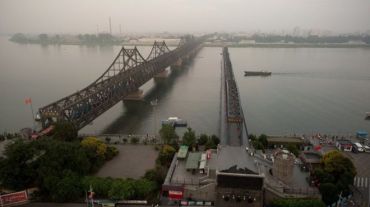
North Korean labourers work beside coal mound near the Yalu River
The sanctions might have more of an impact on iron and seafood, experts said.
Although they are both much smaller sources of export revenue for North Korea, the two industries have seen a rise in exports this year.
Iron ore exports grew to $74.4m in the first five months of this year, almost equalling the figure for all of 2016. Fish and seafood imports totalled $46.7m in June, up from $13.6m in May.
The sanctions do not apply to the growing clothing assembly industry in North Korea.Mr Von Hippel said in gross terms, it is nearly as large as coal, but in reality it is worth much less because North Korea has to import the inputs.
Trade and security tensions
The sanctions come against a backdrop of increased tensions between the US and North Korea, as well as heightened trade tensions between the US and China.
After weeks of heated rhetoric between the US and North Korea, on Tuesday North Korea’s leader Kim Jong-un has decided to hold off on a strike towards the US territory of Guam, state news agency KCNA reported.
The apparent pause in escalating tensions comes after US President Donald Trump warned of “fire and fury like the world has never seen” if Pyongyang persisted with its threats.
On Monday, the US President Donald Trump ordered a trade probe into China’s alleged theft of US intellectual property, which the Chinese state press saw as an attempt to force China to act more decisively on North Korea.
Officially, the US has denied any link between the two issues, although the president had previously suggested he might take a softer line on China in exchange for help on North Korea.
WHEN Britain eventually leaves the European Union it will prosper by trading farther afield. So argues Theresa May, Britain’s prime minister, ahead of her first big bilateral trip abroad, a three-day visit to India, which begins on Sunday, November 6th. She talks of forging a “new global role” with this trade mission, hobnobbing with Indian leaders and championing free trade in general. The idea is to promote ties between small and medium businesses in the two countries. Yet creating a stronger economic relationship with India will prove much tougher than Mrs May and her colleagues expect.
On the face of it, the signs are good. India has nearly 1.3bn people. Many are emerging as middle-class consumers for the first time. The country is creating a single market for goods and services, reducing internal and external barriers to trade and tackling some corruption and bureaucracy. Its economy, worth over $2trn, is the fastest-growing large one in the world. It is likely to rattle along quickly for many years to come; by 2030, India could rank as the world’s third-largest. The prime minister, Narendra Modi, wants to make it less difficult for businesses to operate there, and to win more foreign investment and trade deals. British firms are already among the biggest investors. Now India is opening up for foreign activity in sectors that might suit British firms especially: notably in insurance, defence, railways and some retail. At the same time, large Indian firms—such as Tata, which owns Jaguar Land Rover, as well as Tata Steel—are in Britain. London has also become a base for Indian firms, for example in business consulting, that tap the wider EU market. A common language, shared cultural, historic, legal and sporting ties, plus the influence of the Indian diaspora in Britain, bode well for closer ties.
Mrs May is thus right to reach out. But anyone expecting quick gains will be disappointed. One of India’s priorities, for example, is avoiding complications over a long-stalled free trade agreement with the EU, which has been under negotiation since June 2007. After 12 rounds of talks, some consensus has been found on issues including trade in rice, sugar, textiles and pharmaceuticals. It is not clear that India’s overstretched trade negotiators will see much benefit in being diverted to work on a deal with Britain alone, especially if that makes it harder to complete one with the bigger EU market. Even if they do decide to talk biltaterally, among the sticking points has been India’s 150% tariff on imports of whisky from Scotland. Future British negotiators would struggle to be more effective than their European counterparts at getting that scrapped. The biggest concern, however, is about Britain’s ever colder shoulder towards Indians who want to travel and study there. Under the Conservatives, Britain has in the past six years become less welcoming to foreigners, notably from South Asia, who hope to attend university and then work. Eye-wateringly expensive visas, increasingly hostile rules to get them, official talk of cracking down on foreign students in Britain, and graduates who lose the right to work after finishing a degree in Britain all leave Indians feeling unwelcome. Anecdotes abound of bright Indian students who win places at the best British universities but are refused visas to travel. Perceptions of generally rising xenophobia in Britain are discouraging to Indians too.
For Mrs May to win a warm welcome in India she needs to offer a message that is not only about investment and trade, but also sets out that Britain—in particular its universities—will again become more open to Indian visitors, migrants, students and their families. America is proving far more successful at attracting the highest-skilled migrants, especially software and other engineers. Other countries, including some in Europe, are rolling out policies to attract more Indian students to their universities. Yet Britain appears more hostile to migrants than it has in many decades. Within a few years, it is worth remembering, India’s economy will be bigger than Britain’s. Welcoming more exchanges of people, as well as encouraging higher levels of trade and investment, would make sense for both sides.
ON OCTOBER 30th India celebrates Diwali, the most important festival in the Hindu calendar. Over five days, millions of lamps and candles will be placed on doorsteps and rooftops; prayers will be offered to Lakshmi, the goddess of prosperity; and fireworks will go off in the skies over the streets of nearly every town and village. A festival that celebrates the victory of light over darkness, Diwali has in recent years brightened the mood of Chinese exporters as well: many Indian households favour cheaper, electric decorations made in China over the traditional earthen diyas (pictured).
But this year’s edition could take a dark turn. The country’s noisy social media are cluttered with posts calling for Indians to shun Chinese goods. A fake letter championing the boycott, ostensibly signed Narendra Modi, the prime minister, has gone viral. Politicians from India’s ruling Hindu-nationalist Bharatiya Janata Party (BJP) have endorsed the cause. What is going on?
The economic roots of the boycott are not new. China is India’s largest trading partner, with $71bn worth of goods exchanged between them in the past financial year. But China is also the nation with which India has its largest trade deficit, an imbalance that rose 9% to $53bn in 2015-2016. In contrast, China’s trade surplus with America reached $367bn in 2015. What the deficit is made of matters most. China’s light-industry goods compete directly and with overwhelming success against India’s small industries, the lifeline of its manufacturing sector and a reservoir of jobs. So India exports mostly raw materials to its neighbour. That has the government worried: of the 572 anti-dumping measures India took between 1995 and 2015, 146 were aimed at Chinese-made goods. The “Make in India” campaign, which has been championed by Mr Modi and sees foreign investment as crucial to boosting his country’s manufacturing power, has been careful not to advocate protectionism. Yet in a country where economic boycotts were first popularised as a non-violent strategy to combat British rule, such appeals carry emotional and historical heft. Geopolitics provided the spark for the current call. India has long been trying to get Masood Azhar, the boss of Jaish-e-Mohammad (JeM), a Pakistan-based jihadist group, listed as a terrorist by the United Nations. India suspects JeM of carrying out the January attack on an air-force base in Punjab, which killed eight Indians, including one civilian. JeM is also the alleged perpetrator of last month’s massacre at the Kashmiri garrison of Uri, in which 19 soldiers were killed (though another group claimed responsiblity). Yet twice this year, China used its Security Council veto to block Mr Azhar’s addition to the UN sanctions list. The move underscored Beijing’s all-weather support for the Pakistani establishment, elements of which India suspects of harbouring Mr Azhar. Some Indians don’t understand why they should have to trade with a nation working against their interests. This perception of China was compounded by its decision in June to oppose India’s accession to the Nuclear Suppliers Group, a 48-nation body that governs the global nuclear trade.
Yet calls for a boycott of Chinese-made goods are unlikely to have much effect. Both India and China are members of the World Trade Organisation, which forbids arbitrary bans on foreign goods. India’s commerce minister, Nirmala Sitharaman, recognised as much earlier this month when she said blocking imports was not a feasible option. A BJP leader deleted his tweets, blaming staff for the text; the opposition is silent on the issue. Nor is the wider business community likely to embrace the cause. Traders and industrialists, who have come to rely heavily on Chinese-made merchandise and machinery, form powerful lobbies. Yet with Mr Modi’s government promoting an increasingly assertive brand of nationalism, anger over China’s snubs will not easily go away. Expect further diplomatic fireworks.
JAPAN is often viewed with antipathy in China, but increasingly commerce is trumping contempt. During the lunar new-year holiday in February, Chinese tourists thronged to Japan in record numbers. Many came home lugging a high-end Japanese luxury: a heated toilet-seat complete with pulsating water jets, deodorisers and even music to drown out less melodious tinklings. In recent weeks the run on Japanese loos has been a topic of much debate among Chinese commentators, revealing deep insecurities.
Chinese visitors bought more high-tech lavatory seats than almost any other Japanese product during the week-long break, according to Hottolink, a Japanese consulting firm. Most popular was a new variety with hands-free lid opening, say staff at a branch in Tokyo of Bic Camera, a consumer electronics store where Chinese shoppers are so numerous that signs advertise wares in Chinese and assistants speak Mandarin. These cost around ¥65,000 ($540). Some bought several seats, including portable, battery-powered ones.
Relations between China and Japan have shown recent, tentative signs of warmth after a long chill. But only three years ago demonstrators in several Chinese cities called for a boycott of Japanese goods in protest against Japan’s stance in a still-festering dispute over uninhabited islands in the East China Sea. Some Japanese companies responded by minimising or hiding their branding on products sold in China.
Iran has asked India for $1.5 billion in back oil payments under the nuclear deal that provides Tehran some relief from Western sanctions, Indian sources with direct knowledge of the matter said on Thursday.
If the payments are approved, this could make India the third of Iran’s major buyers, after Japan and South Korea, to start processing frozen back payments. The payments are contingent on Iran holding to its agreement to start curbing its nuclear programme.
Indian refiners are holding about $3 billion in payments due the Middle Eastern crude producer, one of the sources said.
Other funds owed to Tehran are held in a rupee-denominated account at India’s UCO Bank.
Under the Nov. 24 agreement with six major powers, Iran won access to $4.2 billion of its oil revenues frozen abroad. The fund will be paid out in eight money transfers on a schedule that started with a $550 million payment by Japan on Feb. 1.
Thailand has announced that a contract to sell more than a million tonnes of rice to China has been cancelled.
The Ministry of Commerce said the Chinese government pulled out of the the deal to buy 1.2 million tonnes of rice because of an ongoing probe.
Thailand\’s Anti-Corruption Commission is investigating PM Yingluck Shinawatra over a rice purchase policy.
The policy has been a factor in the anti-government protests that have sparked Thailand\’s political crisis.
The deal with China would have been the first stage of what the Thai government was hoping to be a larger shipment of of rice this year.
\”China lacks confidence to do business with us after the National Anti-Corruption Commission started investigations into the transparency of rice deals between Thailand and China,\” Thai Commerce Minister Niwatthamrong Bunsongphaisan said, announcing the cancellation.


 Photo taken on April 14, 2020 shows containers at the Lianyungang Port in Lianyungang City, east China’s Jiangsu Province. China’s foreign trade showed signs of stabilizing in March with export and import both beating bearish market expectations, official data showed Tuesday. (Photo by Geng Yuhe/Xinhua)


 CHINDIA ALERT: You'll be living in their world, very soon