07/04/2020
- Buying and paying for meals and supplies online was already second nature for many Chinese before the Covid-19 lockdown
- The supply and delivery networks that were already in place were able to work with the authorities in cities like Wuhan
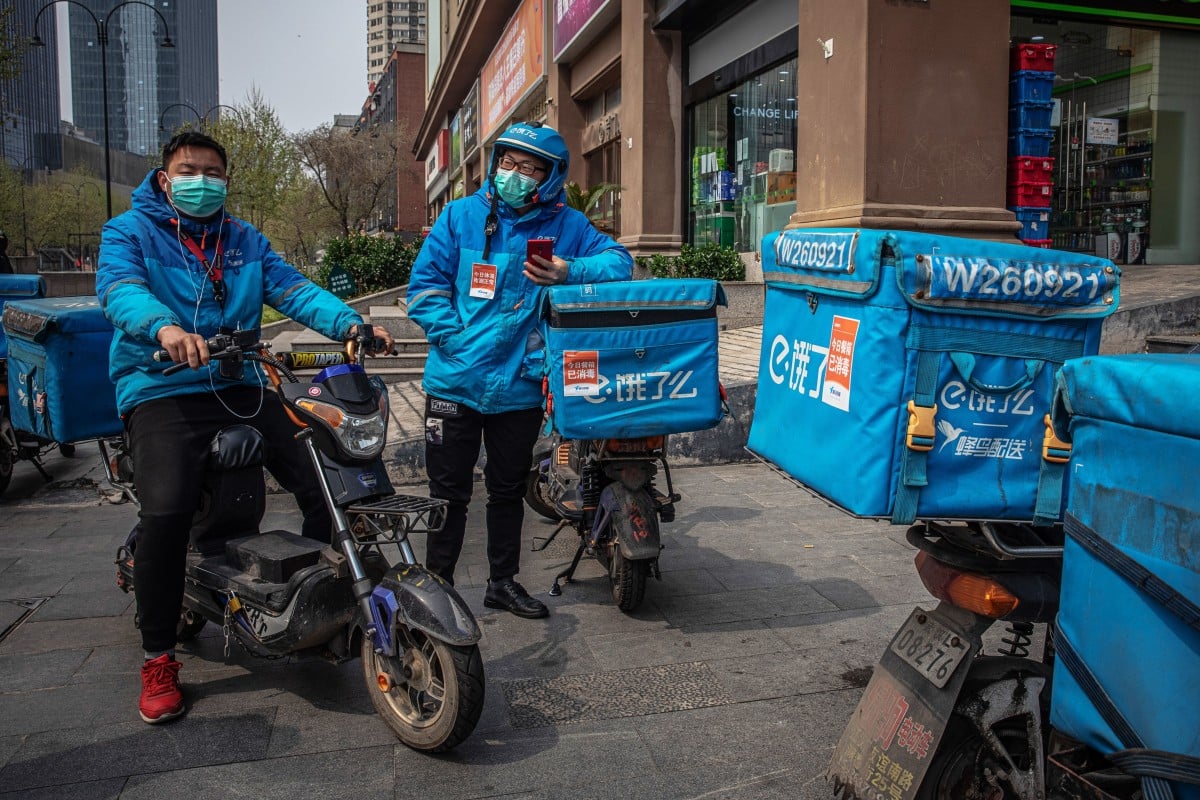
China’s established home delivery system played an important role in getting food and other necessities to residents during the Wuhan lockdown. Photo: EPA-EFE
When Liu Yilin, a retired middle schoolteacher in Wuhan, first heard rumours of a
spreading in the central Chinese city he started to stock up on supplies such as rice, oil, noodles and dried pork and fish.
These preparations spared the 66-year-old from some of the early panic when
and shoppers flooded to the markets and malls to snap up supplies.
But as time went on and with residents banned from leaving their homes, he became increasingly concerned about getting hold of fresh supplies of vegetables, fruit and meat until the nation’s vast network of delivery drivers came to the rescue.
“It was such a relief that several necessity purchasing groups organised by community workers and volunteers suddenly emerged on WeChat [a leading social media app] days after the lockdown,” Liu said. “China’s powerful home delivery service makes life much easier at a time of crisis.”
Hu Xingdou, a Beijing-based independent political economist said: “Home delivery played a very important role amid the coronavirus outbreak. To some extent, it prevented people from starving especially in cases when local governments took extreme measures to isolate people.”
According to Liu, people in Wuhan during the lockdown had to stay within their residential communities, with community workers guarding the exits.
Human contact was limited to the internet. Residents placed orders online with farmers, small merchants or supermarkets to buy daily necessities, and community workers helped distribute the goods from deliverymen.
Every morning, Liu passed a piece of paper with his name, phone number and order number to a community worker who would collect the items from a courier at the gate of the residential area.
Thanks to a high population density in urban areas, affluent labour force and people’s openness to digital life, China has built a well-developed home delivery network.
Extensive funding from technology companies has been invested in hardware infrastructure, software to improve logistics and big data and cloud computing to help predict consumers’ behaviour.
Mark Greeven, professor of innovation and strategy at IMD Business School in Lausanne, Switzerland, said: “Whether it is delivery of products, air parcels or fresh food or even medicine or materials for medical use, China has a very well developed system. Much better developed than I think almost any other places in the world.
“Well before the crisis, China had started to embrace digital technology in daily life whether it is in consumption, business, government and smart cities and use of third party payments. All of these things have been in place for a long time and the crisis tested its agility and capability to deal with peak demand.”
China’s e-commerce giants help revive sales of farm goods from Hubei
According to e-commerce giant
JD.com, demands for e-commerce and delivery services spiked during the outbreak of Covid-19, the illness caused by the new coronavirus.
It sold around 220 million items between January 20 and February 28, mainly grains and dairy products with the value of beef orders trebling and chicken deliveries quadrupling compared with a year ago.
Tang Yishen, head of JD Fresh, its fresh foods subsidiary, said: “The surge of online demand for fresh merchandise shows the pandemic helped e-commerce providers further penetrate into the life of customers. It also helped upstream farm producers to know and trust us.”
Meituan Dianping, a leading e-commerce platform, said its grocery retail service Meituan Instashopping reported a 400 per cent growth in sales from a year ago in February from local supermarkets.
The most popular items ordered between January 26 and February 8 were face masks, disinfectant, tangerines, packed fresh-cut fruits and potatoes.
The food delivery service Ele.me said that, between January 21 and February 8, deliveries of frozen food surged more than 600 per cent year on year, followed by a nearly 500 per cent growth in delivery of pet-care products. Fresh food deliveries rose by 181 per cent while drink and snack deliveries climbed by 101 per cent and 82 per cent, respectively. Ele.me is owned by Alibaba, the parent company of the South China Morning Post.
Chinese hotpot restaurant chain adapts as coronavirus fears push communal meals off the menu
E-commerce providers used the opportunity to show goodwill and improve their relationship with customers and partners, analysts say.
Sofya Bakhta, marketing strategy analyst at the Shanghai-based Daxue Consulting, said the food delivery sector had made significant headway in reducing physical contact during the outbreak.
Delivery staff left orders in front of buildings, in lifts or temporary shelters as instructed by the clients as most properties no longer allowed them inside.
Some companies also adopted more hi-tech strategies.
In Beijing, Meituan used self-driving vehicles to deliver meals to contactless pickup stations. It also offered cardboard boxes to be used as shields aimed at preventing the spread of droplets among its clients while they ate in their workplaces. In Shanghai, Ele.me employed delivery drones to serve people under quarantine in the most affected regions.
Some companies even “shared” employees to meet the growing labour demand in the food delivery industry that could not be satisfied with their ordinary workforce, Bakhta said.
More employees from restaurants, general retail and other service businesses were “loaned” to food delivery companies, which faced manpower shortages during the outbreak, according to Sandy Shen, senior research director at global consultancy Gartner.
“These arrangements not only ensured the continuity of the delivery service but also helped businesses to retain employees during the shutdown,” she said.
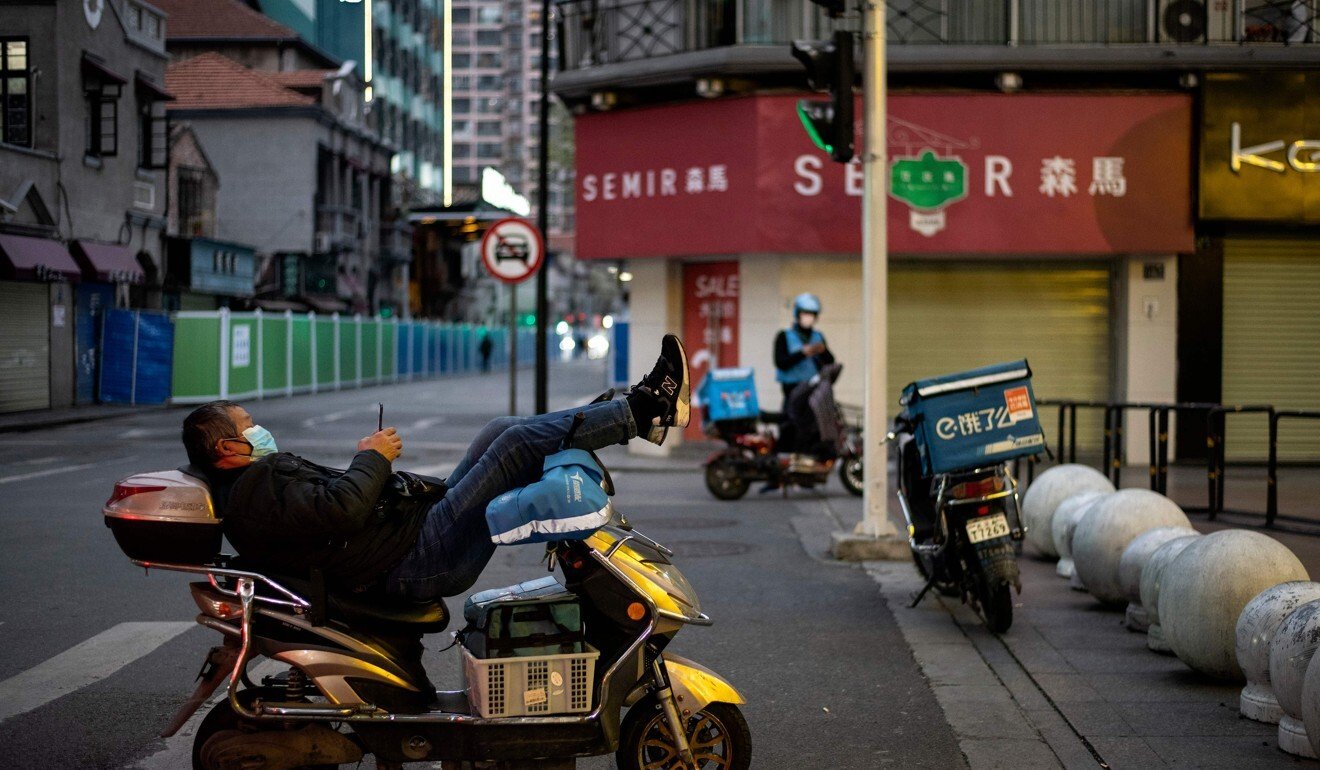
A delivery man takes a break between orders in Wuhan, central China, during the lockdown. Photo: AFP
Mo Xinsheng became one such “on-loan” worker after customers stopped coming to the Beijing restaurant where he worked as a kitchen assistant.
“I wanted to earn some money and meanwhile help people who are trapped at home,” said Mo, who was hired as a delivery man.
But before he could start work he had to go through lengthy health checks before he was allowed into residential compounds.
He also had to work long hours battling the wind and cold of a Beijing winter and carrying heavy loads.
“I work about 10 hours every day just to earn several thousand yuan [several hundred US dollars] a month,” he said.
“Sometimes I almost couldn’t breathe while my hands were fully loaded with packages of rice, oil and other things.
“But I know I’m doing an important job, especially at a time of crisis,” Mo said, “It was not until then that I realised people have become so reliant on the home delivery system.”
Woman uses remote control car to buy steamed buns amid coronavirus outbreak in China
The delivery system has been improved by an effective combination of private sector innovation and public sector coordination, said Li Chen, assistant professor at the Centre for China Studies at Chinese University of Hong Kong.
“[In China,] government units and the Communist Party grass roots organisations have maintained fairly strong mobilisation capabilities to cope with emergencies, which has worked well in the crisis,” he said.
However, Liu, the Wuhan resident, said prices had gone up and vegetables were three times more expensive than they had been over Lunar New Year in 2019.
“There were few varieties that we could choose from, apart from potatoes, cabbage and carrots,” he said.
“But I’m not complaining. It’s good we can still get fresh vegetables at a difficult time. Isn’t it? After all, we are just ordinary people,” he said.
Source: SCMP
Posted in air parcels, Alibaba, army, banned, beef orders, Buying and paying, cabbage, came to the rescue, cardboard boxes, carrots, Centre for China Studies, chicken deliveries, China’s, Chinese University of Hong Kong, community workers, complaining, contactless pickup stations, coronavirus, coronavirus outbreak, Country, COVID-19, Covid-19 lockdown, dairy products, Daxue Consulting, deliver meals, delivery drivers, delivery drones, disinfectant, dried pork, drivers, droplets, E-commerce, e-commerce giant, e-commerce giants, face masks, farmers, Fish, flooded, food delivery, fresh food, fresh merchandise, fresh supplies, fresh-cut fruits, frozen food, fruit, Gartner, global consultancy, grains, hardware infrastructure, home delivery system, hotpot, Human contact, IMD Business School, Internet, isolate, JD Fresh, JD.com, keep, Lausanne, local governments, lockdown, lunar new year, malls, markets, materials, meals and supplies, Meat, medical use, medicine, name, new coronavirus, noodles, Oil, order number, ordinary, outbreak, packed, pandemic, pet-care products, phone number, potatoes, products, purchasing groups, quadrupling, quarantine, resident, residential communities, residents, restaurant chain, Rice, Shanghai, shields, shoppers, small merchants, social media app, software, south china morning post, starving, steamed buns, supermarkets, supplies, supply and delivery networks, Switzerland, tangerines, trebling, Uncategorized, vast network, vegetables, volunteers, WeChat, winter, Wuhan |
Leave a Comment »
20/09/2019
- Superstitious medical student, 23, said it was customary in her hometown to throw money for good luck
- Cousin’s child had fallen ill on flight from Jiangxi to Sichuan, she said
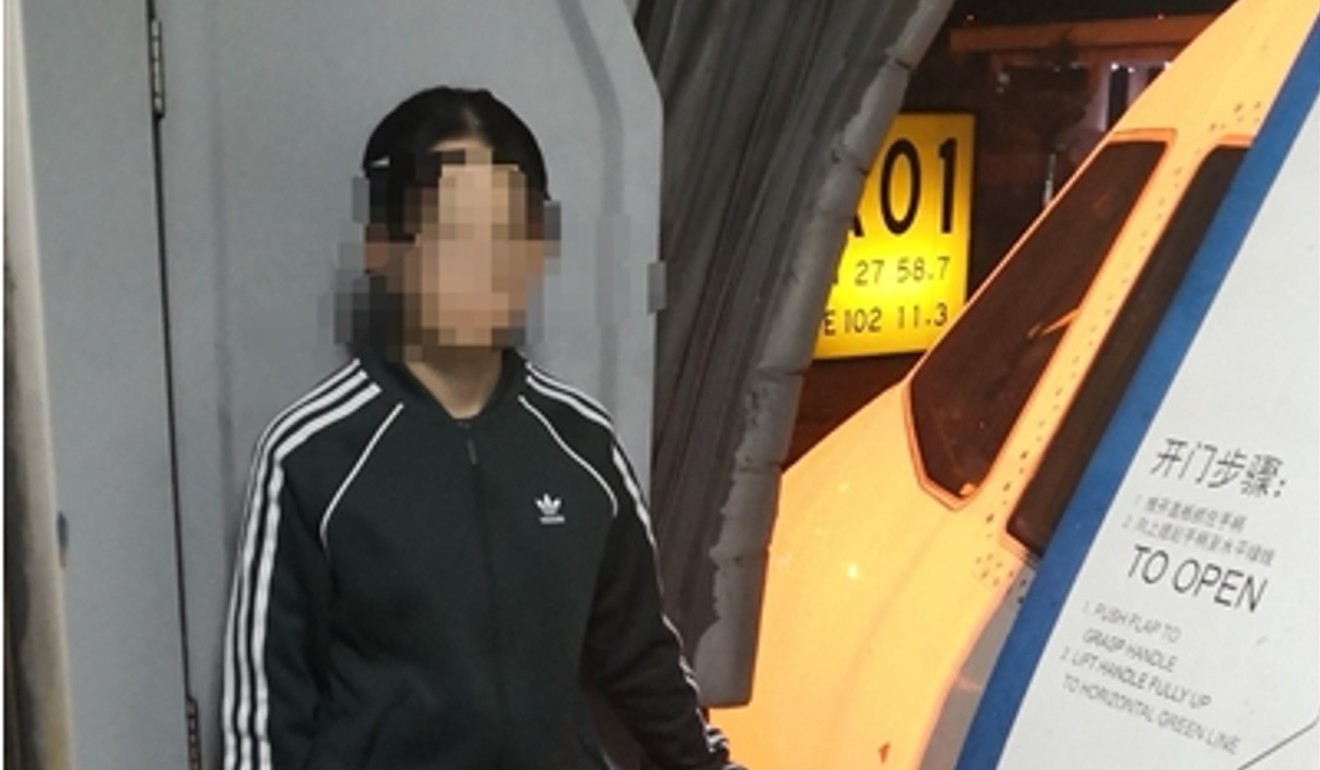
A woman was fined for tossing coins onto the apron at an airport in Sichuan province. Photo: Weibo
A woman who
threw coins onto the parking apron at an airport in southwest China in the superstitious belief it might cure her cousin’s baby’s diarrhoea was instead fined 200 yuan (US$28), local media reported.
The incident happened on September 5, as the woman, surnamed Wang, and a group of her relatives arrived in Xichang, Sichuan province, after flying from Nanchang, Jiangxi province, to attend a family wedding, the Chengdu Business News reported on Friday.
Wang, 23, dropped the coins through the gap between the aircraft and the jet bridge as she and her family were disembarking.
Police said the medical student was shocked when she realised the trouble she had caused. Photo: Weibo
Although no one spotted what she had done at the time, airport workers later found three coins on the ground while conducting a security check and reported the matter to the police.
Officers reviewed footage from the airport’s surveillance cameras and identified Wang as the guilty party and went to see her at her hotel the following morning, the report said.
Wang said that during the flight her cousin’s baby had suffered from diarrhoea and that it was customary in her hometown to toss coins in the hope it would bring the child good luck.
“She said she didn’t realise her action could have had a very serious outcome,” a police officer was quoted as saying, adding that Wang appeared shocked when she realised the trouble she had caused.
However, as her actions had not resulted in any delays to flights or created any other problems, she was charged only with a minor offence.
Many Chinese think tossing coins before a flight will bring them good luck. Photo: EPA
Wang, who recently completed a bachelor’s degree in medicine and was preparing to sit a graduate school entrance examination, was worried the incident might have an impact on her future education and job prospects, the officer said.
More than 5,000 people commented on the story on news portal 163.com, with one asking: “You are so superstitious, how can you treat patients?”
In recent years there have been numerous reports of Chinese travellers causing delays and being punished for tossing coins onto airport runways and even into aircraft engines.
In April, a woman was detained for throwing six coins as she was about to board a plane in southern China in the hope it would guarantee her a safe trip.
Source: SCMP
Posted in aircraft engines, Airport, airport runways, airport workers, apron, baby’s diarrhoea, Bachelor's degree, Chengdu Business News, child, Chinese travellers, Chinese woman, conducting, Cousin, cure, customary, diarrhoea, disembarking, fallen ill, Family, fined, flight, footage, future education, gap, good luck, graduate school entrance examination, ground, guarantee, guilty party, hometown, Hotel, incident, jet bridge, Jiangxi Province, job prospects, medical student, medicine, Nanchang, officers, parking apron, plane, Police, punished, reported, safe trip, security check, sichuan province, Superstitious, surveillance cameras, threw coins, throw money, tossing coins, Uncategorized, worried |
Leave a Comment »
04/09/2019
Chinese Premier Li Keqiang, also a member of the Standing Committee of the Political Bureau of the Communist Party of China Central Committee, presides over a forum on the work of National Science Fund for Distinguished Young Scholars in Beijing, capital of China, Sept. 2, 2019. (Xinhua/Pang Xinglei)
BEIJING, Sept. 3 (Xinhua) — Chinese Premier Li Keqiang has pledged greater government support to help create a more favorable and freer environment for young scientists to explore and innovate.
He said the National Science Fund for Distinguished Young Scholars will play a bigger role in financially supporting the researchers to be dedicated to basic research and innovation.
Li made the remarks at a forum on the work of the fund, which was held on Monday. He also visited an exhibition of scientific research achievements in the fields of astrophysics, new material, new energy application, medicine and biology, thanks to the support of the fund.
He stressed the need to reinforce basic research in an effort to lay a solid foundation for China’s innovation-driven development.
Governments at all levels should lend long-term and stable support to basic research, and enterprises will also be encouraged to increase investment into basic research, he said.
“We should continue to streamline administrative approvals, delegate power to lower levels and improve regulations and services in the field of science and technology to further reduce constraints,” he said.
The premier also required the further improvement of the management and evaluation of scientific research projects as well as the income distribution system for researchers.
He suggested the fund be used as a national “venture capital fund,” which will not only promote innovation but also be tolerant to failures, so that more scientific and technological personnel, especially young talent, will be encouraged to venture into “no man’s land” to achieve more breakthroughs.
Source: Xinhua
Posted in astrophysics, Biology, Chinese premier Li Keqiang, explore and innovate, favorable and freer environment, government support, medicine, National Science Fund for Distinguished Young Scholars, new energy application, new materials, no man's land, pledged, promote innovation, science and technology, scientific and technological personnel, tolerant to failures, Uncategorized, venture capital fund, young scientists |
Leave a Comment »
12/05/2019
NEW YORK, May 11 (Xinhua) — An opera featuring the famous monk Jianzhen of China’s Tang Dynasty (618-907 A.D.) will be presented at New York City’s Lincoln Center next month, according to local theatrical sources.
Based on true history, “Voyage To The East – A Fearless Buddhist Master’s Mission To Japan” told the story of monk Jianzhen, who started sailing to Japan in 742 A.D., but only succeeded in 754 A.D. after five failed attempts. Apart from spreading Buddhism, he also introduced Chinese art, medicine and craftsmanship to Japan, thus becoming a highly respected figure in both nations.
Famous Chinese-American opera singer Tian Haojiang plays Jianzhen in the opera. Tian reportedly has had over 1,400 performances of some 50 roles in all major opera houses worldwide. In order to better depict the role, Tian lived with real monks for some time in Daming Temple of east China’s Yangzhou city, where Jianzhen had stayed before embarking on his journey to Japan.
Produced by China’s Jiangsu Performing Arts Group, the opera’s score is a fusion of modern opera with the original sound of the Japanese koto, the zither, the Chinese guzheng, temple blocks and Buddhist chants.
The opera will be staged on June 22 to 23 at the David H. Koch Theatre of the Lincoln Center.
Source: Xinhua
Posted in "Voyage To The East - A Fearless Buddhist Master's Mission To Japan", Buddhism, Buddhist chants, Chinese art, Chinese opera, Chinese-American opera singer, craftsmanship, Daming Temple, David H. Koch Theatre, debut, guzheng, Japan, Japanese koto, Jiangsu Performing Arts Group, Jianzhen, legendary monk, Lincoln Center, medicine, New York City, Tang Dynasty (618-907 A.D.), temple blocks, Tian Haojiang, Uncategorized, Yangzhou, zither |
Leave a Comment »
04/11/2014
Traditional Chinese medicine teaches that some people have hot constitutions, making them prone to fever and inflammation in parts of the body, while others tend to have cold body parts and get chills. Such Eastern-rooted ideas have been developed over thousands of years of experience with patients. But they aren’t backed up by much scientific data. As the WSJ’s Shirley S. Wang reports:

Now researchers in some the most highly respected universities in China, and increasingly in Europe and the U.S., are wedding Western techniques for analyzing complex biological systems to the Chinese notion of seeing the body as a networked whole. The idea is to study how genes or proteins interact throughout the body as a disease develops, rather than to examine single genes or molecules.
“Traditional Chinese medicine views disease as complete a pattern as possible,” says Jennifer Wan, a professor in the school of biological sciences at the University of Hong Kong who studies traditional Chinese medicine, or TCM. “Western medicine tends to view events or individuals as discrete particles.” But one gene or biological marker alone typically doesn’t yield comprehensive understanding of disease, she says.
…
In cities throughout China, doctors practicing Western and Chinese medicine can both be found. Many patients go to Western doctors for certain situations, such as acute illness, but seek out TCM guidance in others, often to prevent disease.
TCM was largely ignored by Western medicine until recent years, but is slowly gaining traction among some scientists and clinicians. The Cleveland Clinic in Ohio recently opened a herbal therapy center. The U.S. government established the National Center for Complementary and Alternative Medicine in 1998. The organization now has a budget of over $120 million to fund research on the efficacy and safety of alternative medicines, including those rooted in traditional Chinese medicine.
via Traditional Chinese Medicine Gets Traction Among Scientists – China Real Time Report – WSJ.
Posted in China alert, medicine |
Leave a Comment »






 CHINDIA ALERT: You'll be living in their world, very soon