Archive for ‘Economics’

30/05/2012

* First batch of 20,000 North Korean workers in China

Hong Kong’s Singtao Daily reports: According to South  Korea’s  “Korean Daily”, the Chinese government is issuing work visas to allow 20,000 North Koreansto work in the three Northeast provinces.

The Korean paper cites diplomatic sources in Seoul, that in order to ease the labour shortage in the three Northeast provinces, the authorities have decided to let in 20,000 North Korean labourers to work as “industrial study students”. An enterprise in Tulin, Jilin Province has recently employed 29 North Korean women and another batch of 160 North Korean women will be sent to that area. Sources say the monthly pay for a North Korean worker exceeds US$150.


In my previous posts on Sino-North Korean and US-North Korean relations, I said that China would be benefited from North Korea’s isolation in exploiting North Korea’s cheap labour and rich natural resources. It seems this process has now begun on quite a large scale.

From China Daily Mail blog:  First batch of 20,000 North Korean workers in China.

30/05/2012

* China could owe America one trillion dollars

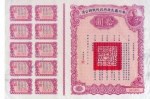
China has a secret: It owes American investors hundreds of billions of dollars.

The Chinese government doesn’t like to talk about it and the U.S. government doesn’t want to raise it. But decades ago, Beijing defaulted on debt owed to Americans, as well as investors and governments around the world. In one case, it was paid. In the rest it was not. More than 20,000 American investors own this debt. The U.S. government may also own Chinese war debt, unpaid since World War II.

With the simple stroke of an executive proclamation, President Barack Obama can begin the process of addressing this issue. A 1930s-era law has established a quasi-public agency within the Securities and Exchange Commission, known as the Corporation of Foreign Securities Holders, which can arbitrate this dispute, much as a predecessor agency did for decades. China can both afford and benefit from this solution; it will afford goodwill at a time when relations between the world’s two superpowers are strained.

The story begins nearly 100 years ago, in 1913, when the government of China began issuing bonds to foreign investors and governments for infrastructure work to modernise the country. As the country fell into civil war in 1927, paying these debts became increasingly difficult and the government fell into default. Even so, in April 1938, the Nationalist government of China began to issue U.S.-dollar denominated bonds to finance the war against Japan’s brutal invasion.

Locked in a pitched battle for survival, the government issued these bonds into 1940. As part of its wartime financial aid, the U.S. government further provided a $500 million credit to China in March 1942, shipping gold there and helping to stabilise the currency. In return, it appears that the U.S. government redeemed some of these dollar-denominated bonds. But China doesn’t appear to have repaid this debt either, according to State Department records, and the declaration of the People’s Republic of China in 1949 ended decades of political, military and financial cooperation.

While successor governments are usually bound by the debts of predecessor governments, the new Communist government refused to pay any of these claims. The issue lay dormant for decades, just as the bilateral relationship did. Then, in 1979, as part of normalising relations, Washington released government financial claims regarding the expropriation of American property and appears to have dropped the matter of the war debt entirely. However, it is one thing for government decision-makers to let go of government debt, however questionable that is.

And it is entirely another thing for individual citizens to press their claims. Some U.S. investors tried to sue the Chinese government in the 1980s and 1990s. However, the Foreign Sovereign Immunities Act makes it very hard for any U.S. citizen to sue a foreign government in U.S. courts because the law generally says that U.S. courts do not have jurisdiction.

The law usually only allows the jurisdiction of U.S. courts if a foreign government waives its immunity, commits a tort or seizes property. Recent additional exceptions have been added for terrorism. China lost an initial summary judgement for failing to appear in court but, with the urging of the U.S. State Department, later appeared in court and successfully argued that U.S. courts did not have jurisdiction.

Today, the Chinese bonds held by U.S. investors may be worth as much as $750 billion, according to Jonna Bianco, president of the American Bondholders Foundation, who estimates the value of bonds held by investors worldwide may be $10 billion, including interest and penalties for default.

China Daily Mail blog: “China could owe America one trillion dollars.”

29/05/2012

* Japan, China to begin direct currency trading on June 1

Xinhua: “Japan and China will begin direct yen- yuan trading on June 1, Japanese Finance Minister Jun Azumi said Tuesday, abandoning the existing system that determines yen-yuan rates via their U.S.dollar values.

Image used to convey the idea of currency conv...

Image used to convey the idea of currency conversion (Photo credit: Wikipedia)

The move is broadly seen as a way to boost trade and investment between the world’s second- and third- largest economies, and as part of measures China took to internationalize its currency.”

via Japan, China to begin direct currency trading on June 1 – Xinhua | English.news.cn.

The writing is on the wall for the US as the world’s only currency acting as a reserve and exchange currency.  This is another sign that the supremacy of the US as the world leader is also beginning to wane. But Americans can relax – for now. It took the Roman Empire over 500 years to decline and the British Empire over 100 years.

29/05/2012

* Chinese wages see double-digit growth

Xinhua: “The average annual salaries of urban Chinese workers at non-private companies hit 42,452 yuan (6,717 U.S. dollars) in 2011, up 14.3 percent year on year, statistical authorities announced Tuesday. After taking inflation into account, wages actually grew by about 8.5 percent, according to data from the National Bureau of Statistics NBS.

Meanwhile, the annual salaries of workers at privately-owned businesses in urban regions grew 12.3 percent after deducting factor of inflation to 24,556 yuan in 2011, NBS data showed. The data was based on a survey of 1.48 million non-privately owned organizations and 620,000 private companies, the NBS said.

Wages for workers in the nation’s more developed eastern regions and major cities were the highest, while the central provinces of Anhui, Henan and Hubei ranked lowest, according to the NBS. The finance, telecommunication, computer service and software development sectors offered the highest salaries, the NBS said.”

via Chinese wages see double-digit growth – Xinhua | English.news.cn.

Chinese wages have risen higher than GDP consistently for over five years. The accusation of low-wages beating foreign competition is becoming less true each year. So much so that reverse outsourcing is beginning to happen for some companies and countries.

Related posts:

29/05/2012

* India PM Manmohan Singh in historic Burma visit

BBC News: “Manmohan Singh has held talks with Burmese President Thein Sein as he makes the first official visit to Burma by an Indian prime minister since 1987. The two sides signed 12 agreements to strengthen trade and diplomatic ties. During his three-day trip, Mr Singh will meet opposition leader Aung San Suu Kyi, whose mother once served as Burma’s ambassador to India.

The two nations share a 1,600km (1,000 mile) border, but relations have often been uneasy. On Monday, they signed agreements on border area development, air services, cultural exchanges, a $500m credit line between India’s Export-Import Bank and Myanmar [Burma] Foreign Trade bank, and establishment of a joint trade and investment forum, the BBC’s Sanjoy Majumder reports from the Burmese capital, Nay Pyi Taw.

Delhi cold-shouldered Burma’s military rulers during the 1990s, infuriating the generals by openly supporting Ms Suu Kyi. But Mr Singh, who arrived in the Burmese capital on Sunday, has overseen a dramatic turnaround in Delhi’s policy, and hosted former ruler Than Shwe on a state visit in 2010. Earlier, on his arrival in Burma, Mr Singh said: “I am coming here after 25 years when the last prime minister of India visited here. We have centuries-old ties of religion, culture and civilisation with the people of Myanmar. He had earlier said he wanted “stronger trade and investment links, development of border areas, improving connectivity between our two countries and building capacity and human resources”.”

via BBC News – India PM Manmohan Singh in historic Burma visit.

27/05/2012

* Children of the Revolution

WSJ: “China’s ‘princelings,’ the offspring of the communist party elite, are embracing the trappings of wealth and privilege—raising uncomfortable questions for their elders.

English: People's daily, on 1 October, 1949, t...

English: People’s daily, on 1 October, 1949, the day of the establishment of China, P. R. 中文: 1949年10月1日,中华人民共和国建国时的《人民日报》头版 (Photo credit: Wikipedia)

… State-controlled media portray China’s leaders as living by the austere Communist values they publicly espouse. But as scions of the political aristocracy carve out lucrative roles in business and embrace the trappings of wealth, their increasingly high profile is raising uncomfortable questions for a party that justifies its monopoly on power by pointing to its origins as a movement of workers and peasants.

Their visibility has particular resonance as the country approaches a once-a-decade leadership change next year, when several older princelings are expected to take the Communist Party’s top positions. That prospect has led some in Chinese business and political circles to wonder whether the party will be dominated for the next decade by a group of elite families who already control large chunks of the world’s second-biggest economy and wield considerable influence in the military.

“There’s no ambiguity—the trend has become so clear,” said Cheng Li, an expert on Chinese elite politics at the Brookings Institution in Washington. “Princelings were never popular, but now they’ve become so politically powerful, there’s some serious concern about the legitimacy of the ‘Red Nobility.’ The Chinese public is particularly resentful about the princelings’ control of both political power and economic wealth.” …

The antics of some officials’ children have become a hot topic on the Internet in China, especially among users of Twitter-like micro-blogs, which are harder for Web censors to monitor and block because they move so fast. In September, Internet users revealed that the 15-year-old son of a general was one of two young men who crashed a BMW into another car in Beijing and then beat up its occupants, warning onlookers not to call police. An uproar ensued, and the general’s son has now been sent to a police correctional facility for a year, state media report.

Top Chinese leaders aren’t supposed to have either inherited wealth or business careers to supplement their modest salaries, thought to be around 140,000 yuan ($22,000) a year for a minister. Their relatives are allowed to conduct business as long as they don’t profit from their political connections. In practice, the origins of the families’ riches are often impossible to trace.

Last year, Chinese learned via the Internet that the son of a former vice president of the country—and the grandson of a former Red Army commander—had purchased a $32.4 million harbor-front mansion in Australia. He applied for a permit to tear down the century-old mansion and to build a new villa, featuring two swimming pools connected by a waterfall.

Many princelings engage in legitimate business, but there is a widespread perception in China that they have an unfair advantage in an economic system that, despite the country’s embrace of capitalism, is still dominated by the state and allows no meaningful public scrutiny of decision making.

The state owns all urban land and strategic industries, as well as banks, which dole out loans overwhelmingly to state-run companies. The big spoils thus go to political insiders who can leverage personal connections and family prestige to secure resources, and then mobilize the same networks to protect them.

The People’s Daily, the party mouthpiece, acknowledged the issue last year, with a poll showing that 91% of respondents believed all rich families in China had political backgrounds. A former Chinese auditor general, Li Jinhua, wrote in an online forum that the wealth of officials’ family members “is what the public is most dissatisfied about.”

One princeling disputes the notion that she and her peers benefit from their “red” backgrounds. “Being from a famous government family doesn’t get me cheaper rent or special bank financing or any government contracts,” Ye Mingzi, a 32-year-old fashion designer and granddaughter of a Red Army founder, said in an email. “In reality,” she said, “the children of major government families get very high scrutiny. Most are very careful to avoid even the appearance of improper favoritism.”

For the first few decades after Mao’s 1949 revolution, the children of Communist chieftains were largely out of sight, growing up in walled compounds and attending elite schools such as the Beijing No. 4 Boys’ High School, where the elder Mr. Bo and several other current leaders studied.

In the 1980s and ’90s, many princelings went abroad for postgraduate studies, then often joined Chinese state companies, government bodies or foreign investment banks. But they mostly maintained a very low profile.

Now, families of China’s leaders send their offspring overseas ever younger, often to top private schools in the U.S., Britain and Switzerland, to make sure they can later enter the best Western universities. Princelings in their 20s, 30s and 40s increasingly take prominent positions in commerce, especially in private equity, which allows them to maximize their profits and also brings them into regular contact with the Chinese and international business elite. …

http://online.wsj.com/article/SB10001424053111904491704576572552793150470.html

27/05/2012

* State of Paradox

NY Times: ““‘India’ and ‘change’ were once virtual antonyms: old India hands returned again and again in large part because the subcontinent was so dependably different from the West,” Geoffery C. Ward writes in The Sunday Review section of The New York Times. “But since 1991, when a financial crisis forced India’s government to devalue the rupee, lower import barriers and relax controls on private investment, things have nearly reversed themselves.”

“As the journalist Akash Kapur demonstrates in his lucid, balanced new book, ‘India Becoming,’ his homeland now seems almost synonymous with change,” Mr. Ward writes. Mr. Kapur is especially qualified to “assess the contrasts and contradictions all that change has brought,” he writes. “The son of an American mother and an Indian father, he was raised on the outskirts of Auroville, a utopian international community in the southern state of Tamil Nadu.”

via State of Paradox – NYTimes.com.

See also: How close will India be in 25 years?

26/05/2012

* Chinese fashion group has global designs

FT: “When research agency Millward Brown Optimor released rankings of the fastest growing global brands this week, at number 10 was a company that most Financial Times readers have probably never heard of: Chinese youth fashion brand Metersbonwe.

Some mainland brands are becoming household names in the west – such as Lenovo, Haier or Huawei – but they were not on the list. Instead, unknown Metersbonwe appeared, just a few slots below Apple.

Present in even the smallest Chinese cities, Metersbonwe will soon be coming to a high street near you if Zhou Chengjian, founder and chairman of the board, has his way. Within three to five years, he plans to push into the fashion markets of London, Paris, New York and Milan with his youthful and inexpensive designs.With revenue last year of Rmb10bn ($1.6bn) and net profit of Rmb1.2bn – up 32 and 59 per cent respectively year on year – Metersbonwe has done what so few other Chinese brands have been able to: outpace foreign rivals in the hyper-competitive mainland fashion market.

Millward Brown Optimor ranked Metersbonwe tenth in the world for “brand momentum” – advertising-speak for growth potential and consumer popularity. The result was based entirely on the company’s performance in China, where Euromonitor says Shenzhen-listed Metersbonwe is the third-largest apparel brand by sales behind Nike and Anta, a local sportswear brand. Even China’s economic slowdown seems not to be dimming the company’s lustre: Metersbonwe is predicting a 20 per cent rise in revenues and net profit this year, with sales so far appearing recession-proof.

The Metersbonwe story embodies the phrase “rags to riches”. Mr Chengjian, 46, who created the company 17 years ago, started out as a penniless tailor. Now he is the second richest person in Shanghai – a city of the stunningly wealthy – with a fortune of nearly $5bn, according to the latest Hurun rich list. A peasant from a tiny village in coastal Zhejiang province, he says he was no good at school, did not enjoy working in the sun and rain on construction sites, but did like the soft feel of fabric under his fingers so became a tailor. “My dream is to be the world’s tailor,” he told the FT in an interview this week, in an office decorated with posters of Chinese leaders Mao Zedong and Deng Xiaoping. His staff say he reveres Mao because he “made China free” and Deng because he “made China open”.

Mr Zhou says there is no particular secret to his success, apart from keeping his head amid all the fabulous opportunities for making money. “I work very hard and China is developing very fast,” he said. “Other Chinese companies dabble in too many things. But we set out 10 years ago to focus only on fashion.” He created a downmarket version of H&M and Zara, targeting college students and recent graduates, with a brand that many think is European.

Although Mr Zhou claims Metersbonwe was first a Mandarin name, many of its shops carry most prominently only the English transliteration, an obvious attempt to appeal to Chinese consumers who equate foreign brands with better style and quality.

“They did the right thing at the right time,” says Wu Xiaobo, dean of the school of management of Zhejiang University, who points out that Metersbonwe was the first garment company in China to adopt the international practice of outsourcing all manufacturing. …

With international retailers beating a path to China to make money, why is Mr Zhou so intent on launching overseas? In his typically earthy way, Mr Zhou says he is like a frog in boiling water, where the water is the increasingly competitive Chinese fashion scene. If he hangs around too long, he will die; there is no alternative but to jump out while there is still time – to become a household name around the world.”

via Chinese fashion group has global designs – FT.com.

Related posts: 

25/05/2012

* China to Spend $27 Billion on Emission Cuts, Renewables

Scientific American: “China’s central government plans to spend 170 billion yuan ($27 billion) this year to promote energy conservation, emission reductions and renewable energy, the Ministry of Finance said in a statement on its website on Thursday.

The ministry said China plans to promote more use of energy-saving products and low or no-emission power generation such as solar and wind. It also wants to accelerate the development of renewable energy, as well as energy-saving technologies, such as electric and hybrid cars.

China is the worlds biggest emitter of carbon dioxide CO2, followed by the United States. A report by the International Energy Agency IEA on Thursday said China spurred a jump in global CO2 emissions to their highest ever recorded level in 2011, offsetting falls in the United States and Europe.

However, its CO2 emissions per unit of GDP, or its carbon intensity, fell by 15 percent between 2005 and 2011, the IEA said, suggesting the world’s second-largest economy was finding less carbon-consuming ways to fuel growth.

Longer term, China is targeting cuts to its 2020 greenhouse gas emissions by 40-45 percent compared with 2003 levels and aims to boost its use of renewable energy to 15 percent of overall energy consumption.”

via China to Spend $27 Billion on Emission Cuts, Renewables: Scientific American.

Related pages/posts:

24/05/2012

* Who Cares if the Rupee Keeps Falling?

NY Times: “As the Indian rupee continues to fall in global markets, many respected analysts contend that the weakening currency signals the failure of the economic policies of the Indian government.

In an op-ed column last weekend in The Business Standard, a leading business daily in India, Shankar Acharya said: “The real cause of the rupee’s weakness is the relentless deterioration in our economic policies in recent years. A falling rupee is simply a symptom of the underlying disease: unsound economic policies.” Mr. Acharya was part of the team that helped design the original economic reforms of 1991 and is a former chief economic adviser to the Indian government so his words should be taken seriously.

In a similar vein, in a recent op-ed column in The Wall Street Journal, Eswar Prasad wrote: “The falling Indian rupee, which Monday closed at an all-time low relative to the dollar, is a perfect metaphor for the free fall India’s economy seems to be in.” He went on to lay the blame squarely on the government’s failure to pursue necessary economic reforms, contending that the “real message” of the depreciating currency is that “India’s policy making has lost its way.” Mr. Prasad is a professor at Cornell and a former senior official of the International Monetary Fund, and his voice too must be given heed.

With all due respect to these eminent economists and others in the media who have been opining in a similar fashion, the charge that the rupee’s misfortune principally reflects the government’s policy failures cannot be decisively established on the basis of the evidence at hand. If the Indian government was in the dock, and Anglo-American rules of evidence were applied, the verdict would have to be “not guilty,” or, at best, “not proved,” if Scottish rules were used instead.

The rupee’s downward trajectory, if it were drawn on paper, could best be seen as a Rorschach test of analysts’ hopes and expectations. There is no doubt that the current Indian government has failed to deliver on much-needed “second generation” reforms, as many observers, including myself here in India Ink, have noted. This fact – driven by the reality that good economics is often bad politics in a democracy, as I argued late last year in an op-ed column in the Business Standard – is surely regrettable.”

via Who Cares if the Rupee Keeps Falling? – NYTimes.com.

Author: Vivek Dehejia is an economics professor at Carleton University in Ottawa, Canada, and a writer and commentator on India. You can follow him on Twitter @vdehejia.

Related articles

Law of Unintended Consequences

continuously updated blog about China & India

ChiaHou's Book Reviews

continuously updated blog about China & India

What's wrong with the world; and its economy

continuously updated blog about China & India