Archive for ‘Economics’

16/03/2012

* India changes strategy to stay competitive globally in IT sector

extract from The Hindu: “Competition to India’s information technology and IT-enabled services (ITeS) companies from other cost-effective nations and protectionist moves of some key markets like the U.S. have caught the attention of the government. As a result, the government is not only changing its strategy to stay competitive globally but also taking initiatives to promote growth of the sector by increasing IT adoption within the country. …
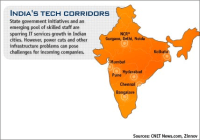
As per industry estimates, India’s IT and BPO sector (excluding hardware) revenues were $87.6 billion in 2011-2012 (a growth of 14.8 per cent) – $68.7 billion exports and $19 billion domestic, while it generated direct employment for nearly 2.8 million people and indirect for around 8.9 million people.

As a proportion of national GDP, IT and ITeS sector revenues have grown from 1.2 per cent in 1997-98 to around 7.5 per cent in 2011-12. “Consistent demand from the U.S., which increased its share from 61.5 per cent to 62 per cent, characterised 2011-12. Emerging markets of the Asia Pacific and the rest of the world also contributed to overall growth,” the Survey pointed out.

Referring to future strategy for the sector, the Survey said the government had been a key catalyst for increased IT adoption – through sector reforms that encouraged IT acceptance, National e-Governance Plan (NeGP), and the Unique Identification Development Authority of India (UIDAI) programme that created large-scale IT infrastructure and promoted corporate participation.

Talking about electronics hardware production, the Survey said it was expected to grow by 27.6 per cent in 2011-12 and cross Rs.1.55-lakh crore ($33 billion). Electronics hardware exports is expected to grow by 12.8 per cent and cross Rs.47,090 crore ($10 billion) in 2011-12 as against Rs.41,721 core ($8.86 billion) in 2010-11. In its recently released draft, the National Policy on Electronics (NPE), the government projected that the electronics system design and manufacturing industry was likely to reach a turnover of $400 billion by 2020, involving investment of about $100 billion, besides creating 28 million jobs.”

via The Hindu : News / National : Centre changes strategy to stay competitive globally in IT sector.

16/03/2012

* India to be a youngest nation by 2020

The Hindu: “India will be one of the youngest nations by 2020 and this changing demographic condition, while providing great opportunities, could pose some challenges too, the Economic Survey 2011-12 has said.

India is passing through a phase of unprecedented demographic changes, wherein the proportion of the working age population (15-59 years) is likely to rise from around 58 per cent in 2001 to over 64 per cent by 2021, according to the Survey. The comparative figures for China and the U.S. are 37 years, while it is 45 for West Europe and 48 Japan.

The ‘demographic dividend’ would pose a challenge, as the average Indian will be only 29 years old in 2020, the Survey notes. In absolute numbers, there will be around 63.5 million new entrants to the working age group between 2011 and 2016. These changes are likely to contribute to a substantially increased labour force. However, it will benefit India only if the population is “healthy, educated, and appropriately skilled.”

The bulk of this increase is likely to take place in the relatively younger age group of 20-35. According to the Human Development Report (HDR) published by the United Nations Development Programme (UNDP), India is still in the ‘medium human development’ category, while countries such as China, Sri Lanka, Thailand, Philippines, Egypt, Indonesia, South Africa, and Vietnam have a better rank.

Notwithstanding the fact that life expectancy in India has increased by one percentage point from 64.4 in 2010 to 65.4 in 2011, it was way behind the global average and some other nations, including Sri Lanka. Life expectancy at birth in Norway was 81.1 years, Australia (81.9), Sri Lanka (74.9), China (73.5), while the global average was 69.8 years.

Similarly, the performance of India in terms of mean years of schooling is not only much below that of countries such as Sri Lanka, China, and Egypt, which have higher per capita incomes, but also below that of Pakistan, Bangladesh, and Vietnam that have lower per capita incomes. It is also much lower than the global average.

In terms of the gender inequality index, there is a higher degree of gender discrimination in India compared to countries such as China, Pakistan, Bangladesh, Bhutan and Sri Lanka, as also the global average.”

via The Hindu : News / National : India to be a youngest nation by 2020.

The young Indian population is one of the main reasons some economists cite to predict that India will overtake China sometime during the 21st Century.

Related page: https://chindia-alert.org/prognosis/and-india/

Tags:
14/03/2012

* Stephen Roach on the consumer opportunity in China

McKinsey: “Focusing on exports to the world’s second-largest economy will help the United States generate growth and jobs, says Morgan Stanley Asia’s former non-executive chairman.

A year ago, the National People’s Congress enacted China’s 12th five-year plan, which included three main building blocks: a greater focus on jobs, urbanization to boost wages, and financing a social safety net that encourages families to spend rather than save. Stephen Roach, a professor at Yale University and former nonexecutive chairman of Morgan Stanley Asia, says that this document’s implementation is marking a major shift in China’s model, away from exports and investment and toward internal, private consumption. Therein lies a huge opportunity for other nations to benefit from the emergence of the world’s largest consumer population.

China, currently the biggest and most rapidly growing US export market, is well on its way to “create a consumption dynamic that will outstrip the growth of any consumer market in the world,” Roach asserts—“and shame on us if we’re not a part of that.” In this video, Roach explains how China must turn to internal demand to drive economic development and prosperity and why improving the testy China–US bilateral relationship is so critical for the economic future of both countries. McKinsey Publishing’s Rik Kirkland conducted the interview at the World Economic Forum, in Davos, in January 2012.”

via Stephen Roach on the consumer opportunity in China – McKinsey Quarterly – Retail & Consumer Goods – Sectors & Regions.

Related page: https://chindia-alert.org/economic-factors/consumerism-blossoms/

14/03/2012

* (Indian) Rail Budget directionless, anti-people: BJ Party

The Hindu: “The Bharatiya Janata Party on Wednesday termed the Railway Budget as “directionless” and “anti-people”, saying it will add to the woes of the common man already facing the brunt of spiralling prices.

“It is a directionless and anti-people budget,” BJP’s vice-president Mukhtar Abbas Naqvi said, adding that without taking effective steps for ensuring security, facility and time, “announcements have been made for an expensive journey”.

He said at a time when the common man was already under attack from the burden of price rise and inflation, “the railway budget has given another bigger blow”.

Mr. Naqvi said, “While the Railway Minister has announced a five-year plan for taking care of security, facility and time, the burden of increased fare has been slapped on the common man in five minutes.”

BJP general secretary Ananth Kumar said the Rail Budget was “anti-aam aadmi” and there was no vision in the budget. “There is no vision. There is no action and passenger has been raised… prices will shoot up,” he said.”

via The Hindu : News / National : Rail Budget directionless, anti-people: BJP.

See also other (supportive) post today on the Railway Budget.

14/03/2012

* Indian PM Manmohan terms Rail Budget forward-looking

The Hindu: “Prime Minister Manmohan Singh on Wednesday hailed as “forward-looking” the Rail Budget which has proposed hike in passenger fares in various ranges in different categories.

“The Railway Minister has presented a forward-looking budget with emphasis on safety and modernisation of the Indian Railways,” Dr.

indian railways

indian railways (Photo credit: peevee@ds)

Singh said in a statement. He said the budget has been formulated against the background of the Railways’ responsibilities in meeting the demands of the 12th Five Year Plan.

Presenting his first budget, Railway Minister Dinesh Trivedi announced hike in passenger fares ranging from 2 paisa per kilometre to 30 paisa per kilometre in various categories of trains while noting that the Railways was passing through a “difficult phase”. He also announced introduction of 75 express trains, 21 passenger trains and extension of 39 trains besides increase in the frequency of 23 trains.”

via The Hindu : News / National : Manmohan terms Rail Budget forward-looking.

See also other (opposing) post today on Indian railway budget.

13/03/2012

* China’s Q1 foreign trade with other BRICS nations surges

BRICS summit participants: Prime Minister of I...

Image via Wikipedia

Xinhua: “China’s top customs authority announced Friday that the country’s foreign trade with the other four BRICS nations surged by 45.8 percent to reach 59.9 billion U.S. dollars in the first quarter of this year.

The first-quarter foreign trade growth between China and the other four nations of BRICS (an acronym for Brazil, Russia, India, China and South Africa), was 16.3 percentage points higher than China’s average foreign trade growth during the period, China’s General Administration of Customs said in a statement on its website.

During the first three months, China’s imports from the other BRICS countries reached 33.05 billion U.S. dollars, up 57.2 percent year on year. Exports to those countries hit 26.85 billion yuan, up 33.8 percent. …

Q1 bilateral trade between China and India rose 25.2 percent to 17.63 billion U.S. dollars. Trade with Brazil surged 58.9 percent to 16.11 billion U.S dollars, while that with Russia rose 33.5 percent to 15.99 billion U.S. dollars. Bilateral trade between China and South Africa increased more than one fold to 10.16 billion U.S. dollars.”

via China’s Q1 foreign trade with other BRICS nations surges.

It used to be BRIC, since 2010 it has become BRICS to include South Africa. http://en.wikipedia.org/wiki/BRICS

Related Page: https://chindia-alert.org/economic-factors/

13/03/2012

* Japan to buy $10b Chinese govt bond

China Daily: “Japan got the permission from China to purchase 65 billion yuan (about $10.3 billion) worth of Chinese government bond, Japanese Finance Minister Jun Azumi said Tuesday.

It was the first time the Japanese government announced the specific figure of its permitted allotment of Chinese government bond.

Azumi told reporters that the size was “appropriate” in view of strengthening the economic ties between the two countries.”

via Japan to buy $10b Chinese govt bond|Economy|chinadaily.com.cn.

Another small but sure step towards establishing the Yuan as an international currency.

Related Page: https://chindia-alert.org/political-factors/geopolitics-chinese/

11/03/2012

* A tale of two (Chinese) regions

China Daily: “China’s economic development over the last 30 years has been “a tale of two regions” — prosperous coastal areas where GDP matches some developed countries and inland areas that have lagged behind. …

In 2011, China laid out a 10-year development plan for the middle and western areas of the country, demarcating 14 impoverished regions and creating development plans for each region. Three of the 14 regions are in southwest China’s Guizhou province, which has a total of 65 counties listed as impoverished.

“When these areas develop, it will help to effectively close the gap with the eastern part of the country,” said Li Zhanshu, secretary of the Guizhou provincial committee of the Communist Party of China and a deputy to the National People’s Congress (NPC), which is meeting now in Beijing.

The gap between the coast and many other parts of China is indeed large. From 1978 to 2011 per capita GDP in coastal Zhejiang province has risen on average 11.6 percent per year to $9,000 in 2011, far above the national average. This figure is about three times the amount for Tibet and Gansu province, in China’s west.

Closing this gap has been a major topic of the current annual NPC session and the concurrent meeting of the Chinese People’s Political Consultative Conference, China’s leading political advisory body.”

via A tale of two regions|Economy|chinadaily.com.cn.

Given China’s success at creating a major ‘municipality’ of Chongqing in 1997 to act as a magnet in the centre of China, we shouldn’t be surprised if in 15 years these impoverished regions start to become more like the coastal regions of China.

Related page: https://chindia-alert.org/prognosis/chinese-challenges/

09/03/2012

* Indian government clears distribution of 5 million tablet PCs in schools, colleges

The Hindu: “In a move that will give a big push to broadband penetration in the country, the Department of Telecommunications (DoT) has cleared an ambitious plan to distribute 50-lakh (5 million) tablet PCs (personal computers) to students in the next financial year (2012-13). A note containing the nitty-gritty of the ambitious Aakash-2 project is likely to be placed before the Cabinet soon. …

The government wants to initially assemble the tablet PCs through its public sector undertakings (PSUs) and eventually indigenise it to maintain cost-competitiveness.

The DoT has declared that the Centre for Development of Advanced Computing (C-DAC), the research and design wing of the Department of Information Technology, will be the nodal agency for successfully implementing the Aakash-2 project. It will be assisted by the Indian Institute of Technology-Mumbai. They will be responsible for finalising specifications, ensuring quality and testing the tablet PCs. The DoT has decided to rope in two PSUs — Bharat Electronics Ltd and ITI Ltd — for manufacturing and procuring the tablet PCs that will be priced between $55 and $70 (around Rs.2,750 and Rs.3,500).”

via The Hindu : Sci-Tech / Gadgets : DoT clears distribution of 50 lakh tablet PCs in schools, colleges.

This initiative will help push India further into the information era both in terms of the next generation of knowledge workers as well as in terms of hardware development.

Related page: https://chindia-alert.org/economic-factors/information-technology/

06/03/2012

* China’s debt-to-GDP ratio hits 43%

China Daily: “China‘s government debt amounts to about 17.5 trillion yuan ($2.78 trillion), about 43 percent of the country’s gross domestic product, Yang Kaisheng, president of the Industrial and Commercial Bank of China, said Tuesday.

The debt is composed of 10.7 trillion yuan ($1.7 trillion) of local government debt and 6.8 trillion yuan ($1.07 trillion) of central government debt, Yang said at a press conference on the sidelines of China’s annual parliamentary session.”.

via China’s debt-to-GDP ratio hits 43%|Economy|chinadaily.com.cn.

This is shocking news as a year ago (2010) the ratio was only 17.5%! Of course, earlier we blogged about the parlous state of local government debt rising astronomically. This is the result.  ;-(

See: http://www.economicshelp.org/blog/774/economics/list-of-national-debt-by-country/

Some of us are so riveted by China’s trade surplus of some $3 trillion, that we forget about its debt ratio. In other words, China is behaving only slightly more frugally than many Western nations. The only difference *and it is an important one) uis that the trade surplus does (just about) cover the debt.  😉

Law of Unintended Consequences

continuously updated blog about China & India

ChiaHou's Book Reviews

continuously updated blog about China & India

What's wrong with the world; and its economy

continuously updated blog about China & India