Chindia Alert: You’ll be Living in their World Very Soon
aims to alert you to the threats and opportunities that China and India present. China and India require serious attention; case of ‘hidden dragon and crouching tiger’.
Without this attention, governments, businesses and, indeed, individuals may find themselves at a great disadvantage sooner rather than later.
The POSTs (front webpages) are mainly 'cuttings' from reliable sources, updated continuously.
The PAGEs (see Tabs, above) attempt to make the information more meaningful by putting some structure to the information we have researched and assembled since 2006.
Failure to strike a deal would have seen tariffs on $200bn worth of Chinese goods rise from 10% to 25% at the start of next year, and would have opened the way for tariffs on additional Chinese goods.
On Monday, China’s foreign ministry said the presidents of China and the US had instructed their economic teams to work towards removing all tariffs following the G20 meeting,
But it didn’t say if that was a plan with specifics or something that was merely desirable.
Asian markets rallied after news of the trade war truce. In China, Hong Kong’s Hang Seng index climbed 2.5% and the Shanghai Composite index jumped 2.6%. Japan’s Nikkei 225 index rose 1%.
The gains spread to Europe, with the UK’s FTSE 100 index, the Cac 40 in France and Germany’s Dax index all up by about 2% in early trade.
The trade war has seen the US and China hit each other with escalating tariffs in an attempt to make their domestically made goods more competitive.
The US says its tariff policy is a response to China’s “unfair” trade practices and accuses it of intellectual property theft.
Since July, the US has hit China with tariffs on $250bn (£195.9bn) worth of goods. China has retaliated with duties on some $110bn of US goods over the same period.
As part of this, the US imposed a 25% tariff on Chinese cars, on top of the 2.5% already in place.
In July, China, which is the world’s largest market for cars, imposed a 40% tariff on US vehicle imports. The rate is much higher than the 15% it places on other trading partners and forced many carmakers to raise prices.
In his tweet, President Trump said Beijing had “agreed to reduce and remove tariffs on cars coming into China from the US”.
He did not provide a new level for the Chinese tariffs, and Beijing did not immediately confirm the statement.
What was agreed at the G20?
In a statement, the White House said US tariffs on Chinese goods would remain unchanged for 90 days, but added: “If at the end of this period of time, the parties are unable to reach an agreement, the 10 percent tariffs will be raised to 25 percent.”
Image captionThe US manufactures cars for export to China, the world’s largest car market
The US said China agreed to “purchase a not yet agreed upon, but very substantial, amount of agricultural, energy, industrial, and other products from the United States to reduce the trade imbalance between our two countries”.
Both sides also pledged to “immediately begin negotiations on structural changes with respect to forced technology transfer, intellectual property protection, non-tariff barriers, cyber intrusions and cyber theft”, according to the White House.
Chinese Foreign Minister Wang Yi told reporters after the talks that “the principal agreement has effectively prevented further expansion of economic friction between the two countries”.
Are tariffs still in place?
Yes. The truce prevents raising tariffs as planned on $200bn worth of Chinese goods.
But it does not remove tariffs that apply to a total of $250bn of Chinese goods targeted since July.
The truce also does not affect the existing duties China has imposed on $110bn of US goods in a tit for tat retaliation.
Will this resolve the dispute?
While the result of the G20 meeting was better than expected, it is unclear how the two countries will manage to resolve their underlying differences.
“There should be no wishful thinking that the truce would end the trade war between the world’s two largest economies,” DBS strategist Philip Wee wrote in a research note.
He said it “remains to be seen if real progress could be achieved during this narrow window to resolve the contentious issues, not just on trade, but also intellectual property”.
Louis Kuijs, head of Asia economics at Oxford Economics, said while the agreement itself was “positive” the next steps remained unclear.
“Whether we will see further de-escalation or whether it is temporary reprieve continues to be very much up to a political decision in Washington DC – that will continue to make this uncertain,” Louis Kuijs, head of Asia economics at Oxford Economics said.
India’s new billionaires have accumulated more money, more quickly, than plutocrats in almost any country in history. By James Crabtree
On 3 May, at around 4.45pm, a short, trim Indian man walked quickly down London’s Old Compton Street, his head bowed as if trying not to be seen. From his seat by the window of a nearby noodle bar, Anuvab Pal recognised him instantly. “He is tiny, and his face had been all over every newspaper in India,” Pal recalled. “I knew it was him.”
Few in Britain would have given the passing figure a second look. And that, in a way, was the point. The man pacing through Soho on that Wednesday night was Nirav Modi: Indian jeweller, billionaire and international fugitive.
In February, Modi had fled his home country after an alleged $1.8bn fraud case in which the tycoon was accused of abusing a system that allowed his business to obtain cash advances illegally from one of India’s largest banks. Since then, his whereabouts had been a mystery. Indian newspapers speculated that he might be holed up in Hong Kong or New York. Indian courts issued warrants for his arrest, and the police tried, ineffectually, to track him down.
It was only by chance that Pal spotted him. A standup comic normally based in Mumbai, he happened to be in London for a run of gigs. “My ritual was to go to the same noodle bar, have a meal, and then head to the theatre,” Pal said. “I always sat by the window. And then suddenly Modi walks past. He was unshaven, and had those Apple earphones, the wireless ones. He looked like he was in a hurry.”
It was another month before the press finally caught up with Modi, as reports of his whereabouts emerged in June, along with the suggestion that he was planning to claim political asylum in the UK. (Modi denies wrongdoing, and did not respond to requests for comment.) In the process, Modi also gained entry into one of London’s more notorious fraternities: the small club of Indian billionaires who seem to end up in the British capital following scandals back at home.
The most prominent among these émigré moguls is India’s “King of Good Times”, Vijay Mallya, the one-time aviation magnate and brewer, who transformed Kingfisher beer into a global brand. A few years ago, Mallya was one of India’s most celebrated industrialists, famous for his mullet haircut and flamboyant lifestyle. But in early 2016, Indian authorities filed charges relating to the collapse of his Kingfisher airline, which went bust in spectacular fashion in 2012, leaving behind mountainous debts and irate, unpaid staff. And so, facing allegations of financial irregularities and of refusing to repay outstanding loans, Mallya quietly boarded a plane for Britain, too.
Like Modi, Mallya denies wrongdoing. Last month he released a long statement accusing India’s government of conducting a witch-hunt against him. And to the extent that this claim has some merit, it is because Indian prime minister Narendra Modi (no relation to Nirav Modi) has of late been under great pressure to bring supposedly errant tycoons such as Mallya to book.
Men like Mallya and Modi were members of India’s expanding billionaire class, of whom there are now 119 members, according to Forbes magazine.Last year their collective worth amounted to $440bn – more than in any other country, bar the US and China. By contrast, the average person in India earns barely $1,700 a year. Given its early stage of economic development, India’s new hyper-wealthy elite have accumulated more money, more quickly, than their plutocratic peers in almost any country in history.
A cardboard cut-out of billionaire jeweller Nirav Modi at a protest against him in New Delhi in February. Photograph: Chandan Khanna/AFP/Getty Images
Narendra Modi won an overwhelming election victory in 2014, having promised to put a stop to the spate of corruption scandals that had dogged India for much of the previous decade. Many involved prominent industrialists – some directly accused of corruption, while others had simply mismanaged their finances and miraculously managed to escape the consequences. Voters turned to Narendra Modi, the self-described son of a poor tea-seller, hoping he would deliver a new era of clean governance and rapid growth, ridding India of a growing reputation for crony capitalism.
Narendra Modi pledged to end a situation in which the country’s ultra-wealthy – sometimes called “Bollygarchs” – appeared to live by one set of rules, while India’s 1.3 billion people operated by another. Yet as they continue to hide out in cities like London, men like Mallya and Nirav Modi have come to be seen as representing the failure of that pledge; the Indian authorities “have a long road ahead”, as one headline put it in the Hindustan Times last year, referring to a “long and arduous” future extradition process in Mallya’s case.
And as Narendra Modi gears up for a tough re-election battle next year, he is fighting the perception that India is unable to bring such men to heel, and that it has been powerless to respond to the rise of this new moneyed elite and the scandals that have come with them. “This ongoing battle to get India’s big tycoons to play by the rules is one of the biggest challenges we face,” says Reuben Abraham, chief executive of the IDFC Institute, a Mumbai-based think-tank. “Getting it right is central to India’s economic and political future.”
India has long been a stratified society, marked by divisions of caste, race and religion. Prior to the country winning independence in 1947, its people were subjugated by imperial British administrators and myriad maharajas, and the feudal regional monarchies over which they presided. Even afterwards, India remained a grimly poor country, as its socialist leadership fashioned a notably inefficient state-planned economic model, closed off almost entirely from global trade. Over time, India grew more equal, if only in the limited sense that its elite remained poor by the standards of the industrialised west.
But no longer: the last three decades have seen an extraordinary explosion of wealth at the top of Indian society. In the mid-1990s, just two Indians featured in the annual Forbes billionaire list, racking up around $3bn between them. But against a backdrop of the gradual economic re-opening that began in 1991, this has quickly changed. By 2016, India had 84 entries on the Forbes billionaire list. Its economy was then worth around $2.3tn, according to the World Bank. China reached that level of GDP in 2006, but with just 10 billionaires to show for it. At the same stage of development, India had created eight times as many.
In part, this wealth is to be welcomed. This year India will be the world’s fastest-growing major economy. During the last two decades, it has grown more quickly than at any point its history, a record of economic expansion that helped to lift hundreds of millions out of poverty.
Nonetheless, India remains a poor country: in 2016, to be counted among its richest 1% required assets of just $32,892, according to research from Credit Suisse. Meanwhile, the top 10% of earners now take around 55% of all national income – the highest rate for any large country in the world.
Put another way, India has created a model of development in which the proceeds of growth flow unusually quickly to the very top. Yet perhaps because Indian society has long been deeply stratified, this dramatic increase in inequality has not received as much global attention as it deserves. For nearly a century prior to independence, India was governed by the British Raj – a term taken from the Sanskrit rājya, meaning “rule”. For half a century after 1947, a system dominated by pernickety industrial rules emerged, often known as the Licence-Permit-Quota Raj, or Licence Raj for short. Now a system has grown in their place once again: the billionaire Raj.
The rise of India’s super-rich – the first and most obvious manifestation of the billionaire Raj – was propelled by domestic economic reforms. Starting slowly in the 1980s, and then more dramatically against the backdrop of a wrenching financial crisis in 1991, India dismantled the dusty stockade of rules and tariffs that made up the Licence Raj. Companies that had been cosseted under the old regime were cleared out via a mix of deregulation, foreign investment and heightened competition. In sector after sector, from airlines and banks to steel and telecoms, the ranks of India’s tycoons began to swell.
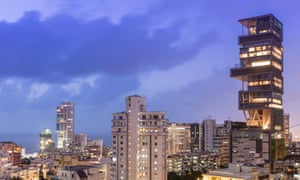
Nothing symbolises the power of this billionaire class more starkly than Antilia, the residential skyscraper built in Mumbai by Mukesh Ambani, India’s richest man. Rising 173 metres above India’s financial capital, the steel-and-glass tower is rumoured to have cost more than $1bn to build, looming over a city in which half the population still live in slums.
The Antilia building, at right of photograph, in Mumbai. Photograph: Alamy
Ambani owns Reliance Industries, an empire with interests stretching from petrochemicals to telecoms. (His father, Dhirubhai, from whom he inherited his company, was one of the main beneficiaries of the economic reforms of the 1980s.) At Antilia, Ambani entertains guests in a grand, chandeliered ballroom that takes up most of building’s ground floor. There are six storeys of parking for the family’s car collection, while the tower’s higher levels feature opulent apartments and hanging gardens. Further down, in sub-basement 2, the Ambanis keep a recreational floor, which includes an indoor football pitch. Antilia became an instant landmark upon its completion in 2010. The city had long been a place of stark divisions, yet the Ambani’s home almost seemed to magnify this segregation. (A spokesman for Reliance did not respond to a request for comment.)
The emergence of the Indian super-rich was bound up in larger global story. The early 2000s were the heyday of the so-called “great moderation”, when world interest rates stayed low and industrialised nations grew handsomely. This was also when the fortunes of India’s new tycoons began to change. Pumped up by foreign money, domestic bank loans and a surging sense of self-belief, industrialists went on a spending spree. Ambani dumped billions into oil refineries and petrochemical plants. Vijay Mallya spent heavily on new fleets of Airbus jets. Nirav Modi began building a global chain of jewellery stores. Stock markets boomed. From 2004 to 2014, India enjoyed the fastest expansion in its history, averaging growth of more than 8% a year.
The boom years brought benefits, most obviously by reintegrating India into the world economy. Yet this whirlwind growth also proved economically disruptive, socially bruising and environmentally destructive, leaving behind what the writer Rana Dasgupta describes as a sense of national trauma. India’s new wealth has been shared remarkably unevenly, too. Its richest 1% earned about 7% of national income in 1980; that figure rocketed to 22% by 2014, according to the World Inequality Report. Over the same period, the share held by the bottom 50% plunged from 23% to just 15%.
Unsurprisingly, some feel resentful. “You walk around the streets of this city, and the rage at Antilia has to be heard to be believed,” Meera Sanyal, a former international banker turned local anti-corruption campaigner, told me in 2014. Six years before that, in 2008, as the scale of India’s billionaire fortunes were becoming clear, Raghuram Rajan – an economist who would later become the head of India’s central bank – asked an even more pointed question about his country’s tycoon class: “If Russia is an oligarchy, how long can we resist calling India one?”
Back in London, Vijay Mallya feels unjustly targeted by India’s recent attempts to shed its reputation for crony capitalism, the second defining characteristic of the billionaire Raj. “I have been accused by politicians and the media alike of having stolen and run away with Rs 9,000 crores [90bn rupees, or $1.3bn] that was loaned to Kingfisher Airlines,” he wrote in his open letter last month. His case had become, he suggested, a “lightning rod for public anger” over the alleged misbehaviour of his fellow tycoons.
In spring 2017, I met Mallya at his London home, a Grade I-listed town house a short walk from Baker Street tube station. A variety of Rolls-Royces and Bentleys were parked along the mews at the rear, alongside a fat silver Maybach with the number plate VJM 1, which idled outside Mallya’s back door. Inside, he sheltered behind a grand wooden table, a gold lighter and two mobile phones lined up in front of him. At one point I asked to be excused to visit the toilet. A flunky ushered me into a golden bathroom, with a shiny gold seat to match its golden taps and loo-roll holder. The fluffy hand towels were white, but each one came embossed with the letters “VJM” in gold thread.
On the surface, Mallya still seemed every bit the ebullient tycoon of old: a bulky man in a red polo shirt, with gold bracelets on each wrist and a chunky diamond ear stud. But by then he had been stuck in Britain for more than a year, and grew downbeat as the afternoon wound on and our conversation turned to his business troubles and the state of his homeland. “India has corruption running in its veins,” he said with a sigh. “And that’s not something one is going to change overnight.”
With his shoulder-length hair and taste for bling, Mallya had long honed an image as the most piratical of India’s generation of entrepreneurs. A specially kitted-out Boeing 727, its bar well-stocked with his own Kingfisher beer, whisked him between parties and business meetings – a distinction that was, in any case, often hazy. “It was all a bit ridiculous,” one ex-board member at a Mallya company told me.
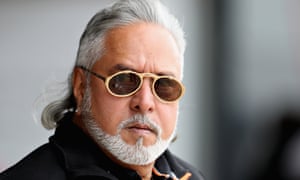
Vijay Mallya, who fled India for London in 2016. Photograph: Mark Thompson/Getty Images
Now marooned in London, Mallya had plenty of time to ponder his missteps. Once a member of the Rajya Sabha, the Indian upper house of parliament, his diplomatic passport has been cancelled. As a long-time UK resident, he was permitted to stay in the country, but without travel documents he was unable to travel, curtailing his notorious jet-setting lifestyle almost entirely. Earlier this month, a UK court issued an order allowing authorities trying to recover debts to enter his various British properties.
In his pomp, Mallya seemed to represent a new India. In a country whose old commercial elite had been dominated by cautious, discreet industrialists, Mallya was different: rich, powerful and not inclined to hide it. Not all of India’s pioneers behaved in this way – its software and IT billionaires, for instance, were typically less flamboyant figures. But while Mallya continues to deny that he did anything wrong, he admits that he has become what he calls the “poster boy” for a moment of public anger against India’s rich, as many newly wealthy business figures found themselves mired in allegations of wrongdoing.
India’s old system created fertile ground for corruption, forcing citizens and businesses alike to pay myriad bribes for basic state services. But these humdrum problems were trivial compared with the grand scandals that emerged during the 2000s. Assets worth billions were gifted under the table to big tycoons by senior politicians and bureaucrats in what became known as the “season of scams”. Giant kickbacks helped businesses acquire land, bypass environmental rules and win infrastructure contracts. Headlines filled up with fresh outrages, from fraudulent public housing schemes to dodgy road-building projects.
Many of those who backed India’s economic reforms hoped that a more free-market economy would lead to more honest government. Instead, crony capitalism infiltrated almost every area of national life. Hundreds of billions of dollars were siphoned away, according to some estimates, by a shadowy alliance of colluding politicians and business tycoons. India’s old system of retail corruption went wholesale.
Many politicians also became astoundingly rich, and would have made the Forbes list had their holdings not been hidden carefully in shell companies and foreign banks. Rapid economic growth increased the value of political power, and what could be extracted from it. Political parties had to raise more money, to fight elections and fund the patronage that kept them in office. One estimate suggested that India’s 2014 election cost close to $5bn, a huge increase over the cheap and cheerful polls of the pre-liberalisation era. Election experts believe most of this money is brought in illegally from favoured tycoons, in exchange for unknown future favours.
Politicians spend the money to fund campaigns, but also on handing out favours, jobs and cash to constituents. “It’s sort of an unholy nexus,” as Raghuram Rajan put it to me during his tenure as head of India’s central bank. “Poor public services? Politician fills the gap; politician gets the resources from the businessman; politician gets re-elected by the electorate for whom he’s filling the gap.”
This nexus between business and politics lies at the heart of the third problem of India’s billionaire Raj, namely the boom-and-bust cycle of its industrial economy. In recent decades, China went on the largest infrastructure building spree in history, but almost all of it was delivered by state-backed companies. By contrast, India’s mid-2000s boom was dominated almost exclusively by its private-sector tycoons, giving the industrialists and the conglomerates they run a position of outsized importance in India’s economic development.
Bollygarchs borrowed huge sums from state-backed banks and invested with gleeful abandon, in one of the largest deployments of private capital since America built its railroad network 150 years earlier. But when India’s good times came to an end after the global financial crisis, the tycoons’ hubris was exposed, leaving their businesses over-stretched and struggling to repay their debts. In 2017, 10 years on from the crisis, India’s banks were still left holding at least $150bn of bad assets.
Since taking office, Narendra Modi has tried, often ineffectually, to fix this corporate- and bank-debt crisis, alongside the related problems of cronyism and the super-rich that contributed to it. Watching developments such as these, some argue that the power of India’s tycoon class is fading. Yet India’s ultra-wealthy are still thriving, while its ranks of billionaires keep swelling, and will continue to do so.
There is every reason to believe that on its current course, the country’s the gap between rich and poor will widen, too. Perversely, the closer India comes to its achieving its ambitions of Chinese-style double-digit levels of economic growth, the faster this will happen. On most measures, it should already be ranked alongside South Africa and Brazil as one of the world’s least-equal countries. Even more importantly, poor countries that start off with high levels of inequality often struggle to reverse that trend as they grow richer.
Many experts believe India needs to act. “The main danger with extreme inequality is that if you don’t solve this through peaceful and democratic institutions then it will be solved in other ways … and that’s extremely frightening,” as French economist Thomas Piketty has said of India’s future, pointing to likely rising future tensions between the wealthy and the rest.
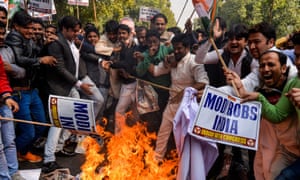
Protesters burning an effigy of Nirav Modi in New Delhi in February. Photograph: Chandan Khanna/AFP/Getty Images
India is now entering a new phase of development, as it tries to follow Asian economies such as South Korea and Malaysia out of poverty and towards full “middle-income” status. There is no reason this cannot happen. But as we’ve seen in Latin America, the economies with the widest social divides have tended to be the ones that are most likely to get stuck in the “middle-income trap”, achieving moderate prosperity but failing to become rich. The more successful countries of east Asia, by contrast, grew prosperous while managing to stay egalitarian, partly by building basic social safety nets and ensuring that their wealthiest citizens paid their taxes. Of the two models, it seems clear which India should want to follow.
Much the same is true of corruption. India’s old system of cronyism, with its political favours and risk-free bank loans, has came under intense scrutiny, but the battle against corruption is at best half-won. Kickbacks still dominate swathes of public life, from land purchase to municipal contracts. State and city governments are just as venal as ever. Surveys report that India remains Asia’s most bribe-ridden nation. “For any society to lift itself out of absolute poverty, it needs to build three critical state institutions: taxation, law and security,” according to the economist Paul Collier. All three in India – the revenue service, the lower levels of the judiciary and the police – still suffer endemic corruption. Perhaps most importantly, the country’s under-the-table political funding system remains largely untouched.
Progress in fixing India’s problems of corporate and bank debt has also been frustratingly slow. Modi has introduced some important measures, including a new bankruptcy law and a series of bank recapitalisations. But more radical options have been ignored, notably the privatisation of struggling public-sector lenders.
If these struggles sound familiar, that is because they are. India is far from the first country to enjoy a period of rampant cronyism and wild growth, and then grapple with how to respond. In Britain, the onset of the industrial revolution in the mid-19th century kicked off such a moment, as captured in the novels of Charles Dickens and Anthony Trollope. But the more obvious parallel is with America, and the era between the end of the civil war in 1865 and the turn of the 20th century: the Gilded Age, or the era of “the great corporation, the crass plutocrat [and] the calculating political boss”, as one historian put it.
India’s own Gilded Age is different in many ways, but it shares at least one characteristic – namely, that such a period of early industrialisation is also a time of rapid political and economic change, in which it should be possible to invoke what the philosopher Richard Rorty once called the “romance of a national future”, the sense of hope that infuses powers on the rise.
India is set to grow in economic might throughout this century, as America did during the 19th. By some accounts, it has already overtaken China as the world’s most populous nation; in others, the baton will pass during the next decade or two. Whatever the case, the fate of a large slice of humanity depends on India getting its economic model right. Meanwhile, as democracy falters in the west, so its future in India has never been more critical. To make this transition, India’s billionaire Raj must become a passing phase, not a permanent condition. India’s ambition to lead the second half of the “Asian century” – and the world’s hopes for a fairer and more democratic future – depend on getting this transition right.
The Billionaire Raj: A Journey Through India’s New Gilded Age by James Crabtree is published by Oneworld, and available at guardianbookshop.com
China’s densely populated cities are making it easier for companies to deliver everything from food takeout to large appliances quickly and at cheaper rates than other parts of the world. China boasts 156 cities with over 1 million people, compared with just 10 in the United States. This density has enabled Chinese companies to build an elaborate supply chain network that ships more than 140 million parcels a day and makes China the world’s largest eCommerce market, according to Ronald Keung of Goldman Sachs Research. Keung notes that the nation’s online retail segment is projected to reach $2 trillion by 2020.
The strong logistics supply chain is currently the key driver of much higher online penetration in China that will lead the rest of the world.
Chinese President Xi Jinping(C), Russian President Vladimir Putin and Indian Prime Minister Narendra Modi hold an informal meeting in Buenos Aires, Argentina, Nov. 30, 2018. Leaders of China, Russia and India had an in-depth exchange of views on cooperation among their countries under new circumstances at the meeting. (Xinhua/Yao Dawei)
BUENOS AIRES, Nov. 30 (Xinhua) — Leaders of China, Russia and India had an in-depth exchange of views on cooperation among their countries under new circumstances at an informal meeting held here Friday on the sidelines of the Group of 20 (G20) summit.
Chinese President Xi Jinping, Russian President Vladimir Putin and Indian Prime Minister Narendra Modi agreed to strengthen coordination, build consensus and increase cooperation among their countries to jointly promote world peace, stability and development.
Xi pointed out that China, Russia and India are all major countries of important influence, and they are each other’s important strategic cooperation partners.
The three countries have extensive common interest and similar development goals, and bear great responsibility for the future of the region and the world as a whole, Xi said.
Common development and close cooperation among China, Russia and India under current circumstances have become an increasingly important force for stability and certainty in the transformation of the world landscape, Xi said.
In the past over 10 years, Xi said, the three countries have actively conducted trilateral dialogue and cooperation in the spirit of openness, unity, mutual understanding and trust, and have made important progress.
He called on the countries to further advance trilateral cooperation in the face of fresh challenges.
He suggested that China, Russia and India advocate a new type of international relations, keep consolidating political mutual trust, establish partnerships instead of alliances, and strive for a virtuous cycle in major-country relations and win-win cooperation.
He also called on the three countries to strengthen coordination and cooperation in important multilateral mechanisms including the Group of 20, BRICS and Shanghai Cooperation Organization.
China, Russia and India should advance liberalization and facilitation of trade and investment, promote an open world economy, take a clear-cut stand against protectionism and unilateralism, and jointly safeguard the multilateral trading system as well as the common interest of emerging economies and developing countries, he said.
The three countries, he added, should actively champion a vision of common, comprehensive, cooperative and sustainable security, strengthen regional and global counterterrorism cooperation, promote political settlement of hotspot issues, and play an even bigger part in safeguarding peace and security in the region and the world.
For his part, Putin said Russia, China and India are friendly countries to each other and have developed sound relations based on equality and mutual respect.
Under the current circumstances, it serves the interest of all three countries and bears positive significance on the world that Russia, China and India strengthen cooperation, he said.
He called on the three countries to dedicate themselves to building a fairer and more just international system, promoting world peace and stability, strengthening cooperation in economy and finance and on issues on the G20 agenda, and boosting the synergy between the Eurasian Economic Union and the Belt and Road Initiative.
In his remarks, Modi said it is very necessary for the three countries to compare notes on major issues faced by today’s world.
There are increasing uncertainties on the international horizon, with rising unilateralism and cliquism posing challenges to multilateralism, he said.
Modi said developed countries have failed to meet their assistance commitments to developing countries, and that there is a long way to go before the realization of the 2030 Sustainable Development Goals.
India, China and Russia, as major countries in the world, have the responsibility to maintain close communication, and actively play their parts in safeguarding international and regional stability, promoting economic prosperity, sharing development experience and jointly meeting new challenges, so as to safeguard multilateralism and maintain the multilateral system, he added.
The three leaders agreed to further strengthen the cooperation mechanism among their countries.
BUENOS AIRES, Nov. 30 (Xinhua) — Leaders of China, Russia and India had an in-depth exchange of views on cooperation among their countries under new circumstances at an informal meeting held here Friday on the sidelines of the Group of 20 (G20) summit.
Chinese President Xi Jinping, Russian President Vladimir Putin and Indian Prime Minister Narendra Modi agreed to strengthen coordination, build consensus and increase cooperation among their countries to jointly promote world peace, stability and development.
Xi pointed out that China, Russia and India are all major countries of important influence, and they are each other’s important strategic cooperation partners.
The three countries have extensive common interest and similar development goals, and bear great responsibility for the future of the region and the world as a whole, Xi said.
Common development and close cooperation among China, Russia and India under current circumstances have become an increasingly important force for stability and certainty in the transformation of the world landscape, Xi said.
In the past over 10 years, Xi said, the three countries have actively conducted trilateral dialogue and cooperation in the spirit of openness, unity, mutual understanding and trust, and have made important progress.
He called on the countries to further advance trilateral cooperation in the face of fresh challenges.
He suggested that China, Russia and India advocate a new type of international relations, keep consolidating political mutual trust, establish partnerships instead of alliances, and strive for a virtuous cycle in major-country relations and win-win cooperation.
He also called on the three countries to strengthen coordination and cooperation in important multilateral mechanisms including the Group of 20, BRICS and Shanghai Cooperation Organization.
China, Russia and India should advance liberalization and facilitation of trade and investment, promote an open world economy, take a clear-cut stand against protectionism and unilateralism, and jointly safeguard the multilateral trading system as well as the common interest of emerging economies and developing countries, he said.
The three countries, he added, should actively champion a vision of common, comprehensive, cooperative and sustainable security, strengthen regional and global counterterrorism cooperation, promote political settlement of hotspot issues, and play an even bigger part in safeguarding peace and security in the region and the world.
For his part, Putin said Russia, China and India are friendly countries to each other and have developed sound relations based on equality and mutual respect.
Under the current circumstances, it serves the interest of all three countries and bears positive significance on the world that Russia, China and India strengthen cooperation, he said.
He called on the three countries to dedicate themselves to building a fairer and more just international system, promoting world peace and stability, strengthening cooperation in economy and finance and on issues on the G20 agenda, and boosting the synergy between the Eurasian Economic Union and the Belt and Road Initiative.
In his remarks, Modi said it is very necessary for the three countries to compare notes on major issues faced by today’s world.
There are increasing uncertainties on the international horizon, with rising unilateralism and cliquism posing challenges to multilateralism, he said.
Modi said developed countries have failed to meet their assistance commitments to developing countries, and that there is a long way to go before the realization of the 2030 Sustainable Development Goals.
India, China and Russia, as major countries in the world, have the responsibility to maintain close communication, and actively play their parts in safeguarding international and regional stability, promoting economic prosperity, sharing development experience and jointly meeting new challenges, so as to safeguard multilateralism and maintain the multilateral system, he added.
The three leaders agreed to further strengthen the cooperation mechanism among their countries.
Theresa May has met President Xi Jinping for talks on the second day of her visit to China.
At a joint press conference with Mr Xi, Mrs May said Britain and China were enjoying a “golden era” in their relationship.
And she wanted to “take further forward the global strategic partnership that we have established”.
The UK prime minister is in China at the head of a 50-strong business delegation.
With Mrs May’s discussions with Premier Li Keqiang on Wednesday largely given over to trade and Brexit, the talks with Mr Xi were due to focus on global issues, including North Korea’s nuclear ambitions.
After shaking hands for the cameras, Mrs May and Mr Xi were seated with their delegations on opposite sides of a large conference table at the Diaoyutai State Guesthouse in Beijing.
Mrs May hailed improved trading links between the two nations since Mr Xi’s state visit to Britain in 2015.
She added: “I’m very pleased with the people-to-people links we have been able to build on in education and in culture too.
“Also as you say we are both significant players on the world stage of outward looking countries.
“And as we both sit together as permanent members of the security council of the united nations, there are global challenges which we both face, as do others in the world.”
Image captionTheresa May outside the British Embassy in Beijing
Mrs May is understood to have raised environmental issues with Mr Xi – and she presented him with a box-set of the BBC’s Blue Planet II series, with a personal message from presenter Sir David Attenborough.
The show examined the effect of human behaviour on the environment and was referenced by Mrs May last month when she pledged to eradicate all avoidable plastic waste in the UK by 2042 as part of a 25-year green strategy.
Warm words
On the first day of her trip the prime minister announced a UK-China effort to strengthen international action against the illegal trade in ivory.
After meeting Mrs May in Beijing on Wednesday, Chinese Premier Li Keqiang said China would further open up its markets to the UK, including to agricultural products and financial services.
UK-China trade is currently worth a £59bn a year and Mrs May has said she expects deals worth a further £9bn to be signed during the course of her visit.
One of the UK companies travelling with the PM, health-tech firm Medopad, has said it signed more than £100m of commercial projects and partnerships with organisations including China Resources, GSK China, Peking University and Lenovo.
BBC political editor Laura Kuenssberg said the prime minister would want to build on the warm words from China when she meets Mr Xi, amid pressure on her from her own party and Brussels in recent days.
Fox urges Tories to focus on the ‘big picture’
By Laura Kuenssberg, political editor
International Trade Secretary Liam Fox is in China and wants his restive colleagues at home to focus on the big picture.
Listing the number of deals that have been done already this week during the prime minister’s visit he told me that building levels of trade with China is a real “success story”.
No 10 is confident that by the end of this marathon trip well over £9bn of new contracts will have been secured – such a high profile political investment edging deals over the line.
Dr Fox accepts it will take some to get trade deals done in the longer term. The UK will be limited not just before Brexit, but also during the transition period, in how much can get done.
Theresa May has announced new education links with China as she arrives for a three-day visit to boost trade and investment after Brexit.
The initiative includes the extension of a Maths teacher exchange programme and a campaign to promote English language learning in China.
The UK prime minister has claimed her visit “will intensify the golden era in UK-China relations”.
But she has stressed China must adhere to free and fair trade practices.
In an article for the Financial Times ahead of her arrival, she acknowledged that London and Beijing did not see “eye-to-eye” on a number of issues – and she promised to raise concerns from UK industry about the over-production of steel and the protection of intellectual property against piracy.
‘Two great nations’
Other issues likely to be discussed include North Korea and climate change. It is not clear whether they will include human rights in Hong Kong.
Mrs May, who will hold talks with Chinese President Xi Jinping, is travelling at the head of a 50-strong business delegation, including BP and Jaguar Land Rover, as well as small firms and universities including Manchester and Liverpool.
Her first stop, Wuhan, in central China, is home to the largest number of students of any city in the world.
The education deal includes:
Extension of a maths teacher exchange programme for a further two years to 2020, enabling around 200 English teachers to visit China
Joint training of pre-school staff in the UK and China
Better information-sharing on vocational education
The launch of an “English is GREAT” campaign to promote English language learning in China
Education deals worth more than £550m, which it is claimed will create 800 jobs in the UK
Mrs May said new agreements signed on her trip would “enable more children and more young people than ever to share their ideas about our two great nations”, helping to ensure that “our golden era of co-operation will endure for generations to come”.
During the three-day trip, Mrs May is expected to focus on extending existing commercial partnerships rather than scoping out new post-Brexit deals.
She said she expected China to play a “huge role” in the economic development of the world, adding: “I want that future to work for Britain, which is why, during my visit, I’ll be deepening co-operation with China on key global and economic issues that are critical to our businesses, to our people, and to what the UK stands for.”
She acknowledged that her agenda “will not be delivered in one visit: it must be our shared objective over the coming years”.
Hong Kong concerns
But she added: “I’m confident that, as China continues to open up, co-operation and engagement will ensure its growing role on the global stage delivers not just for China, but for the UK and the wider world.”
In a statement ahead of the visit, a Chinese Ministry of Foreign Affairs spokesman said Beijing saw Mrs May’s trip as “an opportunity to achieve new development of the China-UK global comprehensive strategic partnership”.
But asked whether the UK had achieved its aim of becoming China’s closest partner in the West, he replied: “Co-operation can always be bettered. As to whether China and Britain have become the closest partners, we may need to wait and see how Prime Minister May’s visit this time plays out.”
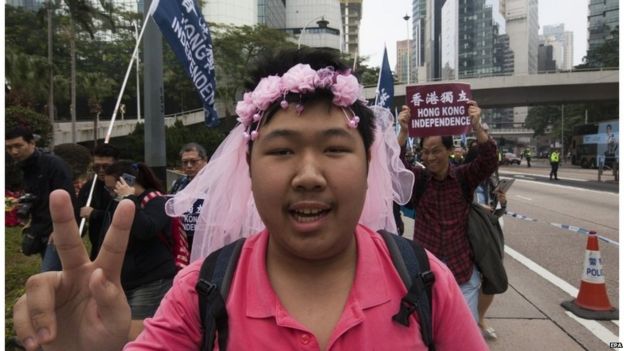
Image copyrightEPAImage captionCritics accuse China of abandoning its “one country, two systems” pledge on Hong Kong
In recent years, both countries have hailed a “golden era” in UK-Sino relations.
China has signalled its desire to invest in high-profile UK infrastructure projects, including the building of a new nuclear reactor at Hinkley Point – although its involvement has raised some national security concerns.
British trade with China has increased by 60% since 2010 and UK ministers are expected to use the trip to stress that the UK will remain an “excellent place to do business” after it leaves the EU next year.
The UK has said it will prioritise negotiating free trade agreements with major trading partners such as the United States, Australia and Canada after it leaves the EU in March 2019.
Earlier this year, the UK said it would not rule out becoming a member of the Trans Pacific Partnership free-trade zone, whose members include Japan, South Korea and Vietnam and which is considered by many as a counter-weight to Chinese influence in the region.
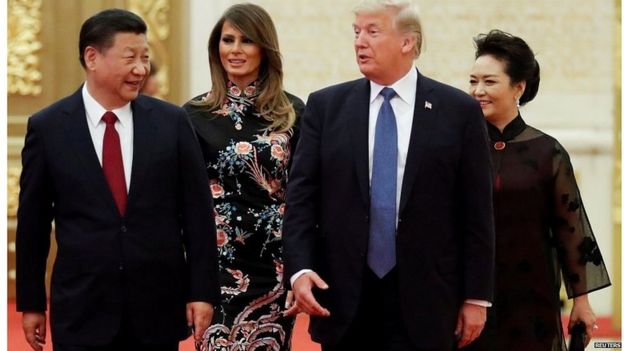
Image copyrightREUTERSImage captionUS President Donald Trump and French counterpart Emmanuel Macron have both visited China recently
Lord Patten, the last British governor of Hong Kong, has urged Mrs May to use the visit to privately raise what he says has been the steady erosion of freedoms and rights in the former British colony in recent years.
Hong Kong is supposed to have distinct legal autonomy under the terms of its handover to China in 1997.
In a letter to the PM, Lord Patten and ex-Lib Dem leader Lord Ashdown said its residents needed assurances that the UK’s growing commercial relationship with China would not “come at the cost of our obligations to them”.
NATTY yellow carts whizz tourists around Wenchang space port, a sprawling launch site on the tropical island of Hainan. The brisk tour passes beneath an enormous poster of Xi Jinping, China’s president, then disgorges passengers for photographs not far from a skeletal launch tower. Back at the visitor centre there is a small exhibition featuring space suits, a model moon-rover and the charred husk of a re-entry capsule that brought Chinese astronauts back from orbit. A gift shop at the exit sells plastic rockets, branded bottle openers and cuddly alien mascots.
The base in a township of Wenchang city is the newest of China’s four space-launch facilities. It is also by far the easiest to visit—thanks in part to the enthusiasm of officials in Hainan, a haven for tourists and rich retirees. Wenchang’s local government has adopted a logo for the city reminiscent of Starfleet badges in “Star Trek”. It is building a space-themed tourist village near the launch site, with attractions that include a field of vegetables grown from seeds that have been carried in spaceships.
If the dream is to turn this palm-fringed corner of Hainan into a tourist trap comparable to Florida’s balmy space coast, there is still a lot to do. Several idle building sites suggest that some investors have gambled rashly. Signs have been taken down from a patch of scrub that was once earmarked for an amusement centre. On a recent weekday, pensioners wintering nearby were among the few visitors to the launch site. A local says that people often come out feeling like they have had a lesson in patriotism, but not much fun.
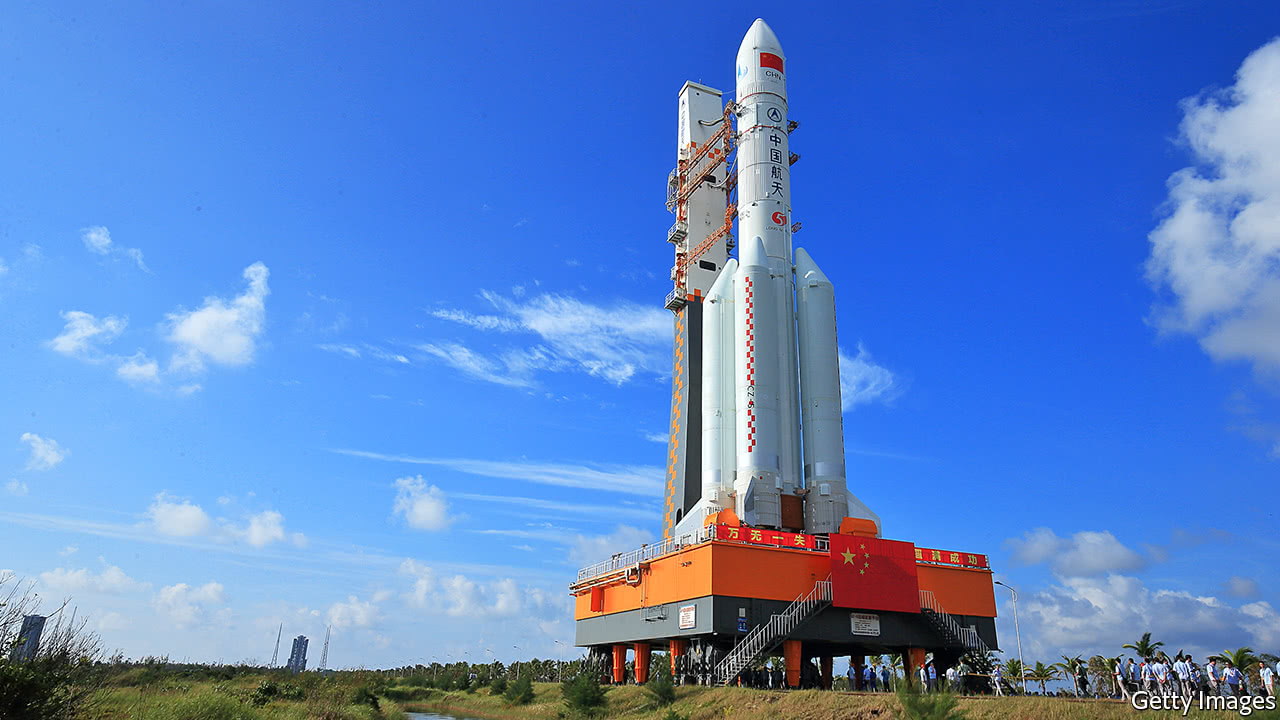
Perhaps this will change when Wenchang gets up to speed. The base is crucial to China’s extraterrestrial ambitions because it is the only site from which it can launch its latest and largest rocket, the Long March 5 (pictured). Narrow railway tunnels limit the size of the components that can be delivered to the three other bases. Rockets are anyway more efficient the closer they are launched to the equator, where the faster rotation of Earth provides extra lift. Of China’s launch centres, Wenchang is by far the nearest to that sweet spot.
The Long March 5 can carry about 25 tonnes into low orbit, roughly double the maximum load of China’s next most powerful rocket. This is only a bit less than the biggest rocket currently used by America’s space agency, NASA, can carry—but far less than the Falcon Heavy, a behemoth being developed by SpaceX, a private American firm (see article). The Long March 5’s maiden launch, in 2016, was a success. But the second one last summer failed a few minutes after lift-off. Wenchang’s two launch pads have stood empty ever since.
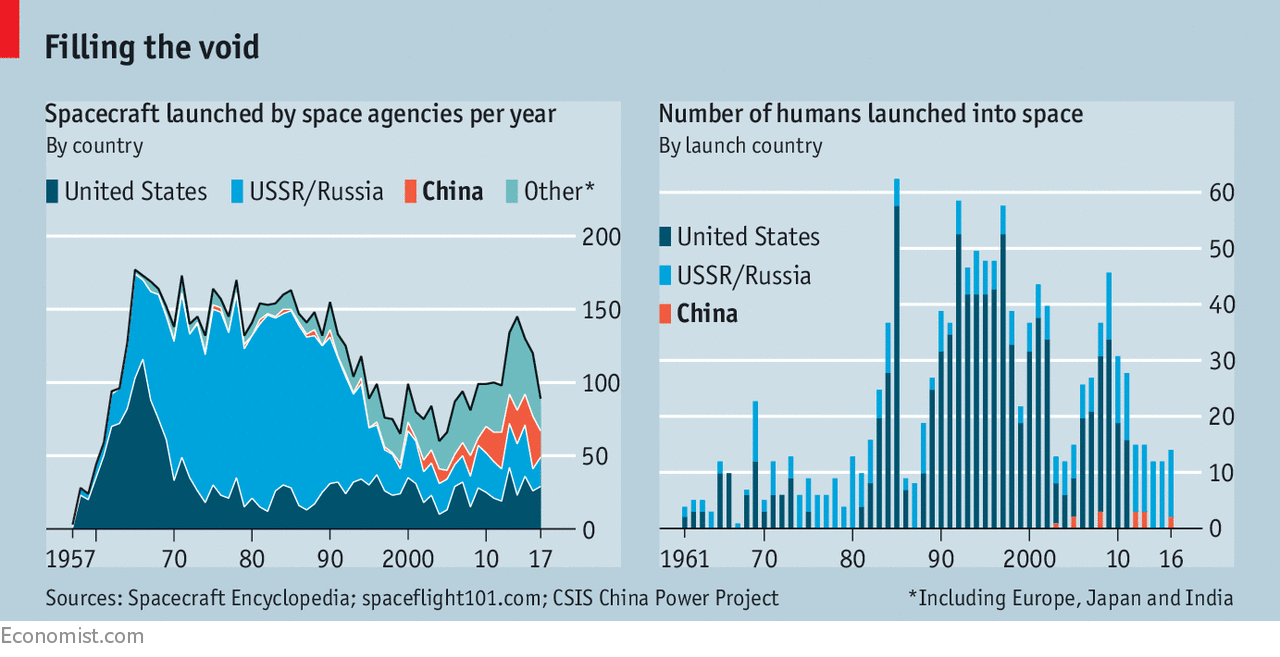
That failure, and another one last year involving another type of Long March rocket, slowed China’s space efforts. Officials had hoped to launch around 30 rockets of one type or another in 2017 but only managed 18 (there were 29 launches in America and another 20 of Russian ones—see chart). But they promise to bounce back in 2018, with 40-or-so lift-offs planned this year. These will probably include a third outing for the Long March 5—assuming its flaws can be fixed in time—and missions that will greatly expand the number of satellites serving BeiDou, China’s home-grown satellite navigation system.
The next two years could see big progress in China’s two highest-profile civil programmes in space: lunar exploration and building a space station. In 2013 China sent a rover to the moon’s surface, the first soft landing there since Russia and America discontinued such efforts in the 1970s. Towards the end of this year China hopes to put a robot on the far side of the moon, a region never yet explored from the lunar surface. That landing will help preparations for an attempt—tentatively planned for 2019—to collect rocks from the surface and return them to Earth.
China talks of launching the main module of a permanent space station as soon as 2019, and expanding it with two bolt-ons early in the following decade. It is going it alone with this programme. America passed a law in 2011 that forbids NASA from sharing knowledge or resources with its Chinese equivalent. This ensured that China remained locked out of the International Space Station; America was never keen on letting it in because of the military uses of China’s space programme. China has instead experimented with two temporary orbiters of its own, the newest of which it crewed for a month in 2016 (the older one has reached the end of its mission and looks likely to tumble to the Earth sometime in the next few months).
Eventually, China would like to send its taikonauts to the moon. There is no target date for achieving this, but in 2016 an official speculated that a Chinese citizen might step on the lunar surface within 15 to 20 years. The country has Mars in its sights, too. It plans to land a rover there in 2020 or shortly thereafter. It wants to retrieve rocks from Mars sometime in the 2030s.
China still lags far behind America in its space accomplishments, but it does not appear bent on a cold-war-style race. It spends far less on its civil space programme than the $19.7bn that NASA was allocated last year. China is doggedly pursuing its goals, however. Joan Johnson-Freese of the US Naval War College compares China to Aesop’s tortoise.
One of the Communist Party’s aims is to boost national pride at home. In 2016 Mr Xi declared that April 24th would be celebrated annually as “space day”: it is the anniversary of China’s first satellite launch in 1970. Even if outshining America remains a distant goal, China is mindful of the progress being made by India, another big developing country that dreams of the stars. India is planning its first soft-landing on the moon in March, more than four years after China’s.
Europe is keen to collaborate. Chinese and European scientists launched their first joint satellite in 2003. They are now co-operating in a study of solar wind. Astronauts from the European Space Agency (ESA) recently trained with Chinese counterparts in survival skills. Karl Bergquist, an ESA official, says a few European astronauts are learning Chinese to prepare for possible joint missions.
But America’s worries are growing about the military aspects of China’s space programme. Marco Aliberti of the European Space Policy Institute in Vienna says this has been particularly evident since 2013, when China showed it could launch projectiles into the lofty orbits traced by America’s most sensitive satellites, suggesting it was developing an ability to knock them out. Many American scientists favour a more relaxed approach. But in an era of “America First”, the chances are slim of NASA being allowed to befriend China.
All this rankles among Chinese officials. They note that tense relations between America and Russia have not prevented those two countries’ space agencies from working together (since retiring the space shuttle, America has been dependent on Russian rockets to get astronauts into space). As many people in China see it, America’s behaviour is further confirmation of a long-held belief that America wants to create impediments to China’s rise. Jiao Weixin, a space expert at Peking University, says America is locked in “cold-war thinking”. If American authorities do not wish to work with China, he says, there are others who will.
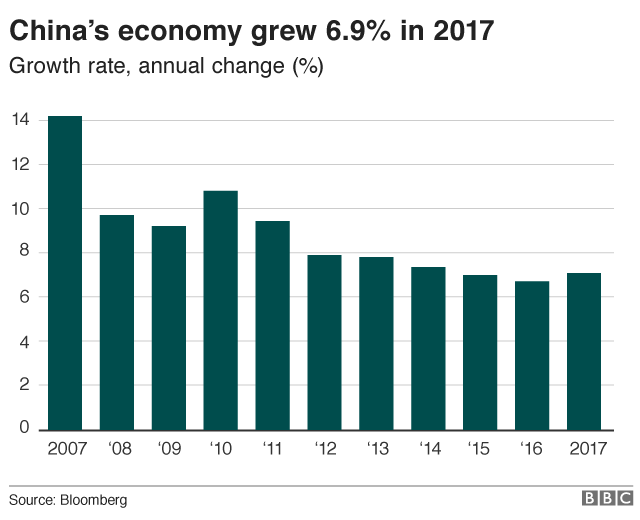
China’s economy grew by 6.9% in 2017 according to official data – the first time in seven years the pace of growth has picked up.
The figure beats Beijing’s official annual expansion target of about 6.5%.
China is a key driver of the global economy and so the better-than-expected data is likely to cheer investors around the world.
But many China watchers believe the GDP numbers are much weaker than the official figures suggest.
This month alone, the governments of Inner Mongolia and of the large industrial city of Tianjin have admitted their economic numbers for 2016 were overstated.
Taking the figures at face value, the 2017 growth rate is China’s highest in two years. And it represents the first time the economy has expanded faster than the previous year since 2010.
However as Beijing ramps up efforts to reduce risky debt and to increase air quality, analysts said this may impact 2018 growth.
The numbers released on Thursday also showed that in the last three months of 2017, the economy grew at an annual rate of 6.8% – slightly higher than analysts had been expecting.
Analysis
Robin Brant, BBC China Correspondent, Shanghai
Two things stand out.
First, it looks like stronger exports – as the world economy picked up – and the final sputter of (another) government infrastructure investment spurt helped make 2017 better than expected.
But that’s the model China is trying – gently – to get away from.
Second, is it true?
China’s figures can be so stable, so in line with government targets, that it’s hard to really believe them.
In the run up to these figures being published there’s also been an unusual spate of honesty from several provincial governments, who’ve admitted faking their GDP or fiscal figures. All of which fed into the national picture.
China’s debt has risen significantly in recent years, with worrying numbers around local government loans, corporate and household debt and non-performing bank loans.
Beijing meanwhile says it has been taking steps to contain risky debt despite the impact that might have on economic growth – efforts the IMF said it recognised.
A cargo train loaded with 41 containers of electronic products departed from Chengdu, capital of southwest China’s Sichuan Province, for the Netherlands on Wednesday.It brings the total number of cargo trains from Chengdu to Europe to 1,000 this year, and 1,700 since the city launched the service in 2013.The city has rail routes to 14 European countries.”Rail freight is one of the fields where the Sino-European cooperation has made very important progress and will continue to do so in the future,” said Filippo Nicosia, Italy Consul General in Chongqing.In 2018, at least 1,000 cargo trains are expected to run from Chengdu to Europe.Demand for rail cargo between China and Europe, an alternative to slower and riskier sea freight and much costlier air cargo, has exploded in recent years.About 35 Chinese cities run cargo trains to Europe.
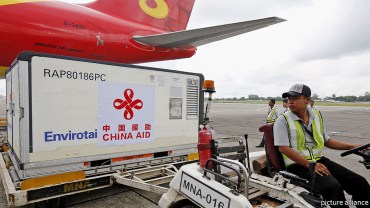
CHINA is one of the world’s largest providers of foreign aid. But it has a reputation as a rogue donor: stories abound of shoddy projects, low environmental standards and mistreatment of workers.
A hospital built by the Chinese in Luanda, the capital of Angola, developed alarming cracks and had to be rebuilt. Aid is widely thought to have been diverted for arms purchases by Robert Mugabe’s regime in Zimbabwe. The list goes grimly on.
Stories do not abound, however, about who gets China’s aid and what it goes on. The government says that it spends about $5bn a year on assistance to other countries. But it has no aid ministry comparable to, say, Britain’s Department for International Development. Most details of the aid programme are kept secret, perhaps because the largesse is unpopular domestically. Many Chinese think that their country is too poor to give handouts and the money ought to be spent at home. When the health ministry tried to investigate whether Chinese projects in Africa made people healthier, the rest of the government flatly refused to co-operate.
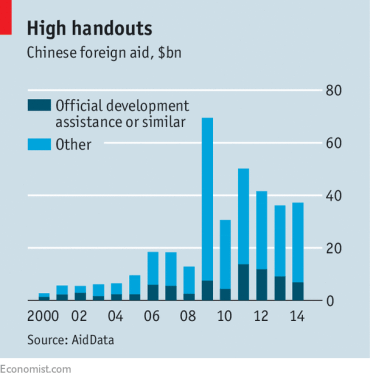
The most detailed study so far of Chinese aid, published this week by AidData, a research group at the College of William and Mary in Virginia, shines a light on the murky data. The report looks at 4,400 projects which China has either committed to, is building or has finished, between 2000 and 2014. It finds that the country gave or lent about $350bn over that period—not much less than the total of American aid, which was $424bn in those years. But almost all of America’s aid is in the form of grants, compared with a fifth of China’s. The rest is concessional lending at below-market interest rates, mostly to Chinese companies working abroad—the kind of aid that used to be common in the West but went out of fashion in the 1990s because it overburdened recipients with debt. The grant component of China’s aid was $75bn, still a lot (about the same as Britain’s), but not a tidal wave of money.
Previous AidData studies of Chinese aid have been controversial. In 2013 the researchers reckoned that aid to Africa alone (which accounts for half of China’s total foreign aid) was $75bn between 2000 and 2011. Deborah Brautigam of Johns Hopkins University in Maryland said their calculation was “way off”. She criticised what she described as its excessive reliance on unreliable news reports. AidData’s new estimate appears to be better grounded. It is based more on official announcements from Chinese commercial offices abroad and from the finance and planning ministries of recipient countries.
The authors use their new numbers to look at whether Chinese aid works—an equally controversial subject. In a study published along with the data set, researchers including Bradley Parks of the College of William and Mary find that the grant kind does. They reckon a doubling of Chinese grant aid is associated with a 0.4-point increase in the rate of GDP growth of the recipients after two years. That is more than can be said for China’s no-strings-attached concessional lending, which, according to AidData, has no effect on the receiving country’s GDP. It appears to be tantamount to an export subsidy to Chinese firms, with a side order of backhanders for local elites.
On a happier note, the study looks at whether Chinese aid damages Western assistance. The researchers do this by calculating whether aid effectiveness declines in countries that receive Western aid and then get an influx of Chinese cash. It finds no decline, implying Chinese aid does not harm efforts by other donors.
Three conclusions can be drawn from AidData’s findings. First, Chinese aid could do more good in poor countries if more of it came in the form of grants, rather than cheap loans. Next, Western aid agencies should not be so wary of co-operating with the Chinese. Co-ordination is important in aid-giving because otherwise you might find, say, three aid agencies each building a hospital in the same city. Because China is regarded as a rogue, it is not roped into the co-ordination efforts among Western donors. That should change. Lastly, the paucity of information about China’s aid (despite AidData’s efforts) is caused by the opacity of China’s government. Perhaps it might consider being more open about a programme that appears, for all its flaws, to be moderately effective.


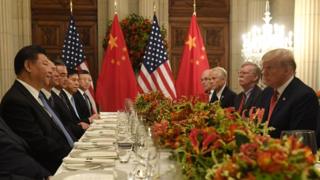 Image copyrightGETTY IMAGES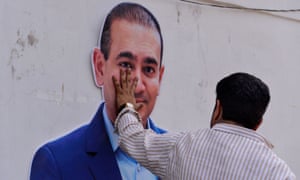



 CHINDIA ALERT: You'll be living in their world, very soon