Archive for ‘Economics’

18/05/2017

China taps into cool future for global energy | South China Morning Post

China has succeeded in extracting methane gas from solid deposits under the sea in an experiment that could eventually lead to the commercial production of what is being touted as an abundant new source of energy.In a first for the country, engineers extracted the gas from the so-called “flammable ice” – methane hydrate, where the gas is trapped in ice crystals – and converted it to natural gas in a single, continuous operation on a floating production platform in the Shenhu area of the South China Sea, about 300km southeast of Hong Kong, the Ministry of Land and Resources said on Thursday.

Methane hydrate is formed in such abundance that the US Department of Energy has estimated the total amount could exceed the combined energy content of all other fossil fuels, sparking interest in the resource worldwide.

The US, Canada and Japan have been leading research into it, and Japan said earlier this month it had successfully produced natural gas from methane hydrate off its Pacific coast and plans to conduct continuous production for three to four weeks. Japan’s tests are being carried out on a ship, whereas China is using a floating platform.
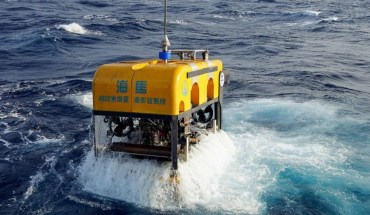
China was a latecomer to the methane hydrate scene, but has been catching up fast since the discovery of promising reserves in the South China Sea in 2007. Earlier this year scientists built the nation’s first land-based drilling platform on the Tibetan Plateau, where abundant methane is trapped under the permafrost.

In the latest breakthrough, a bore head was lowered to extract the gas and convert it to natural gas, according to video footage shown on China Central Television.

“We brought the gas to the surface and have lit it up since May 10. By now, the drill has been running continually for eight days,” Ye Jianliang, project leader and deputy chief engineer at the China Geological Survey, told the broadcaster.

“The daily output [of gas] exceeds 10,000 cubic metres. The best day recorded 35,000 cubic metres,” Ye said.Chen Yifeng, associate researcher with the Key Laboratory of Marginal Sea Geology at the Chinese Academy of Sciences in Guangzhou, said the trial run was different from previous operations by other countries because it followed the procedures of commercial production.

“The technology and equipment they use is no longer for experimental purposes. They mean business,” she said.But methane hydrate has its disadvantages, according to Chen. Unlike oil and natural gas reserves which are usually concentrated in confined spaces, the hydrates are often scattered over large areas on the sea floor, and extracting them was like “picking strawberries in a field”.

Also, unlike mineral ores, the “ice” cannot be taken straight out of the water because it would disintegrate with the loss of pressure. Sophisticated machinery and technology was required to depressurize or melt it on the sea bed and channel the gas to the surface.

She also noted that one reason why some countries had put commercial exploitation on hold was because of a fear of a massive escape of methane, a greenhouse gas, into the atmosphere, which could occur if drilling machines destroyed the stability of a seabed.

Some researchers have speculated that methane hydrate had caused a rapid buildup of pipeline pressure that led to the deadly explosion and subsequent massive oil spill on BP’s Deepwater Horizon oil rig in the Gulf of Mexico seven years ago.

A mainland government energy researcher, who declined to be named, doubted whether commercialisation could begin any time soon.

“The government statement has not disclosed the cost, but at this stage, to produce natural gas from combustible ice is likely to make no economic sense,” the researcher said.

“China became the world’s first because no other country has the motivation to do it while oil prices remain low.”

Source: China taps into cool future for global energy | South China Morning Post

18/05/2017

Indian cabinet approves plans to build 10 nuclear reactors | Reuters

India’s cabinet approved plans on Wednesday to build 10 nuclear reactors with a combined capacity of 7,000 megawatts (MW), more than the country’s entire current capacity, to try fast-track its domestic nuclear power programme.

The decision by Prime Minister Narendra Modi’s government marks the first strategic response to the near collapse of Westinghouse, the U.S. reactor maker that had been in talks to build six of its AP1000 reactors in India.Westinghouse, owned by Japan’s Toshiba, filed for Chapter 11 bankruptcy in March after revealing billions of dollars in cost overruns at its U.S. projects, raising doubts about whether it can complete the India deal.

India has installed nuclear capacity of 6,780 MW from 22 plants and plans to add another 6,700 MW by 2021-22 through projects currently under construction. The 10 additional reactors would be the latest design of India’s Pressurised Heavy Water Reactor.

“This project will bring about substantial economies of scale and maximise cost and time efficiencies by adopting fleet mode for execution,” the government said in a statement.

“It is expected to generate more than 33,400 jobs in direct and indirect employment. With manufacturing orders to domestic industry, it will be a major step towards strengthening India’s credentials as a major nuclear manufacturing powerhouse.”

Westinghouse has said it plans to continue construction of its AP1000 plants in China and expects to bid for new plants in India and elsewhere, without elaborating on how it plans to do so.

Indian companies such as Larsen and Toubro, Kirloskar Brothers Limited and Godrej & Boyce welcomed the government’s move.

Sanjay Kirloskar, chairman of Kirloskar Brothers Limited, said: “nuclear power plants will go a long way in reducing the perennial energy deficit,” while Larsen and Toubro’s director S.N. Roy called the move “bold and historic.”

Source: Indian cabinet approves plans to build 10 nuclear reactors | Reuters

05/05/2017

China’s first big passenger plane takes off for maiden flight – BBC News

After about 90 minutes in the air the plane landed safely back at Pudong airport in Shanghai.

China’s first large domestically made passenger aircraft has completed its maiden flight, mounting a major challenge to Boeing and Airbus.

After about 90 minutes in the air the plane landed safely back at Pudong airport in Shanghai.

The plane is a key symbol of Beijing’s soaring ambitions to enter the global aviation market.

The jet by state-owned firm Comac has been planned since 2008 but the flight was repeatedly pushed back.For Friday’s maiden flight, the plane carried only its skeleton crew of five pilots and engineers and took off in front of a crown of thousands of dignitaries, aviation workers and enthusiasts.

Ahead of the flight, state television said the plane would fly at an altitude of only 3,000 metres (9,800 feet), some 7,000 metres lower than a regular trip, and reach a speed of around 300 kilometres (186 miles) per hour.

The C919 is designed to be a direct competitor to Boeing’s 737 and the Airbus A320.

It’s estimated that the global aviation market will be worth $2tn (£1.55tn) over the next 20 years.

China’s new pride of the skies

Robin Brant tours the C919

  • The C919 is a single-aisle twin-engine plane with a capacity to seat up to 168 passengers.
  • It will have a range of between 4,075 and 5,555km (2,532 – 3,452 miles).
  • According to Chinese media, it will cost around $50m, less than half of a Boeing 737 or Airbus A320.

The plane still relies on a wide array of imported technology though, it is for instance powered by engines from French-US supplier CFM International.

Orders have already been placed for more than 500 of the planes, with commitments from 23 customers, say officials, mainly Chinese airlines. The main customer is China Eastern Airlines.

Europe’s aviation safety regulator has started the certification process for the C919 – a crucial step for the aircraft to be successful on the international market.

China has had ambitions to build its own civil aircraft industry since the 1970s, when leader Mao Zedong’s wife, Jiang Qing, personally backed a project.

But the Y-10, built in the late 1970s, was impractical due to its heavy weight and only three of the aircraft were ever made.

Source: China’s first big passenger plane takes off for maiden flight – BBC News

03/05/2017

China Focus: Key component of world’s longest cross-sea bridge installed – Xinhua | English.news.cn

Chinese engineers installed a 6,000-tonne key part of the world’s longest cross-sea bridge linking Hong Kong, Zhuhai and Macao.

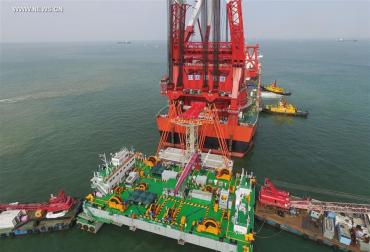
A gigantic crane, which was transformed from a tanker, hoists a 6,000-ton key structure of the world’s longest cross-sea bridge linking Hong Kong, Zhuhai and Macao, May 2, 2017. The wedge, 12-meter-long and weighing more than 25 Airbus A380 jets, was lowered to connect the immersed tubes of the underground tunnel of the bridge. The 55-kilometer bridge connects Zhuhai in Guangdong Province with Hong Kong and Macao. It includes a 22.9-km bridge and 6.7-km underground tunnel. (Xinhua/Liu Dawei)

The wedge, 12 meters long, and weighing more than 25 Airbus A380 jets, was lowered to connect the tubes which will form the tunnel section of the bridge, said Lin Ming, chief engineer of the island and tunnel section of the bridge.

The 55-kilometer bridge connects Zhuhai in Guangdong Province with Hong Kong and Macao. It includes a 22.9-km bridge and 6.7-km tunnel.

Before the wedge was installed on Tuesday, 33 immersed tubes, each 180 meters long and weighing 80,000 tonnes, had been installed.

“There is only one wedge for a tunnel, and we cannot afford to fail in its installation. It took two years to prepare for today,” said Chen Yue, director of the chief engineer’s office of the bridge’s island and tunnel section. The installation procedure took more than 10 hours.

“The margin of error for the wedge is 1.5 centimeters. We have to measure precisely the influence of wind, current and buoyancy force,” said Lin.

“It is like putting a needle through a hole in the sea — a truly unprecedented event in the history of transportation,” Lin said.

A gigantic crane, which was transformed from a tanker, was used to hoist the wedge, lowering it to the desired destination between the tubes.The wedge will be welded and finished by June, Lin said.

By the end of the year, the bridge will be open to traffic, said Zhu Yongling, director of the bridge management bureau.

Construction began in December of 2009 at Zhuhai. The Y-shaped bridge connects Lantau Island in Hong Kong with Zhuhai and Macao.

Tan Guoshun, an expert in bridge construction who has participated in many big projects, told Xinhua that breakthroughs were made in construction management, technique, safety and environmental protection.

For instance, the bridge is designed to be used for 120 years. “Anticorrosion and quake-proof measures were improved so as to make the goal possible,” he said.

The bridge was pieced together with different parts built in different locations like building blocks. “The progress of China’s equipment manufacturing industry made this construction method possible,” said Zhong Huihong, deputy chief engineer of the bridge management bureau.

Take the floating crane as an example. In the 1990s, China’s floating cranes could only handle about one hundred tonnes. “Now their capacity has reached 10,000 tonnes,” Zhong said.

“Some foreigners believe that completion of the bridge marks a leap forward of China’s construction industry,” said Su Quanke, chief engineer of the bridge management bureau.

The bridge will cut land travel time between Hong Kong and Zhuhai from three hours on the road to a 30-minute drive.

“As economic exchanges between Hong Kong, Macao and Zhuhai deepen, an urban agglomeration has formed. The bridge will further boost the interconnection,” said Zheng Tianxiang, vice president of the Asia-Pacific Innovation Economic Research Institute.

Guo Wanda, executive vice president of the Shenzhen-based China Development Institute, believes that the bridge could also help boost the industrial gradient transfer of inland provinces like Guizhou, Yunnan, Hunan and Jiangxi.

“The area will become an important hub of the Belt and Road Initiative,” he said.

Source: China Focus: Key component of world’s longest cross-sea bridge installed – Xinhua | English.news.cn

02/05/2017

Secrets of tea plant revealed by science – BBC News

Botanists have unlocked the genetic secrets of the plant prized for producing tea.A team in China has decoded the genetic building blocks of the tea plant, Camellia sinensis, whose leaves are used for all types of tea, including black, green and oolong.

The research gives an insight into the chemicals that give tea its flavour.

Until now, little has been known about the genetics of the plant, despite its huge economic and cultural importance.

“There are many diverse flavours, but the mystery is what determines or what is the genetic basis of tea flavours?” said plant geneticist Lizhi Gao of Kunming Institute of Botany, China, who led the research.

“Together with the construction of genetic maps and new sequencing technologies, we are working on an updated tea tree genome that will investigate some of the flavour.”

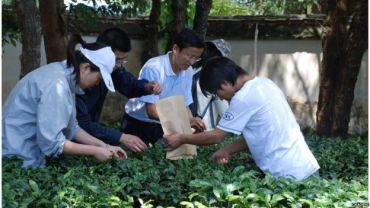
A botanist collects tea leaves for research

The Camellia grouping, or genus, contains over 100 species, including ornamental garden plants. But only Camellia Sinensis is grown commercially for making tea.

The researchers found that the leaves of the tea plant contain high levels of chemicals that give tea its distinctive flavour. They include flavonoids and caffeine.

Other members of the Camellia genus contain these chemicals at much lower levels.

Dr Monique Simmonds, deputy director of science at Kew Royal Botanic Gardens, UK, who is not connected with the research, said it provided an important insight into the genetic building blocks of tea.

She told BBC News: ”Overall, the findings from this study could have a significant impact on those involved in the breeding of tea but also those involved in breeding many plants used medicinally and in cosmetics, as the compounds that occur in tea are often associated with the biological properties of plants used medicinally or in cosmetics.”

Decoding the genome of the tea plant took more than five years. At three billion DNA base pairs in length, the tea plant genome is more than four times the size of the coffee plant genome and much larger than most sequenced plant species.

“Our lab has successfully sequenced and assembled more than 20 plant genomes,” said Prof Gao, who carried out the work with scientists in South Korea and the US.

“But this genome, the tea tree genome, was tough.”

More than 50 types of plant have now had their genetic code laid bare

The genetic knowledge could lead to ways to improve the quality and price of tea, by selective breeding of tea plants.

Guy Barter, chief horticulturist at the Royal Horticultural Society (RHS), UK, said the work gave plant breeders a “powerful new tool”.

“Once you understand the basis for the flavours and the processing quality of the tea, you can then have genetic markers that breeders can look for when trying to produce new varieties,” he told BBC News.

Six main types of tea are produced from Camellia sinensis – white, yellow, green, oolong, black and post-fermented. Each has its own aroma, taste and appearance.The distinctive flavours of these teas are created by their different chemical compositions.

Dr Simmonds said knowledge of the genome of tea helped us understand how the plant evolved.

”Another important finding is that the biochemical pathways involved in the synthesis of the compounds important in the taste of tea are also present in some of the ancestors of tea and have been conserved for about 6.3 million years,” she said.

The first plant genome was sequenced more than 15 years ago.

Since then more than 50 types of plant have been sequenced, including food crops such as the banana, potato and tomato.

The research is published in the journal Molecular Plant.

Source: Secrets of tea plant revealed by science – BBC News

02/05/2017

Infosys plans to hire 10,000 U.S. workers after Trump targets outsourcing firms | Reuters

India-based IT services firm Infosys Ltd said it plans to hire 10,000 U.S. workers in the next two years and open four technology centers in the United States, starting with a center this August in Indiana, the home state of U.S. Vice President Mike Pence.

The move comes at a time when Infosys and some of its Indian peers such as Tata Consultancy Services and Wipro Ltd have become political targets in the United States for allegedly displacing U.S. workers’ jobs by flying in foreigners on temporary visas to service their clients in the country.

The IT service firms rely heavily on the H1-B visa program, which U.S. President Donald Trump has ordered federal agencies to review.A

In a telephone interview with Reuters from Indiana, Infosys Chief Executive Vishal Sikka said his company plans to hire U.S. workers in fields such as artificial intelligence.

“When you think about it from a U.S. point of view, obviously creating more American jobs and opportunities is a good thing,” Sikka said.

While Indian outsourcing firms have recruited in the United States, Infosys is the first to come out with concrete hiring numbers and provide a timeline in the wake of Trump’s visa review.

Last month, two industry sources told Reuters that Infosys was applying for just under 1,000 H-1B visas this year. One of the sources said that was down from about 6,500 applications in 2016 and some 9,000 in 2015.Indian IT service firms, which typically flood the lottery system each year with thousands of applications, have been among the largest H1-B recipients annually.

Indian politicians and IT industry heads have been lobbying U.S. lawmakers and officials from the Trump administration to not make drastic changes to visa rules, as this could hurt India’s $150 billion IT service sector.

The 10,000 new U.S. jobs would be a small part of Infosys’ overall workforce of more than 200,000.Sikka said Infosys has already hired 2,000 U.S. workers as part of a previous effort started in 2014.

“We started small at first and have been growing since then,” Sikka said. “The reality is, bringing in local talent and mixing that with the best of global talent in the times we are living in and the times we’re entering is the right thing to do. It is independent of the regulations and the visas.”

The four hubs being set up will not only have technology and innovation focus areas, but will also closely serve clients in sectors such as financial services, manufacturing, healthcare, retail and energy, said Infosys.

The first hub, which will open in Indiana in August 2017, is expected to create 2,000 jobs by 2021, the company said.

Infosys did not disclose the financial impact of its plans. It declined to comment on whether the planned U.S. jobs would account for a large percentage of overall hiring in the coming two years.

Based on Infosys’ recent hiring trends, however, the planned hirings in the U.S. could account for a substantial portion of the company’s net workforce additions over the period.

Infosys, which added nearly 18,000 jobs in 2015, slowed its hiring pace considerably, creating just about 6,000 jobs in 2016 amid market uncertainty caused by Brexit and heightened clamor for tougher U.S. immigration laws that led some U.S. clients to hold-off on new projects.

“Hiring locally is a compulsion and it’s not just because of what’s happening in the U.S.,” said Harit Shah, research analyst at Reliance Securities. “The model itself is not sustainable.”

The company cautioned last month that it would struggle to reach its ambitious $20 billion revenue target by 2020, as the Indian software service sector has been hit by cautious client spending due to a rising protectionist wave globally.

The United States is the largest market for Indian software service companies, but other countries like Australia have also begun to target Indian IT service companies that use temporary visa programs.Shares in Infosys were down less than 1 percent in midday trading in India, following news of the U.S. hiring plans.

Source: Infosys plans to hire 10,000 U.S. workers after Trump targets outsourcing firms | Reuters

01/05/2017

Journey to the Rest: China’s Migrant Workers Top 280 Million – China Real Time Report – WSJ

Over the past two decades, Guo Wenli has traveled throughout China, everywhere except Tibet.

The 40-year-old has camped in the Gobi Desert in the north and at the foot of snow-capped mountains in the southwestern province of Yunnan.Mr. Guo isn’t a backpacker. He is one of China’s migrant workers—rural laborers who left the farm to work in factories and construction. According to an official survey, they numbered 281 million in 2016, slightly more than the previous year.

More than 65% of the country’s migrant workforce is male, 39 years old on average, and earns a monthly salary of 3,275 yuan ($475), the National Bureau of Statistics said in an annual report released Friday. More than half either work in factories (30.5%) or at construction sites (19.7%), the report said.

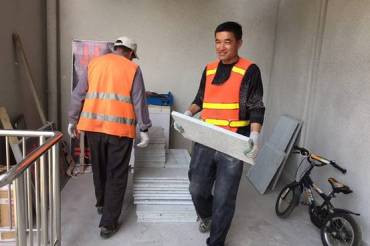
“Young people in our village with some education all find jobs at factories. Nobody wants us old folks,” said Mr. Guo, wearing an orange vest while paving sidewalks in a Beijing neighborhood known for its late-night restaurants.

This latest survey shows the migrant workforce is aging rapidly. More than 19% of migrant workers in 2016 were older than 50, compared with 14% five years ago.

More are choosing to work closer to home, especially women, who now make up 34.5% of the migrant labor force, up from 33.6% in 2015.  More migrants are also heading to western China, where the government is trying to direct investment and promote development. The migrant labor force in the west rose 5.3% from a year earlier, the survey said. In the better-off east, which has drawn a large share of foreign and private investment for years, the migrant workforce shrank marginally, by 0.3%, but the majority—56.7%—still work in those areas.

The statistics bureau carries out door-to-door visits to nearly a quarter of a million rural households every quarter for the survey.

A native of Xinxiang in the central province of Henan, Mr. Guo still keeps his farm, where he grows wheat and corn. His wife and two sons remain there, and he returns three times a year—planting season, harvesting season, and for the Lunar New Year holiday, altogether about three months. The crops bring his family an extra 3,000 to 4,000 yuan each year.

Mr. Guo said he earns about 5,000 to 6,000 yuan every month, depending on the construction job. The biggest project he worked on was the 60-story Fortune Financial Center, a landmark office tower in Beijing’s financial hub. He said he spent more than a year installing windows and other glass. He’s seen the completed building on TV, but he’s never visited it himself.

Mr. Guo, who lives in a room in a prefab hut he shares with five other coworkers, typically gets up at 5 a.m., works wherever he is sent by his boss—a contractor with the city government—and returns about 7 p.m. That’s longer than the average of 8.5 hours a day, based on the findings of the government survey.

He said he doesn’t have the time, energy or the money to go to check out the tourist sites in Beijing. His jobs usually last a few months, but he estimates, adding up the stints, he’s spent years of his life working in the capital.

Mr. Guo thinks his life is improving, because he’s earning more than in the past and isn’t living in a tent, as he has done on many jobs. While wages have been rising, the pace has slowed in recent years. Wages rose 6.6% on average last year, down from 7.2% in 2015, the official survey showed.

But he doesn’t want his two sons to follow in his footsteps; he wants them to live like city dwellers and have an easier life.

Nearly 18% of the migrant workers have purchased property in the cities in 2016, higher than the 17.3% in 2015, said the statistics bureau.

For Mr. Guo, buying an apartment Beijing, which typically cost millions of yuan, isn’t part of his dream. He wants to start his own business, growing and selling garlic, if he can get a small bank loan.

Unlike some of his fellow villagers who managed to receive zero-interest loans, he said he doesn’t have connections at the local government or at the bank to get one.

“Without a loan, I can’t do anything. I guess I’ll keep working in cities until the day I can’t move.”

Source: Journey to the Rest: China’s Migrant Workers Top 280 Million – China Real Time Report – WSJ

28/04/2017

The last, toughest mile: China’s new approach to beating poverty | The Economist

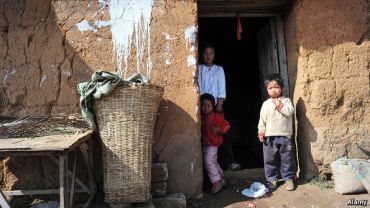
MOST of Tian Shuang’s relatives are herding goats in the barren hills of Ningxia province, one of the poorest parts of western China. But last year Mr Tian came down to Minning, a small town in the valley, when the local government, as part of an anti-poverty programme, gave him a job growing mushrooms and ornamental plants in a commercial nursery garden. His name, address and income (20,000 yuan a year, or $2,900—six times the minimum wage) are written on a board by its greenhouse door.

Mr Tian’s name is also pinned up on the walls of the town hall, along with those of 409 other people in the area who, without help, would be living below the local poverty line of 3,200 yuan a year (this is about 40% above the national minimum, but still not enough to buy meat more than once a week, or to spend on new clothes). The town lists the problems and requirements of each of its poor people. Thirty-seven are poor because of health problems; 77—including some of Mr Tian’s relatives—live in isolated, inhospitable areas; 95 are physically handicapped, and so on. Also listed is the help given by the government to each person, such as the provision of work, a solar generator or a cow.

Minning is a model town. Its poverty-alleviation scheme was set up by Xi Jinping, China’s president, between 1999 and 2002 when he was governor of Fujian, a wealthy province in the south. (Fujian is twinned with Ningxia as part of a national attempt to spread expertise and money from rich to poor areas.) The system that Minning pioneered is now spreading throughout China. It focuses on poor individuals, and on drawing up specific plans for each, rather than merely helping poor places to develop in the hope that wealth will trickle down to the poorest. Other countries are trying this, too, but China is one of the few developing nations with a bureaucracy big enough and bossy enough to do it well.

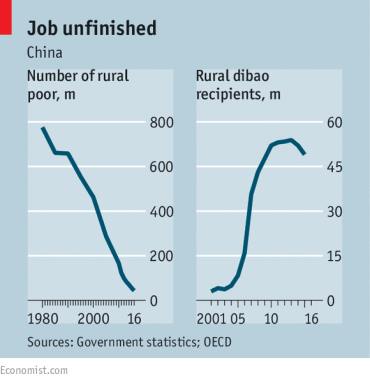
China has been a hero of the world’s poverty-reduction efforts. It has eradicated poverty in cities (by its definition, at least) and reduced the number of rural people below the official poverty line of 2,300 yuan a year at 2010 prices from 775m in 1980 to 43m in 2016 (see chart). Its aim now is to have no one under the line by 2020.Two years ago Mr Xi set this as one of the main jobs of his presidency. He calls it “the baseline task for building a moderately prosperous society” (which the Communist Party wants to create by its 100th birthday in 2021). Politically, poverty reduction matters because, as one party member says, unless China solves the problem of income inequality, the party’s legitimacy will be questioned. The party owes its power to a revolt fuelled by the miseries of the countryside. It does not want to be accused of failing to fulfil its mandate to eliminate them.

But the last stage of poverty reduction will be the most difficult. China’s success so far has been based largely on economic growth, which has generated jobs for the able-bodied. The final stage will be costly and complicated because many of the remaining poor are people who, because of physical or mental disabilities, cannot hold down jobs. A recent government survey found that 46% of China’s poor were poor because of their health.

Targeting individuals will help. By 2014 the government had compiled a “poverty-household registry” of every person and household below the poverty line. The following year it said a personalised poverty-alleviation plan must be drawn up for everyone included. The Philippines and Mexico also have such registries—they can help with monitoring the status of the poor, identifying their needs and (in theory) preventing waste and corruption.

There are signs that China’s is indeed improving its main form of poor relief, which is called “subsistence guarantee”, or dibao. The dibao programme has been notoriously inefficient. Many households that qualify for payments do not receive them because of corruption and bureaucratic failings. A survey by the World Bank found that between 2007 and 2009 just 10% of those that did get the dibao had household incomes below the poverty line (ie, 90% did not qualify for the handouts they were getting). The system is also corrupt. In 2015 an official in Henan province was found to have 267 bank deposit books in the names of extremely poor people, from which he had misappropriated 500,000 yuan of welfare payments.

But this may be changing. Poor people are getting more job training, as in Minning. There has been a crackdown on corruption. Ben Westmore of the OECD, a club mostly of rich countries, recently trawled through household data from five provinces collected by researchers at Peking University. He found that in 2014 about a third of rural households receiving dibao paymentswere below the poverty line—not good, but better than 10%. In Guangdong province in the south, an early starter in its focus on individual needs, more than half of recipients were below the line.

Still, there is a long way to go: most poor households still do not get dibao money. In the sample studied by Mr Westmore, three-quarters of them did not. It hardly helps that the poverty registry and dibao data are kept by different government departments; the two are not linked.

The dibao programme, though financed largely by the national government, is administered locally. This means local areas may set their own poverty lines and benefits. Some thresholds are far below the national minimum, and payments are barely enough to live on. Total dibao spending peaked in 2013 and has been falling since then—partly because governments are getting stingier. China spends a mere 0.2% of GDP on the dibao system, far below comparable programmes elsewhere. Indonesia’s poverty relief costs 0.5% of GDP.

Worse, some poor people are not even included in the registry. In a village of 100 poor households in Shanxi province, only ten families are in it—friends of the party boss. If the registry is flawed, poverty relief is all the more likely to be flawed too.

All these efforts are aimed only at extreme poverty in the countryside. The government claims the urban kind does not exist, ie, that no one in cities has less than 2,300 yuan a year. But that minimum is too low for cities, where living costs are higher. Using more realistic thresholds, Mr Westmore found that urban poverty was actually higher than rural poverty in four of the five provinces covered by the data he used.

At current rates of reduction (more than 10m fewer people annually in extreme poverty), Mr Xi should be able meet his target by 2020. It will be hailed as a great achievement. But huge government effort will still be needed to help the worse-off. It will not be the end of poverty in China.

Source: The last, toughest mile: China’s new approach to beating poverty | The Economist

27/04/2017

Artificial intelligence: Implications for China | McKinsey & Company

The country is becoming a hub for global AI development. Five priorities can help China harness AI for productivity growth and prepare for the societal shifts it may unleash.

Artificial intelligence, or the idea that computer systems can perform functions typically associated with the human mind, has gone from futuristic speculation to present-day reality. A new discussion paper from the McKinsey Global Institute, originally presented at the 2017 China Development Forum, explores AI’s potential to fuel China’s productivity growth—and to disrupt the nation’s workforce.

Where computer systems once had to be programmed to execute rigidly defined tasks, they can now be given a generalized strategy for learning, enabling them to adapt to new data inputs without being explicitly reprogrammed. Advances in data collection and aggregation, algorithms, and processing power have paved the way for computer scientists to achieve significant breakthroughs in artificial intelligence. AI has now moved beyond the lab, with many machine-learning systems already in commercial use for a wide variety of applications. Adoption is growing rapidly in sectors such as finance, healthcare, and manufacturing.

As its capacity for innovation deepens, China has become one of the leading global hubs for AI development. Recognizing that the nation’s vast population and diverse industry mix can generate huge volumes of data and provide an enormous market, China’s biggest tech companies are making significant R&D investments in AI.

These technologies can dramatically boost productivity—and that could be a crucial capability for China to sustain its future economic growth as the country’s working-age population declines. Automating workplaces with AI could add 0.8 to 1.4 percentage points to GDP growth annually, depending on the speed of adoption. Realizing AI’s economic potential in China also depends on its actual adoption—not just among the technology giants but across China’s traditional industries. Achieving this goal will require building strategic awareness among business leaders, developing technical know-how, and overcoming implementation costs.

But wide adoption of these technologies would represent a profound shift for hundreds of millions of Chinese workers and for Chinese society as a whole. MGI estimates that half of all work activities in China could be automated, making it the nation with the world’s largest automation potential. Jobs made up of routine work activities and predictable, programmable tasks will be particularly vulnerable. While the impact on the labor market is likely to be gradual at the aggregate level, it can be sudden and dramatic at the level of specific work activities, rendering some jobs obsolete fairly quickly. Overall, AI will raise the premium placed on digital skills while reducing demand for medium- and low-skilled workers, potentially exacerbating income inequality.

Although the market will drive the development and adoption of AI, the right policy framework can establish a healthy environment for growth. Five priorities can form the basis of China’s AI strategy: building a robust data ecosystem, spurring adoption of AI within traditional industries, strengthening the pipeline of specialized AI talent, ensuring that education and training systems are up to the challenge, and establishing an ethical and legal consensus among Chinese citizens and in the global community.

AI technologies have exciting and far-reaching potential to improve healthcare, the environment, security, and education. At the same time, they raise serious and complex ethical, legal, and security questions. China has the capability and opportunity to lead international collaboration in the development and governance of AI, ensuring that the necessary frameworks are in place to ensure that these breakthrough technologies make a positive contribution to global growth and human welfare.

Source: Artificial intelligence: Implications for China | McKinsey & Company

Tags:
21/04/2017

The return of pedal power: In China, bikes are back | The Economist

A MAN pedals a brand-new, orange and silver bicycle to his office door. He dismounts in the middle of the pavement, flicks down the kickstand and disappears inside. A woman approaches and waves her smartphone over a QR code near the rear mudguard. The lock snaps open and off she rides.

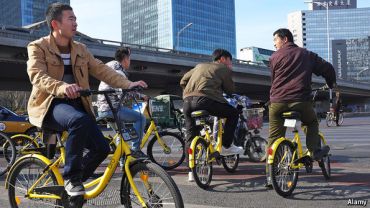
These days, China’s once bicycle-clogged streets are choked with cars. But some urbanites are getting back on two (motorless) wheels, lured by the ease of using shared “dockless” bikes controlled by high-tech gadgetry.

For years, bike-sharing schemes have been common in big cities around the world, including in China. Examples include Paris’s Vélib and London’s Santander Cycles (“Boris bikes”). But these require customers to return the bicycles to docking stations. In China, a more user-friendly approach is spreading rapidly. It involves bikes that can be paid for using a smartphone and left anywhere. GPS tracking enables them to be located with a mobile app. A ride typically costs only one yuan ($0.15) on a sleek-framed bike in an eye-catching colour.

The first such service was launched in June 2015 by a startup called Ofo. The company now has around 2.5m yellow-framed bikes in more than 50 cities in China. Its main rival, Mobike, which started up only a year ago, says it has “several million” of its orange-wheeled bikes spread across a similar area. Bluegogo has half a million bikes in six Chinese cities. It plans to add a new city every two weeks.

Several other companies are piling in, as are investors who believe the firms have global potential. Bluegogo was the first to launch overseas, in San Francisco in February. Ofo has recently started services in Singapore and San Diego, California. It was due to launch another one in Cambridge, England, as The Economist went to press. Mobike, too, is operating in Singapore and is eyeing other markets.The dockless system is prone to abuse. Some riders hide the bikes in or near their homes to prevent others from using them. Another trick involves photographing a bike’s QR code and then scratching it off to stop others from scanning it. With the stored image, the rider can then monopolise the machine. But customers caught misbehaving can have points deducted from their accounts, making it more expensive for them to rent the bikes.

A bigger problem for the new firms is persuading people to use bikes instead of cars. Thirty years ago, 63% of Beijingers pedalled to work. Now only 12% do. Many people think that cycling is only for the poor. A dating-show contestant famously quipped in 2010 that she would “rather cry in a BMW than smile on a bike.”

Cycling is also dangerous. About 40% of road accidents involve bicycles, according to a report in 2013. (Many bike lanes have been eliminated to make room for cars.) Some city authorities accuse the bike-sharing firms of causing congestion. This month the southern city of Shenzhen ordered limits on the number of shared bikes. Other cities, including Shanghai and Beijing, are considering similar measures.

But Chinese leaders like the services—they represent the kind of green innovation that China says it wants. In January the prime minister, Li Keqiang, told Mobike’s co-founder that her business model was “a revolution”. Not, presumably, the kind that Mao led, but one that would have made the chairman feel at home with its profusion of two-wheelers.

Source: The return of pedal power: In China, bikes are back | The Economist

Law of Unintended Consequences

continuously updated blog about China & India

ChiaHou's Book Reviews

continuously updated blog about China & India

What's wrong with the world; and its economy

continuously updated blog about China & India