Archive for ‘Economics’

02/09/2016

Jobs elusive as India clings to fastest-growing economy tag | Reuters

It’s been two years since India emerged as the world’s fastest-growing major economy, but the rapid expansion has done little to improve the lot of Ashok Kumar.

Parked up and sitting on the kerb, the 25-year-old truck driver is going nowhere fast. He is the sole breadwinner for the 13 people in his extended family and his monthly salary is stuck at $150.

With new, better-paid jobs hard to come by, Kumar lacks options. He fears becoming unemployed like his elder brother, who recently returned to their village in Uttar Pradesh after months of searching in vain for work.

Data out on Wednesday showed India’s economic growth slowed to 7.1 percent in the quarter to June, a 15-month low. That is faster than other major economies, but not fast enough to create enough new jobs to absorb all the one million people who join the workforce every month.

A government survey found that job creation fell by more than two-thirds in 2015. Analysts at HDFC Bank estimate that for every percentage point the economy grows, employment now adds just 0.15 of a percentage point – down from 0.39 in 2000.

It’s a major challenge for Prime Minister Narendra Modi, who has promised to create 250 million jobs over the next decade.

“For one job, there are at least 20 candidates,” said Kumar. “If you want the job, you can’t afford to bargain.”

Nearly two-thirds of India’s 1.3 billion people are under 35 years old. This rising demographic “bulge” will create the largest working-age population in the world. At the same time China, which has long curbed family size, will age as a society.

Whether this so-called demographic dividend will translate into the kind of economic gains seen in Japan and Korea, or lead to upheavals, depends on India’s ability to generate jobs.

Yet, despite average annual growth of 6.5 percent between 1991 and 2013, India added less than half the jobs needed to absorb new job seekers.

MORE WORKERS, FEWER JOBS

Under Modi, India has opened up further to foreign investment, hoping to generate more manufacturing jobs. A loan scheme for small businesses has been set up and there are plans for a $1.5 billion fund for startups.

Modi has also launched a programme to train over 4 million people in different skills in six years.Pronab Sen, country director for the International Growth Centre, a British-backed think tank, said such measures were “laudable”, but they aimed at boosting supply when more demand was needed.

“India has become a demand-starved economy,” Sen said. “If there is no demand, there will be no incentive to produce more which, in turn, will mean no new jobs.”

The level of desperation for work is staggering. In August, nearly half a million people, including post-graduates, applied for 1,778 jobs as sweepers in the city of Kanpur.

This was not a one-off. Last year, in Uttar Pradesh, 2.3 million people sought 368 low-level government jobs that required a primary education and ability to ride a bicycle.

Competition for such jobs has become fiercer as the public sector’s share in formal employment is declining.

Two years of drought has caused distress in farming, while the construction business has suffered a prolonged downturn – making work scarcer in the two sectors that employ the bulk of India’s unskilled workforce.

Satellite cities around the capital, like Greater Noida were, until recently, bustling with construction activity.

Now, Greater Noida’s skyline is dotted with half-built, abandoned, high-rises. Cranes and diggers stand idle.

In Delhi and the surrounding National Capital Region, housing starts fell 41 percent year-on-year in the first half of the year, according to consultancy Knight Frank. Across India, starts were down 9 percent from a year earlier.

Bhuwan Mahato, a contractor who supplies workers to construction projects around Noida, says demand for labour is down by at least 25 percent.

“I wish I hadn’t joined this business,” said Mahato, a 30-year-old migrant from the state of Bihar. “But, truthfully, there are no other opportunities, either.”

Source: Jobs elusive as India clings to fastest-growing economy tag | Reuters

02/09/2016

Crime Capital: Why Delhi Is by Far India’s Most Dangerous City – India Real Time – WSJ

Delhi is India’s biggest megacity, home of the country’s central government and, according to new police data, way ahead of the competition in the quest to claim the title as the country’s capital of crime.

The National Crime Records Bureau released its statistics for 2015 on Tuesday and Delhi left everyone else in the dust.Around 25% of the nearly 670,000 crimes recorded in India’s 53 largest cities were committed in Delhi last year, even though the megacity only accounts for around 10% of their combined populations.

The financial capital Mumbai was a distant second, recording only about 6% of the crimes. Tech hub Bangalore claimed about 5% of the crimes and Chennai looked to be the safest of the top five major metros, accounting for only 2% of the crimes.

This is not because Delhi–home of more than 16 million souls–has the largest population. Even on a per capita basis, the capital shined when it came to crime.

Last year it brought home the gold in theft and insulting the modesty of women, beating all the other cities with populations of more than 1 million,  according to the bureau’s data. In rape, only Jodhpur was worse. In the murder category, it was the bloodiest of the five major metros and well above average.

Delhi police attribute the high rate of crime in the city to their hard work. More and more cases are being registered every year as the force cracks down, said Taj Hassan, spokesman for the Delhi police.

“Delhi, being the national capital, witnesses a lot of law and order problems because people from all states live here,” he said. “The law and order situation is under control.”

More than previous years and in other cities, people are now being “encouraged to come forward and report” every incident of crime. “Not even a single complaint goes unnoticed,” he said.

There was, however, one area of hope.Surprisingly Delhi-ites were relatively law-abiding last year when it came to injuries caused by rash driving and road rage. Maybe the city’s notorious traffic is keeping cars from going fast enough to cause injury.

Maybe the city’s police force is too busy tracking down violent criminals to deal with bad drivers.

Source: Crime Capital: Why Delhi Is by Far India’s Most Dangerous City – India Real Time – WSJ

01/09/2016

India’s richest man unveils telecoms venture with free calls, cut-price data | Reuters

India’s Reliance Industries unveiled its new telecom network on Thursday, touting free calls and rock-bottom data prices that sent shares of established telecom players into a nosedive on fears of an all-out price war.

Reliance’s Chairman Mukesh Ambani, India’s richest man, told shareholders at the energy giant’s annual shareholder meet that services on the new network, dubbed Jio, would be available for free until Dec. 31 as it continues network tests. He did not say when the services would be launched commercially.

Reliance, one of India’s biggest business houses which gets most of its revenue from its sprawling oil and gas business, has in the recent years expanded into more consumer-facing markets such as retail and telecom as growth in its core business slows.

The company, which secured telecom airwaves in 2010, has so far invested more than $20 billion on building a nationwide network, and has pledged to offer affordable services to price-conscious Indian customers.

Ambani, who was interrupted by repeated rounds of applause as he took shareholders through Jio’s ambitious rollout plans, free countrywide roaming offering and more, vowed to “transform India from a high-priced data market to one with the lowest data rates anywhere in the world.

“Jio could make Reliance a big provider of telecoms and internet services across India – a nation of one billion mobile phone subscribers – and is a key plank of Ambani’s future strategy even though the business is unlikely to add significantly to consolidated profit any time soon.

Jio will effectively price one gigabyte of data at about 50 rupees for some users, about one-fifth of what rivals charge, Ambani said. Data charges will fall even further for heavier users, he said.

Ambani set a target of 100 million customers for Reliance Jio “in the shortest possible time”, without specifying.

Shares in India’s No. 1 wireless carrier Bharti Airtel Ltd dropped 6.3 percent on Thursday, while smaller rival Idea Cellular fell 10.5 percent, on fears that Jio’s aggressive rates will trigger a price war in the sector.

The incumbents have already started lowering data prices ahead of Jio’s entry.

Still, a telecom analyst, who declined to be named, said Jio would face challenges in luring low-spending phone users to its network.

Jio’s cheapest plan starts at 149 rupees and offers just 0.3 gigabytes of data and the company’s next plan up costs 499 rupees, while a majority of India’s phone users who still have basic phones spend less than 200 rupees a month on telecommunications services.

“It is definitely aggressive and will hurt the incumbents,” he said. “But it’s not like it’s going to push everyone else out of the market.”

($1 = 66.9475 Indian rupees)

Source: India’s richest man unveils telecoms venture with free calls, cut-price data | Reuters

01/09/2016

Indian manufacturing growth at 13-month high in August | Reuters

Indian factory activity expanded at its fastest pace since mid-2015 in August, helped by surging new orders, while only modest price increases should give the central bank scope to ease policy further, a survey showed.

The data will cheer policymakers after an official report on Wednesday showed Indian annual economic growth slowed in the April-June quarter to 7.1 percent, short of expectations for 7.6 percent in a Reuters poll.

The Nikkei/Markit Manufacturing Purchasing Managers Index rose to 52.6 in August from July’s 51.8, marking its eighth month above the 50 level that separates growth from contraction.

“Manufacturing PMI data show that the positive momentum seen at the beginning of the second semester has been carried over into August, with expansion rates for new work, buying levels and production accelerating further,” said Pollyanna De Lima, economist at survey compiler Markit.

The new orders sub-index, which takes into account both domestic and external demand, was 54.8 in August – its highest since December 2014 and indicating robust demand for Indian manufactured goods.

That pushed factories to increase production and the output sub-index climbed to a 12-month peak in August.But price growth lost momentum last month, with raw material costs increasing at their weakest rate in six months and output prices barely rising at all, suggesting consumer inflation could cool in coming months.

“In light of these numbers, the Reserve Bank of India has scope to loosen monetary policy in the upcoming meeting to further support economic growth in India,” De Lima said.On Oct. 4, the RBI is due to announce its first policy decision under newly-appointed governor Urjit Patel, who economists expect to broadly follow in outgoing chief Raghuram Rajan‘s footsteps.

Economists in a Reuters poll last month predicted the RBI would cut the repo rate by 25 basis points to 6.25 percent in the final three months of the year.

They see little steam left in the RBI’s current easing cycle, in which the policy repo rate has come down by 150 basis points since January 2015, to its lowest in more than five years.Consumer inflation in India was 6.07 percent in July, well above the RBI’s March 2017 medium-term target of 5 percent.

Source: Indian manufacturing growth at 13-month high in August | Reuters

31/08/2016

86-year-old transforms her village by selling eggs online[1]| Society

Liao Xiuying, a woman who survived the Japanese invasion more than half a century ago, is now helping to lift her village out of poverty with the help of e-commerce.

Liao’s parents died in the Chinese People’s War Against Japanese Aggression (1937-1945).

Liao started making and peddling salted duck eggs as a teenager, but she had never thought selling the eggs could turn into big business.

Last year, a cooperative was set up in Fenggang village of Ruijin to help the local residents sell farm produce including salted duck eggs through an online platform.

The new business model has paid off. Since its founding, more than two million salted duck eggs have been sold, and residents in poverty have seen their revenues and income increase significantly.

Source: 86-year-old transforms her village by selling eggs online[1]| Society

26/08/2016

The Economist explains: Why Kashmir is erupting again | The Economist

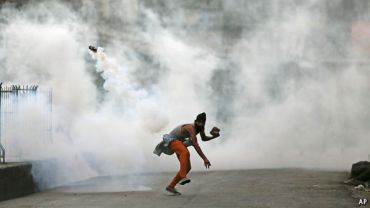
TODAY marks the 48th consecutive day of protests in Jammu & Kashmir, India’s only Muslim-majority state. Young Kashmiri men have been on the streets calling for independence from India and throwing stones at security forces. Indian security forces have responded with tear gas and shotguns that fire small-bore pellets instead of buckshot.

A strict curfew has also been imposed across the Kashmir valley, which includes Srinagar, the region’s largest city. So far, 66 civilians and two police officers have been killed in the violence. Why are Kashmiris protesting?

The region has been disputed since the partition of India and Pakistan in 1947. Both sides claim the territory and have fought three wars over it. Kashmir has been living under India’s Armed Forces (Special Powers) Act, which gives special powers to the army, since the eruption in 1990 of an armed insurgency that was covertly supported by Pakistan. Some 40,000 people have been killed since. Even in the relatively peaceful past decade, unrest has flared up, most notably in the summers of 2008 and 2010. The current protests started on July 9th after Indian security forces killed Burhan Wani, a young and charismatic Islamist militant. Resentment had been building for months. Kashmiris worried when Narendra Modi’s Hindu-nationalist Bharatiya Janata Party (BJP) came to power in 2014 that his national government would make life difficult for Muslims. At state elections later that year, the local Peoples Democratic Party formed a coalition with the BJP, leaving them feeling betrayed. Wani’s killing has mobilised a generation that had grown up under what it sees as an illegitimate Indian occupation.

The result has been a seven-week cycle of violent protests and retaliatory action by the police and paramilitary forces. Their supposedly non-lethal pellets have blinded dozens and injured hundreds. Shops and businesses have remained closed since the protests started, either under curfew orders or because of calls for strikes from separatist leaders. Many Kashmiris have not left their homes for weeks. Few expect the situation to improve any time soon, despite soothing words this week from Mr Modi and a visit to the region by India’s home minister.An obstacle to any lasting solution is India’s insistence on seeing Kashmir through the prism of its rivalry with Pakistan. The Indian government’s immediate reaction to this summer’s unrest was to accuse its neighbour of meddling. In fact, Wani was a home-grown insurgent; the young men on the streets are locals. Unemployment is widespread and economic opportunities are few. The state was also promised special status, guaranteeing autonomy, in India’s constitution. And many Kashmiris now want more: a survey in 2010 by Chatham House, a think-tank, found overwhelming support for independence. Kashmiris are at best ambivalent about their attachment to India. Until the government recognises their demands, the anger is unlikely to dissipate.

Source: The Economist explains: Why Kashmir is erupting again | The Economist

26/08/2016

China’s Oil Industry Destined for Big Changes – China Real Time Report – WSJ

China’s largest oil fields are the stuff of Communist Party folklore, but today they’re potent symbols of the challenges facing China’s energy industry.

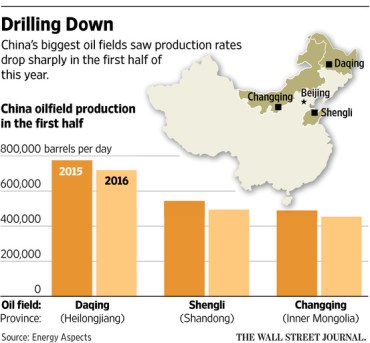
Significant falls in the first half of this year at China’s biggest-producing oil fields — Daqing, Shengli, and Changqing — have solidified a moment anticipated by the global energy industry: Oil production in China is in long-term decline.

The turnabout is jarring for an industry that has long held huge political sway in China. The “Daqing Spirit”– meaning hard work in the face of challenges — has long been celebrated by top leaders. The companies have been held up as critical to fueling China’s economic rise.

The London-based consultancy Energy Aspects compiled data from China’s oil fields. It shows just how great a toll the plunge in crude prices has taken on overall domestic production.

China’s three biggest oil fields experienced production declines of between 7-9% in the first half, according to Energy Aspects. That far outpaced China’s production decline as a whole. Small gains from output in the Xinjiang region and elsewhere haven’t been enough to compensate.

The declines are important, Energy Aspects said in a recent report, “because it symbolizes a significant shift in thinking” by Chinese officials. While the government has a long-held goal of limiting imports — and protecting jobs in places like Daqing — by keeping production high, leaders seem to have realized that track was both unsustainable and expensive.

With global crude prices under $50 per barrel, many aging wells at big oil fields in China lose money with each barrel they pump. Shutting off the taps at home helps to stem losses when cheaper oil can be purchased from overseas.

So what does it mean?In short, the assets that long served as the cornerstone for revenue for companies such as PetroChina are drying up. If China’s energy giants want to be more profitable–as outside investors and China’s government are pressuring them to do–they’re going to need to look to diversify revenue.

That’s likely to include a mix of initiatives, say Chinese executives and analysts. One part of the drive might be trying to secure new oil production overseas. That would mean a renewed push for outbound deals. Big discoveries in Brazil and elsewhere appear particularly attractive to China.

The other path to future growth is more complicated. For example, China’s oil companies are keen to learn how to boost sales and profits at the thousands of retail gas stations across China. Earning more money from sales of Snickers bars or cigarettes would make them somewhat less vulnerable to the vicissitudes of global oil prices.

The bottom line: China’s oil industry, like the economy as a whole, is destined for big changes. Many of those in the coming years will involve a greater global role for the oil giants — PetroChina, Sinopec, and Cnooc — than they currently have today.

The bigger global footprint is inevitable, says one person with ties to China’s top oil executives, as production at home begins to dwindle. The international revenues are needed to stave off a domestic slowdown.

“We are coming. We are coming,” he said.

Source: China’s Oil Industry Destined for Big Changes – China Real Time Report – WSJ

25/08/2016

China’s logistic hub in Djibouti to stabilize region, protect interests – Global Times

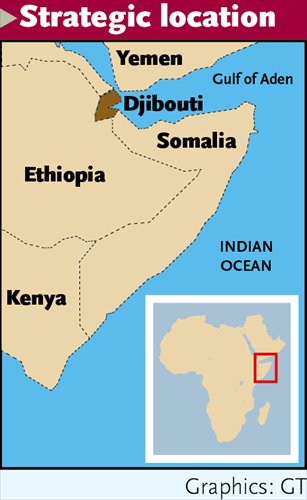
About 7,700 kilometers away from Beijing, in Djibouti in the Horn of Africa, China’s first overseas installation for naval vessels is under construction.

Scheduled to be completed in 2017, the base is set to resupply Chinese warships, according to government statements.

But despite Beijing’s insistence that the facility will simply help with escort missions, peacekeeping and humanitarian rescues in the Gulf of Aden and the waters off Somalia, many have argued this move represents Chinese “military expansion” beyond the Asia-Pacific region.

“Through exaggerating or distorting, they attempt to hype the ‘threat of China’ and tarnish China’s image, so as to suppress China’s efforts to build maritime power,” Li Jie, a Beijing-based maritime expert, told the Global Times.

“The base is far less than a military base in its scale and function,” said Zhang Junshe, a researcher from PLA Naval Military Studies Research Institute. “The base will be a logistic hub for Chinese vessels to get replenishment and temporary rest. It differs from US-style military bases, which have become bridgeheads for the country to easily and quickly wield military deterrence or intervention to other territories,” Li noted. The Republic of Djibouti, located in a strategically important position between the Indian Ocean and the Red Sea, hosts the military facilities of several countries, including the US, Japan and France, the country’s former colonial ruler. Italy and Spain also have permanent military installations in the country, according to a recent report by Hong Kong-based Phoenix TV.

These countries have stationed a variety of assets in these bases, including personnel, ships, UAVs and surveillance aircraft which are used for anti-terror and anti-piracy operations in Africa and the Middle East.

International obligations

The news that China will build a “military base” in Djibouti was first revealed in May last year, when Djiboutian President Ismail Omar Guelleh told AFP that “discussions are ongoing,” and China’s presence would be “welcome.

“Since then, it has aroused wide attention and concern. The US even reportedly protested against it. “Washington protested against the China-Djibouti pact and expressed concern over China’s plans to build a military base in the Obock region, but to no avail,” according to an article published in April on foreignaffairs.com, a US-based international affairs news portal.

At a regular press briefing on November 26, 2015, China’s foreign ministry first confirmed that China was negotiating with Djibouti over the construction of a “logistics facility.” Spokesman Hong Lei citied the need to resolve resupply difficulties for Chinese escort vessels, adding “[The facility] will be significant for Chinese army to fulfill its international obligations and safeguard global and regional peace and stability.”

Three months later at a press briefing by Chinese defense ministry on February 25, spokesman Wu Qian told media that China had reached an agreement with Djibouti to build a facility and construction had already begun. According to official figures, China has deployed more than 30,000 personnel on peacekeeping missions, the most of any of the five permanent members of the UN Security Council.Since 2008, China has sent 22 escort fleets, a total of more than 60 vessels, to the Gulf of Aden and Somali waters, escorting more than 6,000 ships from home and abroad.

In March last year, hundreds of Chinese nationals threatened by escalating violence in Yemen were evacuated to Djibouti by their government.

But currently, these fleets need to dock in the ports of other countries to get rest and food supplies. “They need to organize people to purchase food locally. Besides, due to different types of fuels, refueling is also a problem,” Zhang said.

The new base will help China save money. Yang Huawen, a captain from China’s Northern Theater Command who joined a 10-month peacekeeping operation in Mali in 2014, is happy this facility is being built.

“In those tropical areas, the food goes bad quickly. The cost of mending equipment and maintenance is high,” Yang told the Global Times. “Building a logistic hub in the region can provide stable supplies efficiently and economically.”

Djibouti, with a landmass of 23,200 square kilometers of which 90 percent is volcanic desert, is poor in natural resources. Its ability to produce fruits, vegetables, and seafood is limited, according to a Chinese national who has spent time in the country. “Most of its vegetables are imported from its neighbor Ethiopia. Vegetables sell for there as much as five to 10 times what they do on the domestic market in China,” said the person.

Zhang also cited another advantage of the new facility – the Chinese government needn’t conduct diplomatic negotiations with the host country each time its vessels dock in their port.


Source: China’s logistic hub in Djibouti to stabilize region, protect interests – Global Times

25/08/2016

Iran keen to join China in rival to Panama Canal | Business | The Times & The Sunday Times

Iran has expressed interest in joining forces with a Chinese company that plans to build a $50 billion canal across Nicaragua that links the Atlantic and Pacific and rivals the Panama Canal.Mohammed Javad Zarif, the Iranian foreign minister, said that business leaders who went with him to the Central American state this week had discussed teaming up with HKND, a private Hong Kong company that has broken ground on the project but made little progress in the past two years.

Iranian involvement in a Chinese-run strategic waterway may raise concerns in the United States, which was instrumental in building the Panama Canal a century ago.

Daniel Ortega, Nicaragua’s left-wing president, shares Iran’s antipathy towards the US and is favoured for re-election in polls this November.

The project to build the 172-mile waterway has caused controversy at home, where environmentalists say that the route would take supertankers across Lake Nicaragua, bulldoze fragile ecosystems and involve the biggest earth-moving operation in history.

With an estimated 30,000 people likely to be displaced by construction, there have been protests against the canal, although the government insists that more than 80 per cent of the population of the country backs it. Amnesty International has denounced what it called Nicaragua’s “reckless handling” of the project.

There have been doubts about the financial health of Wang Jing, the Hong Kong tycoon behind the canal, and whether he might be backed by the Chinese government, which has massively invested across Latin America and Africa in the past decade.

Mr Wang is understood to have lost more than 80 per cent of his $10 billion fortune as a result of the volatility in the Chinese stock market. The project managers say that it is an international initiative not dependent on the vagaries of the Chinese share prices. After the groundbreaking ceremony in December 2014, the project appeared to have been put on hold, prompting speculation that it had run out of steam.

However, Mr Wang’s HKND group said this year that work on the Pacific terminal and wharf would begin this month, with work on the canal scheduled to start at the end of the year.

Mr Zarif, whose country recently had years of crippling US sanctions lifted, is on a tour of Latin America that began on Monday in Cuba, which has renewed diplomatic ties with the US but has yet to have its own half-century of sanctions lifted.Nicaragua was Mr Zarif’s second stop with an entourage of 120 Iranian business leaders and state economists, and he was scheduled to head on to Ecuador, Venezuela, Bolivia and Chile.

Source: Iran keen to join China in rival to Panama Canal | Business | The Times & The Sunday Times

25/08/2016

China and US to ratify landmark Paris climate deal ahead of G20 summit, sources reveal | South China Morning Post

China and the United States are set to jointly announce their ratification of a landmark climate change pact before the G20 summit early next month, the South China Morning Post has learned.

Senior climate officials from both countries worked late into the night in Beijing on Tuesday to finalise details, and a bilateral announcement is likely to be made on September 2, according to sources familiar with the issue.

President Xi Jinping will meet his US counterpart Barack Obama for the G20 summit in Hangzhou, Zhejiang province, two days later on September 4.

How China, the ‘world’s largest polluter’, is taking on climate change

“There are still some uncertainties from the US side due to the complicated US system in ratifying such a treaty, but the announcement is still quite likely to be ready by Sept 2,” said a source, who declined to be named.

If both sides announce the ratification on the day, it would be the last major joint statement between the two leaders before Obama leaves office.

China and the US account for about 38 per cent of global greenhouse gas emissions, according to the World Resources Institute.

By ratifying the Paris Agreement on climate change, Beijing and Washington could generate momentum for the accord to come into effect as a binding international treaty.

The pact agreed by representatives from 195 countries in Paris last December aims to keep the increase in the global average temperature to well below 2 degrees Celsius on pre-industrial levels.

Countries began the ratification process on April 22, Earth Day, and by Tuesday, 23 nations had joined, but they account for just 1 per cent of emissions.

China and the US create a new climate for international collaboration on the environment

The treaty will enter into force only after 55 countries representing at least 55 per cent of emissions ratify or join the deal in other ways.

China had said earlier it would ratify the accord before the G20 summit in September.

In June, the US said it would “work towards” approving the deal before end of the year, with the White House keen to seal a key part of Obama’s environmental protection legacy before he leaves office in January.

US law allows the nation to join international agreements in a number of ways, including through the authority of the president.

With China and US joining, some civil society trackers say they are confident the deal could hit the 55 per cent threshold before the end of the year.

On Wednesday, investors managing more than US$13 trillion of assets urged leaders of the Group of Twenty major economies to ratify the deal before the end of December.

The 130 investors also called for the G20 to double global investment in clean energy, develop carbon pricing and phase out fossil fuel subsidies.

How a little-known chapter in Sino-US cooperation may have helped save the planet

“Governments must ratify the Paris agreement swiftly and have a responsibility to implement policies that drive better disclosure of climate risk, curb fossil fuel subsidies and put in place strong pricing signals sufficient to catalyse the significant private sector investment in low carbon solutions,” said Stephanie Pfeifer, chief executive at Institutional Investors Group on Climate Change.

Ratification is expected to play out differently in the US compared with China.

While China has “few uncertainties” at home for passing the deal, it could cause controversy within the US, according to Liu Shuang, an officer with Energy Foundation’s low-carbon development programme.But the Obama administration’s commitment to international frameworks suggests the accord would be passed in a way that would make it difficult for his successors to undo, civil society trackers said.

‘I may do something else’: Donald Trump’s threat to renegotiate UN climate deal greeted with widespread dismay

The two countries started extensive cooperation at the leadership level in 2014. In a joint declaration that year, China promised its emissions would peak before 2030, while the US promised to cut emission by at least 26 per cent. That deal is widely regarded as paving the way for the Paris Agreement.

Source: China and US to ratify landmark Paris climate deal ahead of G20 summit, sources reveal | South China Morning Post

Law of Unintended Consequences

continuously updated blog about China & India

ChiaHou's Book Reviews

continuously updated blog about China & India

What's wrong with the world; and its economy

continuously updated blog about China & India