Archive for ‘Economics’

27/06/2016

China city shuts down waste burning plant over protests | Reuters

A city in central China is shutting down a waste incineration project, it said, after thousands of people protested against the plant over fears it will damage the environment and residents’ health.

Photos posted on social media, which could not be verified by Reuters, showed dozens of riot police marching in the city of Xiantao, located in Hubei province in central China.

About 10,000 people protested in Xiantao on Sunday, the state-backed Global Times reported, citing a local resident, even after the local government said it planned to suspend the project on Sunday morning.

Another resident told Reuters by phone on Monday that the protests continued, and several protesters were injured in clashes with riot police.

“There are hundreds of police here because of the demonstrations,” said the resident, who declined to give his name because of the sensitivity of the matter.

The city government called on residents to refrain from taking “extreme actions” and spreading rumors in a statement on its official microblog.

Tens of thousands of “mass incidents” – the usual euphemism for protests – happen in China each year, spurred by grievances over issues such as corruption, pollution and illegal land grabs, unnerving the stability-obsessed ruling Communist Party.

Last June, thousands of people protested in Jinshan, about 60 km (37 miles) from China’s commercial hub of Shanghai, against plans to build a chemical plant in the district.

A Xiantao official said that the planned plant’s emissions of dioxin, a toxic compound, would have been in line with European Union standards, state media reported.

Source: China city shuts down waste burning plant over protests | Reuters

27/06/2016

This Is What Happens to Your Clothes When You Donate Them in the West – India Real Time – WSJ

As heaps of castoff clothes from the U.S. cascade down a conveyor belt, rows of sari-clad women frantically sort the garments by type—T-shirts in one barrel, women’s jeans in another. They pluck out sweatpants, underwear, sweaters, coats, and even furs.

The jumble is part of the thousands of tons of used clothing that arrive each month in this western Indian port, a hub in the vast global network that purchases secondhand clothes in rich countries and resells them throughout the developing world.

“I don’t understand why people throw away all these clothes,” says one of the sorters, as she sits on a warehouse floor during a break. “Maybe they don’t have time to wash them.

”In fact, the glut springs from the rise of fast fashion, which has flooded the world with inexpensive clothing, often produced in some of the same low-wage countries where it later ends up sold in market stalls or reprocessed into goods like blankets or pillow stuffing.

To some, this a virtuous circle, minimizing waste while providing jobs and a source of low-cost clothes for the poor. Even retailers such as Hennes & Mauritz AB and others have gotten into the act, collecting worn apparel to recycle. Since it began collecting used clothing at its stores in 2013, H&M has recycled more than 20,000 tons of it.

Source: This Is What Happens to Your Clothes When You Donate Them in the West – India Real Time – WSJ

24/06/2016

Two stumbles forward, one back | The Economist

LAST November, two days after India’s ruling party suffered a drubbing at local polls in the state of Bihar, the government unexpectedly opened a dozen new industries to foreign direct investment (FDI). A gushing official called it “the biggest path-breaking and the most radical changes in the FDI regime ever undertaken”.

On June 20th, two days after Raghuram Rajan, the respected governor of India’s central bank, abruptly announced that he would soon step down, the government covered its embarrassment with another impromptu salute to FDI. The slim package of enticements, amounting to a slight lowering of barriers in some of the same industries, has made India “the most open economy in the world for FDI,” said the office of Narendra Modi, the prime minister.

Hyperbole is not unexpected from a government keen to burnish its liberalising credentials. But it has not lived up to its cheery slogans (“Startup India”, “We Unobstacle”, “Minimum Government, Maximum Governance”). Two years after clinching a sweeping electoral mandate, and with the opposition in disarray, Mr Modi’s reform agenda should be in full swing. Instead, as with previous governments, his ill-focused initiatives have run up against India’s statist bureaucracy.

To be fair, much of what has been done is useful. Corruption has been stemmed, at least at ministerial level. A vital bankruptcy law has been approved. Yet for all the evidence that Mr Modi’s team is doing a better job running the existing economic machinery, it has shown limited appetite for overhauling it.

Pessimists see Mr Rajan’s departure as evidence of a further wilting of ambition. After all, as a former chief economist of the IMF, he is an enthusiastic advocate of structural reform. Then again, at the central bank he has focused chiefly on bringing down inflation. Optimists hope he is being eased out because of his habit of speaking his mind, thereby occasionally contradicting the government line, rather than to pave the way for retrograde policies.

Thanks to a mix of lower oil prices and prudent fiscal policies (and perhaps also flawed statistics) the economy grew by 7.9% in the first quarter, compared with the same period the year before, the fastest pace among big economies. Ministers think further acceleration is possible.

That may prove difficult. India’s public-sector banks, which hold 70% of the industry’s assets, are stuffed with bad loans; the central bank reckons that some 17.7% are “stressed”. That Mr Rajan forced them to disclose this fact will not have endeared him to politically connected tycoons now being badgered to repay the banks. Bank shares rose after he said he was leaving, presumably in the hope that his successor will go easy on them. Rating agencies fret that they will still need recapitalising, blowing a hole in the government’s finances. In the meantime, credit to industry has all but ground to a halt.

India’s overweening bureaucracy is another drag on growth. Copious red-tape and poor infrastructure put India 130th out of 189 countries in the World Bank’s “Ease of doing business” rankings. Getting permits to build a warehouse in Mumbai involves 40 steps and costs more than 25% of its value, compared with less than 2% in rich countries. It takes 1,420 days, on average, to enforce a contract.

A slew of liberalising reforms in 1991, when India was in far worse shape than now, were left unfinished as the economy gradually recovered. Whereas product markets were freed from the “licence Raj”, which no longer dictates how much of what each factory can produce, inputs such as land, labour and capital are still heavily regulated. Having once sought to prise those open, the Modi government now encourages state governments to take the lead with their own reforms.

One result is that there is no proper market for land: businesses that want to set up shop are best off wooing state governments to provide some. Chief ministers with a presidential approach (a model Mr Modi espoused in his previous job running Gujarat) scurry around scouting for plots on behalf of the private sector in a manner that would have seemed familiar to the central planners of yore.

That India is pro-business but not necessarily pro-market is a frequent refrain. “The government wants to create jobs, not the environment in which job-creation flourishes,” says one investor. Special economic zones are set up as sops, sometimes to entice single companies. Even big foreign investors are essentially told what to do: Walmart can only open cash-and-carry stores closed to the general public, Amazon must sell mostly other merchants’ goods rather than its own, and so on.If businesses cannot get things done themselves, even the most energetic politician will struggle to set up enough factories to general public, Amazon must sell mostly other merchants’ goods rather than its own, and so on.

Source: Two stumbles forward, one back | The Economist

24/06/2016

China rejects bending rule for India to join nuclear club | Reuters

China maintains its opposition to India joining a group of nations seeking to prevent the proliferation of nuclear weapons by controlling access to sensitive technology, said the head of the arms control department in China’s Foreign Ministry.

The Nuclear Suppliers Group (NSG) met this week in Seoul, but China said it would not bend the rules and allow India membership as it had not signed the nuclear Non-Proliferation Treaty (NPT), the main global arms control pact.

“Applicant countries must be signatories of the Treaty on the Non-Proliferation of nuclear weapons (NPT),” Wang Qun, the head of arms control department in China’s Foreign Ministry, was quoted as saying in Seoul on Thursday night.

“This is a pillar, not something that China set. It is universally recognized by the international community,” Wang said according to a statement released by the Chinese foreign ministry on Friday.China is leading opposition to a push by the United States to bring India into the NSG which aims to prevent nuclear weapons proliferation by stopping the sale of items that can be used to make nuclear arms.

The issue of India’s membership was not formally discussed at the NSG meeting this week, Wang said on Friday.

The United States, which has a nuclear cooperation deal with India, considers it a nuclear power that plays by the rules and is not a proliferator, and wants to bring Asia’s third largest economy into the 48-member group.

India already enjoys most of the benefits of membership under a 2008 exemption to NSG rules granted to support its nuclear cooperation deal with Washington.

On Friday, on the sidelines of the plenary meeting of the NSG, Wang stressed China considered it important to handle new memberships under a consensus and that there was no move yet to allow a non-NPT state to join.

“International rules will have to be respected, big or small,” Wang told Reuters. “Big like NPT. Small like the rules and procedures of this group.”   “The important question of which we are concerned, is how to deal with the question of participation of countries within the group of non-NPT states. It’s a formidable task.”Indian Prime Minister Narendra Modi raised the issue on Thursday at a meeting with Chinese President Xi Jinping at a regional summit in Tashkent, Uzbekistan, but there was no breakthrough.

One diplomat at the NSG plenary in Seoul said the group’s outgoing chairman, Argentinian diplomat Rafael Grossi, would act as a “facilitator” to continue to search for an accession deal.

Opponents argue that granting India membership would further undermine efforts to prevent proliferation. It would also infuriate India’s rival Pakistan, an ally of China’s, which has responded to India’s membership bid with one of its own.Pakistan joining would be unacceptable to many, given its track record. The father of its nuclear weapons program ran an illicit network for years that sold nuclear secrets to countries including North Korea and Iran.

Source: China rejects bending rule for India to join nuclear club | Reuters

24/06/2016

Are fears of mass unemployment in China overblown? | Reuters

Despite its sputtering economy – or perhaps because of it – China’s labor market may be able to provide more jobs for laid off workers than many think.

The working age population is shrinking by several million each year and the number of workers willing to migrate beyond their home province is falling, leaving jobs available for those willing to travel.

This suggests concerns about mass unemployment as China cuts down its industrial capacity and the risk that this could lead to social unrest may be overdone.

Take Li Xi, 34, for instance.After losing his job of 15 years at Highsee Iron and Steel in the slow-growing northern province of Shanxi, Li was not out of work for long.

Encouraged by friends to join them at an electronics factory 1,000 km (620 miles) to the south, he made the journey to Suzhou near Shanghai. The rest was easy.”On the first day I did a health check, and on the second day I was working,” Li said.

China’s economic growth slowed to a 25-year-low in 2015 of less than 7 percent and Beijing has flagged layoffs as it reduces massive surplus industrial capacity and gears the economy more to services and consumption.

Sources said in March that China was expecting to lay off 5-6 million state workers in the next two to three years as it curbs production capacity and pollution in rust-belt provinces.

While there is scant official data to build an accurate picture of Chinese unemployment, Chang Chun Hua, China economist at Nomura, said the jobs market can handle the unemployment pressures for now.

The working age population has been shrinking since 2012. Last year, the number of people between the ages of 16 and 59 shrank by 4.87 million, government statistics show. In 2014, the age group contracted by 3.71 million.

At the same time, the government says a higher-than-expected 5.77 million jobs were created between January and May this year.

“In general, the current unemployment pressure is still manageable for the Chinese government,” Hua said.

Source: Are fears of mass unemployment in China overblown? | Reuters

24/06/2016

Capturing China’s $5 trillion productivity opportunity | McKinsey & Company

It won’t be easy, but shifting to a productivity-led economy from one focused on investment could add trillions of dollars to the country’s growth by 2030.

After three decades of sizzling growth, China is now regarded by the World Bank as an upper-middle-income nation, and it’s on its way to being one of the world’s advanced economies. The investment-led growth model that underpinned this extraordinary progress has served China well. Yet some strains associated with that approach have become evident.

In 2015, the country’s GDP growth dipped to a 25-year low, corporate debt soared, foreign reserves fell by $500 billion, and the stock market dropped by nearly 50 percent. A long tail of poorly performing companies pulls down the average, although top-performing Chinese companies often have returns comparable with those of top US companies in their industries. More than 80 percent of economic profit comes from financial services—a distorted economy. Speculation that China could be on track for a financial crisis has been on the rise.

The nation faces an important choice: whether to continue with its old model and raise the risk of a hard landing for the economy, or to shift gears. A new McKinsey Global Institute report, China’s choice: Capturing the $5 trillion productivity opportunity, finds that a new approach centered on productivity could generate 36 trillion renminbi ($5.6 trillion) of additional GDP by 2030, compared with continuing the investment-led path. Household income could rise by 33 trillion renminbi ($5.1 trillion).

Pursuing a new economic model

China has the capacity to manage the decisive shift to a productivity-led model. Its government can pull fiscal and monetary levers, such as raising sovereign debt and securing additional financing on the basis of 123 trillion renminbi in state-owned assets. China has a vibrant private sector, earning three times the returns on assets of state-owned enterprises. There are now 116 million middle-class and affluent households (with annual disposable income of at least $21,000 per year), compared with just 2 million such households in 2000. And the country is ripe for a productivity revolution. Labor productivity is 15 to 30 percent of the average in countries that are part of the Organisation for Economic Co-operation and Development (OECD).

A new productivity-led model would enable China to create more sustainable jobs, reinforcing the rise of the consuming middle class and accelerating progress toward being a full-fledged advanced economy. Such a shift will require China to steer investment away from overbuilt industries to businesses that have the potential to raise productivity and create new jobs. Weak competitors would need to be allowed to fail rather than drag down profitability in major sectors. Consumers would have more access to services and opportunities to participate in the economy.

Making this transition is an urgent imperative. The longer China continues to accumulate debt to support near-term goals for GDP growth, the greater the risks of a hard landing. We estimate that the nonperforming-loan ratio in 2015 was already at about 7 percent, well above the reported 1.7 percent. If no visible progress is made to curb lending to poorly performing companies, and if the performance of Chinese companies overall continues to deteriorate, we estimate that the nonperforming-loan ratio could rise to 15 percent. This would trigger a substantial impairment of banks’ capital and require replenishing equity by as much as 8.2 trillion renminbi ($1.3 trillion) in 2019. In other words, every year of delay could raise the potential cost by more than 2 trillion renminbi ($310 billion). Although such an escalation would not lead to a systemic banking crisis, a liquidity crunch among corporate borrowers and waning confidence of investors and consumers during the recovery phase would have a significant negative impact on growth.

Our report identifies five major opportunities to raise productivity by 2030:

  • unleashing more than 39 trillion renminbi ($6 trillion) in consumption by serving middle-class consumers better
  • enabling new business processes through digitization
  • moving up the value chain through innovation, especially in R&D-intensive sectors, where profits are only about one-third of those of global leaders
  • improving business operations through lean techniques and higher energy efficiency, for instance, which could deliver a 15 to 30 percent productivity boost
  • strengthening competitiveness by deepening global connections, potentially raising productivity by 10 to 15 percent

Capturing these opportunities requires sweeping change to institutions. China needs to open up more sectors to competition, enable corporate restructuring, and further develop its capital markets. It needs to raise the skills of the labor force to fill its talent gap and to sustain labor mobility. The government will need to manage conflicts among many stakeholders, as well as shift governance and incentives that rewarded a single-minded focus on rising GDP, even as it modernizes its own processes.

Source: Capturing China’s $5 trillion productivity opportunity | McKinsey & Company

23/06/2016

Why India’s monsoon is difficult to forecast | The Economist

METEOROLOGISTS are forecasting a bumper monsoon for India this year. This is good news for the more than 600m people—about half of India’s population—who depend on the rains it brings. Knowing when and where the monsoon will arrive is especially important for farmers; even now, two-thirds of India’s fields lack irrigation. But forecasting the monsoon remains fantastically difficult, especially as four in every ten monsoons are classified as abnormal anyway. What makes India’s monsoon so unpredictable?

The word monsoon derives from mausam in Hindi (and originally from Arabic), meaning “weather”. Monsoon climates typically have two very distinct seasons: wet and dry. In India, the onslaught of the rains begins when moist air is carried northwards from the Indian ocean during the summer. The winds transporting the main or “south-west” monsoon come from an area south of the equator which is characterised by high atmospheric pressure. As the air gathers moisture during the journey, atmospheric convection forms huge storm clouds which arrive first in southern India around early June (as they did this year). The monsoon creeps north and west, showering Pakistan and north India about a month later. By September it is in retreat, and has normally withdrawn from the south of the country by December. Many factors seem to affect the duration and intensity of the monsoon. One is El Niño, a climatic phenomenon associated with warmer temperatures in the tropical Pacific ocean. Last year the monsoon proved disappointing while El Niño was in full swing: total rainfall between June and September was 14% below the 50-year average. How exactly the phenomenon interacts with the monsoon is not well understood, however, as even large Niños in the past have coincided with normal monsoons.

Anthropogenic emissions also seem to affect rain patterns. India is the world’s fourth-biggest emitter of greenhouse gases. The insulating effect of such emissions helped make last year the hottest on record; this year looks set to be even more scorching. A warmer atmosphere probably means even greater variability in the monsoon. Rainfall extremes are expected to increase, thanks in part to the fact that a warmer atmosphere can hold more moisture (about 7% more, for every degree Celsius of warming). Air pollution complicates matters further. It is a terrible problem in India, contributing to more than 600,000 early deaths a year. Cooking at home, and the smoke it releases, accounts for much of the trouble. Aerosols such as black carbon interact with sunlight. Some of these tiny particles—many less than a tenth the width of a human hair—scatter light, while others absorb it. In the former case, this prevents the light from warming the earth’s surface. In the latter, absorbing the light causes the particles to warm the air around them. Both alter the heating of the atmosphere, and therefore the heating of the land relative to the ocean—the process which drives the monsoon.

Scientists are using a variety of techniques to better forecast the monsoon, from monitoring changes in land use (because vegetation stores more moisture) to sending underwater robots into the Bay of Bengal (to learn more about the salinity and temperature of the ocean). Their research could improve climate models and farming practices—but improved water-storage facilities, better irrigation and more access to insurance schemes might have to make up for the gaps in knowledge that will persist.

Source: The Economist explains: Why India’s monsoon is difficult to forecast | The Economist

23/06/2016

Tata patriarch’s aviation ambitions a step closer as India opens up | Reuters

Officially at least, Ratan Tata, patriarch of one of India’s wealthiest business families, retired in late 2012. In reality, he has been a driving force behind Tata’s bet on airlines and a rare public campaign to open up the booming aviation sector.

The $100 billion Tata group conglomerate is a major beneficiary of the decision last week to open up aviation in India, making it easier for start-ups to fly overseas sooner.

The decision is no panacea for Tata, whose airlines – Vistara and AirAsia India – have had a slow start in a competitive market dominated by IndiGo, owned by InterGlobe Aviation (INGL.NS), and Etihad-backed Jet Airways (JET.NS), both of which opposed the rule change.

But it marks a victory for 78-year-old Ratan Tata, and ends more than two years of airlines lobbying, of Twitter rows and of frequent public statements from the usually circumspect steel-to-salt group.

“This was a David-and-Goliath kind of situation,” said a source close to Tata group. “There was huge lobbying from the other side.

“Ultimately, sources familiar with the talks said, it was Ratan Tata, a trained pilot, who was key to sealing the deal, capitalising on his clout.In a message earlier this year, he called for “a new open market economy” and said airlines lobbying against a rule change was “reminiscent of protectionist and monopolistic pressures by vested interests’ entities who seem to fear competition.

“A spokesman for Tata Sons, which promotes the group, denied Ratan Tata was directly involved, saying he had “nothing to do with operations or management of either of the airlines” after his retirement, and that views he expressed were personal.

Source: Tata patriarch’s aviation ambitions a step closer as India opens up | Reuters

23/06/2016

Foreign Direct Investment Into India Jumps 26%, U.N. Says – India Real Time – WSJ

India’s fast-growing economy attracted $44 billion in foreign direct investment in 2015, making it the 10th largest destination globally for such investment last year, according to United Nations figures released this week.

That represents a 26% increase in foreign investment in India over the year before, according to the U.N. Conference on Trade and Development, which published the data in its latest World Investment Report. Prime Minister Narendra Modi has touted the growing stream of overseas money entering India as a signal accomplishment of his two years in office.

The latest U.N. figures suggest in particular that the Modi government’s efforts to encourage more global companies to “Make in India” are reaping some success. Foreign investments worth $28.7 billion in so-called “greenfield” manufacturing projects, or those that start from scratch, were announced in India last year—more than double the $11 billion in investments that were announced in 2014. Electronics manufacturing saw an especially big boost, with $13.5 billion invested in such projects in 2015, compared with $1.1 billion the year before.

The Modi administration has made changes to keep the money coming. Last year it began allowing foreigners to own larger stakes in Indian companies in insurance, construction, mining, manufacturing and others. This week the government announced increases in foreign-investment limits in defense, retail, civil aviation, pharmaceuticals and grocery businesses. The changes, the official press release declared, make India “the most open economy in the world” for foreign direct investment.

Some experts doubt the latest rule changes will cause more money to flood in right away, though, given the degree to which Indian regulations remain vague and regulatory decision-making remains opaque.

India has risen steadily as a host of overseas investment since 2000, when the entirety of foreigners’ stakes in the economy was valued at $16 billion. The same figure last year was $282 billion.

In terms of yearly inflows, the country still ranks far behind mainland China, which lured $136 billion in foreign direct investment in 2015; Hong Kong, which attracted $175 billion; and Singapore, $65 billion. The U.S. was 2015’s top host of investment from abroad: $380 billion of it flowed into the world’s largest economy last year.

Among executives surveyed by the UNCTAD, 19% picked India as the most promising host country for investment over the next few years. Nearly half picked the U.S.; 21% chose China. But world-wide, the U.N. body expects foreign investment flows to dip by 10% to 15% this year. Its surveys indicate that multinational companies are skittish about volatile exchange rates, geopolitical uncertainty and mounting debt in developing countries.

Source: Foreign Direct Investment Into India Jumps 26%, U.N. Says – India Real Time – WSJ

22/06/2016

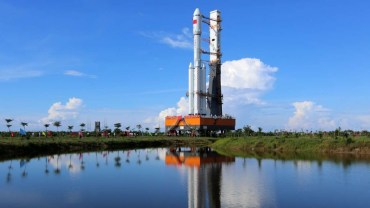
China’s newest space rocket, Long March 7, ready for blast-off | South China Morning Post

China’s latest Long March rocket arrived on the launch pad on Wednesday morning three days before it is due for blast-off on the maiden launch of both the rocket and the launch site.

At 8am on Wednesday the 600-tonnes Long March 7 rocket began a three-hour rail journey of several kilometres from the assembly complex to the launch site at Wenchang Satellite Launch Centre, China Central Television reported.

The Long March 7 will use new liquid fuel, which is environmentally friendly and costs only a fraction of the fuel used by its predecessor, LM-2.It will be carrying a test model of China’s next-generation manned spacecraft, together with several small satellites.

China’s second space lab to go into orbit this year as part of permanent manned space station by 2022

The rocket’s role in future will be to send up cargo ships to the Chinese space station.

If the weather turns bad on Saturday – which is not uncommon at the nation’s southernmost launch site on the tropical Hainan Island – the launch window will be able to remain open until Wednesday.

This launch will be different from others carried out by China because the public will be able to watch what happens in person on the mainland for the first time.

Eight designated “best spot” viewing areas covering 40 hectares around the launch site, including public parks and a private hotel beach, can accommodate about 25,000 spectators.

“This launch will open a new chapter in the history of Chinese space exploration,” a space scientist involved in the development of the new Long March rockets told the South China Morning Post.

“The blast of flames, rise of vapour, the chest-pounding noise and the trembling of the ground under people’s feet … it will be a life-changing experience for many people [watching],” the scientist said.

Source: China’s newest space rocket, Long March 7, ready for blast-off | South China Morning Post

Law of Unintended Consequences

continuously updated blog about China & India

ChiaHou's Book Reviews

continuously updated blog about China & India

What's wrong with the world; and its economy

continuously updated blog about China & India