Archive for ‘Economics’

27/05/2016

Foxconn replaces ‘60,000 factory workers with robots’ – BBC News

If manufacturers like Foxconn and high street companies like McDonald’s and, no doubt soon, offices too start replacing humans with robots, where will it all end? Where will all the ‘surplus’ people find jobs and pay.  And, eventually, who will be able to afford the iPhones, the hamburgers and so forth?  Won’t it be self-defeating in the long run for the employers with no customers or, at best, not enough customers to keep all the robots occupied and earning their keep.

“One factory has “reduced employee strength from 110,000 to 50,000 thanks to the introduction of robots”, a government official told the South China Morning Post.

Xu Yulian, head of publicity for the Kunshan region, added: “More companies are likely to follow suit.”

China is investing heavily in a robot workforce.

In a statement to the BBC, Foxconn Technology Group confirmed that it was automating “many of the manufacturing tasks associated with our operations” but denied that it meant long-term job losses.

“We are applying robotics engineering and other innovative manufacturing technologies to replace repetitive tasks previously done by employees, and through training, also enable our employees to focus on higher value-added elements in the manufacturing process, such as research and development, process control and quality control.

“We will continue to harness automation and manpower in our manufacturing operations, and we expect to maintain our significant workforce in China.”

Since September 2014, 505 factories across Dongguan, in the Guangdong province, have invested 4.2bn yuan (£430m) in robots, aiming to replace thousands of workers.

Kunshan, Jiangsu province, is a manufacturing hub for the electronics industry.

Economists have issued dire warnings about how automation will affect the job market, with one report, from consultants Deloitte in partnership with Oxford University, suggesting that 35% of jobs were at risk over the next 20 years.

Former McDonald’s chief executive Ed Rensi recently told the US’s Fox Business programme a minimum-wage increase to $15 an hour would make companies consider robot workers.

“It’s cheaper to buy a $35,000 robotic arm than it is to hire an employee who is inefficient, making $15 an hour bagging French fries,” he said.”

Source: Foxconn replaces ‘60,000 factory workers with robots’ – BBC News

25/05/2016

China to replace direct coal combustion with electricity in new plan | Reuters

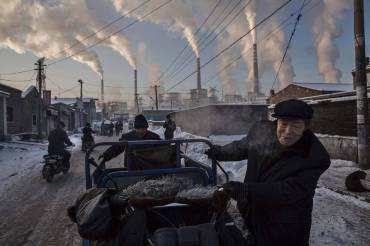
China will reduce the amount of coal burned directly in industrial furnaces and residential heating systems in order to tackle a major source of smog, the country’s energy regulator said on Wednesday.

The National Energy Administration (NEA) said in a joint announcement with other government bodies that around 700 million to 800 million tonnes of coal is burned directly in China every year, much of it in the countryside, where access to electricity is limited.

Directly burned coal amounts to about 20 percent of China’s total coal consumption volume, much higher than the 5 percent rate in Europe and the United States.

China will aim to replace direct burning with electricity, including renewable power as well as ultra-low emission coal-fired generators, the NEA said.

China currently relies on coal for around 64 percent of its total primary energy needs and for three-quarters of its total power generation. Emissions from the direct combustion of coal are around five times higher than those from coal-fired power plants, which are subject to strict anti-pollution regulations.

During the 2016-2020 period, China plans to raise electricity’s share of the country’s overall energy mix to 27 percent, up about 1.5 percentage points from now and raising total power consumption by around 450 billion kilowatt-hours a year, the NEA said.

Experts have estimated that China will need an additional 600 GW of coal-fired power capacity over the 2015-2030 period in order to replace direct coal combustion.

Source: China to replace direct coal combustion with electricity in new plan | Reuters

24/05/2016

Unholy woes | The Economist

AT THE dawn of time Lord Vishnu made gods and demons join in churning the milky oceans to extract an elixir of eternal life. After cheating the demons of their share, Vishnu spilled four drops of the precious nectar. Where they fell sprang up sacred rivers whose waters wash away sins, now sites for mass Hindu pilgrimages called Kumbh Mela.

For a lunar month every 12 years it falls to Ujjain, a town in the central Indian state of Madhya Pradesh, to host the Kumbh Mela by the revered Shipra, whose waters meander north into the mighty Ganges and eventually eastward to the Bay of Bengal. By the time the full moon reappears on May 21st tens of millions of bathers, among them thousands of bearded ascetics known as sadhus (pictured), will have worshipped on Ujjain’s teeming riverbanks.

What few are aware of is that the water is no longer the Shipra’s. Urbanisation, rising demand and two years of severe drought have shrivelled the sacred river. Its natural state at this time of year, before the monsoon, would be a dismal sequence of puddles dirtied by industrial and human waste. But the government of Madhya Pradesh, determined to preserve the pilgrimage, has built a massive pipeline diverting into the Shipra the abundant waters of the Narmada river, which spills westward into the Arabian Sea. Giant pumps are sucking some 5,000 litres a second from a canal fed by the Narmada, lifting it by 350 metres and carrying it nearly 50 kilometres to pour into the Shipra’s headwaters. To ensure clean water for the festival, the Shipra’s smaller tributaries have been blocked or diverted, and purifying ozone is being injected into the reconstituted waters in Ujjain itself.

The pilgrims and merchants of Ujjain are happy. But down in the Narmada valley there is little cheer. “They are wasting water on sadhus…while our farms go dry,” says Rameshwar Sitole, a farmer in the hamlet of Kithud. Since March the canal, which feeds his 2.5 hectares of maize and okra along with the farms of 12 other hamlets, has been bone dry. Mr Sitole’s crops have withered and died: a loss, he reckons, of some 50,000 rupees ($750). The government insists the water will return once Ujjain’s pilgrimage ends, but he is not so sure. “They turn it on when we protest, and then take it away again,” Mr Sitole shrugs. Meanwhile, over the hills, industrial users near Ujjain are lobbying loudly to exploit the fancy new water sources.

Poor monsoons are not unusual, but the back-to-back shortfalls, linked to the El Niño effect, which India has experienced in the past two years are very rare. Ten out of 29 states, with a population of some 330m, have been badly hit, with the worst-affected areas in the centre of the country. India is suffering its gravest water shortage since independence, says Himanshu Thakkar, a water expert in Delhi, the capital. Every day brings news of exhausted rivers and wells, destitute farmers migrating to the cities or even committing suicide, water trains being dispatched to parched regions—and of leopards venturing into towns in search of a drink.

The central government has responded with make-work programmes for afflicted areas, emergency shipments of water, and many promises. In February Narendra Modi, the prime minister, pledged to double farm incomes by 2022. Other ministers speak of massive irrigation projects, and have dusted off an ambitious water-diversion scheme for parched regions that is priced at $165 billion and involves no fewer than 37 links between rivers. Most links would be via canals—some 15,000km of artificial waterways in all.

Source: Unholy woes | The Economist

24/05/2016

China’s Middle Class Vents Over Growing List of Grievances – China Real Time Report – WSJ

The death here of a 29-year-old man in police custody—a new father and graduate of a prestigious Chinese university—has exposed growing anxieties in the country’s growing middle class, already shaken by a decelerating economy and a disparate series of high-profile incidents threatening their sense of stability.

As WSJ’s Te-Ping Chen reports:

Other wide-ranging targets of recent social-media attention include a violent string of attacks on doctors by embittered patients and their families, a demand that apartment owners in eastern China pay extra to secure the land on which their apartments were already built, confusing changes in college-entrance standards, and fatal chemical explosions wiping out homes.

Such disruptions have come as reminders that rising incomes or better education don’t automatically shield China’s expanding middle-class ranks from danger, whether physical or economic, in a society where the law can be arbitrarily enforced and justice is sometimes brutal.

“There’s a gap between expectation and reality,” said He Yunfeng, who heads Shanghai Normal University’s Institute of Knowledge and Value Sciences. “These kinds of incidents concentrated together have created a kind of panic.” Some critics have begun joking that the Chinese term for middle class— zhongchanjieji—would be better depicted by the term zhongcanjieji, or the “tragic middle class.”

Source: China’s Middle Class Vents Over Growing List of Grievances – China Real Time Report – WSJ

23/05/2016

Doubling down | The Economist

“A COLOSSAL roller-coaster” is how a senior engineer described it. He was talking about the railway that China plans to build from the lowlands of the south-west, across some of the world’s most forbidding terrain, into Tibet. Of all the country’s railway-building feats in recent years, this will be the most remarkable: a 1,600-kilometre (1,000-mile) track that will pass through snow-capped mountains in a region racked by earthquakes, with nearly half of it running through tunnels or over bridges. It will also be dogged all the way by controversy.

Chinese officials have dreamed of such a railway line for a century. In 1912, shortly after he took over as China’s first president, Sun Yat-sen called for a trans-Tibetan line, not least to help prevent Tibet from falling under the sway of Britain (which had already invaded Tibet from India a decade earlier). Mao Zedong revived the idea in the 1950s. In the years since, many exploratory surveys have been carried out.

But it is only after building the world’s second-longest railway network—including, in the past few years, by far the biggest high-speed one—that China’s government has felt ready to take on the challenge. It had a warm-up with the construction of the first railway into Tibet, which opened in 2006. That line, connecting Lhasa with Golmud in Qinghai province to the north (and extended two years ago from Lhasa to Tibet’s second city, Shigatse), was proclaimed to be a huge accomplishment. It included the highest-altitude stretch in the world, parts of it across permafrost. It required ingenious heat-regulating technology to keep the track from buckling. Advertisement: Replay Ad China further honed its skills with the opening of a high-speed line across the Tibetan plateau in 2014—though in Qinghai province, rather than in Tibet proper. But neither track had anything like the natural barriers that the Sichuan-Tibet line will face. It will be just under half as long again as the existing line to Tibet, but will take three times longer to build. The second line’s estimated cost of 105 billion yuan ($16 billion) is several times more than the first one. Lhasa is about 3,200 metres (10,500 feet) higher than Chengdu, yet by the time the track goes up and down on the way there—crossing 14 mountains, two of them higher than Mont Blanc, western Europe’s highest mountain—the cumulative ascent will be 14,000 metres. The existing road from Chengdu to Lhasa that follows the proposed route into Tibet is a narrow highway notable for the wreckage of lorries that have careered off it. Some Chinese drivers regard the navigation of Highway 318 as the ultimate proof of their vehicles’, and their own, endurance. Work on easier stretches of the railway line, closest to Lhasa and Chengdu respectively, began in 2014. Now the government appears to be getting ready for the tougher parts. A national three-year “plan of action”, adopted in March for major transport-infrastructure projects, mentions the most difficult stretch: a 1,000km link between Kangding in Sichuan and the Tibetan prefecture of Linzhi (Nyingchi in Tibetan). The plan says this should be “pushed forward” by 2018. It will involve 16 bridges to carry the track over the Yarlung Tsangpo river, known downstream as the Brahmaputra. Dai Bin of Southwest Jiaotong University in Chengdu says the Chengdu-Lhasa line could be finished by around 2030.

Source: Doubling down | The Economist

09/05/2016

Facebook Wins a Trademark Battle in China – China Real Time Report – WSJ

The court battles on American trademarks in China keep coming. But this time, a U.S. company has walked away with a win.

Late last month, the Beijing Higher People’s Court ruled in favor of U.S. social media giant Facebook in a trademark case against a Chinese beverage company that owned the trademark “face book.”

Zhongshan-based Zhujiang Beverage, which sells products like milk-flavored drinks and porridge, said it registered its trademark, “face book,” or 脸书, (lian shu) in 2011. The company faced objections from Facebook, but gained approval from the Trademark Review and Adjudication Board, the country’s trademark authority, in 2014 to use it.

In a verdict posted on its verified Weibo account, the Beijing court said that the trademark authority’s approval had been revoked and that it is now up to the regulator to revisit its decision. While the verdict was issued last month, it has gotten wider attention in recent days on Chinese social media.

“Lian shu is something very Chinese,” said Liu Hongqun, marketing manager of Zhujiang Beverage. “We have lian shu in traditional operas,” he added, referring to the intricate masks — called “face books” in China — that are used to indicate a historical character in traditional Chinese opera, especially Peking opera.

Facebook naturally wasn’t happy and went back and forth with the trademark authority before eventually bringing the matter to the Beijing court. Facebook won the original lawsuit; Zhujiang then appealed, and, as of the most recent ruling, lost again.

Facebook declined to comment on the case.

Mr. Liu argued that even though Facebook is a known brand around the world, it’s blocked here in China – and has been since 2009.

“How many Chinese customers get access to or sign up for Facebook in mainland China?” Mr. Liu said. “Where can we get access to this product in mainland China?”

The Facebook win is a bright spot for U.S. companies, which lately have been under the trademark gun.

In late March, a Beijing court ruled that a Chinese handbag manufacturer can continue using the trademark “IPHONE,” in a setback to Apple Inc.’s iPhone trademark.

The court said Apple failed to prove that its brand was famous in China before the accessories company applied for its trademark in 2007, even though Apple first registered its iPhone trademark here in 2002.

Athletic gear maker Under Armour, meanwhile, is contemplating legal action against a Chinese sports apparel company called Uncle Martian, which last month unveiled an eerily similar logo to that of the Baltimore-based business.

On social media, Chinese internet users speculated that Facebook co-founder Mark Zuckerberg’s adulation for China may have helped his company win. Mr. Zuckerberg has gained media attention for, among other things, his jog on a heavily-polluted day in Beijing this spring and his prominent placement of Chinese President Xi Jinping’s “The Governance of China” on his desk during a U.S. visit by China’s internet czar.

“[Facebook] shook hands with a standing committee member, after all,” wrote one online user, referring to a meeting in March between Mr. Zuckerberg and Liu Yunshan, a member of China’s top circle of leadership. “How could you dare not to give them the trademark?”

Source: Facebook Wins a Trademark Battle in China – China Real Time Report – WSJ

09/05/2016

How India’s River Row with China Shows The Growing Importance of Water Security – The Short Answer – WSJ

A river that flows through India, China, Bangladesh and Bhutan is churning up the issue of water security in a fast-developing region.

The river–which is called Brahmaputra in India–is a source of tension between India and China and how those two countries are managing it affects Bangladesh downstream, a new report by Washington-based nonprofit, CNA Analysis and Solutions says.

The report, titled “Water Resource Competition in the Brahmaputra River Basin: China, India, and Bangladesh,” recommends ways the countries can stop the issues from drifting out of control.

Here’s a brief rundown of the report.

Where does the river flow?

The river originates in China, where it is known as the Yarlung Tsangpo. It then flows through India and Bangladesh, before entering the Bay of Bengal. Part of the river’s basin is also in Bhutan. In India, it runs through six states in the country’s east and northeast covering a distance of about 570 miles. In parts of India, it is also known as the Siang and in Bangladesh, as the Jamuna. The river’s basin covers 580,000 square kilometers (224,000 square miles) through the four countries. The World Bank estimates that India and China occupy 50% and 34% of that area.

Why is the river important to China?

The river is strategically important for China, mainly for its hydropower potential. The report said China has already built one hydropower dam on the river and plans to raise four more. China is worried about India’splans to build hydroelectric dams in the northeastern state of Arunachal Pradesh, whose border is disputed by both countries. China worries that plans to build on the river could “strengthen India’s ‘actual control’ over the disputed region and complicate border negotiations,” the report said. This could amplify tensions between India and China.

And, to India?

For India the waterway is one of its seven major rivers and is of immense political significance, the report said. Upholding rights on the river isn’t only key to India to consolidate its existing control over land that is contested with China, but also to cater to its need to manage flooding and soil erosion in the country’s northeast.

What do the recommendations say?

The report recommends an increase in sharing of hydrological data by India and China. China does so during the flood season and it should consider offering “real-time, year-round river flow data to India,” the report says.

India should do the same. India should disclose how many dams it plans to build, the report said.

It also recommends an annual three-nation dialogue with participation from university and think-tank scholars from India, China and Bangladesh to discuss not just diplomatic, but scientific aspects of water-sharing, like potential ways to mitigate the effects of climate change.

Source: How India’s River Row with China Shows The Growing Importance of Water Security – The Short Answer – WSJ

26/04/2016

As China’s Economy Slows, Unrest Among Veterans Rises – China Real Time Report – WSJ

Over lunch in a Beijing backstreet, four Chinese veterans raised glasses to toast their reunion with fiery “baijiu” liquor.

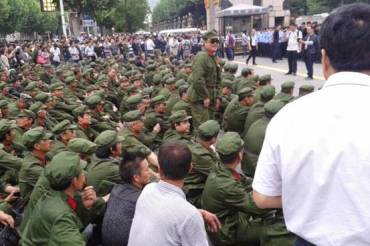
PLA veterans stage a sit-down protest outside government offices in Hubei province on May 4, 2015.

They’d not drunk together since they were in the same army unit, fighting skirmishes with Vietnamese forces in the aftermath of a 1979 border war.

Now in their 50s, they’d come here shortly before an annual parliament meeting in March to fight a different kind of battle – to demand the welfare support that they say was promised to them, and millions of other veterans, on leaving the armed forces years ago.

The four veterans, all from the southern province of Hunan, are an example of the problem facing President Xi Jinping as he prepares to lay off 300,000 out of 2.3 million troops in the biggest restructuring of the People’s Liberation Army, or PLA, since the 1950s.

China already has at least six million PLA veterans on state welfare, thousands of whom have staged well-organized protests in recent years over what they see as insufficient government support. Traditionally the government has offered subsidies to former soldiers and reserved slots for them at state-run companies, though many veterans say officials don’t follow through or that the perks aren’t enough to make ends meet.

Now, with an economic slowdown threatening to cause millions of state sector layoffs, prominent military figures have warned that veterans’ protests could escalate if the government can’t provide jobs or sufficient welfare support for the 300,000 being laid off.

One of the largest veterans’ protests was in June last year when several thousand, mostly veterans of China’s war with Vietnam, wearing uniforms and medals, protested outside offices of the Central Military Commission, which commands the armed forces and is headed by Mr. Xi.

A month earlier, there was another big veterans’ protest outside a Beijing courthouse. Smaller demonstrations occur frequently in other cities, according to experts who monitor them.

Many other veterans have tried to sue the government or lodge formal petitions, as the four in the restaurant did. Before lunch, they said, they’d submitted one at a nearby building that houses the petitions office of the Central Military Commission.

Officials there took the petition and scanned their identity cards, but gave them neither a receipt nor a reply, they said. “They just told us to go back where we came from,” said one of the four, a 54-year-old former worker in a coal-washing plant. “We got the feeling it was useless to go there.”

Source: As China’s Economy Slows, Unrest Among Veterans Rises – China Real Time Report – WSJ

26/04/2016

China Bans Some New Coal Power Plants – China Real Time Report – WSJ

China Bans Some New Coal Power Plants A coal-fired power plant in Shanxi, China. Beijing has announced a ban on new coal plants in areas with surplus power supply.

Beijing has announced a ban on new coal plants in areas with surplus power supply.

China’s government is banning construction of new coal-fired power plants in areas with surplus power supply, a move that could weigh on already-struggling coal markets. As WSJ’s Brian Spegele reports:

The new measures outlined Monday by China’s top economic planner, the National Development and Reform Commission, underscore the central government’s deep concern with overcapacity across China’s economy, a result of weakening industrial demand as growth slows.

Beijing has previously said it aimed to curb thermal power overcapacity; analysts said the fact that it now came from an official NDRC communiqué was the clearest signal yet that it won’t tolerate new coal capacity in regions that already have excess supply.

Weaker demand for coal inside China could ultimately lead to higher exports, which would exacerbate the huge supplies of coal sloshing around global markets. The higher supplies could drive down global benchmark prices and hit the bottom lines of major U.S. and international coal producers.

The global commodities downturn has proven particularly tough on global coal companies. St. Louis-based Peabody Energy Corp. and Arch Coal Inc. are among the large U.S. miners to file for chapter 11 bankruptcy protections in recent months. The U.S. sector has shed 31,000 jobs since 2009.

Source: China Bans Some New Coal Power Plants – China Real Time Report – WSJ

19/04/2016

Will Delhi’s Extreme Traffic Restrictions Have an Impact on Air Pollution This Time? – India Real Time – WSJ

Delhi has implemented severe restrictions on which cars are allowed on the road again in hopes of combating the megacity’s horrendous air-pollution problem.

Volunteers remind commuters the reason for restriction placed on vehicle movement in New Delhi, India, Friday, April 15, 2016.

Similar air-clearing measures had mixed results during the peak Winter smog season but this time citizens are hoping for better results.

For the two weeks starting April 15, most cars in the Indian capital will only be allowed on the roads every other weekday. In the so-called odd-even program, cars with license plate numbers that end in odd numbers are allowed on the roads on odd-numbered days and Sundays while cars with even license plate numbers are allowed on even days and Sundays. For the first few days of the plan most offices and schools were closed for a string of national holidays and the weekend, so Monday is the true test of whether the restrictions are working.

Delhi to Revive Odd-Even Restrictions to Battle Pollution “Today is the litmus test for the odd-even plan. Like the last time, we all need to cooperate to make it a success,” Delhi’s Transport Minister Gopal Rai tweeted from his verified account on Monday. There are 2.6 million private cars and almost 5 million motorcycles and scooters registered in Delhi, according to the latest figures from the capital’s Transport Ministry.

There are many exceptions to the regulations, meaning the number of cars on the streets will not be slashed by half. Women driving alone or with children, disabled drivers, emergency services, cars with diplomatic plates and motorcyclists are all exempt from the restrictions as are military vehicles and taxis.

Source: Will Delhi’s Extreme Traffic Restrictions Have an Impact on Air Pollution This Time? – India Real Time – WSJ

Law of Unintended Consequences

continuously updated blog about China & India

ChiaHou's Book Reviews

continuously updated blog about China & India

What's wrong with the world; and its economy

continuously updated blog about China & India