Archive for ‘Economics’

29/02/2016

India unveils fire-fighting budget to placate voters, sustain growth | Reuters

The government unveiled a fire-fighting budget on Monday that seeks to win back support among rural voters for Prime Minister Narendra Modi‘s government and sustain growth against a grim global backdrop – all without borrowing more.

Finance Minister Arun Jaitley‘s third budget marked a strategic shift by addressing rural distress in a country of 1.3 billion, where two-fifths of families rely on farming and are reeling from two years of drought.

At the same time it hiked public investment in India’s woeful infrastructure by 22.5 percent, while taking further steps to revive corporate investment that Modi needs to create new jobs for India’s burgeoning workforce.

“We have a shared responsibility to spend prudently and wisely for the people, especially for the poor and downtrodden,” the 63-year-old finance minister told lawmakers in his 100-minute address.

India holds several state elections this year, including in the farming state of West Bengal, with the country’s most populous state, Uttar Pradesh, going to the polls in 2017. A strong showing will be vital to Modi’s chances of a second term.

Despite commanding a large majority in parliament’s lower house, Modi’s government has failed to pass several key measures since sweeping to power almost two years ago, raising doubts over the impact of its reform agenda.

Jaitley called Asia’s third-largest economy a bright spot in a gloomy global landscape, and reiterated a forecast that it would grow by 7.6 percent in the fiscal year that is drawing to a close.

Source: India unveils fire-fighting budget to placate voters, sustain growth | Reuters

29/02/2016

China expects to lay off 1.8 million workers in coal, steel sectors | Reuters

China said on Monday it expects to lay off 1.8 million workers in the coal and steel industries, or about 15 percent of the workforce, as part of efforts to reduce industrial overcapacity, but no timeframe was given.

It was the first time China has given figures that underline the magnitude of its task in dealing with slowing growth and bloated state enterprises.

Yin Weimin, the minister for human resources and social security, told a news conference that 1.3 million workers in the coal sector could lose jobs, plus 500,000 from the steel sector. China’s coal and steel sectors employ about 12 million workers, according to data published by the National Bureau of Statistics.

“This involves the resettlement of a total of 1.8 million workers. This task will be very difficult, but we are still very confident,” Yin said.

For China’s stability-obsessed government, keeping a lid on unemployment and any possible unrest that may follow has been a top priority.

The central government will allocate 100 billion yuan ($15.27 billion) over two years to relocate workers laid off as a result of China’s efforts to curb overcapacity, officials said last week.

Source: China expects to lay off 1.8 million workers in coal, steel sectors | Reuters

28/02/2016

Delhi Chief Minister Arvind Kejriwal’s visit to Punjab — Kejriwal vows to curb mining mafia in Punjab – The Hindu

Alleging that a “mining mafia” in Punjab was extorting money from owners of stone crushing units, Aam Aadmi Party chief Arvind Kejriwal on Sunday vowed to put an end to the menace “within 24 hours” if his party comes to power in the 2017 Assembly election.

Delhi Chief Minister Arvind Kejriwal addresses the people at Dhilwan in Punjab on Sunday.

“I am shocked to know that legal crusher owners have to pay ‘goonda tax or jizya’ to the mining mafia in Punjab. I vow that within 24 hours of AAP’s coming into power, this will be curbed in the state,” Mr. Kejriwal, who is on a five-day tour of Punjab to reach out to voters ahead of the Assembly elections, said at a rally here.

Members of the business community, including owners of crushing units, on Sunday met Mr. Kejriwal and alleged that no action was being taken against the extortionists. They also claimed that false cases were being registered against them.

Mr. Kejriwal said once voted to power, AAP would set up a commission to review such cases and take action against officials who had lodged them.

Reacting to reports of a large number of posters which had sprung up in Jalandhar questioning his governance record, the Delhi Chief Minister hit out at the Akali Dal saying they had ruined the state during their 10-year rule.

“People know who has ruined his state for about 10 years and who is a failed CM,” he said.

Mr. Kejriwal also claimed that no government could have achieved in 65 years what his government had accomplished in one year in Delhi.

“What we have done in our one year rule in Delhi, I challenge that no state government could have done in the last 65 years. I am confident if Delhi goes to polls today, other parties will not be able to win even a single seat,” he said.

He also met people from different walks of life, including industrialists, advocates, shopkeepers and members of the Christian community.

Earlier, BJP workers led by district president Suresh Bhatia and Municipal Council president Naresh Mahajan, tried to gherao Mr. Kejriwal at Gandhi Chowk, but were stopped by police who resorted to mild lathi-charge, in which one person was injured.

Around 80 protesters were detained later released after the Delhi Chief Minister left, police said.

Earlier in the day, Mr. Kejriwal visited the Golden Temple and Durgiana Mandir in Amritsar.

Talking to media in Amritsar on Saturday night, he said he met various associations of traders who were not “happy” with the ruling government in Punjab because of “rampant corruption” in government departments. Moreover the state government had failed to “support” traders, he alleged.

Source: Delhi Chief Minister Arvind Kejriwal’s visit to Punjab — Kejriwal vows to curb mining mafia in Punjab – The Hindu

24/02/2016

U.S. Design Company Redesigns the Cycle Rickshaw to Make it ‘Sexy’ – India Real Time – WSJ

It is not quite reinventing the wheel, but one company is trying to overhaul an old-fashioned form of public transport–the cycle rickshaw.

Funded by the Asian Development Bank, Colorado-based Catapult Design has produced a new, flashy design for the vehicle — ubiquitous in Indian and other South Asian cities — that includes electrical assistance and gears for tricky hills.

Cycle rickshaws, or pedicabs, in South Asia provide backbreaking but vital work for the drivers who pedal passengers often on short “last mile” trips from other forms of transport to their final destination.

Dhaka, Bangladesh’s capital, has half a million cycle rickshaws alone, Bradley Schroeder, who is leading the $340,000 project to develop an open-source design of the pedicab, said. But the design hasn’t improved much in 40 years.

The ADB will spend $150,000 on manufacturing 60 prototype vehicles and testing them in Nepal’s capital Kathmandu, and Lumbini, a tourism hotspot in the Himalayan nation and the birthplace of Buddha, over the coming months.

Half of the new rickshaws will be pedal-only, and the rest will have built-in electrical assistance provided by a lithium-ion battery, the company said.

Most rickshaws are currently made from tubular steel and if they have electrical assistance, it is provided by a heavy car battery, Mr. Schroeder said. Exposed parts of the rickshaw’s mechanics mean that clothes such as saris can become caught and cause accidents.

The new design is made from stainless steel and the mechanics are fully enclosed and include gears. The lithium batteries are more lightweight and the electrics comply with European Union standards, he added. The vinyl cover on the rickshaw provides protection from the elements.

“We wanted to make the body very sexy,” Mr. Schroeder said. The designers talked about adding seatbelts but decided against it since the the speeds were so low.

The new cabs are more expensive – they will cost $750, compared with about $400 for an average rickshaw. That cost, Mr. Schroeder says, is a result of the reduced weight and the addition of smartphone vehicle-hailing and driver-evaluation technologies as well as touch screens that can deliver tour guides to passengers.

“Weight is everything in the pedicab industry,” Mr. Schroeder wrote in an emailed response. The lighter model will mean that the pedicab will have a top speed of 15.5 miles an hour, but, Mr. Schroeder wrote, “essentially the vehicle will go as fast as the wallah (driver) can pedal and since the vehicle is lighter and now has gears, the wallah should be able to go faster.”

The drivers of the rickshaws for the trial in Nepal will be taken from the existing pool of the cities’ rickshaw chauffeurs, Mr. Schroeder said.

His team spent several months interviewing drivers, owners and garages. “There are a lot of questions, it’s not always easy. But over time we win them over and they are happy,” he said.

“They live on the fringes of society and are very concerned about making money every day,” he said. “They can see their industry is in decline.’

But although the cycle rickshaw is steeped in tradition, its drivers aren’t resistant to change.

“If you show them a 3-D printed model of the design, they’re blown away,” Mr. Schroeder said.

After the trial, Mr. Schroeder hopes a bicycle, motorcycle or auto company picks up the unpatented design and uses it to manufacture the product.

Source: U.S. Design Company Redesigns the Cycle Rickshaw to Make it ‘Sexy’ – India Real Time – WSJ

24/02/2016

China Inc.’s Nuclear-Power Push – China Real Time Report – WSJ

China wants to shift from customer to competitor in the global nuclear industry as it seeks to roll out its first advanced reactor for export, a move that adds new competition for already struggling global firms.

As WSJ’s Brian Spegele reports:

  • Two state-owned firms teamed up to design the advanced indigenous Hualong One reactor with plans to sell overseas. On Tuesday, one of them, China General Nuclear Power Group, hosted dozens of business executives from Kenya, Russia, Indonesia and elsewhere, as well as diplomats and journalists, at its Daya Bay nuclear-power station to promote the Hualong One for export.
  • Asked how much of the global market share for new nuclear reactors CGN wants Hualong One to win, Zheng Dongshan, CGN’s deputy general manager in charge of international business, said: “The more the better.”
  • The move marks a turnaround for China and the nuclear-power industry. For three decades, China served as a big market for nuclear giants including U.S.-based, Japanese-owned Westinghouse Electric Co. and France’s Areva SA. More than 30 reactors have been built across China since the 1990s with reliance on foreign design and technology.

Source: China Inc.’s Nuclear-Power Push – China Real Time Report – WSJ

23/02/2016

‘Weird’ new buildings banned in Chinese cities| Society

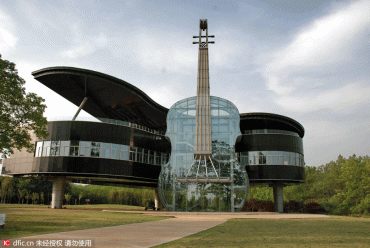
Cities will not be allowed to build more “oversized, xenocentric, weird” buildings devoid of cultural tradition in the future, according to a new directive from the central government.

The State Council, or the cabinet, and the Communist Party of China Central Committee issued the directive on Sunday. It says buildings should be “suitable, economic, green and pleasing to the eye.”

Cities have built some unusually shaped buildings to create memorable skylines in recent years, but many have drawn criticism. Here is one of sixteen very weird buildings in China!'Weird' new buildings banned in Chinese cities

See the other fifteen at:

Source: ‘Weird’ new buildings banned in Chinese cities[12]| Society

20/02/2016

A slow awakening | The Economist

AROUND 270m people have left China’s countryside to work in urban areas, many of them entrusting their children to the care of a lone parent, grandparents, relatives or other guardians.

By 2010 there were 61m of these “left-behind children”, according to the All-China Women’s Federation. In a directive released on February 14th, the government has at last shown that it recognises the problems caused by the splintering of so many families. The document acknowledges that there has been a “strong reaction” from the public to the plight of affected children. It describes improving their lot as “urgent”.

That is clearly right. There have been numerous stories in recent years revealing the horrors some of these children endure. Last year four siblings left alone in the south-western province of Guizhou apparently committed suicide by drinking pesticide. Numerous sex-abuse cases involving left-behind children have come to light.

The new proposals look sensible enough: minors may not be abandoned entirely; local institutions such as schools and hospitals must do more to notify the authorities of cases of abuse or neglect; social workers should monitor the welfare of left-behind children. Sadly, however, the government’s suggested remedies will achieve little. They largely replicate recent laws and policies designed to protect children (not just left-behind ones), which have been almost universally unenforced. It is already illegal to allow minors to live alone, for example. There is no indication that the new recommendations will be made law or implemented any more rigorously.

The new scheme mentions the importance of giving migrants urban hukou, or household-registration certificates, which are needed to gain access to public services such as education and health care. Most migrants leave their children in the countryside because they do not have such papers. In December the government announced plans to make it easier for migrants to gain urban hukou privileges. But few casual labourers are likely to fulfil the still-onerous conditions that must be met to qualify.

A study published last year by researchers at Stanford University found that among more than 140,000 children assessed in areas such as education, health and nutrition, left-behind ones performed as well as or better than those living in the countryside with both parents. But both kinds of children lagged far behind those who grow up in cities.

Source: A slow awakening | The Economist

18/02/2016

Apple Pay takes on China’s internet kings in mobile payments | Reuters

Apple Inc launched its mobile payment system in China on Thursday in a bid to convince the hundreds of millions of users of the country’s entrenched, dominant services to switch.

Photo

“We think China could be our largest Apple Pay market,” Jennifer Bailey, vice president of Apple Pay, told Reuters in an interview in Beijing.

In an early boost, China’s biggest lender, Industrial and Commercial Bank of China Ltd (ICBC), was among the banks that said earlier this week that customers would be able to use Apple Pay from Thursday.

However, Apple Pay has not had an easy ride so far in China, the fifth country to get the service. Even in its U.S. home market, Apple has faced skeptical retailers in its effort to develop a new revenue stream.

China is not likely to prove any easier to crack.

“People switch applications for significantly better experiences, it (Apple) has to deliver not just a little bit more secure, or a little bit easier to use,” said Mark Natkin, founder of Marbridge Consulting.

Greater China is Apple’s second-largest market by revenue, and the world’s biggest smartphone market. By the end of 2015, 358 million people, more than the U.S. population, had already taken to buying goods and services by mobile phone, according to the China Internet Network Information Center.

The vast majority are using payment services from China’s two biggest Internet companies that have existed for years.

Social networking and gaming firm Tencent Holdings Ltd operates WeChat Payment, and e-commerce company Alibaba Group Holding Ltd, through its Internet finance affiliate Ant Financial Services Group, runs Alipay.

“With 100 percent saturation of local payment systems, no one in China is clamoring for Apple Pay,” said one retailer who declined to be named for fear of harming business prospects. “Today, everyone has a local payment option on their phone, so Apple Pay is a solution in need of a problem.”

Source: Apple Pay takes on China’s internet kings in mobile payments | Reuters

18/02/2016

Is India’s Freedom 251, a $4 Smartphone, Too Good to Be True? – India Real Time – WSJ

A little-known Indian company has announced grand plans to sell millions of made-in-India smartphones for less than $4 a piece, despite the fact that it has only been in the smartphone business for five months and has yet to build a factory.

Ringing Bells Pvt. started taking orders for its Freedom 251 phone on Thursday for 251 rupees ($3.67) each, or less than the price of a McDonald’s Big Mac in the U.S. The company has promised to deliver the phones by June 30–after it builds two manufacturing plants.

Social media lit up with discussion about the device–which the company says will have a four-inch display, 3.2-megapixel camera and 8 gigabytes of storage–after ads for the phone with the tagline “dreams will come true,” appeared in newspapers. Ringing Bells said its phones will have apps that help farmers check soil conditions and fishermen get weather reports.

The company’s website crashed Thursday and it stopped accepting orders for the device as it worked to upgrade its servers, the website said.

At a launch event in a public park Wednesday, thousands turned out to see company President Ashok Chadha unveil a poster-sized image of a phone under a shower of pyrotechnics and confetti. It was an impressive turnout considering only days earlier almost no one had even heard of him, his company or its phone.

Phones given to journalists to try looked as if the branding from another manufacturer had been covered up with white-out on the phone’s front. Indian flag stickers covered the rear. The phones used an Android operating system.

Mr. Chadha said the phone he was sharing was a “beta device.”

Ringing Bells said it would spend 5 billion rupees, or about $73 million, to build the factories. Mr. Chadha said the money will come from the family of Mohit Goel, one of the founders and directors of the company. Mr. Goel’s family owns a farming business, Mr. Chadha said. Attempts to reach Mr. Goel were unsuccessful.

Analysts said they couldn’t see how Ringing Bells could ever make money selling phones for $4.

If Ringing Bells follows through with its plans, the difficulties of setting up manufacturing operations in India could mean it runs into delays that could cause it to miss its June deadline, a spokeswoman for another Indian phone manufacturer said. She said setting up a new factory often takes up to a year.

The company aims produce hundreds of thousands of phones a month and take around 30% of the smartphone market within a year, Mr. Chadha said. Over 100 million smartphones were shipped by manufacturers to retailers in India last year, according to International Data Corp., a research company.

Despite the low price, Mr. Chadha said the company expects to make money on the phones. He said that making the phone using components imported from China would cost about 2,500 rupees per phone. India doesn’t make many components used in phones and other phone sellers in the country import their phones and components from elsewhere.

But Mr. Chadha said he expected to reduce costs through through “economies of scale,” tax breaks for local manufacturing, and other cost-cutting measures. “We are technocrats and have some understanding of international economics,” he said.

Ringing Bells says it will offer a smartphone with a 4-inch display, 3.2 megapixel camera and 8 gigabytes of memory for less than $4. The $33 smartphones powered by Mozilla Corp.’s Firefox operating system have a 3.5 inch display, 2 megapixel camera and 256 megabytes of storage.

Source: Is India’s Freedom 251, a $4 Smartphone, Too Good to Be True? – India Real Time – WSJ

16/02/2016

First train from China to Iran stimulates Silk Road revival – Xinhua | English.news.cn

First cargo train from China to Iran arrived in Tehran on Monday, indicating a milestone in reviving the “Silk Road,” which has opened a new chapter of win-win cooperation between China and Iran.

English: the Silk Road in Central Asia

English: the Silk Road in Central Asia (Photo credit: Wikipedia)

silk road

The train, also referred to as Silk Road train, has passed through Kazakhstan and Turkmenistan to Iran, travelling a distance of 10,399 kilometers. It had left Yiwu city in east China’s Zhejiang Province on January 28.

This train was carrying dozens of cargo containers, according to the deputy of Iran’s Road and Urbanism Minister, Mohsen Pour-Aqaei, who made a welcome speech after the arrival of the cargo train at Tehran Train Station on Monday.

As known to all, ancient Silk Road trade route had served as an important bridge for East-West trade and brought a close link between the Chinese and Persian civilizations.

The “Belt and Road” initiative was raised by Chinese President Xi Jinping in 2013, which refers to the New Silk Road Economic Belt, linking China with Europe through Central and Western Asia, and the 21st Century Maritime Silk Road, connecting China with Southeast Asian countries, Africa and Europe.

“To revive the Silk Road Economic Belt, the launch of the train is an important move, since about 700 kilometers of trip has been done per day,” said Pour-Aqaei, who was present at the welcome ceremony of the train in Tehran’s Railway Station.

“Compared to the sea voyage of the cargo ships from China’s Shanghai city to Iran’s Bandar Abbas port city, the travel time of the train was 30 days shorter,” he said.

Pour-Aqaei, also the Managing Director of Iran’s Railway Company, added that according to the plan, there would be one such a trip from China to Iran every month.

The travel of cargo train from China to Iran is part of a Chinese initiative to revive the ancient Silk Road used by the traders to commute between Europe and East Asia.

Tehran will not be the final destination of these kinds of trains from China, the Iranian deputy minister said, adding that in the future, the train will reach Europe.

This will benefit Iran as the transit course for the cargo trains from the east Asia to Europe, he said.

Chinese ambassador to Iran Pang Sen told Xinhua that as one of the cooperation projects after Chinese President Xi Jinping’s state visit to Iran, the cargo train is playing a important role to promote construction of the “Belt and Road” initiative.

Meanwhile, the railway line from Yiwu to Tehran provides the two countries an express and efficient cargo trade transportation method, Pang said, adding that the countries along the railway line will furthur upgrade rail technology with the aim to make its transportation ability faster and better.

Source: First train from China to Iran stimulates Silk Road revival – Xinhua | English.news.cn

Law of Unintended Consequences

continuously updated blog about China & India

ChiaHou's Book Reviews

continuously updated blog about China & India

What's wrong with the world; and its economy

continuously updated blog about China & India