Archive for ‘Economics’

05/10/2015

India’s Competitive Ranking Surges on the Back of Modi Momentum – India Real Time – WSJ

India leapt 16 places to 55th position in the latest ranking of economies’ competitiveness released by the World Economic Forum Wednesday.

The Geneva-based think tank says India is a “bright spot” among larger emerging markets, which have shown a broader trend of either a decline or stagnation. It attributes the country’s big rise–which comes after five years of decline–to the election of Prime Minister Narendra Modi last year, which ignited optimism about the country’s limping policy changes.

“This dramatic reversal is largely attributable to the momentum initiated by the election of Narendra Modi, whose pro-business, pro-growth, and anti-corruption stance has improved the business community’s sentiment toward the government,” the WEF says in the report, which includes the Global Competitiveness Index 2015–2016 Rankings.

The ranking is based on the assessment of 140 countries on 12 parameters such as infrastructure, macroeconomic environment, institutions, health and education, among others.

The report says the quality of India’s institutions was judged more favorably in the latest ranking while its macro-economic stability has improved, with easing inflation and a gradual drop in the government’s budget deficit since its 2008 peak. Infrastructure has also improved, the report said.

“The fact that the most notable improvements are in the basic drivers of competitiveness bodes well for the future, especially the development of the manufacturing sector,” the report said.

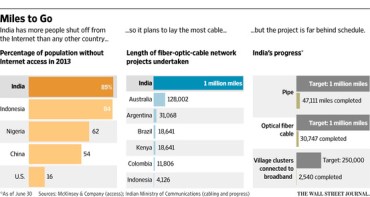
However, India needs to improve its technological readiness: it is one of the least digitally connected countries in the world.Fewer than one in five Indians use the Internet regularly, and fewer than two in five own even a basic cell phone, according to the report.

The ranking of regional rival China has barely budged in the past six years as it has been dealing with rising production costs, an aging population and diminishing returns on the massive capital investments of the past three decades.

However, its 28th position–unchanged  from the previous year–is still much higher than India’s.

China remains by far the most competitive among larger emerging economies. “However, its lack of progress moving up the ranking shows the challenges it faces in transitioning its economy,” the report said.

Switzerland, Singapore and the U.S. were the top three ranked, unchanged from the previous year.

In Asia, Malaysia ranked 18th, up two places, Indonesia ranked 37th, down three notches while Thailand ranked 32nd, down one position.

Among the remaining BRICS group of countries, Brazil was at number 75, plummeting from 57 last year. The Russian Federation was at number 45, up from 53 and South Africa was at 49, better than 56 last year.

Source: India’s Competitive Ranking Surges on the Back of Modi Momentum – India Real Time – WSJ

05/10/2015

U.K.’s Marks & Spencer Is Aiming to Double India Store Count – India Real Time – WSJ

Marks & Spencer Group PLC said it is on track to double its store count in India in the next 15 months, an ambition that poses both risks and opportunities for the British retailer.

M&S has recently struggled in troubled markets such as Russia, Ukraine and Turkey and was forced to reconfigure its footprint in China, but India has emerged as a relative bright spot. Revenue climbed 23% last fiscal year.

“I think there is an instinctive understanding of M&S in India,” said the company’s head of international business, Patrick Bousquet-Chavanne.

M&S is in 21 cities in India so far, with a focus on large cities such as Mumbai, Delhi and Kolkata. Now, M&S is looking to deepen its exposure to India. It plans to open stores in less-developed cities, such as Vijayawada, Jalandhar and Vizag, during the current fiscal year ending in March, while also beefing up its footprint in larger cities.

The company—which operates in India through a joint venture with Reliance Industries Ltd., one of India’s largest companies—in early October will open its 50th store in India, in Mumbai’s Chhatrapati Shivaji airport.

Source: U.K.’s Marks & Spencer Is Aiming to Double India Store Count – India Real Time – WSJ

29/09/2015

Cisco joins flurry of U.S.-China tech partnerships | Reuters

Cisco Systems Inc (CSCO.O) said Thursday it would form a joint-venture with Chinese server maker Inspur to sell networking and cloud computing products in China, where the Silicon Valley firm faces political pressure and declining sales.

Chuck Robbins, incoming CEO of Cisco, listens a question from media during a news conference in New Delhi, India, June 18, 2015. REUTERS/Adnan Abidi

Cisco and Inspur said they would invest $100 million in the project, although they offered few other details.

The partnership is one of a growing number of tie-ups between Chinese and U.S. technology firms announced during or ahead of Chinese President Xi Jinping’s visit to the United States this week.

Microsoft Corp (MSFT.O) said on Thursday it would partner with Baidu Inc (BIDU.O) and Chinese state-owned private investment firm Tsinghua Unigroup on cloud technology, while Dell Inc announced last week it would invest $125 billion over five years in China.

Earlier this year, IBM (IBM.N) pledged to help develop China’s advanced chip industry with a “Made with China” strategy, while chipmakers Intel Corp (INTC.O) and Qualcomm Inc (QCOM.O) are developing chips with smaller Chinese companies.

Similar to its dealings with the foreign auto industry in decades past, Chinese officials have made clear to foreign technology firms that market access depends on their sharing technology and cooperating with Chinese industry.

Like many of its peers, Cisco’s market share has retreated in recent quarters in China, where its products have been labeled a cybersecurity threat by state media and government-affiliated experts.

U.S. business lobbies have said the Chinese allegations amount to protectionism, while China has pointed to the experience of Cisco’s Shenzhen-based rival Huawei Technologies Co Ltd [HWT.UL], which faced similar accusations from Capitol Hill when it sought to enter the United States.

Source: Cisco joins flurry of U.S.-China tech partnerships | Reuters

29/09/2015

Google’s Sundar Pichai Welcomes India’s Modi to Silicon Valley – India Real Time – WSJ

Before Indian Prime Minister Narendra Modi touches down in Silicon Valley at the weekend, one of his country’s most-successful sons has welcomed him to the U.S. tech hub.

Sundar Pichai, the Indian-born Google CEO, says in a video message that “there is tremendous excitement” about Mr. Modi’s arrival in the valley “among all Googlers” a shorthand for people who work at the search engine giant.

Mr. Modi will meet with Mr. Pichai and other Indian-born CEOs, including Satya Nadella of Microsoft Corp., during his valley visit and tour Google’s headquarters where he will look at inventions in healthcare and smartgrid technology. His visit comes after Chinese President Xi Jinping held a roundtable in Seattle with U.S. and Chinese CEOs including Tim Cook of Apple Inc. and Jeff Bezos of Amazon.com on Wednesday.

“The bond between India and Silicon Valley is strong. India has long been an exporter of talent to tech companies,” Mr. Pichai says in the two minute clip.

Raised in the southern city of Chennai and attending the legendary Indian Institute of Technology, Mr. Pichai became CEO of Google in August having started out at the company in 2004 as a semiconductor engineer after gaining a graduate degree from Stanford University and an M.B.A. from the University of Pennsylvania’s Wharton School. More In Google Who Is Google’s Sundar Pichai? Why Indian Managers Are Succeeding in Tech’s C-Suite Sundar Pichai to Lead Google, Now a Subsidiary of Alphabet, After Restructuring Tech Giants Help Track Nepal Earthquake Survivors as Communications Are Hit Google Executive Dan Fredinburg Killed in Everest Avalanche After Nepal Earthquake

“The products built by Indian graduates from IIT and other institutions have helped to revolutionize the world,” the Google chief adds.

But it is India that is now undergoing its own revolution, he continues. Mr. Pichai touches on Mr. Modi’s plans to digitize India and get 600 million people in remote areas connected to the Internet.

“We at Google as well as many others around the world are passionate about playing our part, there is no more important role for tech companies today than helping to connect the next billion Internet users,” he adds.

The prime minister’s Digital India plan is stuttering however. Up to June only 1% of the villages in the program had been connected to broadband via fiber optic cables.

The slow pace of the rollout of the Internet in India is among the main subjects raised for Mr. Modi in his upcoming Q&A at Facebook Inc. on Sunday.

Meghna Agarwal has asked how Facebook can help India in reaching remote areas “so that each one of the Indians has a voice of their own thus promoting equality and bridging the gap between the rich and the poor?”

Sumit Dhawan asked what Mr. Modi is doing to bring high speed broadband Internet to India.

In Mr. Pichai’s video, the CEO predicts that in the next few years, 50 million women and 20 million small businesses will get online for the first time. He promises Google will help India with products that work on low bandwidth and even offline as well as with investments in core infrastructure to help the Indians among them.

Source: Google’s Sundar Pichai Welcomes India’s Modi to Silicon Valley – India Real Time – WSJ

29/09/2015

Boeing to sell 300 jets to China firms, set up China plant: Xinhua | Reuters

Boeing Co has signed deals to sell 300 aircraft to three Chinese firms and set up an aircraft plant in China, becoming the first U.S. firm to clinch a business tie-up in the country since Chinese president Xi Jinping began a U.S. state visit, the official Xinhua news agency said.

Photo

The aircraft deals, potentially worth tens of billions of dollars in total, are collectively the largest order the aerospace firm has received from Chinese companies.

China’s ICBC Financial Leasing Co, a unit of the Industrial and Commercial Bank of China, on Wednesday separately confirmed it will buy 30 of Boeing’s 737-800 jets, worth $2.88 billion at list prices.

China Aviation Supplies Holding Company and China Development Bank Leasing are the other two customers for the aircraft, said Xinhua.

Boeing, which is locked in a fierce battle for plane orders with European rival Airbus, will build its first aircraft completion plant outside the United States in China in order to gain a foothold in that important market, say industry observers. Boeing raised its forecast for China’s aircraft demand by 5 percent in August, saying that the country will need 6,330 planes over the next 20 years.

It signed a cooperation document with Commercial Aircraft Corporation of China (Comac) to build the aircraft completion center for its 737 passenger jet in China, added Xinhua. The agency didn’t disclose further details.

An aircraft’s interiors and some systems are usually installed, and the plane is painted in the customer’s livery, at completion centers. The final flight trials are then completed before the aircraft is delivered to the customer.

Boeing executives and officials from the Chinese firms could not immediately be reached for comment. Xi, who arrived in Seattle on Tuesday, is set to visit Boeing on Wednesday.

The number of air passengers traveling to, from and within China is set to nearly triple by 2034 to some 1.3 billion, surpassing an expected 1.2 billion for the United States, according to official estimates.

State-owned airlines like Air China, China Eastern Airlines and China Southern Airlines, and privately-owned budget carrier Spring Airlines, are growing fast and adding new planes to meet this demand for both short and long haul air travel.

Boeing’s plans for an aircraft completion center comes after Airbus signed an agreement in July to set up its second Chinese plant.

Source: Boeing to sell 300 jets to China firms, set up China plant: Xinhua | Reuters

23/09/2015

Prime Minister Popularity and Voter Optimism Have Soared in India Under Modi, U.S. Think-Tank Survey Shows – India Real Time – WSJ

In the sixteen months since Prime Minister Narendra Modi won a landslide victory in national elections, he has faced policy setbacks, parliamentary roadblocks and electoral failure. These appear to have had little impact on support for him.

A new report by the U.S.-based think tank Pew Research Center says Mr. Modi remains overwhelmingly popular among Indians. Among those surveyed, 87% said they have a favorable opinion of Mr. Modi. Unpacking that statistic gives Mr. Modi greater reason to celebrate. His popularity is the highest among two crucial demographic groups: 18 to 29 year olds and rural Indians. Nine out of 10 people in each category gave the leader of the world’s largest democracy a thumbs up.

Mr. Modi’s undented approval ratings come at a time when his appeal among investors and analysts has lost some of its sheen. India-watchers complain big policy pronouncements have been few and slow to come, limiting India’s growth potential. Far from sharing that pessimism, a majority of Indians are upbeat about their country’ economic prospects, the survey showed. More than half of the respondents said they were happy with the direction of their country, up from 29% in 2013, toward the end of the Congress party’s decade-long tenure when the economic was stuttering and corruption scandals dogged the government. More than 90% of those surveyed by Pew said they had faith in government, up from 70% two years ago. These findings raise key political questions.

Some strategists wonder why, given his once-in-a-generation mandate, Mr. Modi hasn’t pushed for tougher, more-disruptive measures to accelerate growth. His government recently backtracked on a policy that would have made it easier to acquire land for infrastructure and industry because of protests by opponents in Parliament and fear of a backlash from rural voters.

Others argue Mr. Modi is playing the long game, seeking to build on his popularity to consolidate more political power at state and local levels rather than risking it at an early stage on controversial policies. Leaders of his Bharatiya Janata Party say they are planning for at least two five-year terms under Mr. Modi’s premiership during which they hope their party, whose political authority has grown sporadically since its inception in 1980, will achieve the kind of dominance Congress enjoyed in the decades after India won independence from British colonial rule in 1947.

Such a strategy – and Pew’s data – explains why Mr. Modi is the BJP’s star campaigner. In the state of Bihar where elections are scheduled to begin next month, the BJP has not announced a candidate for chief minister, the person who would run the state if the party won. Instead, posters and hoardings are plastered with Mr. Modi’s face. To be sure, the Bihar polls won’t be easy. Caste allegiances play an important role in the vote and the incumbent regional leader, Nitish Kumar, is seen as an effective leader for development. A recent opinion poll by the Hindi-language ABP News channel and Nielsen showed the BJP and Janata Dal (United)-led alliances are neck and neck.

Source: Prime Minister Popularity and Voter Optimism Have Soared in India Under Modi, U.S. Think-Tank Survey Shows – India Real Time – WSJ

17/09/2015

How Modi’s Win Helped Boost India’s Ranks of Millionaires – India Real Time – WSJ

The ranks of the millionaires grew at a faster rate in India than anywhere else around the globe in 2014 thanks to the election of Prime Minister Narendra Modi and falling oil prices, according to a report on worldwide wealth.

After only marginal growth in 2013, India’s tally of high-net-worth individuals increased by 26.3% in 2014 compared with the previous year and with 17.5% in China and 8.2% in the U.S. over the same period, the data from consultants Capgemini and RBC Wealth Management, said.

High-net-worth individuals are defined as those with investible assets of more than $1 million.

The report says that the election of “a popular reform-minded prime minister” in May 2014 “had a positive effect on the economy and equity markets, boosting [high-net-worth-individual] gains.” More In Narendra-Modi

Mr. Modi’s win “helped to boost investor confidence and contributed to strong performance in the stock market,” the report’s authors said.

“Lower oil prices helped reduce the country’s budget deficit and retail inflation fell considerably,” they added. Still, in absolute numbers of very wealthy, India continues to lag behind. It had 1,975,000 people with $1 million to invest in 2014, compared with 4,682,000 in the U.S. and Canada and 8,901,000 in China.

The Asia Pacific region as a whole though, including India and China, had a higher number of millionaires than North America in 2014.

Source: How Modi’s Win Helped Boost India’s Ranks of Millionaires – India Real Time – WSJ

17/09/2015

Leaving Las Vegas: Chinese state railway companies to build US high-speed link from ‘Sin City’ to LA | South China Morning Post

Work on joint venture for 370km high-speed line linking Las Vegas to Los Angeles could start in 2016 and is part of mainland’s pursuit of overseas high-speed rail deals

A consortium of Chinese state rail companies has teamed up with an American company to build a high-speed rail line in the United States, with work possibly starting as early as September 2016.

It is the latest push by Beijing to export its high-speed rail technology and tap lucrative offshore markets.

China Railway International USA and the private rail venture, XpressWest, said in a joint statement on Thursday that they would form a joint venture to accelerate the launch of a high-speed rail linking the western cities of Las Vegas with Los Angeles.

The deal marks the latest attempt in China’s increasingly aggressive pursuit of overseas high-speed rail deals after the country built the world’s longest network in less than a decade.

Beijing recently clinched contracts in Russia, although it has faced hurdles in Mexico and Indonesia because of bureaucratic reversals of decisions in those countries.

XpressWest, a private venture of a Las Vegas-based hotel and casino developer, was given approval in 2011 to build and run the 370km high-speed line, according to its website.

The project has US$100 million in initial capital, the companies said in the statement, released at a government-organised forum before President Xi Jinping’s forthcoming visit to the US. China Railway International USA is owned by a consortium made up of subsidiaries from the mainland state companies China Railway Group, CRRC Corp, China State Construction Engineering Corp and China Railway Signal & Communication Corp.

Gary Wong, an analyst at Guotai Junan Securities, estimated that the XpressWest project was worth US$5 billion, which he said would likely offer the many Chinese companies involved little financial benefit.

However, it was significant as a deal because it would help open the undeveloped US high-speed rail market, Wong added.

“If this opens up the United States market for them, opportunities for future expansion will increase,” Wong said. “And if [their technology] is used in the United States, it will be easier for them to sell to other countries.”


09/09/2015

Modi Tells Nervous Business Leaders the Global Shakeup Is India’s Time to Shine – India Real Time – WSJ

Prime Minister Narendra Modi called Indian business leaders to his official residence Tuesday to discuss how to bulwark the country as China’s slowdown continues to send shock waves through the global economy.

In the three-hour summit, executives and economists ran through a long-standing wish list that includes investing more in infrastructure, expediting government clearances and lowering capital costs. Some executives suggested an interest-rate cut was overdue from the central bank, and that domestic companies should be given more protection from inexpensive imports.

“We have to be cautious, while we take some bold steps on the economy to increase growth,” Rana Kapoor, chief executive of Yes Bank Ltd., told reporters after leaving the meeting. “At the same time, you have to make sure that India has a soft landing after the severe impact of the yuan devaluation.” There has been a jump in foreign direct investment in India this year. But the executives told Mr. Modi that local companies need to see long-delayed improvements in economic management before they can ramp up capital spending. “Domestic investment is at a standstill, and that’s largely because there is no demand,” said Jyotsna Suri, president of the Federation of Indian Chambers of Commerce and Industry.

Mr. Modi reiterated that the world-wide turbulence is an opportunity to highlight India’s resilient growth, vast domestic market and government policies geared toward promoting investment, Finance Minister Arun Jaitley said.

Source: Modi Tells Nervous Business Leaders the Global Shakeup Is India’s Time to Shine – India Real Time – WSJ

08/09/2015

From ‘Made in China’ to ‘Innovate in China’ – International Finance Magazine

In the West, people often opine that Chinese are not innovators but just copiers who can make a product at a cheaper rate. If somebody mentions inventions, like gunpowder and printing press which were invented by the Chinese, the argument often ends up with ‘they have not really followed through with their innovations and have since then made little progress in this department’.

From ‘Made in China’ to ‘Innovate in China’But the Chinese are ready to transform themselves from the factory of the world to the generator of innovation. Companies like Alibaba Group and Xiaomi among others are making a mark in the world.

“I understand that the China market is characterised by some significant weaknesses when compared to a highly mature Silicon Valley, but the investment power and determination of the Chinese government, along with its appetite to transition away from ‘Made in China’ to ‘Innovated in China’ leaves no doubt in my mind that China will become a leader when it comes to building ecosystems for growth of startups and other innovative organisations,” says Lars Lin Villebaek, co-founder of GrowthEnabler.com, a platform for startups. He has 10 years of personal entrepreneurship experience in China.

Last year, China gave birth to a massive 1.9 million new businesses (across all sectors) and saw some record breaking IPOs in the global market.

And unlike the US, which has Silicon Valley and the area around Boston which are known for their startup ecosystems, China has several dozen ‘Silicon Valleys’. “Most of these are in the embryonic stage. Silicon Valley has a long history of success while the Chinese ones are new. The oldest — Zhongquancun in Beijing district — dates back to the ’80s,” says Zhang Chia Hou, China & India analyst and a board member of GrowthEnabler.com and author of http://www.chindia-alert.org.

According to Wan Gang, China’s minister of science and technology, the district last year birthed 49 startups daily. As of March 2015, 129 high-tech zones had been approved by the State Council. These are designated areas in different cities where entrepreneurs are supported by different policies and benefits, such as fast Internet connections, government assistance in funding, and access to talented and educated human resources from nearby universities.

“Zhongquancun is also home to several universities like the prestigious Tsinghua University which churns out PhDs and computer scientists by the thousands. So there is no shortage of people who understand technology and the investment tap is flowing quite readily,” says Erik Roth, an entrepreneur, lecturer, serial innovator and lead for McKinsey & Company’s Global Innovation & Growth Practice.

Apart from Zhongquancun, Shanghai and Chengdu are also home to several startups.

According to Villebaek, there are several other factors which will help China achieve the ‘startup capital of the world’ status. There is ample access to funding even for high-risk projects. As long as projects replicate proven business models and products, the financing is usually done very quickly.

Additionally, successful companies like Alibaba, Tencent and Baidu have taken upon themselves to nurture the startup system in the country.

Says Alibaba Group spokeswoman: “Our founders started Alibaba Group to champion small businesses, in the belief that the Internet would level the playing field by enabling smallenterprises to leverage innovation and technology to grow and compete more effectively in the domestic and global economies. Alibaba supports innovative entrepreneurs who are able to create products and services that benefit the end user and society as a whole.”

Also, some Chinese are going for international exposure. “Most of the emerging class of entrepreneurs and venture capitalists, including Alibaba’s founder Jack Ma, studied at leading US universities, and worked for great corporations and investment firms. Most Chinese who can afford it (foreign education) decide to have an experience abroad,” says Christoph Tutsch, founder and CEO of ONPEX, a company which provides white-label cloud-based payment technology.

Tutsch adds that China is going in the right direction and people are educating themselves to achieve their goals. “They are trying to think out of the box for solutions that will help the local problems. Even now, they are many successful tech companies in China that no one has heard of because they are kept in the local market, which is good for self-improvement. In the next few years, we will start hearing of more Alibabas who venture West,” says Tutsch.

Where they need to improve

Historically, the Chinese do not have a culture of risk taking. “In a long time, I have not noticed any disruptive business model from China,” remarks Roth. The educational system in the country will have to focus on research and offer education in entrepreneurship to address the needs of entrepreneurs.

“The young in general are following the old path of secure jobs in government or established industry. But with 1.3 billion people, there are enough youngsters interested in innovation and entrepreneurship for them to be a real force,” says Zhang.

Source: From ‘Made in China’ to ‘Innovate in China’-International Finance Magazine

Law of Unintended Consequences

continuously updated blog about China & India

ChiaHou's Book Reviews

continuously updated blog about China & India

What's wrong with the world; and its economy

continuously updated blog about China & India