Archive for ‘pension’

29/09/2019

Are China’s grandparents reaching their limits on free childcare?

  • Millions of Chinese children are raised by their grandparents but some seniors are demanding compensation

For generations in China grandparents have provided childcare, but some are no longer willing to do so for free. Photo: Shutterstock

The traditional role of grandparents in caring for China’s children has been called into question with two recent lawsuits sparking debate about whether seniors should be paid for their efforts.

Two grandmothers took their demands for compensation to court in separate cases which have highlighted the reliance of Chinese workers on their parents to provide childcare while they pursue professional advancement.

A woman in Mianyang, in the southwestern province of Sichuan, was awarded more than 68,000 yuan (US$9,500) by a local court after she sued her son and daughter-in-law for the costs of raising her nine-year-old grandchild, according to Red Star News.

The woman, identified only by her surname Wang, had been the child’s full-time carer for eight years after his parents left home to seek better-paid jobs elsewhere. Wang said she had taken care of most of her grandson’s living expenses and had decided to seek compensation when his parents said they were considering a divorce.

They should respect our contribution. Grandmother Wang, Sichuan province

“I only want to let them know through this lawsuit that it’s their obligation to raise their children,” she was reported as saying. “The young ones should not take it for granted that old people ought to look after their grandchildren. They should respect our contribution.”

Despite winning the case, she has not received a penny and the boy still lives with her.

In another case, three months ago, a Beijing court supported a woman’s demand for compensation for helping to raise her granddaughter since her birth in 2002.

The stories of the two women generated a public reflection on the Chinese way of childcare which, for generations, has involved leaving most – if not all – of the burden on grandparents.

One of 60 million: life as a ‘left-behind’ child in China

From a cultural perspective, it has been a matter of course in a country with a long history of several generations living under one roof, for grandparents to participate in child rearing, according to Xu Anqi, a researcher specialising in family studies at the Shanghai Academy of Social Sciences.

“Today, as people face fierce competition and great pressure from work, it’s still common to rely on their old parents to look after their children,” she said.

While rapid urbanisation in recent decades has broken up multi-generational households, Chinese elderly still take an active role in child rearing, with many relocating to their children’s cities to take on the job.

Millions more families do it the other way round – with parents leaving children in their hometown with the grandparents while they seek better paying jobs in the cities. In August last year, according to the Ministry of Civil Affairs, China had nearly 7 million “left behind kids”, as they are known.
My little granddaughter is adorable, and generally I enjoy doing all this.Li Xiujuan, grandmother

“Many grandmothers like me would joke that we are ‘unpaid nannies’, but at the same time we feel it’s our responsibility to help them out – they would be in financial stress if one of them quit or they hired a nanny,” said Li Xiujuan, who relocated from her hometown in the central province of Henan to Shanghai two years ago to help look after her granddaughter.
“I’m a 24-hour nanny for my grandkid. I prepare food for her, wash her clothes, attend early childhood classes with her, take her for a walk in the park twice a day, sleep beside her at noon and night …” she said.
“I never cared for my daughter when she was little like I do her daughter now. You know, it was also her grandmother who mainly took care of her daily life when she was young,” Li said, laughing.
“My little granddaughter is adorable, and generally I enjoy doing all this. The hard part is that I miss my friends and relatives back home. We don’t have friends here. I have plenty of things to do at home, but here, nothing but babysitting. People are polite, but it’s difficult to make new friends,” she said.
‘Left behind’ sisters cry when parents leave home to go to work
In a 2017 study of about 3,600 households in six major cities including Beijing and Guangzhou, the Chinese Society of Education found almost 80 per cent of surveyed households had at least one grandparent as carer before children began primary school.
The study also showed that 60 per cent of parents still relied on help from grandparents after children were old enough for primary school at the age of six.
Whether grandparents should be compensated for their efforts split a poll of 49,000 users conducted by social media platform Weibo in late June, with half believing that the older generation should be paid for raising their grandchildren. Only 2.3 per cent said babysitting grandchildren was “an unalterable principle” for the elderly.
“This arrangement could be well managed and improve blood ties if children reward the elderly in their own ways, such as sending gifts on holidays and taking them on trips,” Shanghai researcher Xu said.

I think what they need more is words of appreciation, which many of us have neglected. David Dai, Beijing parent

Grandmother Li agreed: “I think regular payment is a little awkward, but I do expect some kind of reward, like cash gifts on festivals and daily necessities as presents.”
David Dai, a 30-year-old white collar worker in Beijing, said how to reward grandparents for their contribution depended on the financial situation of each household.
“My parents are farmers – they are in good shape and not so old – in their late 50s, and if they didn’t come all the way from my hometown in Anhui to Beijing to look after my son, they would still be taking some odd jobs,” he said.
“Therefore, besides covering their living costs at my place, I give them cash gifts on their birthdays, the Spring Festival and other important occasions, because babysitting their grandchild means they lose the opportunity to work,” he added.
“In some families, the grandparents might have retired and have a good pension. They don’t lack money and enjoy spending time with their grandkids. I don’t think they need to be paid. I think what they need more is words of appreciation, which many of us have neglected,” Dai said.
China boosts childcare and maternal health services in bid to lift birth rate
But for those who never show any gratitude, their parents have every reason not to offer child rearing help or to demand payment, Xu said.
Zhang Tao, a lawyer at the Hiways Law Firm in Shanghai, noted that as long as at least one parent of a child was living, the grandparents had no obligation to help with childcare.
“The grandparents should be compensated for the money they have paid for the child’s education, medical fees, and accommodation from the beneficiary,” he said.
But whether they should be paid has become the latest controversy as more grandparents find it a burden.
Source: SCMP
26/04/2016

As China’s Economy Slows, Unrest Among Veterans Rises – China Real Time Report – WSJ

Over lunch in a Beijing backstreet, four Chinese veterans raised glasses to toast their reunion with fiery “baijiu” liquor.

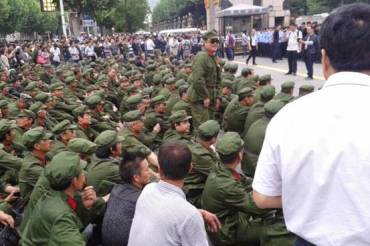
PLA veterans stage a sit-down protest outside government offices in Hubei province on May 4, 2015.

They’d not drunk together since they were in the same army unit, fighting skirmishes with Vietnamese forces in the aftermath of a 1979 border war.

Now in their 50s, they’d come here shortly before an annual parliament meeting in March to fight a different kind of battle – to demand the welfare support that they say was promised to them, and millions of other veterans, on leaving the armed forces years ago.

The four veterans, all from the southern province of Hunan, are an example of the problem facing President Xi Jinping as he prepares to lay off 300,000 out of 2.3 million troops in the biggest restructuring of the People’s Liberation Army, or PLA, since the 1950s.

China already has at least six million PLA veterans on state welfare, thousands of whom have staged well-organized protests in recent years over what they see as insufficient government support. Traditionally the government has offered subsidies to former soldiers and reserved slots for them at state-run companies, though many veterans say officials don’t follow through or that the perks aren’t enough to make ends meet.

Now, with an economic slowdown threatening to cause millions of state sector layoffs, prominent military figures have warned that veterans’ protests could escalate if the government can’t provide jobs or sufficient welfare support for the 300,000 being laid off.

One of the largest veterans’ protests was in June last year when several thousand, mostly veterans of China’s war with Vietnam, wearing uniforms and medals, protested outside offices of the Central Military Commission, which commands the armed forces and is headed by Mr. Xi.

A month earlier, there was another big veterans’ protest outside a Beijing courthouse. Smaller demonstrations occur frequently in other cities, according to experts who monitor them.

Many other veterans have tried to sue the government or lodge formal petitions, as the four in the restaurant did. Before lunch, they said, they’d submitted one at a nearby building that houses the petitions office of the Central Military Commission.

Officials there took the petition and scanned their identity cards, but gave them neither a receipt nor a reply, they said. “They just told us to go back where we came from,” said one of the four, a 54-year-old former worker in a coal-washing plant. “We got the feeling it was useless to go there.”

Source: As China’s Economy Slows, Unrest Among Veterans Rises – China Real Time Report – WSJ

11/03/2015

China to raise retirement age as pressure on pension fund rises | Reuters

China’s pension fund will come under tremendous pressure to break even in coming years and as such, the government needs to gradually raise the official retirement age to salvage the finances, a top official said on Tuesday.

Military delegates arrive for the opening of the annual full session of the National People's Congress, the country's parliament, at Tiananmen Square in Beijing March 5, 2015. REUTERS/Carlos Barria

Yin Weimin, minister of human resources and social security, said the government will gradually raise the official retirement age, which is as low as 50 for some female workers, but stressed that any policy changes will be phased in over five years.

He did not say when retirement ages will be raised.

Analysts have long warned about China’s state pension crisis and the severe funding shortage, with some estimating that the cash shortfall could rise to as high as nearly $11 trillion in the next 20 years.

Yin said the finances were not as dire for the moment, but warned about challenges ahead.

“The pension fund faces tremendous pressure in terms of breaking even in future,” he told reporters at a news briefing on the sidelines of the annual meeting of China’s parliament.

The fund’s income stood at 2.3 trillion yuan (243.28 billion pounds) in 2014, exceeding its expenditure of 2 trillion yuan for the year, he said.

But in coming years, the proportion of Chinese over the age of 60 will rise to 39 percent of the population, from 15 percent now, Yin said.

via China to raise retirement age as pressure on pension fund rises | Reuters.

08/02/2014

* China increasing coverage of serious illness insurance – Xinhua | English.news.cn

China will expand a program that enables people with serious illnesses to get more compensation from medical insurance schemes to all the country’s regions in 2014.

According to a statement issued by the State Council medical reform office on Saturday, pilots of such programs should be launched in all the country’s provincial-level regions by the end of June this year.

The new move is aimed at reducing the number of cases in which people are reduced to poverty by the burden of medical fees, the statement said.

Six Chinese authorities issued a circular in 2012 on the program, stating that part of the funds collected in the current basic medicare insurance schemes for urban and rural residents could be used to purchase commercial medical insurance, so that a greater proportion of the medical fees of people with serious diseases will be covered.

A latest circular issued by the medical reform office said that local finance, human resources and social security, civil affairs, health and insurance authorities should collaborate for the expansion of the program, according to Saturday’s statement.

There should be more efforts to raise public awareness of the program so as to make the benefits easier for people to secure, it said.

The statement added that the quality and the expenditure of medical services should also be scrutinized to curb unreasonable medical treatments and fees.

via China increasing coverage of serious illness insurance – Xinhua | English.news.cn.

Enhanced by Zemanta
07/02/2014

* China to build unified pension system – Xinhua | English.news.cn

China will integrate the basic old-age insurance systems for rural and urban residents to allow people to have equal access to the pension scheme, according to an executive meeting of the State Council on Friday.

China’s separate systems for rural residents and retired company employees in urban areas have basically included everyone in the country, according to the meeting.

China will integrate the two systems and build a unified pension system covering both urban and rural residents, said the meeting.

The meeting, presided over by Premier Li Keqiang, said the move will facilitate population movement and build stable expectations for livelihood improvement.

It will also boost consumption and encourage more business start-ups, said the meeting.

via China to build unified pension system – Xinhua | English.news.cn.

Enhanced by Zemanta
Law of Unintended Consequences

continuously updated blog about China & India

ChiaHou's Book Reviews

continuously updated blog about China & India

What's wrong with the world; and its economy

continuously updated blog about China & India