Archive for ‘Reserve currency’

30/08/2019

Is China set to beat Facebook’s Libra by launching its digital currency this autumn?

  • ‘Forbes’ magazine reported that China’s central bank will launch its own sovereign digital currency to coincide with the Singles’ Day online shopping festival
  • The People’s Bank of China is seeking to address financial risks and counter the current dominance of the US dollar
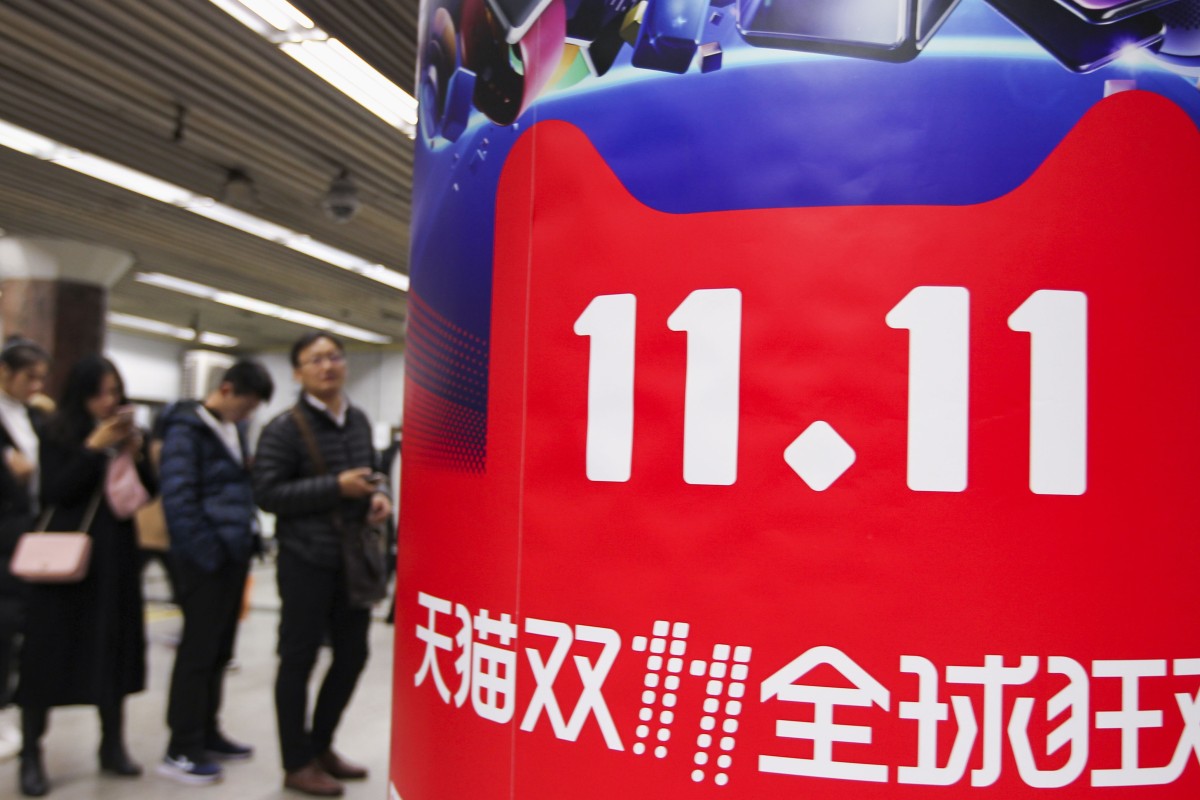
The Singles' Day is a holiday celebrated in China on November 11 and has become the largest online shopping day in the world. Photo: Simon Song
The Singles’ Day is a holiday celebrated in China on November 11 and has become the largest online shopping day in the world. Photo: Simon Song

China’s desire to launch the world’s first government-backed digital currency could see the possible rival to Facebook’s Libra be launched in time for November’s Singles’ Day online shopping festival despite a Chinese media report playing down the timing as “inaccurate speculation”.

Several central bank officials have publicly spoken out over the past several weeks about the need for China to launch its own digital currency since Facebook unveiled its plans for Libra, and the People’s Bank of China (PBOC) appear to be making rapid progress ahead of an expected launch.

Forbes magazine reported this week, citing a source who previously worked for the Chinese government, that China’s central bank could launch the digital currency as soon as November 11 as its bids to address financial risks and to counter the current dominance of the US dollar.

The PBOC did not respond to a faxed request for comment on the Forbes story, although Sina.com said that the report was “inaccurate speculation” citing an unnamed source close to the central bank.

China’s central bank is expected to distribute its digital currency through the big four state-owned banks – the Industrial and Commercial Bank of China, China Construction Bank, the Agricultural Bank of China, and the Bank of China – and mobile payments systems Alipay and WeChat Pay, as well as UnionPay, the state-supported credit card provider, according to the Forbes report. Alibaba is the owner of the South China Morning Post.
Ma Changchun, deputy chief of the Payment and Settlement Division of the PBOC, said at the start of August that a digital currency prototype existed and that the central banks’ Digital Money Research Group had already fully adopted blockchain architecture to ensure its use in retail transactions.

“The People’s Bank digital currency can now be said to be ready,” said Ma on August 11.

The People’s Bank digital currency can now be said to be ready Ma Changchun
Former central bank governor Zhou Xiaochuan said last month that, in addition to central banks, “commercial entities” should be allowed to issue banknotes backed by their own private currency assets, although he did not elaborate on what kind of “commercial entities” might be appropriate to issue a digital currency in China.

China is also ready to make Shenzhen a pilot zone for digital currency as part of plans for the city to become a socialist model city, according to a statement summarising a meeting between the Shenzhen party secretary Wang Weizhong and central bank governor Yi Gang released on Thursday.

The PBOC implemented a blanket crackdown in China on trading of cryptocurrency, including bitcoin, which are not backed by any government, viewing them as risks to China’s financial stability and security. At the same time, in 2014 the central bank created its own academy to study digital currencies and the related blockchain technology.

Neil Woodfine, director of marketing at blockchain start-up Blockstream, said a digital currency created by the PBOC would be “just like cash” and “would be fully controlled by the central bank.”

“If it’s digital instead of physical, they can close accounts and monitor all activities [in the entire financial system]. Commercial bank deposits are difficult for them to monitor, control or pull information out of for verification because the numbers are in each bank’s data centre,” Woodfine said.

Wang Xin, director of the central bank’s research bureau, said last month that

Facebook’s plans 

to create its own digital currency have pushed Beijing to speed up its own digital currency plan as Libra could potentially pose a challenge to Chinese cross-border payments, monetary policy and even financial sovereignty.

Leonhard Weese, the president of the Bitcoin Association of Hong Kong, said that a government-backed digital currency may enhance the PBOC’s control of China’s monetary system, cutting reliance on commercial banks to transmit changes in monetary policy.
“It would be similar to just killing the commercial banks,” Weese said.
Facebook’s Libra,

which would be a non-sovereign digital currency controlled by a Swiss-based company, has come under intense scrutiny by regulators and central banks worldwide. Last month, the Group of Seven industrialised nations, known as the G7, called for urgent regulatory measures and other types of action to address serious concerns over Libra.
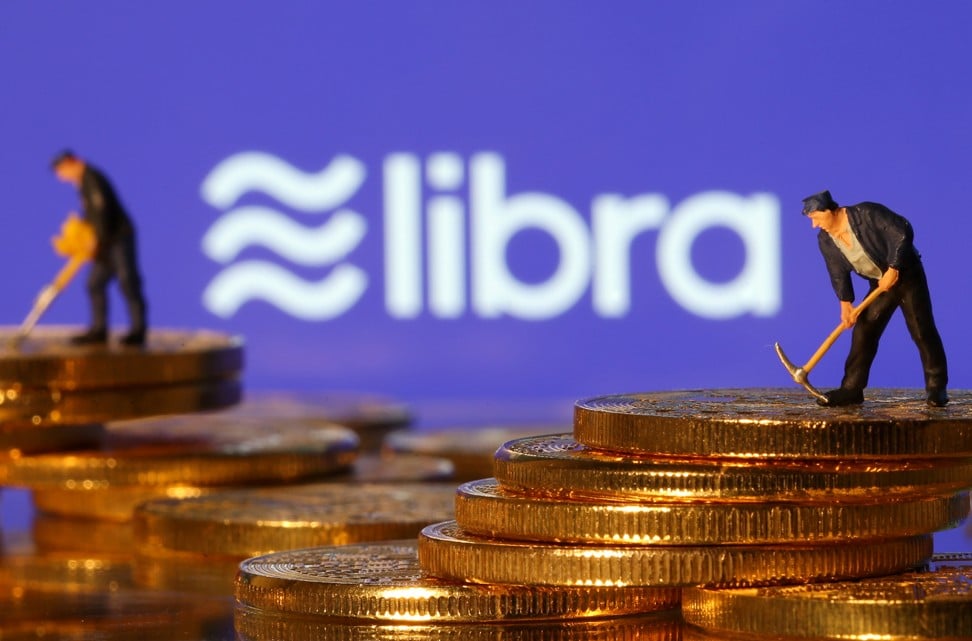
Central banks, however, have expressed interest in launching their own digital currencies to counter the US dollar and to gain more control of their own monetary systems.
Mark Carney, governor of the Bank of England, argued last week that the US dollar, the current dominant reserve currency, could be replaced by a global digital alternative to tackle ultra-low interest rates.
Facebook’s Libra, which is expected to be launched next year, will be pegged to a basket of convertible currencies – so it could serve as a stable online currency – while its payments will be endorsed by Visa and Mastercard. Photo: Reuters

A digital currency “could dampen the domineering influence of the US dollar on global trade”, Carney said last week at the US Federal Reserve’s annual conference, adding that a digital currency has the edge to counter shocks emanating from the US through trade and exchange rates.

Daniel Wang, chief executive and co-founder of blockchain start-up Loopring, said that a Chinese government-backed digital currency may provide a new way for the yuan to compete globally.

“If the central bank wants to increase the global competitiveness of the yuan through its digital currency, only an open and standard-based competitor carries any hope,” said Wang.

A digital yuan would “remain a sovereign currency under a centralised sovereign,” continuing to require the trust from users in the Chinese central bank and government institutions behind it, Wang added.

Alfred Schipke, senior resident representative for China at the International Monetary Fund (IMF), said that the bank is “open” to digital currencies, including the one being developed by China’s central bank.
The IMF in principle is looking at these things favourably. It’s a two-way process where we learn from China, which is often at the forefront of development. Alfred Schipke

“We don’t have a specific view on a particular currency, we haven’t looked at the details of the latest proposals from China,” Schipke said on Thursday. “The IMF in principle is looking at these things favourably. It’s a two-way process where we learn from China, which is often at the forefront of development.”
Blockstream’s Woodfine said that Beijing’s move also reflects a growing concerns among central banks that a financial disaster is on the horizon.
The 30-year US Treasury bond yield fell to an all-time low 1.976 per cent on Thursday, while yields around the world also plunged to multi-year or record low, triggering rising fears over a global recession.
Central banks around have also been driving down interest rates, with the PBOC recently unveiling a key interest rate reform that effectively cuts borrowing costs for companies to boost its slowing economy.
“We’ll see a move by governments and central banks to take back control over the financial system and use that power to direct their economies, continuing to pump money into the system to keep it afloat,” Woodfine added.
“A digital currency would be the perfect channel for helicopter money,” he said in reference to the idea that a central bank could stimulate the economy by giving out large quantities of money to the public, as if dumped from the sky. “They can send out free money to consumers.”
Source: SCMP
03/10/2016

China’s Yuan Just Joined An Elite Club Of IMF Reserve Currencies

China’s yuan joins the International Monetary Fund’s basket of reserve currencies on Saturday in a milestone for the government’s campaign for recognition as a global economic power.

The yuan joins the U.S. dollar, the euro, the yen and British pound in the IMF’s special drawing rights (SDR) basket, which determines currencies that countries can receive as part of IMF loans. It marks the first time a new currency has been added since the euro was launched in 1999.The IMF is adding the yuan, also known as the renminbi, or “people’s money”, on the same day that the Communist Party celebrates the founding of the People’s Republic of China in 1949.

“The inclusion into the SDR is a milestone in the internationalization of the renminbi, and is an affirmation of the success of China’s economic development and results of the reform and opening up of the financial sector,” the People’s Bank of China said in a statement.

China will use this opportunity to further deepen economic reforms and open up the sector to promote global growth, the central bank added.

The IMF announced last year that it would add the yuan to the basket, so actual inclusion is not expected to impact financial markets. But it puts Beijing’s often opaque economic and foreign exchange policy in the international spotlight as some central banks add yuan assets to their official reserves.

Critics argue that the move is largely symbolic and the yuan does not fully meet IMF reserve currency criteria of being freely usable, or widely used to settle trade or widely traded in financial markets. U.S. Republican presidential nominee Donald Trump has said he will formally label China a currency manipulator if he wins November’s election.

China stunned investors by devaluing the currency last year and the yuan has since weakened to near six-year lows, adding to worries about already feeble global growth.

Some China watchers also fear that Beijing’s commitment to further market opening and financial sector reforms will fade after its diplomatic success, despite repeated reassurances from Beijing it will continue with the process.

U.S. Treasury Secretary Jack Lew said on Thursday the yuan was “quite a ways” from true global reserve currency status. The new IMF status recognizes the “enormous” change in China in the last 10 years that had made the yuan more open, but Beijing still had work to do to make its currency and its economy more market-driven, he said. “Being part of the SDR basket at the IMF is quite a ways away from being a global reserve currency,” he said.

Capital Economics said inclusion of the currency in the IMF’s SDR basket will have minimal impact on foreign demand for yuan assets, so “offers little support” for the currency.“

If anything, the risk is that official intervention to keep the renminbi stable ahead of its inclusion will subsequently be paired back, allowing for renewed deprecation,” it said in a research note.

The IMF on Friday fixed the relative amounts of the five currencies in the basket for five years, based on their average exchange rates over the past three months.

Source: China’s Yuan Just Joined An Elite Club Of IMF Reserve Currencies

03/12/2013

China’s yuan surpasses euro as 2nd most-used currency in trade finance: SWIFT | Reuters

China\’s yuan currency overtook the euro in October, becoming the second-most used currency in trade finance, global transaction services organization SWIFT said on Tuesday.

100 Yuan notes are seen in this illustration picture in Beijing November 5, 2013. REUTERS/Jason Lee

The market share of yuan usage in trade finance, or Letters of Credit and Collection, grew to 8.66 percent in October 2013. That improved from 1.89 percent in January 2012.

The yuan, also known as the renminbi, now ranks behind the U.S. dollar, which remains the leading currency with a share of 81.08 percent.

The top five countries using the yuan for trade finance in October were China, Hong Kong, Singapore, Germany and Australia, SWIFT said in a statement.

\”The RMB is clearly a top currency for trade finance globally and even more so in Asia,\” Franck de Praetere, SWIFT\’s Asia Pacific head of payments and trade markets said.

The RMB remained the 12th payments currency of the world, with a slightly decreased share of 0.84 percent compared with 0.86 percent in September.

RMB payments increased in value by 1.5 percent in October, while growth for all payments currencies was at 4.6 percent.

The world\’s second-largest economy is accelerating the pace of financial reform to promote its currency to international players beyond Hong Kong. China aims to lift the yuan\’s global clout and reduce its reliance on the U.S. dollar.

via China’s yuan surpasses euro as 2nd most-used currency in trade finance: SWIFT | Reuters.

20/10/2013

China’s State Press Calls for ‘Building a de-Americanized World’ – Businessweek

“It is perhaps a good time for the befuddled world to start considering building a de-Americanized world.” As nations around the world fret over the U.S. budget impasse, that is the conclusion of a not-so-subtle commentary published by China’s official Xinhua News Agency on Oct. 14.

Key among its proposals: the creation of a new international reserve currency to replace the present reliance on U.S. dollars, a necessary step to prevent American bumbling from further afflicting the world, the commentary suggests.

“The cyclical stagnation in Washington for a viable bipartisan solution over a federal budget and an approval for raising the debt ceiling has again left many nations’ tremendous dollar assets in jeopardy and the international community highly agonized,” says Xinhua. “The world is still crawling its way out of an economic disaster thanks to the voracious Wall Street elites,” it adds.

It’s not a new refrain: Back in March 2009, China’s central bank governor, Zhou Xiaochuan, also called for the creation of a new reserve currency, albeit in less heated language. The world needs a new “super-sovereign reserve currency” to replace the current reliance on the dollar, Zhou wrote in a paper published on the People’s Bank of China’s website (Zhou still heads the bank). The goal, he wrote, is to “create an international reserve currency that is disconnected from individual nations and is able to remain stable in the long run.”

Toppling the dollar isn’t enough today, however: “Several cornerstones should be laid to underpin a de-Americanized world,” explains the Xinhua piece. Along with a greater role for developing-market economies in both the World Bank and International Monetary Fund, “the authority of the United Nations in handling global hot-spot issues has to be recognized. That means no one has the right to wage any form of military action against others without a UN mandate” (all quite reasonable propositions, it must be said).

“A self-serving Washington has abused its superpower status and introduced even more chaos into the world by shifting financial risks overseas, instigating regional tensions amid territorial disputes, and fighting unwarranted wars under the cover of outright lies,” the commentary continues.

“Such alarming days when the destinies of others are in the hands of a hypocritical nation have to be terminated, and a new world order should be put in place, according to which all nations, big or small, poor or rich, can have their key interests respected and protected on an equal footing.”

via China’s State Press Calls for ‘Building a de-Americanized World’ – Businessweek.

20/10/2013

China Got Into Bed With the U.S. Treasury and Can’t Get Out – Time

The good news is that the mutual economic interdependence between China and America means that any chance of real conflict in the foreseeable future is a remote possibility.

From: http://business.time.com/2013/10/15/china-got-into-bed-with-the-u-s-treasury-and-cant-get-out/?utm_source=feedburner&utm_medium=feed&utm_campaign=Feed%3A+time%2Fbusiness+%28TIME%3A+Top+Business+Stories%29%22

“The Chinese sure are doing a lot of worrying these days about the stalemate in Washington. Li Keqiang, China’s Premier, told U.S. Secretary of State John Kerry that he was watching the tussle over raising the government’s debt ceiling with “great attention” in a meeting last week. He has good reason to be concerned. With a stash of nearly $1.3 trillion in Treasury securities, China is the world’s largest foreign owner of U.S. government debt. If U.S. Congress fails to lift the ceiling to allow the government to borrow more by Thursday, Washington may not have enough money to pay its bills, potentially leading to a default. That could sink the value of Treasuries — wiping out a big chunk of Chinese wealth in the process.

Chinese President Xi Jinping looks up as he and U.S. President Barack Obama speak to reporters in California

That possibility has caused much consternation in China. In a blistering (and highly hypocritical) editorial, state news agency Xinhua blasted what it sees as Washington’s irresponsibility in handling global affairs and called for greater say for developing nations in international institutions like the IMF and a new reserve currency to replace the dollar.

“As U.S. politicians of both political parties are still shuffling back and forth between the White House and the Capitol Hill without striking a viable deal to bring normality to the body politic they brag about, it is perhaps a good time for the befuddled world to start considering building a de-Americanized world,” the commentary recommended. “Such alarming days when the destinies of others are in the hands of a hypocritical nation have to be terminated, and a new world order should be put in place.”

Among the Chinese public, the stalemate in Washington has caused confusion and ire. Why, some Chinese are asking, have our leaders invested so much of the country’s money in a government that seems so dysfunctional? “Bought so much [American debt], now you are under the control of others,” went one typical comment posted on microblogging site Sina Weibo. “We should find out who made this decision and let him take the responsibility.”

The Chinese can blame themselves. Since the earliest days of Chinese economic reform, policies that the government has employed to create growth and exports have also made it dependent on debt issued by the U.S. Treasury. Those policies have generated huge current-account surpluses and gargantuan reserves of foreign currency that have left Beijing no other option but to invest in the U.S.

Chinese policy has generally pushed exports while discouraging imports. By controlling the value of its currency, the renminbi (RMB), to promote exports, China hasn’t allowed its exchange rate to adjust to shifts in trade in a way that would bring balance. Economist Huang Yiping once proffered that policies that reduce prices of land, energy and other costs of production also subsidize exports, and thus contribute to surpluses. Meanwhile, the government’s regulation of interest rates has favored investment and punished savers, suppressing domestic consumption.

The current-account surpluses China has notched over the years have resulted in a vault full of foreign-currency reserves — a staggering $3.66 trillion at last count. Though China’s surpluses have been declining (relative to GDP), the country is still adding to this mountain of foreign currency. In the third quarter, China’s foreign-exchange reserves jumped by the largest amount in more than two years.

To many, this ocean of foreign currency shows China’s economic strength, but at the same time, it is also a financial burden. Chinese policymakers simply don’t have many options when managing these giant reserves, and that has forced them to gorge on Treasuries. The U.S.-government-bond market is deep, liquid and reliable — the perfect (and, arguably, only) place to park all those greenbacks. Sure, the Chinese can switch some of their dollars into other currencies, but there is a limit to that strategy. Dumping the dollar would depress its value, eroding China’s own holdings. The only way for China to wean itself off its Treasury habit is to change its entire economic system.

That, though, is happening slowly. One strategy China is pursuing to lessen its dollar dependence is by promoting its own currency as an alternative to the greenback in global trade and finance. The government has had some success. The European Central Bank and China’s central bank recently agreed to a large swap of their currencies. And according to a recent survey from the Bank for International Settlements, the RMB entered the list of top 10 most traded currencies for the first time. Yet in order for the RMB to become a true rival to the dollar, China has to undertake far more reform.

The RMB isn’t fully convertible, nor does it trade freely around the world like the dollar, euro or yen. China is taking stabs at the sort of financial liberalization that would give the RMB an international boost — experimenting with freer capital flows in a new zone in Shanghai, for instance — but those steps are tentative at best. The Chinese government is still reluctant to throw open its financial sector and loosen capital flows and currency trading in a way that would turn the RMB into a solid reserve currency like the dollar.

“China’s policymakers remain deeply uncomfortable with allowing market forces a say in determining the exchange rate at times of uncertainty,” research firm Capital Economics said in a report on Monday. “Policymakers still see opening of capital controls as an important goal. But their actions underline that it remains a long way off.”

What this all means is that China and the U.S. Treasury remain locked in an embrace from which it is very hard for Beijing to escape. What it will take is extensive reform to China’s own economy that so far Beijing has been reluctant to undertake. So Beijing can call for a “de-Americanized world” all it wants. China is not ready to take America’s place.”

01/06/2013

Yuan may continue to appreciate

China Daily: “The yuan may be trading at below 6.1 against the US dollar as the Chinese currency continues to rise in the next few months, said a currency analyst at DBS Bank.

Yuan may continue to appreciate

A trader with an Asian bank in Shanghai said that the yuan’s valuation has peaked for a few days, while sales of dollars are easing.

An employee from the Industrial and Commercial Bank of China is counting the renminbi and Japanese yen in Huaibei, Anhui province, on May 17. The yuan has gained some 20 percent against the yen since the beginning of the year. Woo He / For China Daily

“Most of my peers working in Shanghai share the opinion that in the short term the renminbi may further appreciate against the US dollar,” the trader said.

China’s central bank, the People’s Bank of China, set the yuan’s midpoint at a record-high level of 6.1796 against the US dollar, while the spot yuan closed at 6.1345 per dollar on Friday.

It has been 12 months since Japan’s yen and China’s yuan became directly convertible, and the yuan has gained some 20 percent against the yen since the beginning of the year.

The appreciation of the yuan and the depreciation of the yen may cast risks to China’s currency as it’s the only currency which lacks the elasticity of East Asian economies, wrote Liu Yuhui, a financial researcher at the Chinese Academy of Social Sciences in an article published on Tuesday.

“It has been very difficult for us to guarantee orders from Japan these days because our price advantage disappeared,” said Yuan Hongtao, owner of a Hangzhou-based plastic production company, which exports some 40 percent of its products to Japan.

Analysts said that policymakers now have to figure out ways to help companies grow, as the renminbi is increasingly going global.

“While the benefits of direct convertibility between the renminbi and other currencies are obvious, including cutting the costs of exchange and reducing the risks brought by the fluctuation of the US dollar, it can also bring some risks to companies and regions in China whose growth is driven by foreign trade,” said Liu Yang, a foreign exchange analyst with Shanghai Gaofu Consultancy.

Currently, the yuan is directly convertible to the yen and the Australian dollar. New Zealand and China are in an early stage of negotiations for direct convertibility of each other’s currencies, according to a Reuters report on May 26.

“One important step to make the renmibi more internationalized is to use more yuan in direct investment overseas”, said Nathan Chow, vice-president and economist of group research with DBS Bank (Hong Kong) Ltd.

Chow said that only about 6 percent of China’s outbound direct investment uses renminbi, while 36 percent of foreign direct investment in China uses renminbi.

If regulations on ODI using renminbi are eased, a large amount of yuan will be released to overseas markets and help divert risks of the fluctuation of the US dollar, which is being used for foreign exchange reserves, said Chow.

He added that more big corporations may want to issue dim sum bonds — yuan-denominated bonds issued in Hong Kong — as the renminbi bond market grew significantly this year, driven by lower funding costs, improved macroeconomic conditions and the heightened expectations for yuan appreciation.

“Despite all these factors, market facilities for renminbi bonds still have a lot of catching up to do. Decision makers and financial institutions need to work closer with corporations, while continuing to improve the fundraising infrastructure in offshore renminbi centers such as Hong Kong and Singapore,” he said.

The yuan had appreciated 1.72 percent against the dollar since the beginning of the year, following a moderate gain of 1.03 percent throughout 2012.”

via Yuan may continue to appreciate |Economy |chinadaily.com.cn.

See also:

24/04/2013

* Australia’s central bank to invest in Chinese bonds

BBC: “Australia’s central bank is planning to invest around 5% of its foreign currency reserves in Chinese government bonds, its deputy governor has said.

China's President Xi Jinping shakes hands with Australia's Prime Minister Julia Gillard

It will be the first time the Reserve Bank of Australia (RBA) will invest in sovereign bonds of an Asian country other than Japan.

The RBA has foreign currency reserves of A$38.2bn ($39.2bn; £25.7bn).

Earlier this month, the Australian dollar became the third currency to trade directly with the Chinese yuan.

“This decision to invest in China is an important one,” Philip Lowe, deputy governor of the RBA said in a speech to the Australian Chamber of Commerce in Shanghai.

“It reflects the broader economic relationship between China and Australia and our increasing financial ties.

“It provides greater diversification of our investments and will help with our understanding of the Chinese financial markets,” he added.”

via BBC News – Australia’s central bank to invest in Chinese bonds.

13/04/2013

* France plans currency swap line with China: paper

Reuters: “China to make Paris a major offshore yuan trading hub in Europe, competing against London, the China Daily on Saturday cited Bank of France Governor Christian Noyer as saying.

A bank clerk counts Chinese yuan banknotes at a branch of Industrial and Commercial Bank of China in Huaibei, Anhui province, June 8, 2012. REUTERS/Stringer

Yuan deposits in Paris amount to 10 billion yuan ($1.6 billion), making it the second largest pool for the Chinese currency in Europe after London. Almost 10 percent of Sino-French trade is settled in yuan, also called the renminbi or RMB, according to French data cited by the official newspaper.

“The Bank of France has been working on ways to develop a RMB liquidity safety net in the euro area with due consideration of a supporting currency swap agreement with the People’s Bank of China,” Noyer told the English-language newspaper.

The yuan’s internationalization and bilateral financial cooperation could be among the main topics during French President Francois Hollande’s visit to China in late April, the paper said.”

via France plans currency swap line with China: paper | Reuters.

08/08/2012

* Dollar losing its attraction

The Times: “Soft power is sometimes defined as a way of achieving the outcome you desire without using force. In Britain’s case, this has traditionally been exercised using subtle diplomacy, cultural and legal institutions.

The United States exercises soft power through its culture, films and music, too, but it also does through the ubiquity of the US dollar.

With power comes responsibility. There is a danger now that, in seeking to use the dollar’s reserve currency status to achieve US foreign policy aims, America is undermining that power. A key criticism of the US sanctions on Iran, particularly the ban on Iranian banks from using the Swift payments system, is that it has created incentives for other countries to trade with Iran without using dollars. Iran itself has exploited this by using its own currency in bilateral trade deals with India, China, Russia and Japan.

It is a small step from finding ways of trading with Iran without using dollars to trading with each other without using dollars, something that has been noted by the People’s Bank of China, whose officials are talking increasingly loudly about how and when the yuan might become a global reserve currency.

The aggression shown by the New York State Department of Financial Services towards Standard Chartered has just created another incentive to avoid doing business in dollars.”

via It may be unfair, but the damage is done | The Times.

It’s called shooting oneself in the foot. It’s also another case of the Law of Unintended Consequences.  See also:


Law of Unintended Consequences

continuously updated blog about China & India

ChiaHou's Book Reviews

continuously updated blog about China & India

What's wrong with the world; and its economy

continuously updated blog about China & India