Archive for ‘stock market’

12/08/2019

Cathay Pacific threatens staff with sack after Beijing draws line on Hong Kong protests

  • Chief executive Rupert Hogg says staff who ‘support or participate in illegal protests’ would face disciplinary action that ‘may include termination of employment’
  • Airline’s shares down 4.37 per cent on Monday morning to lowest level in 10 years, despite it complying with orders on Friday from China’s aviation authority
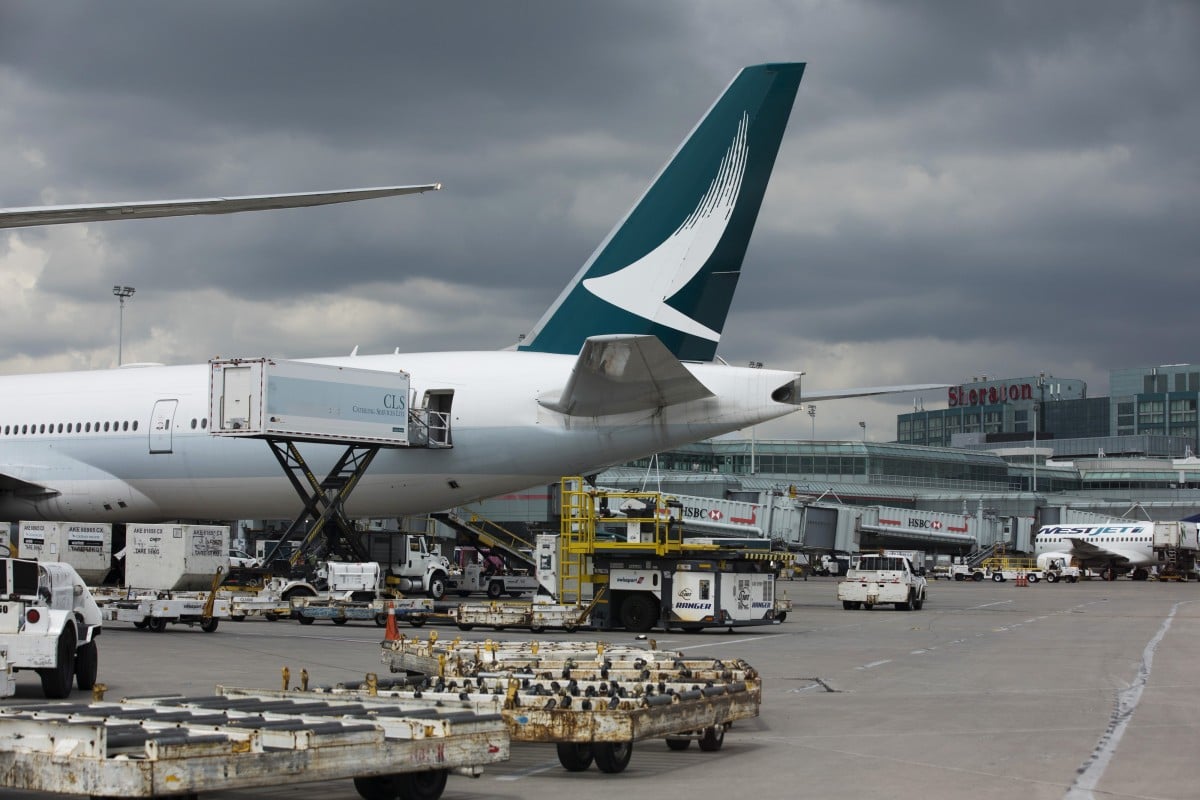
Cathay Pacific moved over the weekend to comply with new orders from China’s aviation authority. Photo: Bloomberg
Cathay Pacific has warned that it would sack staff taking part in illegal protests in Hong Kong, saying it would take a “zero tolerance” approach, as its shares slumped to their lowest level in 10 years in morning trading on Monday.
In a note to staff on Monday, chief executive Rupert Hogg said staff who “support or participate in illegal protests” would face disciplinary action that “could be serious and may include termination of employment”.

His warning indicated an escalation by the company, under pressure to crack down on employees after China’s civil aviation regulator said on Friday that airline staff supporting the Hong Kong protests would be barred from flights going to, from or through mainland China.

“We are all obliged to abide by law at all times,” Hogg said. “Cathay Pacific Group has a zero-tolerance approach to illegal activities. Specifically, in the current context, there will be disciplinary consequences for employees who support or participate in illegal protests. These consequences could be serious and may include termination of employment.”

By noon in Hong Kong, the stock had fallen 4.37 per cent to HK$9.85 (US$1.26), its lowest level since June 2009. Losses dragged the carrier’s parent company Swire Pacific down 5.4 per cent to HK$77.50, making it the worst performer on Hong Kong’s stock market during morning trading.

This was the lowest price since October 2018 for Swire, which owns 45 per cent of the airline. Air China, which owns 22.7 per cent of Cathay, also fell 1.53 per cent in Hong

On Friday, the Civil Aviation Administration of China (CAAC) told Hong Kong’s flagship carrier that any staff members who had taken part in what it called “illegal protests”, “violent actions” and “overly radical activities” would not be allowed to fly to or from the mainland, in a first warning shot at a Hong Kong-based corporate giant.

The CAAC also said that the airline would have to submit identification details of all crew operating all services using mainland China airspace, and that flights with unapproved crew lists would be barred. It gave the airline until Thursday to submit a detailed plan to improve its procedures.
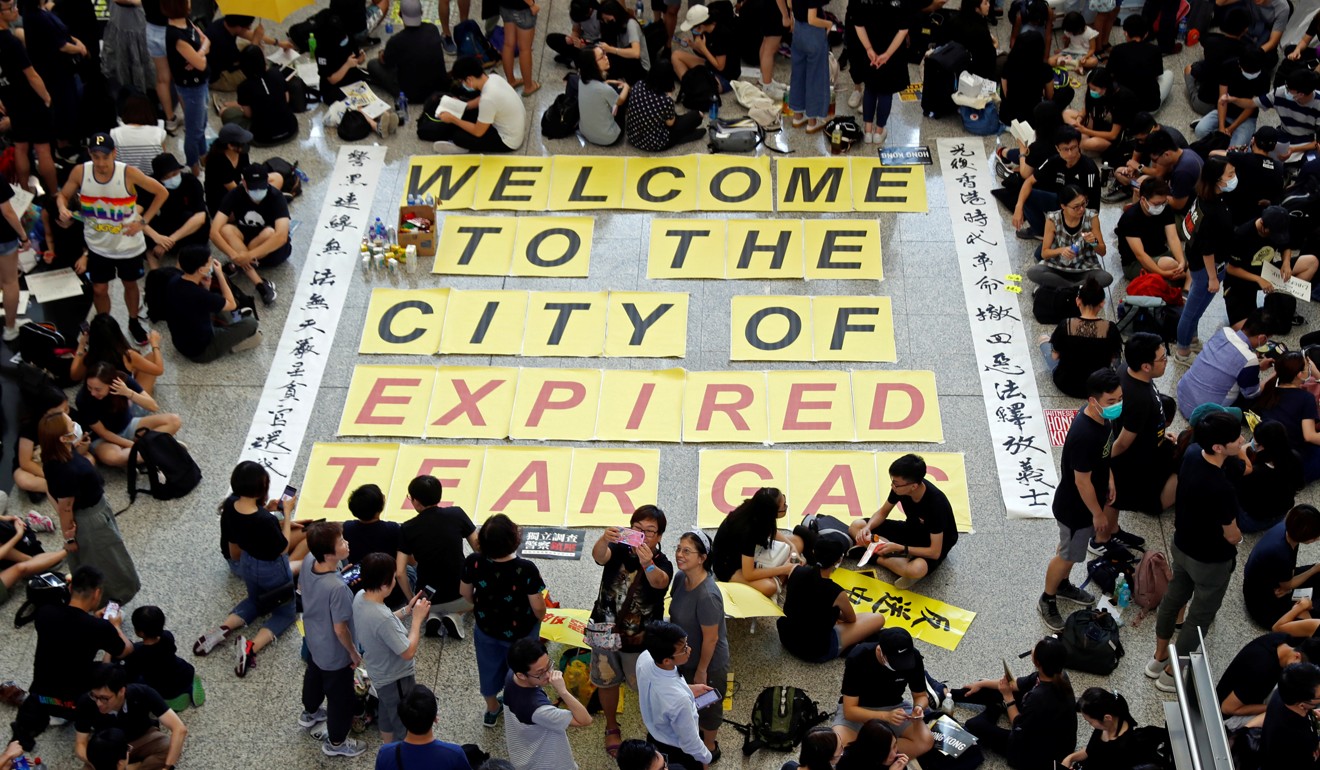
Anti-extradition bill protesters join a sit-in protest at Hong Kong International Airport on Sunday. Photo: Reuters

Cathay Pacific had earlier said it would not stop staff members from taking part in demonstrations.

On Wednesday, Cathay Pacific chairman John Slosar said the company would not rein in staff for openly supporting the protests. “We certainly wouldn’t dream of telling them what they have to think about something,” Slosar said.

But in his second statement in two days in relations to the CAAC’s sanctions, Hogg said the “actions and words” of staff outside of work hours could have a “significant effect on the company”, adding that the actions of a few of Cathay’s 34,000 employees would be seen as a company position.

He also asked staff to not “support or participate” in the illegal protest at the airport, saying the carrier was concerned that the protests could become disorderly and violent.

No flights by Cathay Pacific, nor by its subsidiaries Cathay Dragon or HK Express, were delayed or cancelled on Saturday or Sunday, the company said.

The CAAC’s move was widely seen as a clear warning to Hong Kong’s business community to toe Beijing’s line to pressure ongoing anti-government protests in the city that have been taking place for over two months.

Despite the airline acting over the weekend to comply with the rules, Chinese state media continued to put pressure on the company.

Global Times, a tabloid associated with Communist Party mouthpiece People’s Daily, said on Sunday the airline had still not allayed all concerns despite its adjustments to comply with the ruling.

Carrie Lam’s remarks about Beijing’s sovereignty ‘add fuel to the fire’, analysts warn

“These are only small steps [showing] that Cathay Pacific is heading towards the right direction, and their sincerity will need to be tested over time,” the tabloid said in an opinion article on Sunday.

It said 2,000 company staff joined citywide strikes last Monday, and cited the case of a pilot who was arrested and charged with rioting during a demonstration on July 28.

“Cathay Pacific has touched on this behaviour lightly, which has a huge impact on the trust the industry and the public have towards the company,” the article said.

State broadcaster CCTV published a short video on Weibo on Monday morning of its anchor issuing further warnings to the airline, saying there were reports of staff continuing to join “illegal gatherings” and asking tourists not to go to Hong Kong.

“If this continues, it’s not a matter of whether or not people would still want to come to Hong Kong, but whether they would still want to be on your airline,” Kang Hui said in a one-minute video.

“Let me send a friendly reminder: one would not be in trouble had one not asked for it,” Kang said, in Mandarin and then in English, translating the popular Chinese internet meme phrase “No zuo no die” and claiming some Cathay Pacific staff pretended not to understand Mandarin. Cantonese is the dominant language in Hong Kong.

Elsewhere, the company announced that two of its airport employees

had been sacked

for leaking passenger information about a Hong Kong police soccer team who had been on a flight to mainland China. It has also suspended the pilot who was among 44 people charged with rioting on July 28.

Although the company does not clearly specify its country-by-country performance, China and Hong Kong produced half of all its 2018 revenue – HK$57 billion of a total of HK$111 billion. A fifth of all the carrier’s flight are to and from the mainland.
Source: SCMP
03/03/2019

China stock market to see big capital inflow in 2019 upon MSCI weight decision, UBS says

NEW YORK, March 2 (Xinhua) — Capital inflow into Chinese on-shore stock market would accelerate in 2019 thanks to global index supplier MSCI’s decision to hike the inclusion factor of China’s A-Shares from 5 percent to 20 percent in three steps within 2019, according to a research note by Swiss multinational investment bank UBS AG.

The weighting for Chinese A-shares in MSCI Emerging Market index would rise to 3.3 percent by November, up from around 0.7 percent at present, said MSCI.

“This latest MSCI weight increase should help trigger at least 60 billion U.S. dollars in inflows to A-shares in 2019, pushing cumulative foreign ownership above 160 billion U.S. dollars,” said the research note issued on Friday.

Higher A-share allocation is a long-term structural trend for international investors, it added.

Incremental buying in the short term will probably remain biased toward select sectors and stocks currently prefered by overseas capital, such as white goods, insurance, healthcare and electronics, it said.

Meanwhile, the sharp run-up in onshore brokers, partially stoked by recent recovery in onshore stock markets, offers attractive levels to take profits in the sector, according to UBS.

MSCI’s announcement of higher A-share inclusion factor will bring a new pool of international investors to the A-share market, which overtime will help raise transparency and improve governance to these listed companies, said Jorge Mariscal, chief investment officer on emerging markets with UBS Wealth Management.

The weight of China’s A-shares in MSCI Emerging Market index could increase to 15 percent within the next 10 years and active emerging market investors would find it hard to brush aside exposure to Chinese onshore portfolios amid similar moves by other international index providers, according to UBS.

UBS said it remains tactically overweight on Chinese equities in its Asian portfolios and continues to prefer onshore to offshore Chinese stocks with the former set to benefit from capital inflow, more accommodative monetary policy and fiscal stimulus.

Widely-followed Shanghai Composite Index has entered territory of bull market thanks to solid growth so far this year and closed just shy of 3000 points on March 1.

Source: Xinhua

09/07/2015

How India Could Be Hit by Chinese Stock Slide – India Real Time – WSJ

The dive in Chinese markets on Wednesday may have rattled investors across the globe, but prospectors in India need not panic: any trickle down impact of the crisis on the South Asian nation will be limited to certain sectors.

The Shanghai Composite index has lost around a third of its value over the past month and concern is growing that Beijing’s failure to prop up its equity markets means it will be unable to push through its broader agenda of liberalizing the economy to mitigate the country’s slowing growth.

India’s metals companies are likely to be affected the most as China is the world’s biggest importer of steel and iron ore. Any further slowdown in China’s economy will bring down global prices, hurting Indian firms’ profitability.


Meanwhile, luxury-car manufacturers are also likely to take a hit. Tata Motors 500570.BY +1.62%’ share price has already lost about 8% in the past two trading sessions on concerns that the problems in China could further worsen the slowdown in demand for its Jaguar Land Rover luxury cars there, which is now the single-largest market for JLR.

But long-term effects are expected to be minimal. India’s benchmark S&P BSE Sensex index has gained about 5% during the past month.

Though India’s benchmark index fell 1.7% yesterday, analysts and fund managers attribute it to a domino effect from China that won’t last. India’s improving domestic fundamentals are capable of thwarting a similar meltdown.

“India is relatively better off among the emerging markets as we don’t have too many negatives compared to other countries,” said Deven Choksey, managing director of Mumbai-based brokerage K.R. Choksey Shares and Securities.

He said investors will give preference to the ongoing reform process in India and key legislation such as the Land Acquisition Bill and the Goods and Services Tax Bill, rather than global events.

Analysts said upcoming corporate earnings will also matter more to Indian stock prices than the Chinese turmoil. Though corporate earnings are expected to take some time to improve, analysts are confident that a sharp recovery in profits is likely from the second half of this financial year. The January-March period was the worst earnings season in the past two years.

“Both (China and India) can’t be compared and, in fact, the developments in China will only serve to reinforce confidence in India and India’s market structure,” said Aashish Somaiyaa, chief executive of Motilal Oswal Asset Management Co.

In fact, foreign investors, who own about 43% of the publicly-traded shares of companies in the Sensex, have invested about $600 million already in July, after pulling out nearly $1.8 billion in the previous two months.

And domestic investors have not lost faith in the Indian story as they have poured in nearly $2.4 billion into stocks since May.

“Whenever there is a correction in [the] Indian market, we are getting more enquiries,” said Nandkumar Surti, chief executive of J.P. Morgan Asset Management India Pvt. Ltd.

via How India Could Be Hit by Chinese Stock Slide – India Real Time – WSJ.

08/07/2015

Greece and China expose limits of ‘whatever it takes’ | Reuters

For a world so confident that central banks can solve almost all economic ills, the dramas unfolding in Greece and China are sobering.

“Whatever it takes,” Mario Draghi‘s 2012 assertion about what the ECB would do to save the euro, best captures the all-powerful, self-aware central bank activism that’s cosseted world markets since the banking and credit collapse hit eight years ago.

From the United States to Europe and Asia, financial markets have been cowed, then calmed and are now coddled by the limitless power of central banks to print new money to ward off systemic shocks and deflation.

But even if you believe central banks will do whatever it takes – to save the euro, stop the recession, create jobs, boost inflation, prop up the stock market and so on – it doesn’t necessarily mean it will always work.

Draghi himself merely pleaded for faith on that score three years ago when he added, “Believe me, it will be enough.”

Critically, given the direction of events in Athens, his celebrated epigraph was preceded by “Within our mandate…”

And so the prospect of the European Central Bank potentially presiding over, some say precipitating, the first national exit from a supposedly unbreakable currency union will inspire a rethink of the limits of Draghi’s phrase for all central banks.

Of course, the ECB does not want to push Greece out of the euro. But ‘whatever it takes’ may just not be enough to preserve the integrity of the 19-nation bloc if the ECB’s mandate prevents it from endlessly funneling emergency funding to insolvent Greek banks.

And as long as the Greek government is at loggerheads with its creditors, the central bank can’t wave a magic wand of monetary support without breaking its own rules.

The ECB continues to insist it will do all in its power to prevent contagion to other euro zone markets and there’s little doubt it will make good on that. But the problems stemming from a Greek exit are not of financial seepage but of political contagion to other euro electorates tiring of austerity. And that sort of contagion is beyond ECB control.

via Greece and China expose limits of ‘whatever it takes’ | Reuters.

08/07/2015

China Stock Tumble Scarier Than Greek Debt Crisis – China Real Time Report – WSJ

China’s stock plunge is scarier than Greece, writes Morgan Stanley Investment Management’s Ruchir Sharma:

The continuing crisis is viewed, locally and globally, as a test of China’s control over the economy. The “Beijing put”—a perception that Chinese economy and markets are backstopped by the government—is under threat. That perception has underpinned the widespread belief that Chinese growth won’t fall much below 7%, because that is the government’s desired target and Beijing is omnipotent.

But if Beijing can’t stop the market’s tumble, there could be a sudden shift in the perception of exactly how far economic growth might fall under the weight of too much debt. If that floor crumbles and the Chinese economy spirals downward, it will make the drama surrounding Greece feel like a sideshow. China has been the largest contributor to global growth this decade; Greece’s economy is about the size as that of Bangladesh or Vietnam.

via China Stock Tumble Scarier Than Greek Debt Crisis – China Real Time Report – WSJ.

28/11/2014

Indian Stock Exchange Rises Up World Rankings, Catching Up With China – India Real Time – WSJ

Indian shares are on a roll and that’s bringing the country’s stock exchanges onto the global stage.

English: National Stock Exchange of India Русс...

English: National Stock Exchange of India Русский: Национальная фондовая биржа Индии (Photo credit: Wikipedia)

On Friday, the market capitalization, or total value of listed companies, on Mumbai’s BSE exchange reached a new record of 100 trillion rupees ($1.6 trillion.)

The market value of companies listed on Indian stock exchanges has risen by more than 40% over the past year, as investors are betting that Indian companies will benefit from a turn in the local economy and policies expected from the new government that came to power in May.

The BSE stood 10th among the world’s stock exchanges as measured by market value at the end of October, according to data from the World Federation of Exchanges.

It is followed closely by India’s National Stock Exchange, which is ranked 11th.

Industry experts say India’s standing is likely headed higher.

“It is a matter of time before we make it to the top 5,” stock exchanges in the world, said Kalpana Morparia, chief executive of J.P. Morgan India, in a statement Friday.

If the market cap of Indian companies keeps increasing at its recent pace, the BSE and NSE could soon overtake Germany’s Deutsche Borse and China’s Shenzhen Stock Exchange.

via Indian Stock Exchange Rises Up World Rankings, Catching Up With China – India Real Time – WSJ.

13/05/2014

India stocks, rupee rise as exit polls tip BJP win – Businessweek

India’s stock market and currency rallied Tuesday on exit polls predicting election victory for a pro-business party and its allies.

Flag of the Bharatiya Janata Party (BJP), a na...

Flag of the Bharatiya Janata Party (BJP), a national political party in India. (Photo credit: Wikipedia)

Official election results are expected on Friday, but exit polls by at least six major Indian TV stations show the Hindu nationalist Bharatiya Janata Party likely to win enough seats to form a coalition government.

The Sensex stock index rose more than 2 percent to an all-time high of 24,068.94 before paring its gain and closing at 23,871.23.

via India stocks, rupee rise as exit polls tip BJP win – Businessweek.

Enhanced by Zemanta
12/03/2014

Decoupling Happened: U.S. Stocks Soared, China’s Shrugged – Businessweek

The idea that emerging markets could keep growing smartly despite the collapse of the U.S. was something romanced quite a bit in recent years. Decoupling, as it’s called, was at least numerically possible. After all, China, Brazil, India, and Russia—the planet’s four biggest emerging economies, which chipped in two-fifths of global economic growth in the year leading up to Wall Street’s 2008 collapse—stood out as the least dependent on exports to America. Upwards of 95 percent of China’s double-digit growth was attributable to domestic demand.

Turns out a decoupling did transpire in the five years since peak meltdown—only it’s the U.S. market that seems to be doing fine while China founders. It’s a divergence of fortunes few would have predicted.

The benchmark Standard & Poor’s 500-stock index has produced a total return of 207 percent to touch a record high in the five years since the market set a low unseen since the 1990s. Citigroup is clocking U.S. shares at “euphoric” territory. By comparison, the MSCI Emerging Markets Index has returned 125 percent.

via Decoupling Happened: U.S. Stocks Soared, China’s Shrugged – Businessweek.

Enhanced by Zemanta
Law of Unintended Consequences

continuously updated blog about China & India

ChiaHou's Book Reviews

continuously updated blog about China & India

What's wrong with the world; and its economy

continuously updated blog about China & India