Archive for ‘Tourism’

30/09/2014

China’s Legions of Tourists Will Spend $155 Billion Abroad This Year – Businessweek

China is preparing for roadways clogged with cars and trains overloaded with travelers during its weeklong National Day holiday starting Oct. 1. But the real action for Chinese tourists will be happening overseas.

Chinese tourists in Paris

Over the full year, 116 million Chinese tourists are expected to travel abroad and spend $155 billion, up 20 percent over 2013, projects a new report by the China Tourism Academy. That compares with less than $55 billion that will be spent by tourists inside the country, a gap of more than $100 billion. “The deficit will further increase in the future,” predicts academy head Dai Bin, who was quoted in the China Daily.

China now sends more tourists abroad than any country in the world, according to China’s National Tourism Administration. Favored destinations include Australia, South Korea, and Southeast Asian countries as well as, increasingly, Europe and the U.S. Chinese tourists abroad will exceed half a billion annually within five years, says Shao Qiwei, administration chief of the English language paper.

In the first half of this year, Chinese spent $70 billion on overseas travel, up 20.7 percent from the same period a year earlier. Chinese travelers abroad spend almost three times as much per capita as foreign tourists in China, says Fan Zhiyong, an economist at Renmin University in Beijing, the official Xinhua News Agency reported.

Along with hotel lodging fees and restaurant meals, overseas spending includes plenty of purchases of such high-priced products as Rolex watches, Prada (1913:HK) shoes, and Chanel handbags. One-third of all Chinese travel expenditures goes to buy goods, often “luxury items—to take back home,” says McKinsey & Co. in a June report. Total spending could reach $194 billion by 2015, Morgan Stanley (MS) estimated last year.

via China’s Legions of Tourists Will Spend $155 Billion Abroad This Year – Businessweek.

07/08/2014

These ten historical monuments earn India the most revenue

As airfares become cheaper and the world gets more adventurous, India’s tourism sector has been reaping the benefits. Revenues are expected to rise by 7.9% over the next decade. In 2012, according to the World Travel and Tourism Council, tourism accounted for 6.6% of India’s GDP.

Here’s a list of India’s most lucrative historical sites, based on the revenues they earned in 2013-2014.

1) Taj Mahal, Agra

Revenue: Rs. 21,84,88,950

Mughal emperor Shah Jahan’s marble tribute to third wife, Mumtaz Mahal, the Taj is by far the most iconic structure in India, as well as the country’s biggest-earning monument.

2) Qutab Minar complex, Delhi

Revenue: Rs 10,16,05,890

The Qutub Minar was built in the early 13th century and is the second-tallest tower in India (after Mohali’s Fateh Burj). It is made out of red and buff sandstone and is a UNESCO World Heritage Site.

3) Agra Fort, Agra

Revenue: Rs 10,22,56,790

Agra Fort, another UNESCO World Heritage site, was constructed under the third Mughal emperor Akbar over the remains of the ancient site known as Badalgarh.

4) Humayun’s Tomb, Delhi

Revenue: Rs 7,12,88,110

The tomb of the Mughal emperor Humayun was built in 1572 by his widow, Bega begum.

5) Red Fort, Delhi

Revenue: Rs 6,15,89,750

The Red Fort was originally built as the fortified palace of Shahjahanabad under Shah Jahan. It was the residence of the Mughal emperors for nearly 200 years.

6) Group of monuments, Fatehpur Sikri

Revenue: Rs 5,62,14,640

The city of Fatehpur Sikri was founded in 1569 by the Mughal emperor Akbar. It served as his capital from 1571 until 1585.

7) Group of monuments at Mahabalipuram

Revenue: Rs 2,72,93,480

The sculpted temples and buildings in this town, 60 kms south of Chennai, are the remains of a port from where ancient Indian traders travelled to South East Asia.

8) Sun Temple, Konarak

Damien Roué/Flickr

Revenue: Rs 2,43,52,060

This 13th-century temple in Odisha was conceived of as a gigantic solar chariot with 12 pairs of exquisitely-ornamented wheels pulled by seven rearing horses.

9) Group of temples, Khajuraho

Revenue: Rs 2,24,47,030

Khajuraho, in Madhya Pradesh, is synonymous with this large group of medieval Hindu and Jain temples, some of which have erotic sculptures.

10) Ellora Caves

Revenue: Rs 2,06,72,820

Ellora Caves are among the largest rock-hewn monastic-temple complexes in the entire world. The site includes one of the world’s largest monolithic structures, the Kailash temple.

via Scroll.in – News. Politics. Culture..

11/07/2014

China’s Patriotic Red Tourism Makes a Comeback – Businessweek

Ear-splitting explosions go off and plumes of gray smoke drift over the arid Shaanxi countryside of northwestern China. Ragtag Communist soldiers in blue uniforms fire their rifles at an advancing Nationalist tank while villagers run for cover. Finally, justice prevails; the red flag of the Chinese Communist Party is held proudly aloft while peasants dance in celebration.

A reenactment of the “Defense of Yan’an”

It’s a scene repeated every day at 11 a.m. as 350 actors reenact the “Defense of Yan’an,” a famous battle against the Nationalist forces of Generalissimo Chiang Kai-shek that was crucial to the founding of the People’s Republic in 1949. “By coming here we can understand how the party sacrificed, created the new China, and built such a beautiful country for us,” says 13-year-old Deng Yi, visiting from Wenzhou, who along with his mother and father, each shelled out 150 yuan ($24) to watch the show.

That’s what China’s leaders want to hear as they expand “red tourism” in more than 100 sites across China. Their goal: to boost patriotism and support for the Chinese Communist Party. “We need to seize these two concepts—red bases and patriotic education on the one hand and developing red tourism on the other,” said President Xi Jinping in March.

Red tourism is not new to China. Millions flocked to red sites including Mao Zedong’s birthplace in Shaoshan, Hunan province, during the Cultural Revolution from 1966 to 1976. Visits to revolutionary locales spiked in 2011, as China prepared to celebrate the party’s 90th anniversary. If China’s leaders have their way, red tourism will have a massive renaissance. Already last year, 786 million tourists visited revolutionary sites, up 17.3 percent from the previous year, generating 198.6 billion yuan ($32 billion) in revenue, up 19.1 percent, according to the National Tourism Administration.

“We need to seize these two concepts—red bases and patriotic education on the one hand and developing red tourism on the other.”—President Xi

One of the most popular is Yan’an, the “cradle of the revolution” where Mao, General Zhu De, and other revolutionaries spent more than a decade living in caves starting in 1936. It’s also where President Xi, while a teenager, spent seven years among the peasants during the Cultural Revolution. Jinggangshan, in Jiangxi province, where the rebels hid out in the late 1920s and early 1930s, and Zunyi, in Guizhou province, a key stop on the Long March, are also top destinations.

To prepare for the onslaught of photo-snapping fellow travelers, China’s Ministry of Civil Affairs last year spent 2.8 billion yuan on constructing memorials, while the state bureau in charge of cultural relics earmarked 487 million yuan for renovating red sites. Another 1.5 billion yuan was spent on 66 “red tourism highways” across the country.

“We hope to teach the next generation about what happened before,” says Hong Jiasheng, chairman of Yan’an Shengdian Red Tourism Development, which is run jointly with the local government and draws 500,000 tourists annually. An entrepreneur from Zhejiang province, Hong launched on July 6 a similar show in Fushun, Liaoning province, reenacting an important 1948 battle.

The push to develop red tourism is part of a larger campaign launched in December to instill citizens with what Xi calls core socialist values aimed at realizing the “Chinese Dream.” Those include patriotism, dedication, civility, and harmony. The values campaign will expand patriotic education in primary and middle schools, with university students encouraged to go on organized weeklong summer visits to red sites. Since China’s opening to the world, “Chinese have embraced diversified thoughts, including the decayed, outdated ideals of mammonism and extreme individualism,” the People’s Daily said in a February editorial.

via China’s Patriotic Red Tourism Makes a Comeback – Businessweek.

13/06/2014

Can Asia’s Biggest Low-Fare Airline, AirAsia, Make Money in India? – Businessweek

After successfully building the largest low-cost airline in Southeast Asia, AirAsia’s (AIRA:MK) chief executive, Tony Fernandes, is taking on one of his biggest challenges yet: Making money in a country with some of the highest operating costs in Asia. Today, AirAsia India, a joint venture with Tata Sons and Telestra Tradeplace, began flying in India, where a crowded market and high costs have pushed several major carriers into the red. Because of high jet fuel taxes and airport charges, operating an airline in India can cost as much as 60 percent more than in nearby countries, KPMG India partner Amber Dubey said on Bloomberg Television today.

An AirAsia India Airbus A320 takes off as it embarks on the carrier's inaugural domestic flight to Goa from the Kempe Gowda International Airport in Bangalore on June 12

But with new Prime Minister Narendra Modi inspiring confidence that things will finally change for the better in India, Fernandes “is very optimistic,” he told Bloomberg Television today. “State governments are very aviation friendly at the moment; there is a strong national government that has put tourism at the top of its agenda,” he said. “It’s all about the timing.” AirAsia is starting small in India, with only two planes, although Fernandes says the plan is scale up to six. At that level, “we are very confident of breaking even,” he said.

That won’t be easy. While India has several weak incumbents, such as Jet Airways (JETIN:IN) and SpiceJet (SJET:IN), the country is also home to IndiGo, the biggest domestic carrier by market share. IndiGo has plans to more than double its fleet to 150 planes by 2023, its president, Aditya Ghosh, told Bloomberg News in September. It has greeted AirAsia’s arrival by introducing group discounts of up to 25 percent and offering flights between Bangalore and Goa for one single rupee. With a fare war already under way, “no way can anyone make profits,” KPMG’s Dubey told Bloomberg Television today.

via Can Asia’s Biggest Low-Fare Airline, AirAsia, Make Money in India? – Businessweek.

10/06/2014

India’s Taj Mahal Gets a Facial – India Real Time – WSJ

One of seven wonders of the world, the Taj Mahal is tightening its pores with an anti-pollution face mask designed to take years off the marbled beauty.

The dirt and grime that has over time stained the 17th century white marble mausoleum will be scrubbed clean using fuller’s earth, a type of clay used in face packs. Additives designed to specially rid the marble of stains from chewing tobacco and hand prints left on the walls by inconsiderate tourists will be added to the mud pack, according to Manoj Kumar Bhatnagar, an official with the Archaeological Survey of India in Agra – the city where the Taj Mahal is located.

Mr. Bhatnagar refused to divulge the list of secret ingredients that will accompany the lime-rich clay pack except to say that it will “be similar to how ladies used to do facials traditionally during the Mughal period.”

The iconic monument was built by the Mughal emperor Shah Jahan in the memory of his third wife Mumtaz, who died during the birth of their 14th child in 1631. Construction of the tomb began a year later and took thousands of workers almost 20 years to complete the structure built on the banks of the Yamuna river.

Over the years, the world famous Taj Mahal has received several facelifts. This will be its fourth, Mr. Bhatnagar said.

The passages inside the mausoleum are being cleaned first, followed by the four minarets, the riverfront terrace and the finally the main dome will be coated in the mud pack and left to dry overnight. The mud is washed off the next day using distilled water and nylon paint brushes, according to Mr. Bhatnagar.

The Taj Mahal is the most visited monument in India, according to India’s tourism ministry. In spite of its rigorous scrubbing schedule, the monument will remain open to tourists.

via India’s Taj Mahal Gets a Facial – India Real Time – WSJ.

Enhanced by Zemanta
06/06/2014

In China, Cruise Lines Hope to Woo Millions of First-Time Guests – Businessweek

Cruise lines are betting that the growing number of middle class consumers in China are keen to sample chocolate buffets and stroll the Lido deck. And that’s leading to an influx of ships being sent to sail year-round from mainland China.

The Carnival Sun Princess

China is expected to be the world’s second-largest cruise market (after the U.S.) by 2017, with growth rates far higher than in North America and Europe, the two regions where the industry has historically collected most of its profits. Carnival (CCL), the industry’s largest player, with 10 brands and more than 100 ships, plans to base four ships in mainland China next year, while also boosting its year-round fleet in Australia. The Asian Cruise Association estimated in a 2013 report that area demand will nearly triple to 3.8 million annual cruisers in 2020, with 1.6 million from China.

“The reality is that the [Asian] market’s huge, and it’s going to be very significant over the next 10 to 20 years,” Carnival Chief Executive Officer Arnold Donald says. “We have never been more committed to China as a market of great strategic importance for our company.”

via In China, Cruise Lines Hope to Woo Millions of First-Time Guests – Businessweek.

Enhanced by Zemanta
23/05/2014

In China, Cruise Lines Hope to Woo Millions of First-Time Guests – Businessweek

Cruise lines are betting that the growing number of middle class consumers in China are keen to sample chocolate buffets and stroll the Lido deck. And that’s leading to an influx of ships being sent to sail year-round from mainland China.

Cruise Ship

Cruise Ship (Photo credit: sebastien.barre)

China is expected to be the world’s second-largest cruise market (after the U.S.) by 2017, with growth rates far higher than in North America and Europe, the two regions where the industry has historically collected most of its profits. Carnival (CCL), the industry’s largest player, with 10 brands and more than 100 ships, plans to base four ships in mainland China next year, while also boosting its year-round fleet in Australia. The Asian Cruise Association estimated in a 2013 report that area demand will nearly triple to 3.8 million annual cruisers in 2020, with 1.6 million from China.

“The reality is that the [Asian] market’s huge, and it’s going to be very significant over the next 10 to 20 years,” Carnival Chief Executive Officer Arnold Donald says. “We have never been more committed to China as a market of great strategic importance for our company.”

The industry’s second-largest cruise company, Royal Caribbean Cruises (RCL), surprised many in the industry last month by announcing plans to move a brand new ship, Quantum of the Seas, to Shanghai in May after its inaugural six-month run in New York. Traditionally, the industry has deployed only older ships to Asia—a practice that’s likely to wane, given Chinese consumers’ demand for equal access to the newest and best amenities from companies vying to break into the market.

via In China, Cruise Lines Hope to Woo Millions of First-Time Guests – Businessweek.

Enhanced by Zemanta
21/05/2014

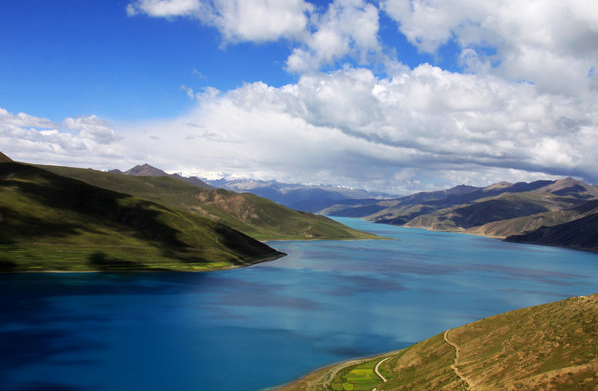
Tibet on track to become global tourist attraction[1]- Chinadaily.com.cn

Tourism increased in the Tibet autonomous region in the first four months of the year, as the region aspires to become a world-class travel destination.

Tibet on track to become global tourist attraction

The region had more than 830,000 tourists from January through April, a year-on-year increase of 23.4 percent, the regional tourism bureau said on Tuesday.

Foreign tourists numbered 20,000, an increase of 10.3 percent, and the number of domestic tourists was 810,000, an increase of 23.8 percent.

Meanwhile, the revenue generated by the tourism industry was 926 million yuan ($148.4 million), an increase of 26.2 percent, it said.

Karral Millar, 62, an Australian tourist, said she had a good time in Tibet.

“It’s wonderful. It’s been three days now. We have visited the Potala Palace and many temples, and we are learning new things about Tibetan Buddhism and history,” Millar said on Tuesday.

Cycling has become a popular way to tour the region in recent years, as many tourists want to have close contact with the natural scenery and culture of Tibet.

“It’s my second time in Tibet. I am absolutely impressed with the natural scenery and unique culture. I feel as if I am at home here,” said Liu Xiaojun, from Hebei province.

“I am also overwhelmed with the hospitality and politeness of the local people,” said Liu, adding that he plans to make a bicycle tour to Zhangmu Port in Tibet’s Xigaze prefecture.

Many businesses near the scenic spots in Lhasa see the coming of summer peak season as a harvest.

“Compared with the same period last year, we had more guests this year. We have 62 rooms, and more than half are booked every day,” said India, 41, a receptionist at the Kyichu Hotel, a Nepalese hotel in Lhasa.

Tibet received more than 12 million tourists from home and abroad lastar.

The region hopes to have 15 million tourists this year.

via Tibet on track to become global tourist attraction[1]- Chinadaily.com.cn.

Enhanced by Zemanta
07/05/2014

China’s Premier Li Goes to Africa – Businessweek

Chinese Premier Li Keqiang is visiting Ethiopia, Nigeria, Angola, and Kenya this week in his first trip to Africa since assuming office. Accompanying him is his wife, Cheng Hong, who is making her first public appearance on a diplomatic mission—and a splash in China’s domestic media, given the relative novelty of top leaders’ wives appearing in public in official roles.

Li speaking on May 5 in Ethiopia

Over the past decade, China’s economic ties to Africa have grown quickly. Trade has risen (PDF) from $10 billion in 2000 to $166.3 billion in 2011. Meanwhile China’s foreign direct investment in Africa has jumped from $392 million in 2005 to $2.5 billion in 2012, according to figures from China’s commerce ministry. Much of that money has gone to infrastructure projects, including roads, dams, mines, and oil rigs.

On Monday in Addis Ababa, Ethiopia’s capital, Li laid out his vision for the future of China-Africa relations. Speaking at the headquarters of the African Union, he said he imagined a day when all African capitals would be connected by high-speed rail—quickly adding that China’s experience and technology could “help make this dream come true,” according to state-run newswire Xinhua.

via China’s Premier Li Goes to Africa – Businessweek.

Enhanced by Zemanta
24/04/2014

Chinese Travelers Breathe New Life Into Australian Tourism – China Real Time Report – WSJ

Chinese investors, done splurging on Australia’s once-booming mining industry, are sniffing around the country’s tourism market in search of bargains.

As Ross Kelly and Rebecca Thurlow report:

Their arrival promises to give a new lease of life to dilapidated resorts and properties stretching from Queensland state on the eastern coast to rural Western Australia.

Many investors are betting on an explosion in tourism Down Under, particularly from China—where people from the country’s expanding middle class are increasingly choosing to spend their holidays in countries that are considered exotic. Although Australia remains a relatively expensive destination, more Chinese are attracted each year to the country’s sunny beaches and unusual wildlife.

Sensing an opportunity, Chinese investors have begun snapping up hotels across the country at an unprecedented rate. They’re also weighing into casinos, a popular hangout for Chinese travelers, as well as experimenting with more offbeat attractions such as a China-themed amusement park.

Tourist arrivals in Australia surged by 10% in the 12 months through February, helped in part by a sudden pullback in the Australian dollar last year from historic highs. The number of Chinese traveling to Australia touched a record 748,000 people in the same period—up 16% from a year earlier, according to government figures.

If the current pace of growth in tourism continues, China may soon surpass neighbor New Zealand as Australia’s primary source of visitors, brokerage Commonwealth Securities predicts. Chinese visitors are already spending more in Australia than travelers from any other country, government data show.

via Chinese Travelers Breathe New Life Into Australian Tourism – China Real Time Report – WSJ.

Enhanced by Zemanta
Law of Unintended Consequences

continuously updated blog about China & India

ChiaHou's Book Reviews

continuously updated blog about China & India

What's wrong with the world; and its economy

continuously updated blog about China & India