After spending half an hour driving around the Olympic Park area of Beijing in search of a parking space near his home, a furious Xu Fei pulled over to the curb, ditched his car and walked the 10-minute journey home.
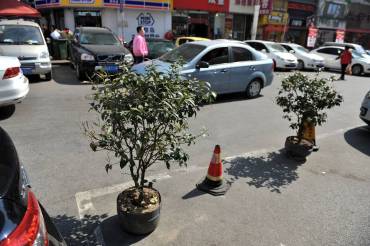
With no spaces near his apartment, parking illegally was his only option, risking a fine of 200 yuan ($30). “I usually bargain with the grocery-store owners downstairs to rent their driveways for parking,” said the 24-year-old finance specialist who lives in a 1970s building that has no parking for any of its 30 apartments. “That evening they were all rented out.”
Once known as the land of the bicycle, China is now the world’s largest automotive market. While the rapid expansion of car ownership has created millions of jobs and helped drive the economy, with it has come congestion, pollution and a shortage of at least 50 million parking spaces in a country where 180 million vehicles ply the roads.
Beijing has 4.4 million private cars, Shanghai 2.1 million cars and the southwestern city of Chengdu 3.3 million cars. By contrast, New York City has 1.9 million cars, Chicago 1.1 million and San Francisco 408,000.
Some major cities have taken measures to restrict car purchases and created tens of thousands of parking spaces over the past years. A Shanghai Municipal Transportation Commission official told the city legislature this week that the agency is considering jacking up parking fees, state media reported.
These measures aren’t keeping pace with car ownership, and there is plenty of room for further growth—vehicle ownership in China is 1/7 that of the U.S.A 2002 residential complex, the Shanghai Grand Garden, comprises 20 high-rise blocks with 1,560 units. The property developer initially assigned 450 spots for cars. Now there are 1,500 resident vehicles.
Cars occupy most of the nearby sidewalks, with some pulled into tiny spots between flower beds, squeezing out pedestrians. The situation gets much worse in the evening, said Tao Baosen, a doorman, pointing at a charcoal Volvo crossover that was pulled over onto the artificial turfs last night.
“Even though it’s very clear how bad the situation is, the number of cars is still growing,” Mr. Tao said.
Parking is a universal problem in densely populated cities. While many developed countries require new buildings to create a specific number of parking spaces, they also take measures to restrict parking. For example, New York City reduced 25,000 off-street parking spaces in Manhattan’s central business district from 1978 to 2010 to prod commuters to take public transportation. London levies costly congestion charges to drive a vehicle into the city center.
By contrast, China is “too lenient towards drivers,” said Liu Shaokun, a vice country director at The Institute for Transportation and Development Policy, a New York-based nonprofit outfit.China has encouraged government and private capital to build more parking spaces. The central government in 2015 required cities with a population of more than 500,000 to target a ratio of 1.3 parking spaces per car when planning residential and commercial developments.
By comparison, every 100 households in New York City’s Brooklyn borough share 40 parking spaces and in Queens, the ratio rises to 60 spaces per 100 households, according to the institute’s research.
“Increasing supply is unlikely to achieve the desired effect,” said Mr. Liu, noting high vacancy rates at many public and commercial parking lots and garages. “Many drivers go to cheaper off-street parking spaces, or just pull over onto the sidewalks since the costs of violating laws are low,” he said.
A variety of services and parking apps has sprung up to try to match cars and parking spaces for money. Edaibo, a Shanghai-based startup that provides valet parking services, has operated at 23 airports in China and last year received an investment from French tire maker Michelin Group to provide the service in major city centers.
D Parking, a Beijing startup, offers an app to connect drivers and parking spots. It aims to take advantage of commuting and business patterns. The company’s research found that more than 70% of the parking spaces in residential communities are idle in the daytime, while office buildings, shops and hospitals nearby face a dearth of spots. The opposite occurs in the evening.
Some efforts to increase supply have also upset drivers who complain they are now being charged to park in areas that were once free.
“We’re used to parking for free. When it comes to money, most of us will drive round and round for a free one,” said Fang Yi, a finance manager for a local hospital in Yiyang, a small city in the center of the country. He said he now spends 15 minutes searching for a free spot when going out
Source: Parking in China Can Be a Long March – China Real Time Report – WSJ


 Image copyright AFP
 Image copyright GETTY IMAGES
 CHINDIA ALERT: You'll be living in their world, very soon