Chindia Alert: You’ll be Living in their World Very Soon
aims to alert you to the threats and opportunities that China and India present. China and India require serious attention; case of ‘hidden dragon and crouching tiger’.
Without this attention, governments, businesses and, indeed, individuals may find themselves at a great disadvantage sooner rather than later.
The POSTs (front webpages) are mainly 'cuttings' from reliable sources, updated continuously.
The PAGEs (see Tabs, above) attempt to make the information more meaningful by putting some structure to the information we have researched and assembled since 2006.
Nissan Motor Co. said Tuesday that it planned to accelerate the penetration of internet-connected vehicles by offering a connection device to existing customers in Japan and India starting next year.
Nissan has been among the most aggressive car makers in putting connection technology in lower-priced vehicles. Now, it is expanding the offering to owners of older models.
The device will allow car owners to get live updates on maintenance needs, make service appointments and order parts ahead of time. Nissan said it planned to bring the device to other countries eventually and install it in 30% of the 40 million Nissan vehicles on the road globally today.
The device contains a Global Positioning System tracker and can transmit information about the vehicle’s health to Nissan through mobile networks. The goal is to give customers a taste of connected-car services that will become available on new cars, Nissan said.
“In the coming years, customers will see sophisticated applications of software and hardware that will keep them connected with work, with friends and family. It will allow them to control their vehicles from their phones in their pockets,” said Kent O’Hara, who runs Nissan’s after-sales division.
The derailment of a train in northern India that killed more than 130 people highlights the dangers and challenges along the country’s rail network.
Accidents on the rail system resulted in more than 25,000 deaths in 2014, according to the latest statistics available.
While the cause of Sunday’s incident isn’t yet known, it again draws the spotlight onto the country’s rickety rail system.
So how dangerous is traveling on the country’s trains? Here are the numbers.
28,360 The number of railway accidents in India in 2014. Though that was a decrease of 9.2% from a year earlier, 25,006 people died. That figure is much higher than the 768 deaths recorded on America’s railways the same year.
17,480 The number of railway accidents that were reported to be due to someone falling from a train or a “collision with people at track.” In India, passenger trains are often full to bursting, with people hanging out of windows and doors. Pedestrians also often cross tracks by foot. The government has sought to raise awareness about the proper use of level crossings and the dangers of strolling near railway lines.
5,024 The number of people who died in railway accidents in Maharashtra in 2014. The western state is home to Mumbai, the country’s financial capital, which has some of the most crowded and dangerous suburban trains.
442 The number of rail-construction projects active in India as of March 2014. Indian Prime Minister Narendra Modi has made modernizing the ageing network a priority, and has made building a high-speed corridor a pet project.
$16 billion The amount a government audit found that delays and poor planning had caused costs on the 442 rail projects to balloon.
40% The proportion of the more than 31,000 railway crossing that are unmanned. Those level crossing contribute to about 40% of train accidents, according to a government news release.
Like hundreds of thousands of people across India, Sujitha‘s journey from an under-developed village in India’s south to the outskirts of the city of Chennai (Madras), has transformed her life.
“My native place is a small village called Kizhattur. There is not even proper transport over there,” says Sujitha. “Because I grew up in that situation, I knew that I had to study hard and find a job.”
And she did just that – albeit against the wishes of her family who wanted her to marry and settle down.Sujitha secured a diploma and when Renault-Nissan advertised a position for a junior engineer five years ago, she jumped at the opportunity.”I can’t even imagine what I would be doing if I did not work in this factory. Perhaps I would be in the village doing small jobs on the farm,” she says. “I would just about make ends meet.”
Nissan and Renault are two of several international carmakers that have set up shop outside Chennai in the last 10 years.
Nearly a fifth of all cars made in India are produced in the area around Chennai in Tamil Nadu state
Today the area, known as the “Detroit of Asia”, is a thriving manufacturing hub where cars are produced for export as well as for the domestic market.India makes about 24 million vehicles a year, nearly a fifth of them in this region of Tamil Nadu state.
“We have seen a number of other car manufacturers establish plants in the state and that has helped us attract and help local suppliers relocate and set up in Tamil Nadu itself,” says Colin Macdonald, managing director of Renault-Nissan.
“Since 2010, we had about 15% of our suppliers in the Tamil Nadu area. We are now operating with 60% of our Indian suppliers in Tamil Nadu. So from an employment perspective, this is huge.
“High unemployment
Creating jobs is central to Prime Minister Narendra Modi‘s Make in India campaign, an effort to promote inclusive growth in the country.Modi has promised foreign players he will make it easier to do business in India.
But more than two years after taking power, and after introducing a raft of policies, unemployment rates are at a five-year high.According to a recent government survey, about 77% of Indian households have no regular wage or salaried person, and so for many, life is not improving fast enough.
Domestic market growth
Despite that, success in places like Chennai is a sign that India remains appealing to foreign companies.Now that the area has become an auto hub, cost-effective raw materials can be sourced. With the port less than 100km away, it is easy to import parts and export products back out. Labour is cheap too.
Several car companies have set up shop on the outskirts of Chennai. Workers here are seen at Ford’s plant in Chengalpattu
The growth of the domestic market only adds to India’s appeal.”Today, only 20 in 1,000 people in India own a vehicle but we expect that to grow dramatically in the next five years and we expect the market to be five million cars by 2020, making India the third biggest market on the planet,” says Colin Macdonald.
A matter of pride
For Sujitha Rajendrababu, owning a car one day has become more of a reality than a dream.
“What I had dreamed of becoming in the future was made true by this job. I do not know how to express this.”
The daughter of a farmer, she has already used the money she has earned to buy a fridge, a TV, some jewellery and even a holiday around India. But her ambitions don’t stop there.
“My long-term goal is to become the manager of the stamping shop. I don’t only want to be the manager of the stamping shop, but of this organisation as well.”
And she wants the same for other people just like her.
“A lot of people in my village ask me if I can help them find jobs for their children. That makes me feel proud.”
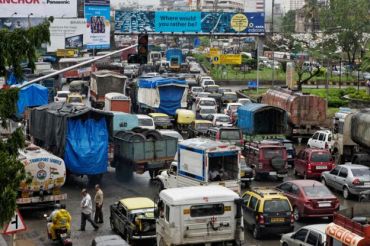
For a crash course in India’s car-crash culture, go to Mumbai. There are more accidents here than any other Indian city. You’ll witness a dangerous mix of pedestrians, scooters, cars, buses and lorries jostling through choked junctions. Many ignore both signals and the traffic police.Officers can do little about such rampant law-breaking.
“We can catch a maximum of two offenders at a time – maximum,” one shouts at me above the horns and revving engines at one particularly busy junction. “The rest,” he says flicking his wrist, “just go. There are no consequences.”
Mumbai: “A dangerous mix of pedestrians, scooters, cars, buses and lorries”
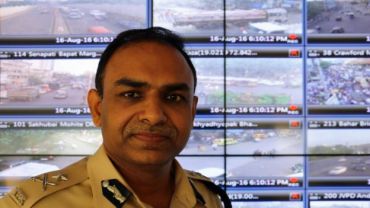
Mumbai’s commissioner of traffic police, Milind Bharambe, says this will soon end. From his cool office, flanked by monitors with live CCTV feeds of notorious accident spots, he explains how cameras will enforce the law electronically, targeting those who speed and run red lights. Combine that with the recent introduction of stiff new fines and within six months, he promises “a sea change” in driver behaviour.
Milind Bharambe, Mumbai’s commissioner of traffic police
But bad driving and weak enforcement are only part of the problem. Another aspect of it is the rapidly growing number of vehicles – a new one joins the chaos every 10 seconds. It adds up to almost 9,000 new vehicles a day, or more than three million a year.
This means that the streets are increasingly choked. It’s almost impossible to leave a safe distance between vehicles, and when space does open up, frustrated drivers often respond by putting their foot down.
Neal Razzall presents Fixing India’s Car Crash Capital on Crossing Continents, at 11:00 BST on Radio 4 – catch up on BBC iPlayer Radio
The problem is perhaps most acute in Mumbai, which is surrounded by water on three sides and has little room to grow. Officials here have in the past responded to the crush of cars by tearing out pavements to make room for more.”The government still thinks the major issue is ‘How do we move people in cars faster and quicker?'” says Binoy Mascarenhas from the pedestrian advocacy movement, Equal Streets. In reality, he says most journeys are local and, in theory, can be done on foot.
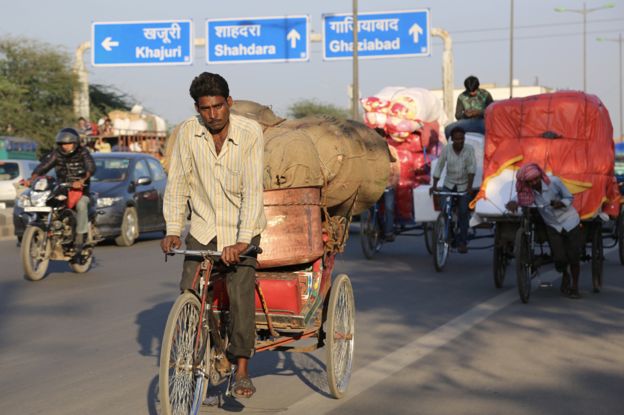
Pavements are often non-existent on Mumbai roads
In theory. He grew up in Mumbai, and used to walk to school. His daughter now goes to school in a car because it’s too dangerous to walk. Pavements, where they exist, are often in such a poor state people have to walk on the roads. No wonder then that pedestrians account for 60% of road deaths in Mumbai.
There are dangers outside the city, too.
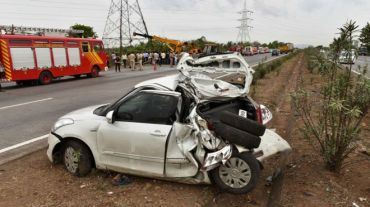
India’s first expressway, between the cities of Mumbai and Pune, opened in 2002. It has three wide lanes and room to move at high speed – a relief after the congestion of the city. But drive it with one of India’s few professional crash investigators, Ravi Shankar, and a quiet terror settles in. He’s studied thousands of crashes on this road and can point to dangers all around.
“There are small, man-made engineering problems that are actually killing people,” he says. Instead of rumble strips to warn drivers they’re at the road’s edge, there are black and yellow curb stones embedded into the concrete. Hit one of those, Shankar says, and your car can flip over. Then there are cliffs with no barriers, and guard-rails with tapered ends, which, he says, can send cars into the sky “like a rocket launcher”.
Things like this are happening all the time. The expressway is just 94km (58 miles) long but about 150 people die on it every year.
“That’s serious. That’s a very bad number,” Shankar says.
He and his colleagues at JD Research have identified more than 2,000 spots on the expressway where relatively simple engineering fixes, from better barriers to clearer signs, could save lives.Jump media playerMedia player helpOut of media player. Press enter to return or tab to continue.
“Road engineers are not serious about this problem,” Shankar says. “So we keep fighting with them on this point. How many deaths are you going to wait for, until you really understand that this is a serious concern?”
In this context, Prime Minister Narendra Modi‘s plan for the biggest expansion of roads in Indian history is unnerving. In the next few years he wants to pave a distance greater than the circumference of the earth and there’s a particular push to build highways and expressways.
Piyush Tewari, CEO of the safety charity Save Life India, says without putting the country on a “war footing”, including a complete overhaul of road safety legislation and a modern road-building code, Modi’s new roads will only add to the number of dead.
“Road crash deaths will increase at the rate of one death for every 2km of new road that is constructed. That’s the average death rate on Indian highways – one death every 2km, annually. So if we don’t fix any of this, if we’re constructing 100,000km of highways, 50,000 deaths is what the average maths tells us will be added to the total,” he says.
Image copyrightROLEX AWARDS/JESS HOFFMANImage captionPiyush Tewari believes the planned new roads could lead only to more fatalities
Modi’s government insists the new roads will be safer. “We are improving the road engineering; we are improving the traffic signal system; we are making crash barriers”, transportation minister, Nitin Gadkari, tells me.
There is progress in other areas too. When Mumbai’s commissioner of traffic police predicts a “sea change” in driver behaviour he is partly putting his faith in a new motor vehicle bill, now before parliament, which if passed would increase fines, toughen vehicle registration requirements and mandate road-worthiness tests for transport vehicles.
And earlier this year, a Good Samaritan Act came into effect which ended the crazy situation whereby people who helped crash victims could be held liable for the costs of treating them or even accused by police of causing the crash in the first place. That alone, campaigners say, will save thousands of lives.
More from the Magazine
When a road accident occurs, bystanders will usually try to help the injured, or at least call for help. In India it’s different. In a country with some of the world’s most dangerous roads, victims are all too often left to fend for themselves.
Save Life India estimates that half of all road deaths are the result of treatable injuries. That means 75,000 lives could be saved every year just with better medical care.
One man trying to save some of those lives is Mumbai neurosurgeon Dr Aadil Chagla, who is working with volunteers to build a series of clinics along Highway 66, south of Mumbai – many of them in rural areas – to prevent victims having to be driven for hours to the city.
The first is more than half-built. It looks out over rice paddies and lush hills, but Dr Chagla estimates it will be treating victims from “one or two crashes a day, every day”.
“If I can have an ambulance service and trauma centres every 50 to 100km run by the locals it would make huge difference to this entire highway – with or without government support,” he says.
Image captionDr Chagla’s as-yet-unopened clinic to treat victims of road accidents
Since Dr Chagla started practising in the 1980s, the number killed on India’s roads has increased by 300%.
“I waited all this time and nothing has really come through so it’s important that I should do something about it,” he says.
So if transportation minister Nitin Gadkari is to make good on his promise to cut road deaths from 150,000 to 75,000 per year in two years, it will be thanks in part to the efforts of volunteers.
The state corporation that owns the Mumbai-Pune Expressway, meanwhile, says it will reduce deaths to zero – yes, zero – by 2020. It has accepted the list of essential improvements identified by crash investigator Ravi Shankar and authorised them to be made and then audited by Save Life India.
But there’s a snag, which suggests India is not yet on a “war footing” when it comes to safety.
The state government owns the road, but a private company runs it in exchange for collecting tolls. The two sides dispute who should make the safety upgrades. The official in charge of the expressway says the work will be done, even if it requires litigation to recover the costs.
While the dispute drags on, 100,000 vehicles use the expressway every day in its current, dangerous state. In the past week, it claimed six more lives.
Air fares in India are the lowest in the world, according to a global transportation study, underscoring the intense competition between carriers in the South Asian country.
In India, it costs an average of just $2.27 to fly 100 kilometers (62 miles) on domestic routes on a budget airline and $2.67 on a full-service carrier, according to a survey conducted by Kiwi.com, a Czech Republic-based online travel agency.
The most expensive place to fly domestically is the United Arab Emirates where flights are 80 times costlier than India. It costs $181.38 for 100 kilometers on a budget airline in the UAE and $220.36 on a full-service airline, according to website’s 2016 Aviation Price Index, which analyzed more than one million flights worldwide.
Domestic budget airline fares in India are similar to those in Malaysia—the second least expensive country–which cost $2.32 per 100 kilometers. Fares on full-service carriers in the Southeast Asian nation are however more expensive, at $5.81 for a similar distance.
Indian fares are cheaper thanks to strong competition and comparatively lower jet fuel prices. The country also has a number of budget airlines, including InterGlobe Aviation Ltd.’s IndiGo and SpiceJet Ltd.
A Boeing Co. 737 aircraft operated by SpiceJet Ltd. approaches to land at Chhatrapati Shivaji International Airport in Mumbai, India, Oct. 26, 2015. Spicejet is among a number of budget carriers in India.
Prices in India have fallen as competition increased with the arrival of new carriers. Malaysia’s AirAsia Bhd. started a budget airline venture with India’s Tata Sons Ltd. while Singapore Airlines Ltd. began a full-service carrier with Tata Sons.
Russia is ranked third least expensive for domestic air travel, with prices at $7.02 for budget airlines and $6.32 for full-service, the survey showed.
On the steep side, Finland — where it costs $39.61 and $130.80 to fly 100 kilometers on a low-cost and a full-service airline respectively — is the second most expensive. Qatar is the third-most expensive costing $64.36 for a budget airline ticket and $85.31 for a full-service airline ticket for the same distance.
The website said China offered the least expensive international flights on both budget and full-service airlines, at $1.22 and $2.84 respectively for 100 kilometers of travel. International flights from Canada are the most expensive at $43.70 and $94.66 on low-cost and full-service airlines respectively.
Germany’s Daimler AG plans to sell Mercedes-Benz branded all-electric battery cars in China, its China chief said on Wednesday, as the automaker capitalizes on government initiatives aimed at growing the market for new-energy vehicles (NEVs).
Hubertus Troska said the government’s push, which involves tax breaks and other policy support, helped the number of NEVs sold last year surpass 300,000, making China the world’s biggest market for electric, gasoline-electric and other such vehicles.
The majority of those vehicles were priced under 250,000 yuan ($37,515) and offered mainly by Chinese automakers, Troska said at an analyst and investor conference in Beijing.
Given factors including the government push – which falls under a broader drive to cut oil dependence and air pollution – Daimler is “very confident NEVs will be an important factor of the Chinese market,” Troska said.”Mercedes-Benz is also going to play a role in China in NEVs,” he said, referring to the planned cars.
He also said he sees demand over time shifting toward a “higher segment” of more expensive and capable all-electric battery cars and plug-in hybrids.Troska did not elaborate on the planned cars such as cost, pricing, models or launch dates. But investor relations head Björn Scheib said Daimler plans to show a concept electric car at the Paris Motor Show which opens to the public on Oct. 1.
Daimler currently sells one all-electric battery model in China under its smart brand, and one under the Denza brand it operates with local partner BYD Co Ltd.
Its China line-up also includes plug-in gasoline-electric hybrid versions of the Mercedes-Benz C-class and S-class sedans and GLE crossover sport utility vehicle.
Iran has expressed interest in joining forces with a Chinese company that plans to build a $50 billion canal across Nicaragua that links the Atlantic and Pacific and rivals the Panama Canal.Mohammed Javad Zarif, the Iranian foreign minister, said that business leaders who went with him to the Central American state this week had discussed teaming up with HKND, a private Hong Kong company that has broken ground on the project but made little progress in the past two years.
Iranian involvement in a Chinese-run strategic waterway may raise concerns in the United States, which was instrumental in building the Panama Canal a century ago.
Daniel Ortega, Nicaragua’s left-wing president, shares Iran’s antipathy towards the US and is favoured for re-election in polls this November.
The project to build the 172-mile waterway has caused controversy at home, where environmentalists say that the route would take supertankers across Lake Nicaragua, bulldoze fragile ecosystems and involve the biggest earth-moving operation in history.
With an estimated 30,000 people likely to be displaced by construction, there have been protests against the canal, although the government insists that more than 80 per cent of the population of the country backs it. Amnesty International has denounced what it called Nicaragua’s “reckless handling” of the project.
There have been doubts about the financial health of Wang Jing, the Hong Kong tycoon behind the canal, and whether he might be backed by the Chinese government, which has massively invested across Latin America and Africa in the past decade.
Mr Wang is understood to have lost more than 80 per cent of his $10 billion fortune as a result of the volatility in the Chinese stock market. The project managers say that it is an international initiative not dependent on the vagaries of the Chinese share prices. After the groundbreaking ceremony in December 2014, the project appeared to have been put on hold, prompting speculation that it had run out of steam.
However, Mr Wang’s HKND group said this year that work on the Pacific terminal and wharf would begin this month, with work on the canal scheduled to start at the end of the year.
Mr Zarif, whose country recently had years of crippling US sanctions lifted, is on a tour of Latin America that began on Monday in Cuba, which has renewed diplomatic ties with the US but has yet to have its own half-century of sanctions lifted.Nicaragua was Mr Zarif’s second stop with an entourage of 120 Iranian business leaders and state economists, and he was scheduled to head on to Ecuador, Venezuela, Bolivia and Chile.
Poland is in talks with potential investors from China over selling a stake in the state airline LOT [LOT.UL], Deputy Prime Minister Mateusz Morawiecki said on Wednesday.
Poland’s euroskeptic, conservative government has been looking to tighten its relations with China since coming to power last year. The two countries pledged deeper co-operation during the visit of China’s leader Xi Jinping to Warsaw in June.”LOT is our national carrier, which we are trying to save no matter the cost. It is deeply in debt,” Morawiecki told state news agency PAP on Wednesday, adding that without a national carrier Poland would become a more peripheral country.
LOT, one of the world’s oldest airlines, has for years struggled to compete against low-cost competitors like Ryanair (RYA.I) and bigger rivals. The state-owned airline was saved from bankruptcy in 2012 thanks to public aid of more than 500 million zlotys ($130 million).
“The previous government has already granted public support for LOT, we cannot grant another and we are looking for an investor,” Morawiecki said.
“According to EU law a carrier from outside the EU cannot take over more than 49 percent of a carrier from the EU, hence we are in talks with potential investors, among others, from China,” he said.Morawiecki also said that usually it is a very long road to finalize such a transaction.
Earlier on Wednesday, a Polish local newspaper reported that Chinese carrier Air China (601111.SS) is interested in buying a 49-percent stake in LOT with a delegation from the Chinese firm expected to arrive in Warsaw over the coming days.
However, a LOT spokesman said he had no knowledge of any plans for a capital tie-up between LOT and Air China.
“I have no knowledge regarding any planned capital co-operation between LOT and Air China,” Adrian Kubicki, LOT spokesman said. “We have commercial co-operation with Air China, which we want to develop, regarding the Warsaw-Beijing route.”
Air China was not immediately available for comment.
The transit elevated bus TEB-1 is on road test in Qinhuangdao, North China’s Hebei Province, Aug 2, 2016. China’s home-made transit elevated bus, TEB-1, conducted a road test running Tuesday.
The 22-meter-long, 7.8-meter-wide and 4.8-meter-high TEB-1 can carry up to 300 passengers. The passenger compartment of this futuristic public bus rises far above other vehicles on the road, allowing cars to pass underneath. [
Ride-hailing firm Uber is to merge its China operations with bigger rival Didi Chuxing, and hold a one-fifth stake in the new business, in a $35 billion deal to end bruising competition between the two, according to a source familiar with the matter.
A deal between the two – which have been spending heavily to gain market share and battling fiercely for passengers – could be announced as early as Monday, said the source, who declined to be identified because the deal is not yet public.
The new entity combines Didi’s most recent valuation of $28 billion and Uber China’s $7 billion valuation for the $35 billion market capitalization. Uber China investors will have a 20 percent stake in the new company, the source said.Uber did not offer any immediate comment. Didi could not be reached for comment.
“It makes huge sense, Uber faces an uphill task in China especially since Didi is multiple times larger by transaction value and city coverage,” said Hong Kong-based Richard Ji, co-founder of All-Stars Investment Ltd, which manages about $900 million and owns Didi stock.
“This will lead to favorable outcomes for both companies. The biggest benefit is cost savings, they no longer have to give out subsidies to drivers and passengers. It will give pricing power as the new entity will become the dominant player. That means profitability will come sooner than later,” he added.









 CHINDIA ALERT: You'll be living in their world, very soon