Archive for ‘Transport’

01/07/2016

Our bulldozers, our rules | The Economist

THE first revival of the Silk Road—a vast and ancient network of trade routes linking China’s merchants with those of Central Asia, the Middle East, Africa and Europe—took place in the seventh century, after war had made it unusable for hundreds of years. Xi Jinping, China’s president, looks back on that era as a golden age, a time of Pax Sinica, when Chinese luxuries were coveted across the globe and the Silk Road was a conduit for diplomacy and economic expansion. The term itself was coined by a German geographer in the 19th century, but China has adopted it with relish. Mr Xi wants a revival of the Silk Road and the glory that went with it.

This time cranes and construction crews are replacing caravans and camels. In April a Chinese shipping company, Cosco, took a 67% stake in Greece’s second-largest port, Piraeus, from which Chinese firms are building a high-speed rail network linking the city to Hungary and eventually Germany. In July work is due to start on the third stage of a Chinese-designed nuclear reactor in Pakistan, where China recently announced it would finance a big new highway and put $2 billion into a coal mine in the Thar desert. In the first five months of this year, more than half of China’s contracts overseas were signed with nations along the Silk Road—a first in the country’s modern history.

Politicians have been almost as busy in the builders’ wake. In June Mr Xi visited Serbia and Poland, scattering projects along the way, before heading to Uzbekistan. Last week Russia’s president, Vladimir Putin, made a brief visit to Beijing; he, Mr Xi and Mongolia’s leader promised to link their infrastructure plans with the new Silk Road. At the time, finance ministers from almost 60 countries were holding the first annual meeting in Beijing of an institution set up to finance some of these projects, the Asian Infrastructure Investment Bank (AIIB). Like a steam train pulling noisily out of a station, China’s biggest foreign-economic policy is slowly gathering speed.

Chinese officials call that policy “One Belt, One Road”, though they often eviscerate its exotic appeal to foreigners by using the unlovely acronym OBOR. Confusingly, the road refers to ancient maritime routes between China and Europe, while the belt describes the Silk Road’s better-known trails overland (see map).
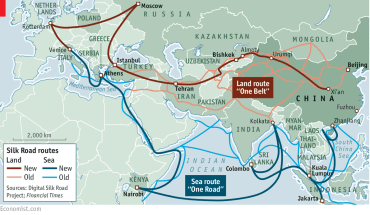
OBOR puzzles many Western policymakers because it is amorphous—it has no official list of member countries, though the rough count is 60—and because most of the projects that sport the label would probably have been built anyway. But OBOR matters for three big reasons.

First, the projects are vast. Official figures say there are 900 deals under way, worth $890 billion, such as a gas pipeline from the Bay of Bengal through Myanmar to south-west China and a rail link between Beijing and Duisburg, a transport hub in Germany. China says it will invest a cumulative $4 trillion in OBOR countries, though it does not say by when. Its officials tetchily reject comparison with the Marshall Plan which, they say, was a means of rewarding America’s friends and excluding its enemies after the second world war. OBOR, they boast, is open to all. But, for what it is worth, the Marshall Plan amounted to $130 billion in current dollars.

Next, OBOR matters because it is important to Mr Xi. In 2014 the foreign minister, Wang Yi, singled out OBOR as the most important feature of the president’s foreign policy. Mr Xi’s chief foreign adviser, Yang Jiechi, has tied OBOR to China’s much-touted aims of becoming a “moderately well-off society” by 2020 and a “strong, prosperous” one by mid-century.

Mr Xi seems to see the new Silk Road as a way of extending China’s commercial tentacles and soft power. It also plays a role in his broader foreign-policy thinking. The president has endorsed his predecessors’ view that China faces a “period of strategic opportunity” up to 2020, meaning it can take advantage of a mostly benign security environment to achieve its aim of strengthening its global power without causing conflict. OBOR, officials believe, is a good way of packaging such a strategy. It also fits with Mr Xi’s “Chinese dream” of recreating a great past. It is not too much to say that he expects to be judged as a leader partly on how well he fulfils OBOR’s goals.

Third, OBOR matters because it is a challenge to the United States and its traditional way of thinking about world trade. In that view, there are two main trading blocs, the trans-Atlantic one and the trans-Pacific one, with Europe in the first, Asia in the second and America the focal point of each. Two proposed regional trade deals, the Trans-Pacific Partnership and the Transatlantic Trade and Investment Partnership, embody this approach. But OBOR treats Asia and Europe as a single space, and China, not the United States, is its focal point.
Source: Our bulldozers, our rules | The Economist

18/06/2016

The great crawl | The Economist

LATE last month a black-and-white photograph of a professor from Beijing Jiaotong University spread on social media. His image was edged by a black frame, like those displayed at funerals in China, and trimmed with white flowers of mourning. Though Mao Baohua is still very much alive, he had angered netizens enough to depict him as dead. His crime? To suggest that Beijing should follow the likes of London and Stockholm, by charging drivers 20-50 yuan ($3-7.50) to enter the capital’s busiest areas in the hope of easing traffic flow in the gridlocked city.

Most Chinese urbanites see buying a vehicle as a rite of passage: a symbol of wealth, status and autonomy, as it once was in America. Hence their outrage at any restraint on driving. Since car ownership is more concentrated among middle- and high-income earners in China than it is in richer countries, any attack on driving is, in effect, essentially aimed at the middle class, a group the Communist Party is keen to keep on side. That makes it hard to push through changes its members dislike.

Since 2009 officials in Beijing and the southern city of Guangzhou have repeatedly aired the idea of introducing congestion charges. Netizens have fought back, accusing their governments of being lazy, brutal and greedy. Many also gripe that the policy would be “unfair” because the fee would have less impact on the super-rich. Complaints about the inequality of congestion charging echo those made in London and other cities before they launched such schemes. But the party, nervous of being accused of straying from socialism, is particularly sensitive to accusations that it is favouring the wealthiest.

Because of such objections, city governments have not pushed their proposals very hard. But that is now changing in Beijing, where officials face a dilemma. Traffic jams in the city and appalling air pollution—30% of which comes from vehicle fumes, by official reckoning—may end up causing as much popular resentment as any surcharge. The local government is trying to work out how close it is to this tipping point. It is conducting surveys to “pressure test” how people would react to a congestion fee, says Yuan Yue of Horizon, China’s biggest polling company (the results will not be made public). It is likely that a concrete plan for a congestion charge will be announced soon. Beijing’s environmental and transport departments (not usual partners) are collaborating on a draft. State media have recently published a flurry of articles about this, not all in favour.

Public opinion is not the only challenge a congestion scheme faces. The urban planners who conceived Beijing’s layout, and that of other Chinese cities, never imagined that so many people would want to drive. The capital now has 3.6m privately owned cars: the number per 1,000 people in Beijing has increased an astonishing 21-fold since 2000, according to our sister company, the Economist Intelligence Unit (see chart).

On most days large tracts of the capital are now bumper to bumper amid a cacophony of car horns. Beijingers have the longest average commute of any city in China, according to data collected by Baidu, a Chinese search engine. The problem is not confined to Beijing. The capital has higher vehicle ownership than any other Chinese city, but car use is rising rapidly across the country. Many second- and third-tier cities are already clogged.

Beijing’s congestion scheme would be the first outside the rich world, where a handful of cities now charge drivers to enter a designated area. (Singapore has a different form of road pricing, with tolls on individual arterial roads.) Such measures have been credited with reductions in downtown car-use, improved traffic flow and greater use of public transport. They have also cut pollution, including emissions of the tiny PM2.5 particles that are particularly dangerous to health and abundant in Beijing’s air.

Transport planners reckon a congestion zone would have similar effects in Beijing, and complement existing attempts to restrict car use. In 2008, after Beijing staged the Olympic games, the city launched the current system whereby each car is banned from the urban core one workday per week, depending on the last digit of its licence plate. Beijing is now one of 11 Chinese cities with similar restrictions.

But some drivers choose to pay the 100 yuan fine, which is far higher than the congestion charge that Beijing is now mulling (around the sums suggested by Professor Mao). People also drive without plates, or buy second cars, to bypass the rules. In 2011 the capital introduced a lottery for obtaining new licence plates (six other cities do this). In Beijing the scheme has slowed the increase in car ownership, but not enough to cut congestion; some residents use vehicles registered elsewhere. Also in 2011 the capital raised parking fees, hoping to deter drivers. But people often park on pavements and traffic islands instead, usually with impunity.

Source: The great crawl | The Economist

23/05/2016

Doubling down | The Economist

“A COLOSSAL roller-coaster” is how a senior engineer described it. He was talking about the railway that China plans to build from the lowlands of the south-west, across some of the world’s most forbidding terrain, into Tibet. Of all the country’s railway-building feats in recent years, this will be the most remarkable: a 1,600-kilometre (1,000-mile) track that will pass through snow-capped mountains in a region racked by earthquakes, with nearly half of it running through tunnels or over bridges. It will also be dogged all the way by controversy.

Chinese officials have dreamed of such a railway line for a century. In 1912, shortly after he took over as China’s first president, Sun Yat-sen called for a trans-Tibetan line, not least to help prevent Tibet from falling under the sway of Britain (which had already invaded Tibet from India a decade earlier). Mao Zedong revived the idea in the 1950s. In the years since, many exploratory surveys have been carried out.

But it is only after building the world’s second-longest railway network—including, in the past few years, by far the biggest high-speed one—that China’s government has felt ready to take on the challenge. It had a warm-up with the construction of the first railway into Tibet, which opened in 2006. That line, connecting Lhasa with Golmud in Qinghai province to the north (and extended two years ago from Lhasa to Tibet’s second city, Shigatse), was proclaimed to be a huge accomplishment. It included the highest-altitude stretch in the world, parts of it across permafrost. It required ingenious heat-regulating technology to keep the track from buckling. Advertisement: Replay Ad China further honed its skills with the opening of a high-speed line across the Tibetan plateau in 2014—though in Qinghai province, rather than in Tibet proper. But neither track had anything like the natural barriers that the Sichuan-Tibet line will face. It will be just under half as long again as the existing line to Tibet, but will take three times longer to build. The second line’s estimated cost of 105 billion yuan ($16 billion) is several times more than the first one. Lhasa is about 3,200 metres (10,500 feet) higher than Chengdu, yet by the time the track goes up and down on the way there—crossing 14 mountains, two of them higher than Mont Blanc, western Europe’s highest mountain—the cumulative ascent will be 14,000 metres. The existing road from Chengdu to Lhasa that follows the proposed route into Tibet is a narrow highway notable for the wreckage of lorries that have careered off it. Some Chinese drivers regard the navigation of Highway 318 as the ultimate proof of their vehicles’, and their own, endurance. Work on easier stretches of the railway line, closest to Lhasa and Chengdu respectively, began in 2014. Now the government appears to be getting ready for the tougher parts. A national three-year “plan of action”, adopted in March for major transport-infrastructure projects, mentions the most difficult stretch: a 1,000km link between Kangding in Sichuan and the Tibetan prefecture of Linzhi (Nyingchi in Tibetan). The plan says this should be “pushed forward” by 2018. It will involve 16 bridges to carry the track over the Yarlung Tsangpo river, known downstream as the Brahmaputra. Dai Bin of Southwest Jiaotong University in Chengdu says the Chengdu-Lhasa line could be finished by around 2030.

Source: Doubling down | The Economist

19/04/2016

Will Delhi’s Extreme Traffic Restrictions Have an Impact on Air Pollution This Time? – India Real Time – WSJ

Delhi has implemented severe restrictions on which cars are allowed on the road again in hopes of combating the megacity’s horrendous air-pollution problem.

Volunteers remind commuters the reason for restriction placed on vehicle movement in New Delhi, India, Friday, April 15, 2016.

Similar air-clearing measures had mixed results during the peak Winter smog season but this time citizens are hoping for better results.

For the two weeks starting April 15, most cars in the Indian capital will only be allowed on the roads every other weekday. In the so-called odd-even program, cars with license plate numbers that end in odd numbers are allowed on the roads on odd-numbered days and Sundays while cars with even license plate numbers are allowed on even days and Sundays. For the first few days of the plan most offices and schools were closed for a string of national holidays and the weekend, so Monday is the true test of whether the restrictions are working.

Delhi to Revive Odd-Even Restrictions to Battle Pollution “Today is the litmus test for the odd-even plan. Like the last time, we all need to cooperate to make it a success,” Delhi’s Transport Minister Gopal Rai tweeted from his verified account on Monday. There are 2.6 million private cars and almost 5 million motorcycles and scooters registered in Delhi, according to the latest figures from the capital’s Transport Ministry.

There are many exceptions to the regulations, meaning the number of cars on the streets will not be slashed by half. Women driving alone or with children, disabled drivers, emergency services, cars with diplomatic plates and motorcyclists are all exempt from the restrictions as are military vehicles and taxis.

Source: Will Delhi’s Extreme Traffic Restrictions Have an Impact on Air Pollution This Time? – India Real Time – WSJ

24/02/2016

U.S. Design Company Redesigns the Cycle Rickshaw to Make it ‘Sexy’ – India Real Time – WSJ

It is not quite reinventing the wheel, but one company is trying to overhaul an old-fashioned form of public transport–the cycle rickshaw.

Funded by the Asian Development Bank, Colorado-based Catapult Design has produced a new, flashy design for the vehicle — ubiquitous in Indian and other South Asian cities — that includes electrical assistance and gears for tricky hills.

Cycle rickshaws, or pedicabs, in South Asia provide backbreaking but vital work for the drivers who pedal passengers often on short “last mile” trips from other forms of transport to their final destination.

Dhaka, Bangladesh’s capital, has half a million cycle rickshaws alone, Bradley Schroeder, who is leading the $340,000 project to develop an open-source design of the pedicab, said. But the design hasn’t improved much in 40 years.

The ADB will spend $150,000 on manufacturing 60 prototype vehicles and testing them in Nepal’s capital Kathmandu, and Lumbini, a tourism hotspot in the Himalayan nation and the birthplace of Buddha, over the coming months.

Half of the new rickshaws will be pedal-only, and the rest will have built-in electrical assistance provided by a lithium-ion battery, the company said.

Most rickshaws are currently made from tubular steel and if they have electrical assistance, it is provided by a heavy car battery, Mr. Schroeder said. Exposed parts of the rickshaw’s mechanics mean that clothes such as saris can become caught and cause accidents.

The new design is made from stainless steel and the mechanics are fully enclosed and include gears. The lithium batteries are more lightweight and the electrics comply with European Union standards, he added. The vinyl cover on the rickshaw provides protection from the elements.

“We wanted to make the body very sexy,” Mr. Schroeder said. The designers talked about adding seatbelts but decided against it since the the speeds were so low.

The new cabs are more expensive – they will cost $750, compared with about $400 for an average rickshaw. That cost, Mr. Schroeder says, is a result of the reduced weight and the addition of smartphone vehicle-hailing and driver-evaluation technologies as well as touch screens that can deliver tour guides to passengers.

“Weight is everything in the pedicab industry,” Mr. Schroeder wrote in an emailed response. The lighter model will mean that the pedicab will have a top speed of 15.5 miles an hour, but, Mr. Schroeder wrote, “essentially the vehicle will go as fast as the wallah (driver) can pedal and since the vehicle is lighter and now has gears, the wallah should be able to go faster.”

The drivers of the rickshaws for the trial in Nepal will be taken from the existing pool of the cities’ rickshaw chauffeurs, Mr. Schroeder said.

His team spent several months interviewing drivers, owners and garages. “There are a lot of questions, it’s not always easy. But over time we win them over and they are happy,” he said.

“They live on the fringes of society and are very concerned about making money every day,” he said. “They can see their industry is in decline.’

But although the cycle rickshaw is steeped in tradition, its drivers aren’t resistant to change.

“If you show them a 3-D printed model of the design, they’re blown away,” Mr. Schroeder said.

After the trial, Mr. Schroeder hopes a bicycle, motorcycle or auto company picks up the unpatented design and uses it to manufacture the product.

Source: U.S. Design Company Redesigns the Cycle Rickshaw to Make it ‘Sexy’ – India Real Time – WSJ

21/12/2015

Successor to Saab announces $12 billion China electric car deal | Reuters

If this initiative gathers momentum, China will do more for electric cars (and for climate change) than the rest of the world put together!

“The China-focussed consortium that bought bankrupt Swedish automaker Saab – and bet on going all electric – unveiled its first major deal on Thursday, a mammoth $12 billion (8 billion pounds) order for electric cars for a Chinese leasing company.

NEVS electric car

The single order for 250,000 electric vehicles, including 150,000 cars based on the Saab 9-3 sedan, appeared to be all but unprecedented. There were just 665,000 electric cars in the world and 83,000 in China as of the end of 2014, according to the International Energy Agency.

National Electric Vehicle Sweden (Nevs) said it would swiftly hire hundreds of workers in Sweden to start building cars for Panda New Energy, a Chinese firm it said leases zero-emission vehicles to chauffeur-driven fleets.

Those based on the Saab 9-3 compact sedan will have a new chassis for electric drive, with bodies built and painted in Sweden and sent to China for final assembly. No details were given about the other 100,000 but a company spokesman said they would primarily be built in China.

Nevs bought the assets of the bankrupt 70-year-old Swedish automaker in 2012 with the aim of transforming it into a leading global producer of electric cars. It exited corporate reorganisation procedures in April.

“This is a strategic collaboration for Nevs not only in terms of the numbers of vehicles, but it is also an important step to implement our vision and new business plan,” Nevs Vice Chairman Stefan Tilk said in a statement.

“Cooperating with many chauffeured car service platforms in China, Panda aims to become one of the biggest electric vehicle leasing companies in the world,” Nevs said of its customer.

Nevs, which was created in 2012, has so far sold only a limited number of gasoline-powered cars based on Saab’s latest model. The deal is the first it has signed in line with its plans to go electric.

“It will be a huge challenge to produce that many cars. Their around 800 suppliers will make up a substantial part of that challenge,” said Skovde University business administration professor Mikael Wickelgren.

Nevs is co-owned by a holding company called National Modern Energy Holdings, as well as the Beijing State Research Information Technology Co. (SRIT) and Chinese industrial park Tianjin Binhai Hi-tech industrial Development Area (THT).

Nevs said at the time of the purchase of Saab’s assets that it would convert the Saab 9-3 to electric power, while simultaneously developing an all-new model to produce in Sweden for the European market and in China for the Chinese market.

($1 = 6.4822 Chinese yuan renminbi)”

Source: Successor to Saab announces $12 billion China electric car deal | Reuters

02/12/2015

China Road Rage Cases Top 17 Million So Far in 2015 – China Real Time Report – WSJ

Chinese police attributed 80,200 traffic accidents in 2013 to road rage, and the number rose by 2.4% in 2014. Men account for 97% of road rage incidents, official data show.

No Caption Available.

China is a notoriously dangerous place for driving in general. The World Health Organization has estimated that 261,000 people died on China’s roads in 2013. Chinese government data show that last year 1,895 people died in traffic accidents when crossing roads, and 4,180 people died between 2011 and 2014 on public buses that were speeding or overloaded.

Yet when it comes to the surge in road rage, experts point to a range of possible explanations. One is that the rapid development of China’s car market has led the country’s roads to become increasingly crowded, creating frustration and anger on the streets. Sociologists also link road rage to general anxiety and fickleness, one of the side products of China’s rapid economic growth — and its accompanying social pressure — over the past three decades.

In China, the total number of vehicles has increased by more than 18 million cars for each of the past five years. As of the end of October, China had 169 million autos, according to Ministry of Public Security statistics, next only to the U.S.’s 240 million. The number of license-holders has risen even more quickly; since 2010, China has added more than 20 million new drivers each year. Now one in five Chinese has a license.

The country’s infrastructure has struggled to keep up. Data from the Ministry of Public Security show that 35 Chinese cities now have more than one million automobiles. Ten of those cities — including Beijing, Chengdu and Shenzhen – each have more than two million cars on the road. But while the number of China’s motor vehicles and drivers has each risen more than 20-fold since 1987, the country’s road capacity has increased only 3.4 times over the same period.

The rash of new drivers is also posing safety hazards. The official Xinhua News Agency cited a spokesman from the Ministry of Public Security as saying that drivers with less than one year of experience play a large role in traffic accidents. To be sure, China has some safety regulations in place. For example, drivers and front-seat passengers are required to wear seatbelts, and the use of mobile phones while driving is prohibited. But these laws are often ignored in practice. Distracted driving – operating a vehicle while texting, talking on the phone, watching videos, eating or reading – contributed to more than a third of fatal traffic accidents in 2014, causing 21,570 deaths, the Ministry of Public Security said.

Chinese authorities are working to counter the trend. In the past month, the Ministry of Public Security launched a public education campaign on road etiquette after several high-profile cases of road rage violence this year. It advocated against dangerous driving behaviors including street racing, drunk driving, aggressive driving and blocking emergency lanes.

Source: China Road Rage Cases Top 17 Million So Far in 2015 – China Real Time Report – WSJ

15/11/2015

In ‘Milestone’ Move, GM to Sell Chinese-Made Cars in U.S. – China Real Time Report – WSJ

Yale Zhang, the head of Shanghai-based consultancy Automotive Foresight, called the export of the Buick Envision SUV from China to the U.S. a “landmark.”

“It means that China’s manufacturing quality has met the requirements of the world’s strictest market,” he said.

GM introduced the Buick Envision SUV in China last October. Since then, it has been one of the best-selling cars sold by GM in the country. According to the China Association of Automobile Manufacturers, a government-backed industry group, the Envision ranked seventh in China’s fast-growing SUV market in October, with monthly sales of 17,300 vehicles. Data from Automotive Foresight show that sales of Buick Envision SUVs totaled 100,826 cars in the period from January to September.

Despite the progress, experts say that Chinese home-grown car manufacturers will continue struggling to compete with foreign brands, even in China.

China is already the world’s largest market for cars in terms of sales and production. But global auto makers have been slow to ship Chinese vehicles to the U.S. and Europe on worries that Western buyers would shun them over quality concerns. European car maker Volvo Car Corp., which is owned by China’s Zhejiang Geely Holding Group Co., was the first to challenge that assumption when it started shipping sedans from a plant in China to the U.S. this spring. A Volvo China spokesman declined to disclose how many Chinese-made Volvos have been shipped to the U.S., saying only that it is a “small volume.”

A study released by automotive industry consultants J.D. Power in October shows that although Chinese car makers have been improving in quality in recent years, they still lag behind international brands in producing reliable vehicles. According to the study, Chinese brands had 120 problems for every 100 vehicles this year, compared with 131 in 2014 and 155 in 2013. International brands had 98 problems for every 100 vehicles in 2015.

“Buick is a household brand in the U.S.,” said Ms. Li from Deren Electronic. “American consumers are probably not aware that the car is made in China. But Chinese local  auto brands, like Chery and Geely, are little known outside of China.” Victor Yang, a spokesman for Zhejiang Geely Holding Group Co., said that as a global player, it’s normal for GM to sell its China-made cars at home in the U.S. “All the cars made by foreign companies in China should be produced in line with their global standards,” Mr. Yang said.

“Geely aims to sell its cars to developed markets including the U.S. By doing so, our quality and technology will be well recognized,” he said, without specifying a time frame. Jin Yibo, a vice president for Chery Automobile, said that Chinese home-grown auto makers “will absolutely go to the U.S. and other developed markets to sell their cars.”

But he cautioned: “It will take time.”

Source: In ‘Milestone’ Move, GM to Sell Chinese-Made Cars in U.S. – China Real Time Report – WSJ

04/11/2015

Prepare for Takeoff: China Rolls Out First Large Passenger Jet – China Real Time Report – WSJ

China’s first large passenger jet rolled off the assembly line on Monday after years of delays, bringing Beijing’s dream of developing a rival to Boeing Co. and Airbus Group SE closer to reality.

As WSJ’s Chun Han Wong reports: Still, the single-aisle C919 airliner won’t be delivered to airlines for at least another three years, highlighting the difficulties

China has faced in becoming a global player in aviation. Developed by the state-run Commercial Aircraft Corp. of China Ltd. (Comac), the twin-engine jet was initially set for its first flight in 2014, ahead of commercial deliveries starting in 2016. Production setbacks forced Comac to extend its deadlines repeatedly. Company executives say flight testing should start next year, with deliveries expected in 2018 or 2019 at the earliest.

Thousands of guests, including government officials and aerospace executives, witnessed the C919’s rollout at an assembly plant near Shanghai’s Pudong International Airport, according to Chinese state media.

Source: Prepare for Takeoff: China Rolls Out First Large Passenger Jet – China Real Time Report – WSJ

16/10/2015

China aims for 30 million annual auto production capacity by 2020: industry association | Reuters

China will aim to have the capacity to make 30 million autos a year by 2020, according to an industry association, a figure that is lower than analysts’ estimates of its current annual production capacity.

Drivers stand next to brand new Geely Englon TX4 taxis, which were created based on the ''London cab'', during an inauguration ceremony in Shanghai, October 11, 2014. REUTERS/Stringer

The capacity target was in an advance copy of a speech that Vice-Secretary Shi Jianhua of the China Association of Automobile Manufacturers (CAAM) is due to make on Friday, predicting what targets the Communist Party will set out for the auto industry when it meets later this month to decide the country’s economic blueprint for 2016 to 2020.

The speech does not specify whether the 30 million refers to passenger cars or the overall auto market, but consultancy IHS estimates China will produce 23.5 million passenger and light commercial vehicles this year and already has capacity to make 36 million annually.

Shi predicts that the country’s next five-year plan will aim for an annual production capacity of 2 million units for plug-in hybrids and battery-electric vehicles by 2020, and to have already produced 5 million vehicles, the speech says.

It also aims to lift the market share of Chinese brand vehicles to more than 60 percent, from roughly 41 percent of the passenger car market so far this year, to create five globally competitive automakers.

China’s government will also target to boost auto exports to 3 million compared to this year’s goal of 860,000.

Source: China aims for 30 million annual auto production capacity by 2020: industry association | Reuters

Law of Unintended Consequences

continuously updated blog about China & India

ChiaHou's Book Reviews

continuously updated blog about China & India

What's wrong with the world; and its economy

continuously updated blog about China & India